Google turns to gas for AI data centers
The gist
Google is igniting controversy by turning to massive, uncaptured natural gas plants to fuel its AI boom—putting its climate promises in the hot seat.
What to know
- By early 2026, Google will tap into giant natural gas plants like the 933 MW Crusoe facility in Texas, risking up to 4.5 million tons of CO2 emissions per year to power AI data centers.
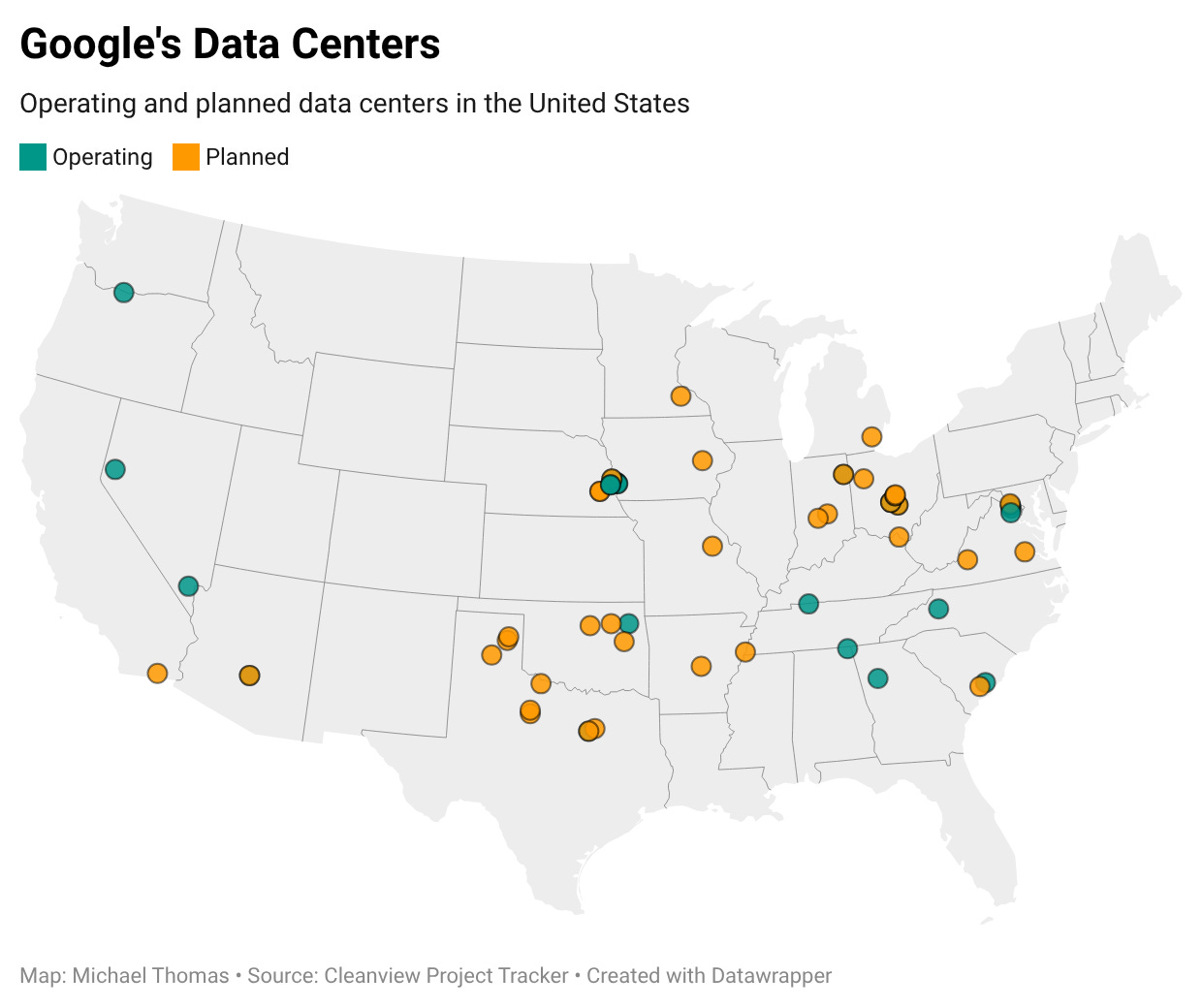
- Google plans to nearly double its AI infrastructure spending to $185 billion in 2026, building dozens of data centers across 20 states, each guzzling as much power as a small city.
- Facing grid bottlenecks and record AI energy demands, Google is prioritizing operational reliability over carbon-free goals, blending flexible gas turbines with renewables while warning of grid instability.
Google’s Energy Trade-Offs
Google is abandoning its carbon-free-only pledge by turning to unmitigated natural gas plants, betting that grid stability and AI growth outweigh climate commitments.
By early 2026, Google has notably shifted its energy strategy to incorporate large-scale natural gas power plants without carbon capture technology alongside its renewable energy portfolio to meet the soaring electricity demands of its AI data centers. This is exemplified by Crusoe Energy’s permit filing for a 933 MW natural gas plant at Google's Goodnight campus in Texas, designed to power two buildings off-grid and potentially emit up to 4.5 million tons of CO2 annually. While Google confirmed its partnership with Crusoe, the exact scale of its power usage from this plant remains undetermined, highlighting ongoing negotiations and the evolving nature of its energy sourcing approach.
This strategic pivot marks a departure from Google's prior commitments to exclusively carbon-free energy, as seen in its 2025 investments in natural gas plants equipped with carbon capture and storage (CCS) in Illinois and Nebraska. The Goodnight plant’s lack of CCS underscores a complex balancing act between operational imperatives and environmental stewardship, reflecting Google’s recognition that while it remains a climate leader, the unprecedented power demands of AI infrastructure necessitate pragmatic compromises.
Google openly acknowledges the indispensable role of responsibly built natural gas plants in providing grid stability and enabling greater integration of renewables amid the explosive growth of AI data centers. As one industry analyst noted, Google has been a vocal advocate for a balanced energy portfolio, pushing back against overreliance on natural gas while conceding that some natural gas capacity—estimated at two to four gigawatts—is essential to meet immediate and large-scale power needs that renewables alone cannot satisfy.
Facing grid interconnection delays of five to seven years, Google and other hyperscalers are increasingly adopting behind-the-meter natural gas generation to rapidly deploy power for AI workloads, prioritizing availability over sustainability. Industry insiders acknowledge that although natural gas infrastructure is carbon-intensive and costly over time, the urgency to power AI data centers has shifted the calculus toward speed and reliability, accepting long-term emissions lock-in risks in favor of immediate operational demands.





AI’s Unprecedented Power Hunger
Google’s $185 billion AI buildout is reshaping data center design, doubling energy use in four years and pushing hardware and operational innovation to keep pace with surging demand.
Google's AI infrastructure investments have reached staggering scales, with the company planning to nearly double its capital expenditures from roughly $90 billion in 2025 to as much as $185 billion in 2026, an amount comparable to the GDP of Hungary. This massive spending spree fuels the construction of dozens of new data centers across 20 U.S. states, each designed to consume between 800 to 1,000 megawatts—equivalent to the power needs of small cities—highlighting the unprecedented energy demands driven by AI expansion.
The explosive growth in AI workloads is not only inflating Google's energy consumption—already at 30.8 million megawatt-hours in 2024, roughly double from four years prior—but also reshaping data center design and operational strategies. Shifting focus from training to inference workloads enables Google to deploy more distributed, flexible data centers that trade traditional ultra-high reliability for increased compute capacity, while innovations like behind-the-meter power generation and demand response agreements help manage the massive and variable power requirements.
Google’s AI infrastructure strategy integrates cutting-edge hardware investments, including specialized TPUs from Broadcom and NVIDIA GPUs, emphasizing performance per watt to optimize energy efficiency amid soaring compute demands. This tightly integrated AI stack supports real-time, agent-scale execution of generative AI applications, enabling Google to transition from experimental AI workloads to always-on, enterprise-grade systems capable of handling thousands of interactions per minute without collapse.
Beyond internal scaling, Google’s investments reflect a broader industry surge, with five major companies collectively planning nearly $700 billion in AI infrastructure spending in 2026 alone. Efficiency gains paradoxically accelerate usage growth—as Stanford HAI notes, a 280-fold cost reduction for GPT-3.5 inference led to a 130-fold increase in Google’s Gemini token usage over 18 months—underscoring how rapidly expanding AI compute demands are driving unprecedented energy consumption and infrastructure challenges globally.



Flexibility vs. Grid Strain
To manage the explosive energy needs of AI, Google is pioneering flexible, dispatchable data centers and selectively embracing gas power—while warning that poorly planned facilities could destabilize the entire grid.
Google’s operational strategy increasingly hinges on data center flexibility to navigate the mounting strain AI workloads place on the aging US grid, which could see data centers consuming up to 17% of national power by 2030. By introducing 'flex' and 'priority' tiers and collaborating with partners like Emerald AI and NVIDIA to create dispatchable AI factories capable of rapid load curtailment, Google exemplifies innovative approaches that balance operational reliability with grid constraints and environmental goals.
Despite its ambitious carbon-free commitments, Google pragmatically embraces responsibly built natural gas plants integrated with renewables to ensure grid stability and meet soaring AI data center power demands that outpaced initial projections by several magnitudes. This acceptance reflects internal tensions where sustainability goals confront competitive pressures, as the energy team acknowledges that rejecting natural gas outright would undermine operational viability against rivals like Amazon.
Google’s deployment of flexible, lower-heat-rate natural gas turbines designed for limited run hours underscores the delicate balance between cost-efficient, reliable power supply and environmental concerns. However, the company criticizes behind-the-meter gas plants lacking proper load planning and balancing entities as irresponsible and grid destabilizing, advocating instead for grid-connected capacity and demand response programs that enhance overall availability while reducing peak power usage and costs.
Operational tensions are further compounded by the US grid’s aging infrastructure and bureaucratic constraints, which force Google and other Western hyperscalers into complex financial arrangements to secure energy and infrastructure at gigawatt scale. The short timeframe to scale alternative clean technologies like geothermal or advanced nuclear has limited Google's ability to fully transition away from fossil fuels, heightening risks around infrastructure investment returns and volatile AI service pricing.