GOP redistricting blitz tests post-VRA landscape
The gist
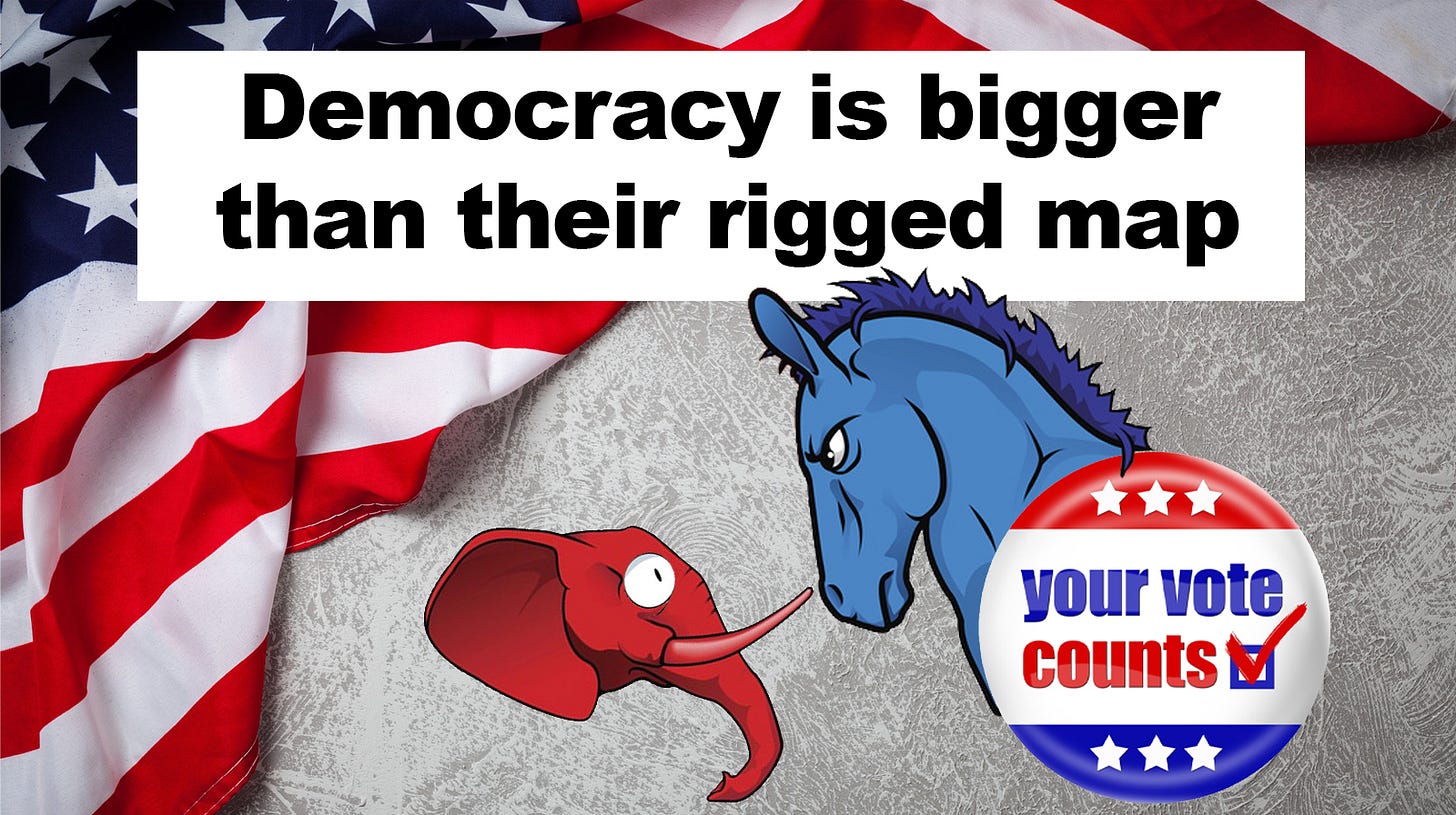
Republicans, with a boost from the courts, are redrawing Southern maps to sideline minority voters and lock in House power ahead of 2026—sparking outrage, legal battles, and a wave of grassroots resistance.
What to know
- After the Supreme Court weakened the Voting Rights Act in Louisiana v. Callais, GOP-led states like Florida, Alabama, and Tennessee rushed to slash majority-minority districts and dilute Black and Latino votes.
- State and federal courts—including the Virginia Supreme Court—are backing GOP-favored maps, blocking voter-approved reforms and fueling accusations of judicial partisanship overriding democracy.
- Activists and Democrats are fighting back with protests, lawsuits, and election integrity task forces, as over 100 new GOP voter suppression bills and aggressive voter purges target minority and low-income voters across the South.
Partisan Maps, Lasting Power
Republican-led states are engineering a lasting House majority by rapidly dismantling majority-minority districts and weaponizing mid-decade redistricting, locking in minority voter dilution for years to come.
Following the Supreme Court's weakening of the Voting Rights Act in the Louisiana v. Callais decision, Republican-led Southern states have launched an aggressive campaign to redraw congressional maps that dismantle majority-minority districts and dilute Black and Latino voting power. States such as Florida, Alabama, Louisiana, Mississippi, South Carolina, Tennessee, and Georgia are actively targeting these districts, with Florida passing a new map within hours of the ruling and Tennessee fracturing its only majority-Black district in Memphis. This coordinated effort aims not merely to flip a handful of seats but to construct a durable partisan firewall, effectively erasing meaningful minority representation and cementing GOP dominance in the House, as highlighted by Carrie Dann of the Cook Political Report and echoed by Democratic leaders warning of a nationwide power grab.
These redistricting efforts have been marked by extreme partisanship and legal maneuvering, including actions that disrupt electoral processes and provoke lawsuits. For example, Louisiana’s governor Jeff Landry suspended house races mid-primary after the state’s map was ruled unconstitutional, prompting lawsuits from voters and candidates, with Democratic Congressman Cleo Fields condemning the move as 'unamerican and unconstitutional.' Similarly, Tennessee’s new map breaking up Memphis’s majority-Black district has drawn legal challenges from the NAACP and ACLU. Despite constitutional prohibitions against partisan gerrymandering in states like Florida, Republican legislatures have circumvented these limits, emboldened by a judiciary increasingly favorable to GOP map changes, including Republican-dominated state supreme courts.
Republican strategists have orchestrated a mid-decade redistricting wave, with coordination dating back to the Trump administration, to capitalize on the Supreme Court’s rollback of Voting Rights Act protections. This effort includes threats from former President Trump to back primary challengers against GOP lawmakers who resist redistricting plans, ensuring party discipline in states like Mississippi and Tennessee. The result is a structural advantage estimated at five to seven net seats, potentially up to thirteen, which could allow Republicans to maintain House control even while losing the national popular vote by several points. This engineered advantage raises concerns about the erosion of democratic accountability and the effective disenfranchisement of minority and Democratic voters ahead of the 2026 and 2028 election cycles.





Courts Tip the Scales
State and federal courts, led by narrow majorities, are overturning voter-approved reforms and using procedural technicalities to entrench GOP-favored maps, sidelining millions of voters and fueling a judicially enabled power shift.
The Virginia Supreme Court's repeated rulings to uphold GOP-favored congressional maps, notably striking down voter-approved redistricting referendums on procedural grounds, exemplify a growing judicial trend that overrides popular will to preserve Republican advantages. In a narrow 4-3 decision, the court blocked a 2026 referendum that sought to redraw districts more equitably, effectively disenfranchising approximately 3 million voters and forcing several Democratic candidates to abandon their campaigns. This judicial intervention, described as 'literally unprecedented' since 1953, highlights how state supreme courts have become pivotal battlegrounds in the partisan redistricting wars ahead of the 2026 midterms, with the Virginia case serving as a national cautionary tale about the fragility of democratic processes when courts wield procedural technicalities to favor GOP interests.
The U.S. Supreme Court's weakening of the Voting Rights Act, especially through the landmark April 29, 2026 Louisiana v. Callais decision, has dismantled critical federal protections against racial gerrymandering, emboldening Republican-led states across the South to redraw maps that dilute Black political representation. By gutting Section 2 of the VRA—the primary legal tool to challenge discriminatory districting—the Court cleared the way for states like Alabama and Tennessee to reduce majority-Black districts, with Alabama's map shrinking from two to one such district despite findings of intentional discrimination. These rulings, influenced by Trump administration allies on the Roberts Court, have triggered unprecedented mid-cycle redistricting efforts that disrupt election timelines and sow voter confusion, effectively institutionalizing racial vote dilution under the guise of partisan map drawing.
Judicial reasoning in these redistricting cases often relies on convoluted legal arguments that mask politically motivated outcomes favoring Republicans, as seen in Virginia where the majority employed arcane semantic interpretations while dissenting justices issued clear, law-based objections. Moreover, the Supreme Court’s readiness to grant emergency relief to states like Alabama to proceed with contested GOP-favored maps despite lower court rulings underscores a judiciary increasingly aligned with partisan interests. This judicial posture not only undermines voter-approved plans but also penalizes Republican lawmakers who resist gerrymandering, as evidenced by primary challenges backed by former President Trump, signaling a coordinated strategy to entrench GOP control over electoral maps.
With federal protections eroded, state supreme courts in blue-trifecta states remain the last viable bulwark against GOP-favored redistricting, though the window to influence the 2026 midterms is rapidly closing. California’s proactive redistricting efforts, which have so far withstood legal challenges, illustrate the critical importance of judicial and legislative alignment to safeguard fair maps. Meanwhile, Democratic attempts to counteract hostile courts, such as proposals in Virginia to lower the mandatory retirement age of Supreme Court justices to reconstitute the bench, have been met with caution and resistance, highlighting the complex and fraught nature of judicial reform as a tool to combat partisan gerrymandering.




Grassroots Resistance Ignites
Activists and lawmakers are mounting urgent, high-profile protests and legal battles against a tidal wave of voter suppression laws and gerrymandering, with turnout and public defiance emerging as the last line of defense.
The Supreme Court's expedited approval of new congressional maps in Louisiana, immediately following its weakening of the Voting Rights Act, has ignited widespread grassroots dissent and alarm over democratic erosion. Justice Ketanji Brown Jackson's scathing dissent criticized the Court for abandoning judicial restraint and violating the Purcell principle by intervening during active primaries, a move she warned risks corrupting democracy and signals a politically motivated effort to cement permanent Republican control. This judicial overreach has galvanized activists and legal experts who see it as part of a coordinated strategy involving Republican governors and justices to entrench GOP power ahead of the 2026 midterms.
In response to aggressive GOP-led gerrymandering and voter suppression, grassroots activists and some legislators are mounting robust opposition that combines symbolic protests, legal challenges, and voter mobilization efforts. Tennessee State Rep. Brother Jones's public burning of a Confederate flag after the passage of a racially gerrymandered map exemplifies this defiant activism, while organizations have established real-time redistricting intelligence operations tracking legislative sessions across Southern states to empower voters with critical information. These efforts are complemented by calls for systemic reforms such as independent redistricting commissions and proportional representation to dismantle winner-takes-all distortions that marginalize minority voters.
The proliferation of over 100 GOP voter suppression bills targeting Black, brown, and low-income voters—ranging from mail-in voting restrictions to voter ID requirements and aggressive voter roll purges—has intensified grassroots and legislative pushback. Notably, purges in Oklahoma and Texas removed hundreds of thousands of legitimate voters under dubious pretenses, while federal efforts like the SAVE Act seek to revive Jim Crow-era tactics. Despite legal setbacks, including failed DOJ lawsuits against purges upheld by the conservative Supreme Court, activists emphasize that turnout remains the ultimate defense, with leaders like Rep. Shomari Figures urging 'turnout, turnout, turnout' to counteract these suppression strategies.
Amid mounting concerns about democratic erosion, Democratic leaders and experts are organizing coordinated legislative and legal responses to counteract Republican redistricting and voter suppression efforts. Senate Minority Leader Chuck Schumer’s election integrity task force, featuring former Attorney General Eric Holder and election lawyer Marc Elias, exemplifies this strategic pushback. Meanwhile, grassroots enthusiasm is surging, with Democrats winning special elections by an average of 12 points and showing higher motivation than Republicans, suggesting that voter mobilization could blunt GOP map advantages. However, analysts warn that without broader institutional reforms—such as term limits for entrenched officials and judicial age restrictions—the struggle to preserve fair representation will remain uphill.