HIVE’s AI pivot sparks investor buzz—and skepticism
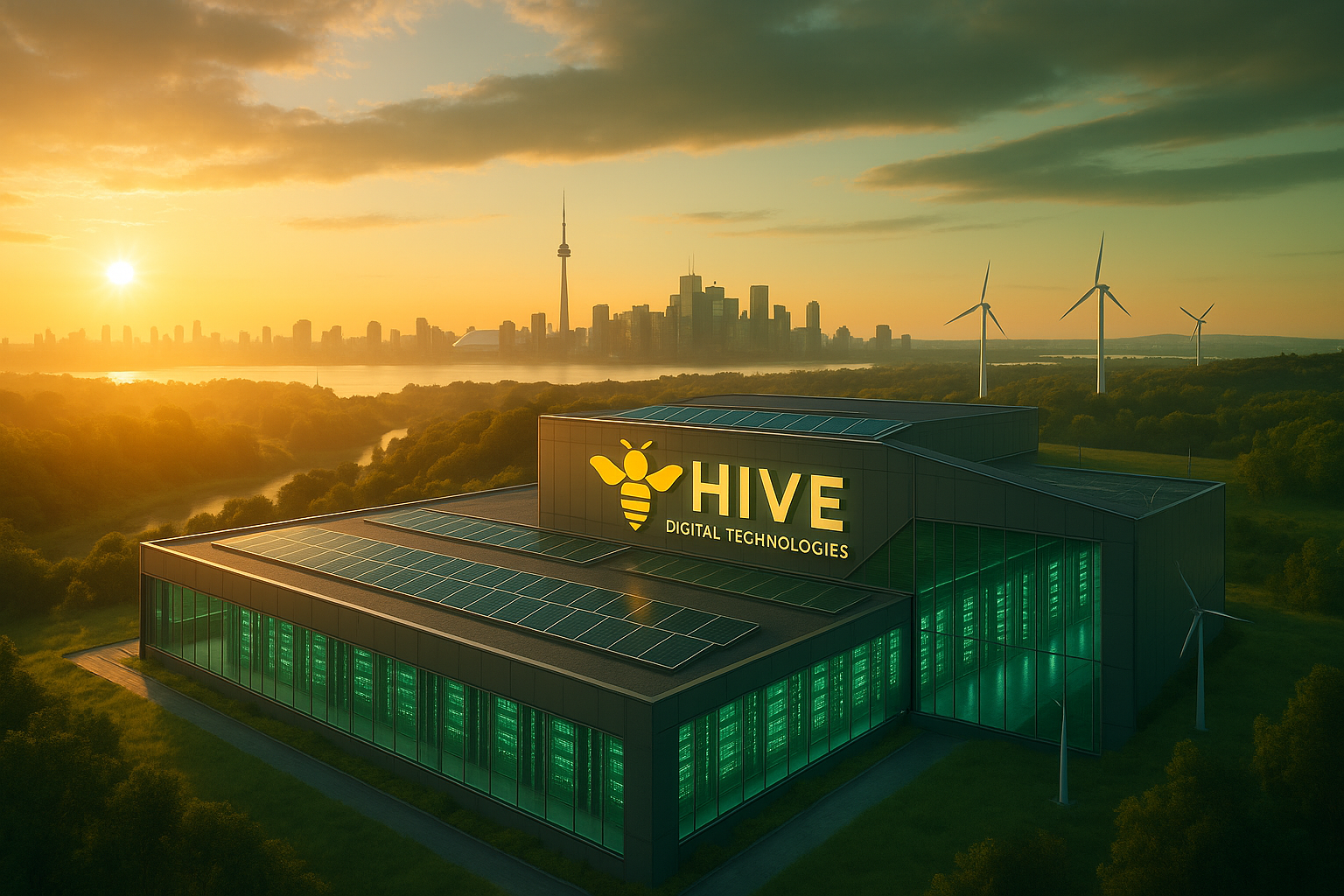
The gist
HIVE Digital Technologies is betting billions on a massive AI pivot, aiming to become Canada’s sovereign AI infrastructure leader—and investors are buzzing, but not all are convinced.
What to know
- HIVE is building the BUZZHPC gigafactory in Canada, targeting 100,000 GPUs and a CAD $3.5B expansion as it shifts from Bitcoin mining to AI infrastructure.
- A major multi-year GPU cloud contract with Bell AI Fabric for Cohere is set to bring in over $100M in annual recurring revenue and anchor HIVE’s dual AI and crypto business model.
- Despite clean-energy data centers and surging AI demand, HIVE faces scrutiny over net losses and execution risks, while power bottlenecks threaten the entire AI data center boom.
HIVE Bets Big on AI
HIVE’s $3.5B BUZZHPC gigafactory and 100,000 GPU buildout mark a radical shift from Bitcoin mining to a clean-energy AI infrastructure empire, with the market still underpricing its growth potential.
HIVE Digital Technologies is aggressively scaling its AI infrastructure footprint with the launch of BUZZHPC, a flagship AI factory in Canada boasting 100,000 GPUs and backed by an ambitious CAD $3.5 billion gigafactory plan. This rapid expansion underscores HIVE’s strategic pivot from a Bitcoin mining-centric model to becoming a sovereign AI infrastructure powerhouse, leveraging its growing AI data center capacity to capture a significant share of the AI cloud market.
Central to HIVE’s transformation is its multi-year AI GPU cloud contract with Bell AI Fabric for Cohere, which is projected to generate over $100 million in annual recurring revenue, including a $70 million deployment slated for early 2027. This contract not only validates HIVE’s pivot but also anchors its dual-engine business model that balances clean-energy Bitcoin mining with GPU-intensive AI workloads, positioning the company as a key player in sovereign AI infrastructure.
HIVE’s AI data centers operate on green energy across multiple international sites—including Canada, Paraguay, Sweden, and Bermuda—reinforcing its commitment to sustainable, clean-energy-powered AI infrastructure. This environmentally conscious approach enhances HIVE’s appeal as a hard-asset hedge in the evolving AI ecosystem, even as its shares currently trade at a discounted 2.14x forward sales multiple, suggesting the market has yet to fully price in the company’s AI-driven growth trajectory.
Investor Sentiment Shifts
HIVE’s repositioning as a clean-energy AI and crypto hybrid is winning analyst praise but faces market skepticism over net losses, dilution risks, and the challenge of flawlessly scaling its dual business model.
Investor perceptions of HIVE Digital Technologies are undergoing a significant transformation as the company shifts from being seen solely as a Bitcoin miner to a dual-engine AI and crypto mining operator. This evolution is driven by HIVE’s substantial contracted AI revenue, including a $100 million-plus annual recurring revenue stream and a $70 million AI deployment expected by early 2027, anchored by major GPU cloud contracts such as the one with Bell AI Fabric for Cohere. This pivot highlights a material change in HIVE’s profit mix and business model, signaling to investors a broader growth trajectory beyond its Bitcoin mining heritage.
Despite robust AI revenue growth and a clear path to $410 million in normalized annualized revenue, HIVE’s shares trade at a discounted forward sales multiple of approximately 2.14x to 2.7x, which is modest relative to the Canadian Software industry average of 3.2x and an estimated fair P/S ratio of 3.3x. This valuation gap suggests the market may be undervaluing HIVE’s AI growth potential, even as analysts like those at Chardan Capital initiate coverage with Buy ratings and $5.00 price targets, citing the company’s unique clean-energy powered dual AI and Bitcoin mining model and optionality from its GTA campus. However, investor caution remains due to ongoing net losses, dilution risks from equity programs funding international expansion, and the need for flawless execution on AI data center capacity and long-term GPU contracts.
HIVE’s executive leadership, notably Chairman Frank Holmes, is actively reframing the company’s narrative to emphasize its positioning as a clean-energy hard-asset hedge that combines Bitcoin mining and AI infrastructure. By aligning Bitcoin and gold as alternative stores of value amid mounting global debt concerns, HIVE seeks to attract investors interested in sustainable, hard-asset exposure while balancing the risks inherent in its hybrid business model. This strategic repositioning aims to stabilize investor sentiment in a volatile share price environment, where the successful scaling of AI data centers and prudent capital management without excessive dilution remain critical near-term catalysts.
Power Bottlenecks Threaten AI Boom
Soaring AI data center demand is colliding with severe power delivery delays and infrastructure shortages, making electricity—not capital—the new choke point for the industry’s explosive growth.
The AI data center market is undergoing explosive growth driven by massive multi-year lease agreements and capital commitments, exemplified by Hut 8’s Beacon Point campus securing $19.6 billion in base-term contracts and Nvidia’s $50.2 billion 1-GW Texas lease. However, this rapid expansion is tempered by significant power delivery bottlenecks, with U.S. data center power demand projected to more than double from 31 GW in 2025 to 66 GW by 2027, straining regional grids and causing utilities to delay power delivery by 1.5 to 2 years. These constraints are compounded by long lead times for critical equipment like transformers (averaging 128 weeks) and fragmented grid regimes, making power availability—not capital or land—the primary limiter for AI data center growth.
As AI workloads surge, power consumption per server rack has skyrocketed from 3 kW to 150 kW, intensifying challenges around heat dissipation, bandwidth, and energy management. Tony Kim highlights this 'logarithmic pressure' on infrastructure, necessitating fundamental redesigns including shifts to light-based data transmission and innovative energy sources like small modular nuclear reactors. Meanwhile, the industry faces a 'RAM apocalypse' with memory fabrication lagging demand, underscoring a broader supply squeeze that extends beyond chips to encompass server design, fiber optics, and robotics, reflecting a comprehensive industrial transformation driven by AI compute demands.
The convergence of blockchain and AI infrastructure is reshaping market dynamics and investor perceptions, as crypto miners like Hut 8 and IREN pivot from volatile Bitcoin mining to stable, high-margin AI cloud contracts exceeding $12 billion. This hybrid model leverages existing large-scale power and electrical infrastructure originally built for ASIC mining, now repurposed for GPU-based AI workloads, positioning these firms as multi-purpose digital infrastructure platforms. Such strategic shifts not only enhance operational efficiency through 24/7 tradable markets but also provide cleaner energy sourcing opportunities, helping to mitigate the volatility traditionally associated with crypto mining businesses.
Despite surging demand and record-breaking capital expenditures—hyperscalers alone plan $602 billion in 2026 with 75% AI-related—scaling AI data centers remains a complex, measured endeavor fraught with execution risks. Industry experts caution against unrealistic expectations of gigawatt-scale buildouts within a year, emphasizing the necessity of experienced partners to navigate phased developments that can span years, as seen in projects like Portugal’s 1.2 GW Start Campus. Additionally, community opposition, grid capacity limits, and supply chain shortages threaten to delay nearly half of planned facility activations, underscoring that while the AI data center market is booming, sustainable growth hinges on overcoming entrenched infrastructure and regulatory hurdles.