How a 19th-century error supercharged corporate power
The gist
**A 19th-century clerical blunder handed corporations the keys to American democracy—fueling a modern era where billionaires and Big Tech can outvote the masses.**
What to know
- A mistaken 1886 Supreme Court headnote—not an actual ruling—sparked the myth that corporations have constitutional rights as 'persons.'
- The 2010 Citizens United decision and subsequent Supreme Court rulings have unleashed super PACs and dark money, letting corporate cash flood U.S. elections.
- By 2026, the conservative Supreme Court majority has struck down key campaign finance limits, making it easier than ever for elite donors to drown out ordinary voters.
America’s Hidden Legal Myth
A single court reporter’s error in 1886 rewrote the Constitution’s intent, letting corporate lawyers spin a legal fiction that transformed democracy into an oligarchic playground.
The origin of corporate constitutional rights is rooted in the 1886 Supreme Court case Santa Clara County v. Southern Pacific Railroad, which famously never ruled that corporations are 'persons' under the 14th Amendment; this critical misinterpretation was introduced by the court reporter J.C. Bancroft Davis in a headnote, not by the justices themselves. The decision itself concerned railroad fence posts and property tax, with the justices explicitly avoiding the question of corporate personhood. This fraudulent headnote laid a hidden but explosive foundation that corporate lawyers would exploit over the next 140 years to build an expansive empire of constitutional rights for corporations, fundamentally altering American democracy.
The Founders deliberately excluded corporations from constitutional protections to safeguard the fledgling democracy from oligarchic domination, viewing entities like the British East India Company as existential threats to political equality and self-governance. Figures such as Thomas Jefferson envisioned a republic of independent yeoman farmers who owned their land and means of livelihood, enabling them to vote their consciences free from employer control, while Benjamin Franklin personified the American Dream of upward mobility through hard work. This original vision sought to prevent the concentration of wealth and power that could recreate tyranny, a concern Franklin underscored by asserting that 'Only a virtuous people are capable of freedom.'
The 1886 misinterpretation marked a pivotal turning point that subverted the Founders’ intent by enabling corporations—initially railroad barons akin to today’s Bezos, Musk, and Zuckerberg—to claim constitutional rights designed solely to protect human beings. This legal fiction became the cornerstone of the Reagan Revolution between 1978 and 1981, when corporate lawyers constructed a vast cathedral of rights that systematically expanded corporate power and influence, effectively replacing the American Dream with a new form of oligarchic feudalism. Over nearly a century and a half, this shift has allowed corporations to amass unprecedented wealth and political clout, undermining democratic principles and concentrating power in the hands of a few.

How Courts Unleashed Big Money
Decades of judicial activism have weaponized the First Amendment to shield corporate campaign spending, dismantling barriers meant to keep elections in the hands of voters, not billionaires.
The judicial expansion of corporate rights and political spending began in earnest with the 1976 Buckley v. Valeo decision, which marked a sharp departure from nearly two centuries of judicial restraint on campaign finance regulation. This shift laid the groundwork for corporations to claim First Amendment protections for political expenditures, a trend that accelerated through the 1970s and 1980s as corporations increasingly asserted their right to spend money on campaigns and advertising. By the early 2020s, these precedents had entrenched a legal framework that severely limited states' and federal governments' abilities to regulate outside spending, as seen when courts struck down Maine's attempts to restrict contributions and foreign-influenced spending, citing political spending as protected speech under the First Amendment.
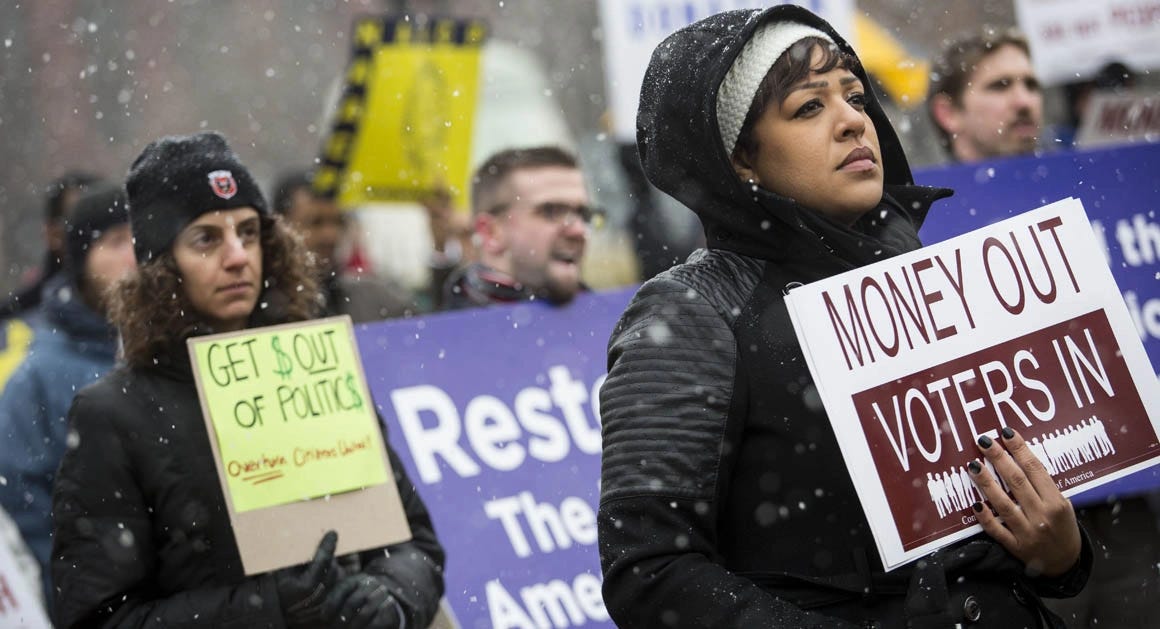
The 2010 Citizens United v. FEC decision represented the culmination of a 140-year judicial trajectory expanding corporate constitutional rights, effectively granting corporations near-unlimited power to influence American democracy through political spending. This ruling not only deregulated campaign finance but also symbolized the final step in a long-term process of corporate personhood expansion, enabling the rise of super PACs that can funnel hundreds of millions into elections. Critics argue that this has eroded democratic trust, with one commentator highlighting how $270 million in campaign contributions can sway government policies to favor wealthy oligarchs, though some contend the Supreme Court merely formalized an existing problem rather than creating it outright.
Beyond the First Amendment, corporations have systematically claimed a broad array of constitutional protections originally intended for individuals, including the Second, Fourth, Fifth, and Fourteenth Amendments, to challenge regulations and expand their political and economic influence. Cases like Dow Chemical Co. v. United States (1986) illustrate how corporate claims to these rights have been used to resist government oversight and disclosure requirements, further entrenching corporate power within the legal system. This multifaceted expansion of corporate constitutional rights underscores how judicial decisions have collectively reshaped the balance of power between corporations and democratic governance.
Looking ahead, the Supreme Court continues to play a pivotal role in shaping campaign finance law, as evidenced by the pending National Republican Senatorial Committee v. Federal Election Commission case. This case challenges federal limits on coordinated spending between political parties and candidates, raising complex First Amendment questions with potentially profound implications for the regulation of political expenditures. The outcome could further redefine the boundaries of permissible campaign finance restrictions, reinforcing the Court’s enduring influence over the intersection of money and politics.


Supreme Court’s Billionaire Superhighway
The Court’s conservative majority has gutted campaign finance limits and voting protections, making it easier for elite donors to drown out the public and rewrite the rules of democracy.
By mid-2026, the Supreme Court's conservative 6-3 majority, including Justices Thomas, Alito, Gorsuch, and Kavanaugh, has decisively shaped a legal landscape that amplifies elite influence at the expense of democratic inclusion. The landmark ruling in National Republican Senatorial Committee v. FEC struck down spending limits on dark money, effectively opening an 'unrestricted superhighway' for billionaire cash to flood elections under the First Amendment’s protection. This majority has consistently opposed voting rights protections such as mail-in ballot counting and birthright citizenship, with Kavanaugh controversially advocating for repealing the 14th Amendment, underscoring a deep philosophical divide that privileges corporate power over ordinary citizens and democratic accountability, as noted by commentators like Don Lemon.
The Court’s 2026 decisions reveal a systemic corruption of American democracy characterized by what political theorist Mark terms 'duplicitous exclusion'—where elites maintain the facade of inclusive participation while effectively shutting out broad democratic engagement. This corruption transcends individual justices’ motives, positioning the Roberts Court as an institution that structurally enables exclusionary practices, undermining campaign finance reform, presidential accountability, and political corruption prosecutions. The cumulative effect is a judiciary that not only tolerates but facilitates the erosion of empowered inclusion, thereby weakening the foundational democratic norm that every affected individual should have an equal voice in collective decisions.
Amid this fraught backdrop, the Supreme Court’s potential 2026 review of Maine’s campaign contribution limits marks a rare inflection point that could partially curb billionaire dominance without overturning Citizens United. Legal experts, including Harvard’s Lawrence Lessig, highlight that while the Court reaffirms Citizens United’s spending protections, it may uphold contribution limits as a legitimate tool to address corruption risks—a stance supported by seven justices grounded in Buckley jurisprudence. This nuanced approach could represent a significant, albeit limited, victory for democratic accountability, with public opinion overwhelmingly favoring measures that reduce elite financial sway in elections.
The heightened polarization surrounding the Court’s rulings is mirrored in the increased security concerns for justices, as evidenced by recent testimonies from Justices Elena Kagan and Amy Coney Barrett requesting enhanced protection funding. This development underscores the contentious environment and public backlash fueled by the Court’s perceived role in enabling elite capture of democracy. The intersection of judicial decisions and societal tensions highlights the fragile legitimacy of the institution amid escalating threats and debates over its influence on the political process.


Local Control Crushed by Courts
Federal judges have stripped states of their power to police political money, empowering oligarchs and fueling a crisis of democratic legitimacy.
By early 2026, the Supreme Court's expansive interpretation of corporate constitutional rights has systematically eroded local democratic control, particularly in election regulation, where federal courts have struck down state efforts like Maine's 2021 measures to limit foreign-influenced spending. This judicial overreach marks a stark departure from two centuries of restraint, shifting the power to regulate money in politics from elected representatives to federal judges, raising urgent questions about who should govern electoral integrity in a democracy.
The Supreme Court’s jurisprudence over the past two decades has entrenched a form of corruption defined by political theorist Mark Warren as 'duplicitous exclusion,' where elites maintain the façade of democratic inclusion while systematically silencing equal participation. This corruption is not merely moral failing but a structural decay of democratic norms, as the Court’s rulings on campaign finance, presidential immunity, and political corruption prosecution have enabled oligarchic interests to dominate political processes under the guise of constitutional protection.
The corporate constitutional rights doctrine, rooted in a fraudulent 1886 headnote from Santa Clara County v. Southern Pacific Railroad rather than an actual Supreme Court ruling, has empowered billionaire oligarchs—such as California’s tech magnates—to wield disproportionate political influence, exemplified by their multi-million-dollar campaigns against wealth taxes like Proposition 40. This historical deception has culminated in the 2010 Citizens United decision, which five Republican justices used to hand morbidly rich elites near-unlimited power to 'buy American democracy outright,' fueling calls from figures like Congressman Ro Khanna and Bernie Sanders for a national billionaire tax to reclaim economic and political equality.
The Founders deliberately excluded corporations from constitutional protections, fearing entities like the British East India Company would threaten the political equality and economic freedom essential to self-governance. Their vision of a republic of independent yeoman farmers owning their livelihoods contrasts sharply with today’s reality, where corporations have appropriated nearly every constitutional right intended for individuals, weaponizing them to dismantle New Deal-era regulatory frameworks and replace the American Dream with an oligarchic feudalism. Addressing this systemic capture demands bold reforms including constitutional amendments and enhanced judicial accountability to restore democratic governance and economic justice both nationally and globally.