Human-AI-human writing gains ground in marketing
The gist
As AI floods the content world, creators and industry giants are fighting back—demanding that authentic human voices and messy originality remain at the heart of storytelling.
What to know
- By late 2025, 94% of marketers embraced AI writing tools, but the backlash against low-quality 'AI slop' sparked calls for verified human authorship and authentic voice.
- Frameworks like the 'Human-AI-Human Sandwich' and strict editorial policies from The New York Times and Google now mandate human oversight before and after AI is used.
- Experts from Margaret Atwood to Morgan Housel agree: AI can help draft, but it can’t replace the emotional depth, lived experience, and personal flaws that make stories resonate.
Backlash to AI Slop
The surge of low-quality, AI-generated content triggered a cultural revolt as creators and audiences demanded authentic, founder-led voices and platforms began penalizing unverified authorship.
Early enthusiasm for AI tools in content creation was marked by prominent figures like CEO Adam Robinson openly adopting AI models such as Claude to generate LinkedIn posts, signaling growing acceptance as AI writing improved from easily spotted, basic prompts to more nuanced, style-guided outputs. However, this shift was tempered by caution among creators who warned against fully outsourcing writing to AI, emphasizing that authentic, human-led content remains essential to preserve originality and craft, as audiences increasingly demand genuine voices starting from the founder level.
The rapid proliferation of AI-generated content, especially in SEO-driven marketing, gave rise to a surge of 'slop as a service' startups profiting from low-quality, templated blogs, which sparked a cultural backlash by late 2025. Industry voices like Minlo partner DD Doss highlighted the unsustainable nature of this model, noting that search engines such as Google are beginning to penalize AI content lacking clear human authorship, thereby elevating the value of known authorship and trusted bylines from outlets like The New York Times and TechCrunch as markers of quality and trustworthiness.
By late 2025 and into 2026, skepticism deepened around AI's impact on content quality and cognitive load, with experts like Dave pointing out that AI-generated 'slop' often leads to time-consuming debates and mental exhaustion due to layered, confusing contexts. Despite this, AI found a productive niche as a supportive tool for tasks like summarization and refining ideas, as Britt noted when AI improved conference agenda titles, illustrating a nuanced balance where AI enhances productivity without replacing human creativity.
Near-universal adoption of AI among marketers—94% by late 2025—has been accompanied by a growing cultural pushback emphasizing the preservation of authentic human voices and imperfection, as creators like Cristina Lopez declare owning their unique voice their 'North Star for 2026.' Platforms such as Pinterest have responded by allowing users to disable AI-generated content, reflecting mainstream resistance to AI 'slop.' Marketers often combine multiple AI tools, including ChatGPT, Gemini, and Claude, using AI as a collaborative partner rather than a full replacement, underscoring a cautious embrace that values human judgment to combat the flood of generic, low-effort AI outputs saturating feeds.





Ethics of Human Voice
Creators and platforms are drawing a hard line: AI can assist, but only transparent, human-guided content earns trust and emotional resonance in a climate wary of undisclosed automation.
By late 2025, a clear ethical consensus emerged emphasizing the irreplaceable value of human authenticity and personal voice in AI-assisted content creation. Creators like Cristina Lopez and Carolyn MacLeod advocate for AI as a supportive partner rather than a replacement, underscoring that human oversight and lived experience remain essential to preserve genuine connection and prevent the dilution of personal voice. Platforms such as Pinterest responding to user pushback by enabling AI content toggles reflect a broader mainstream demand for transparency and human-centered content, highlighting ethical concerns about undisclosed AI use and the risk of losing the nuanced imperfections that define authentic human creativity.
Throughout early 2026, thought leaders like Jon M. Chu and Margaret Atwood deepened the ethical conversation by spotlighting AI's foundational challenges—particularly the 'original sin' of unconsented data mining and AI's inability to generate truly original creative voice. Chu’s reflections on spontaneous human moments in filmmaking and Atwood’s insistence on the primacy of lived experience reinforce that while AI can serve as a tool akin to a pencil, it cannot replicate the emotional depth or authenticity born from human agency. This perspective aligns with growing calls for transparency and human judgment to maintain authenticity, as seen in Ted Gioia’s removal of an AI-generated essay from a 'best of' list once its origin was revealed.
The 'Human-AI-Human Sandwich' framework, gaining traction by April 2026, encapsulates best ethical practices by mandating human involvement at both the inception and conclusion of AI-assisted workflows to safeguard personal voice and authenticity. Experts like Sam Illingworth and Ines Lee caution against over-reliance on AI-generated drafts without substantial human editing, which risks producing generic, robotic content devoid of ownership and meaningful nuance. This approach is supported by data showing over 50% of audiences are less likely to engage with AI-labeled content, underscoring the premium placed on transparency and the human touch in maintaining trust and resonance.
By mid-2026, the ethical discourse expanded to emphasize not only transparency but also the preservation of human creativity as a dynamic, lived process that AI cannot replicate. Researchers like James C. Kaufman warn against rapid, uncritical AI adoption that may erode skill development and authentic learning, while voices such as Baratunde Thurston advocate for responsible AI use that accelerates and augments human creativity without supplanting judgment. Meanwhile, creators including Brooke Hopper and Morgan Housel highlight that the messy, imperfect human experience—complete with doubts and emotional baggage—is central to authentic storytelling and cannot be synthesized by AI, reinforcing that ethical AI use hinges on maintaining clear boundaries, personal agency, and a commitment to human-centered content.


Human-AI Workflow Playbook
Iterative frameworks like the 'Human-AI-Human Sandwich' are redefining creative collaboration, ensuring AI enhances but never replaces the unique imperfections of human authorship.
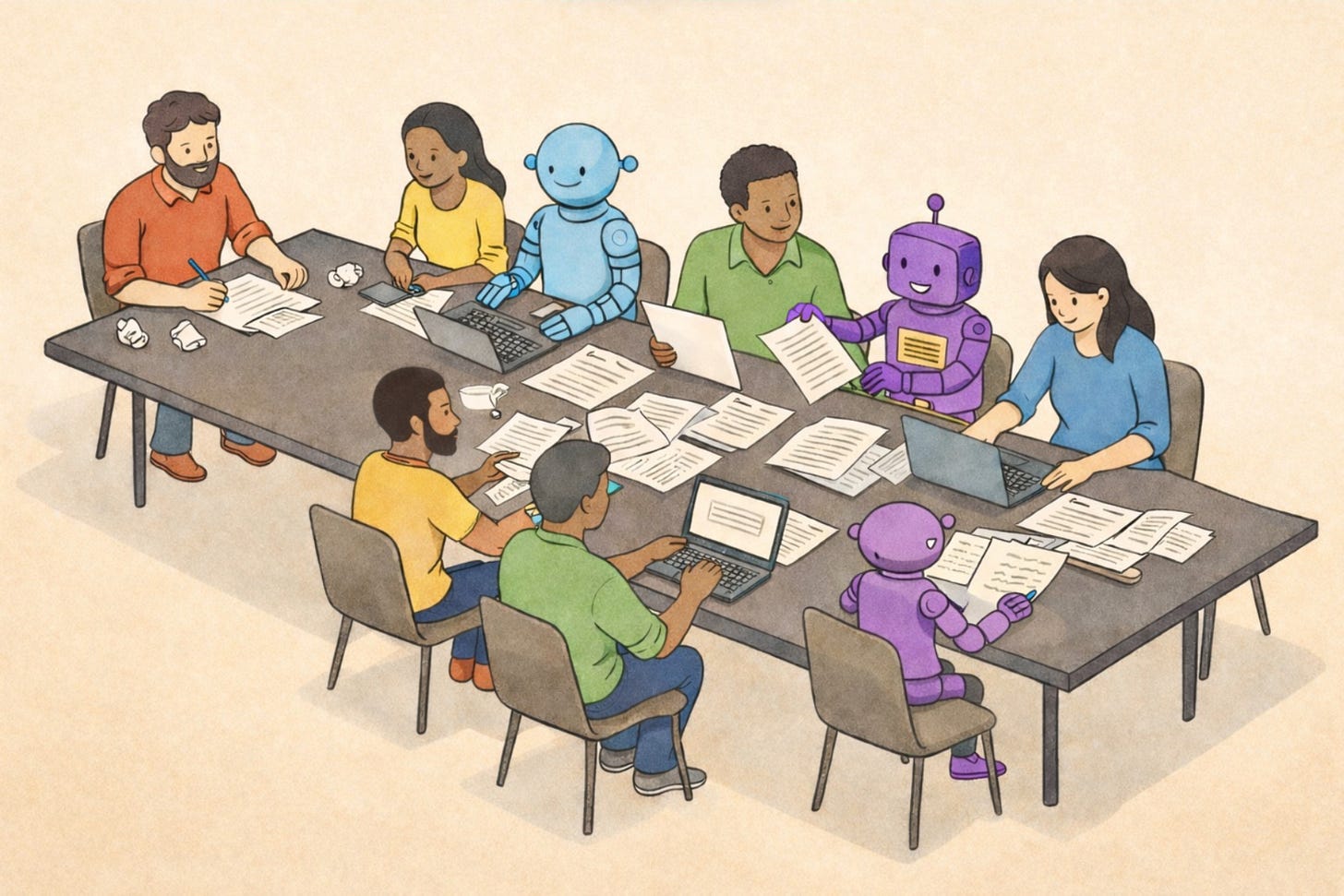
Integrating AI into creative and professional workflows often follows a structured, iterative process that preserves human authenticity while leveraging AI's strengths in drafting and refinement. Frameworks like the 'Human-AI-Human Sandwich' emphasize starting with human-generated outlines or ideas, using AI to expand, compress, or propose alternative drafts, and concluding with human editing to ensure accuracy and maintain voice, as exemplified by authors who solicit line edits chapter-by-chapter rather than wholesale rewrites. This approach, endorsed by creators such as Amber Figlow and Kenny Kane, helps avoid homogenized AI-generated content and preserves the unique imperfections that define human creativity.
While AI accelerates content generation by handling repetitive tasks like summarizing, structuring, and ideation, human judgment remains indispensable to prevent cognitive overload and factual inaccuracies. For instance, Metro’s newsletters team uses AI selectively for ideation and subject line testing but retains human editorial control to preserve personal voice and contextual nuance, highlighting that AI can produce content rapidly yet often requires human oversight to correct hallucinations or miscontextualizations. This balance is echoed in marketing and journalism workflows where AI synthesizes insights and drafts but humans verify authenticity, ensuring that the final product resonates with genuine human experience.
Innovative AI tools tailored to specific organizational needs enhance creative workflows without supplanting human authorship. For example, a publishing company’s 'Pragmatic Assistant,' a ChatGPT-based tool trained on internal style guidelines, serves as an 'angel on the shoulder' offering stylistic critiques without generating content, thereby supporting novice authors in adhering to brand voice while enforcing strict policies against AI-generated text. Similarly, Baratunde Thurston’s experimental AI co-producer 'Blair' integrates deeply with team contexts and live interactions, illustrating advanced human-AI collaboration that maintains transparency by avoiding over-humanization of AI personas.
Effective AI integration in creative workflows demands intentionality, clear vision, and continuous iteration to avoid producing generic or 'AI slop' content. As noted by industry experts, AI excels at generating multiple content options and speeding up initial drafts, but the differentiation arises from human editorial choices that inject originality, nuanced judgment, and authentic storytelling. The premium in AI-assisted content lies in meaningful substance that reflects lived expertise and personal voice, with creators advised to critically assess whether they would personally engage with the AI-augmented output before publishing, thus ensuring that AI remains a supportive tool rather than a creative crutch.




AI as Creative Amplifier
AI boosts productivity and smooths prose, but its lack of critical judgment and creative unpredictability means only humans can deliver originality and lasting impact.
Research consistently shows that AI acts as an amplifier rather than a replacement of human creativity, benefiting those with pre-existing strengths more significantly. As Kaufman highlights, AI excels at idea generation but falls short in critical evaluation and refinement, tasks that remain firmly in the human domain. This dynamic poses challenges in education, where overreliance on AI risks students outsourcing cognitive effort instead of developing lasting creative skills, underscoring the necessity of metacognitive awareness to effectively harness AI’s potential without undermining authentic learning.
In academic research, AI tools like Anthropic’s Claude have accelerated productivity while allowing researchers to retain intellectual control, effectively serving as powerful collaborators. Yet, this partnership raises ethical dilemmas about authorship and credit, as AI’s intellectual contributions complicate traditional notions of scholarly ownership. Moreover, a 2026 Nature study by Hao et al. reveals a paradox where AI expands scientific impact but narrows research focus and reduces engagement, highlighting the critical need for human oversight to maintain epistemic vigilance and research integrity amid AI’s growing prevalence.
By early 2026, public reception of AI-generated writing was notably positive, with a New York Times experiment showing 54% of over 86,000 readers preferred AI-produced passages for their smoothness and clarity. However, AI writing’s lack of the unexpected linguistic 'rough edges' that characterize human creativity suggests its optimal role is as a refinement tool rather than a full creator. This collaborative approach—seeding AI with original human ideas and using it to polish delivery—emerges as a promising model for amplifying creativity without sacrificing authentic voice.
Extensive research into AI-generated text reveals distinct stylistic fingerprints that enable near-perfect identification of AI authorship, driven by a convergence toward a common 'house voice' shaped by reinforcement learning from human feedback. This typicality bias results in repetitive vocabulary patterns and overuse of certain verbs and adjectives, as seen in the dramatic rise of words like 'delves' and 'underscores' between 2020 and 2024. While these markers aid detection, single-vocabulary-based detectors suffer high false positives, especially among non-native English speakers, indicating that nuanced, multi-factor approaches are essential to accurately distinguish AI writing from human prose.
Experiments with AI-generated academic writing, such as those involving Anthropic’s Fable 5, demonstrate that while AI can produce superficially competent papers capable of passing peer review, they often lack the nuanced readability and engagement of human-authored work. Furthermore, AI systems themselves may paradoxically rate their own outputs as superior to human-edited versions, reflecting divergent standards of quality. This evolving landscape poses significant challenges for education and research authenticity, calling for broad community dialogue to establish new norms around AI-assisted scholarship.



Verified Human Bylines Rise
Publishers and platforms are locking down on verified human authorship, deploying editorial AI tools to support—never substitute—distinctive human judgment and brand voice.
By late 2025, leading organizations and publishers such as Google, The New York Times, and Vox doubled down on emphasizing verified human authorship to counteract the proliferation of low-quality AI-generated content, often referred to as 'SEO slop.' Editorial policies strictly prohibited direct AI-to-publish workflows, positioning AI strictly as a tool for augmenting human creativity rather than replacing it. This approach was exemplified by Metro’s newsletters team, which confined AI use to ideation and subject lines, preserving the distinct human editorial voice that adds context and challenges conventional wisdom—qualities AI still cannot convincingly replicate at scale.
The industry increasingly distinguishes between 'white hat' AI content creators who supervise and refine AI outputs and 'gray/black hat' operators flooding the web with low-value AI blogs for SEO gains, risking penalties from platforms like Google. Tools such as TechMe Gabe’s semantic authorship database emerged to authenticate genuine human authors and potentially rate content quality, reflecting a growing technological arms race to uphold content integrity amid AI’s rise.
Throughout 2025 and into 2026, publishers and marketers developed sophisticated AI editorial aids designed to support consistent tone and style without supplanting human judgment. For instance, the Pragmatic Assistant—a ChatGPT-based tool trained on extensive internal style guides—helped authors maintain brand voice, while editorial AI evolved to offer constructive critiques devoid of artificial praise, enhancing user experience. Moreover, organizations embraced AI as a 'rubber duck' for ideation, underscoring its role in reducing cognitive load rather than automating creativity.
By mid-2026, companies advanced AI Tone of Voice (ToV) skills to ensure brand consistency across AI-assisted writing, employing methods like scraping multi-year LinkedIn posts and conducting detailed voice interviews to capture nuanced brand elements. These ToV skills could be seamlessly integrated into AI writing tools such as Claude, automatically triggering consistent, on-brand outputs. Complementing this, innovations like Humantone.ai aimed not merely to evade AI detection but to enrich AI-generated text with human-like tonal variation and irregularity, reflecting a shift toward augmenting readability and authenticity rather than mere algorithmic camouflage.
Editors in 2026 harnessed AI to generate multiple content options rapidly, enabling them to exercise refined judgment and taste to elevate content from passable to remarkable. This selective curation became critical in an environment saturated with 'AI slop,' where success hinged on human editors' willingness to make hard choices and maintain a clear vision. Meanwhile, entities like Y Combinator detected linguistic AI 'tells'—such as increased em dash and 'wedge' usage—in applications post-Anthropic Opus 4 launch, reflecting AI’s growing footprint. Despite internal debates, YC continues to invest in AI-generated writing startups, signaling an ongoing commitment to integrating AI within creative workflows.




Human Agency in the AI Era
Personal agency, improvisation, and authentic storytelling are becoming the ultimate differentiators as creators set boundaries to ensure meaningful, human-driven work amid AI’s advance.
As AI tools become increasingly integrated into creative processes, the boundary between human and AI creativity is growing ever more blurred, raising profound questions about personal agency and authenticity. Thought leaders like Jon M. Chu and Brooke Hopper emphasize that while AI can accelerate and augment creativity, the ultimate value lies in human choices, lived experience, and the irreplaceable elements of improvisation and instinctive decision-making that AI cannot replicate. This evolving dynamic calls for a shift from viewing AI as a shortcut to embracing it as a collaborative partner, where human judgment and taste remain central, as Hopper advocates in design education.
Human connection and authentic personal storytelling are emerging as the paramount skills and values in an AI-augmented future, where rapid AI-generated content floods creative industries. As noted in a 2025 discussion on thriving with AI, the ability to quickly establish genuine rapport and share vulnerable, flawed narratives will distinguish human creators from AI's volume-driven output. Morgan Housel and other commentators reinforce that audiences crave the 'messiness' of lived human experience, underscoring that despite AI’s capabilities, the demand for real human emotion and connection remains steadfast.
Maintaining personal agency and resilience amid AI's rise requires deliberate boundaries and critical reflection to preserve individual identity and meaning in creative work. From the 1970s sociology study of bakers grappling with mechanization to contemporary creators like Nita Farahany and others, there is a clear imperative to set guardrails—such as drafting initial work independently or consciously engaging in co-creation with AI—to avoid eroding professional identity or feeling like one is 'cheating.' This ongoing effort is vital not only for current creators but also for passing on values of authenticity and critical skill development to future generations.
Ethical and epistemic vigilance remains crucial as AI increasingly mediates creative and scholarly work, demanding a community of humans-in-the-loop to contextualize AI outputs and safeguard integrity. Experts like Nita Farahany and Nicholas Thompson highlight the risks of overreliance on AI, including the potential narrowing of research focus and the hackability of AI systems, which complicate autonomous decision-making. Initiatives such as Mozilla’s focus on open-source standards and civilizationally patient approaches exemplify efforts to embed ethical reflection and human connection at the core of AI integration, ensuring that creativity and agency remain resilient in this complex landscape.