Humanoid robots scale up with funding surge
The gist
Humanoid robots are breaking out of the lab and into the workforce, with global funding, government backing, and big industry deals igniting a new robotics gold rush.
What to know
- Humanoid just raised $152 million and will deploy thousands of robots at Schaeffler by 2032, while China aims to have 10,000 humanoids on factory floors by the end of 2026.
- Robotics-as-a-Service models from players like Locus Robotics and Motion are slashing upfront costs, letting warehouses scale automation on subscription.
- Investors—led by OpenAI, Andrew Kang, and venture capital heavyweights—are betting that humanoid robots will revolutionize the $50 trillion physical labor market within 3 to 7 years.
From NASA Labs to Factory Floors
Humanoid robots have evolved from space station prototypes to tireless industrial workers, driven by breakthroughs in physical AI and a foundation of millions of mobile robots already transforming global logistics.
The foundation of humanoid robotics in industrial settings is deeply rooted in the evolution of physical AI and the substantial installed base of traditional industrial robots. By mid-2025, Amazon had deployed its one millionth robot across over 300 facilities, with its DeepFleet model enhancing fleet travel time by 10%, illustrating the scale and efficiency gains possible through mobile robotics. Meanwhile, the International Federation of Robotics reported over half a million industrial robots installed globally in 2024, underscoring a robust platform upon which physical AI innovations could build.
Early humanoid robot designs, such as NASA's Robonaut series beginning in the late 1990s and culminating with Robonaut 2's deployment on the International Space Station in 2011, established the humanoid form as a versatile archetype capable of operating seamlessly in human-centric environments. This lineage inspired commercial ventures like Apptronik, founded in 2016 by former NASA collaborators, who leveraged NASA partnerships and SBIR contracts to develop Apollo—humanoid robots now actively assisting in assembly lines at Mercedes-Benz and other manufacturers. These robots demonstrate the practical utility of humanoid forms by working 10-hour shifts and handling tens of thousands of parts, as seen in Figure's deployment at BMW’s Spartanburg plant.
The integration of advanced AI has been pivotal in transitioning humanoid robots from rigid, purpose-built machines to flexible, general-purpose workers capable of performing high-variability tasks in complex industrial environments. Boston Dynamics' Aya Durbin highlights how physical AI enables robots like Apollo to learn new behaviors through reinforcement learning and egocentric video training, allowing them to adapt to unpredictable factory conditions and perform dexterous tasks with human-like mobility and endurance. This AI-driven adaptability addresses labor shortages in challenging roles, making humanoid robots invaluable in facilities where traditional automation falls short.
A critical enabler for humanoid robotics’ industrial integration has been their compatibility with existing human-shaped factory infrastructures, minimizing costly retrofitting and facilitating one-for-one labor substitution. This ease of integration is bolstered by the ability to train AI models using human motion data and teleoperation inputs, which naturally translate to humanoid forms due to shared biomechanics. Current efforts involve digitizing the physical world from scratch—capturing tactile and visual nuances absent from conventional datasets—through factory workers equipped with training tools like goggles and gloves, laying the groundwork for autonomous humanoid robots that can efficiently augment and transform manufacturing workflows.



Robots-as-a-Service Revolution
Subscription-based robotics models are breaking down automation barriers, letting warehouses deploy and scale fleets without risky capital outlays or disruptive facility redesigns.
Despite the technological readiness of humanoid robotics, the majority of warehouse operations—around 85 to 90%—remain manual due to the prohibitive risks and capital requirements of traditional automation models. Locus Robotics revolutionized this landscape by pioneering a Robotics-as-a-Service (RAS) subscription model over a decade ago, which eliminates upfront capital expenditure and allows companies to incrementally automate high-velocity picking tasks with scalable deployment and manageable risk. This approach enables warehouses to rapidly realize ROI, often within 12 months, without jeopardizing operational continuity or leadership careers.
Locus Robotics exemplifies successful real-world adoption of RAS, having deployed over 15,000 autonomous mobile robots across more than 350 facilities by mid-2026. Their subscription model offers customers flexible scaling—adding robots for peak seasons and reducing fleets during slower periods—while continuously enhancing robot capabilities through software updates. This model not only treats robots as operational expenses but also supports the evolution from navigation-focused units to more complex picking robots, addressing the nuanced challenges of edge cases through extensive real-world data collection.
Complementing Locus’s approach, Servo7 introduces wheeled humanoid robots that autonomously unload loose-loaded shipping containers without necessitating costly facility redesigns, a significant operational advantage in logistics. Their robots learn tasks via imitation learning by observing human demonstrations, enabling rapid onboarding without coding or engineering overhead. Backed by a confident business model featuring flexible trials, money-back guarantees, and output assurances, Servo7 has secured deployments with major logistics players like CEVA, DHL, and PostNL, proving early industrial integration despite the company’s recent founding.
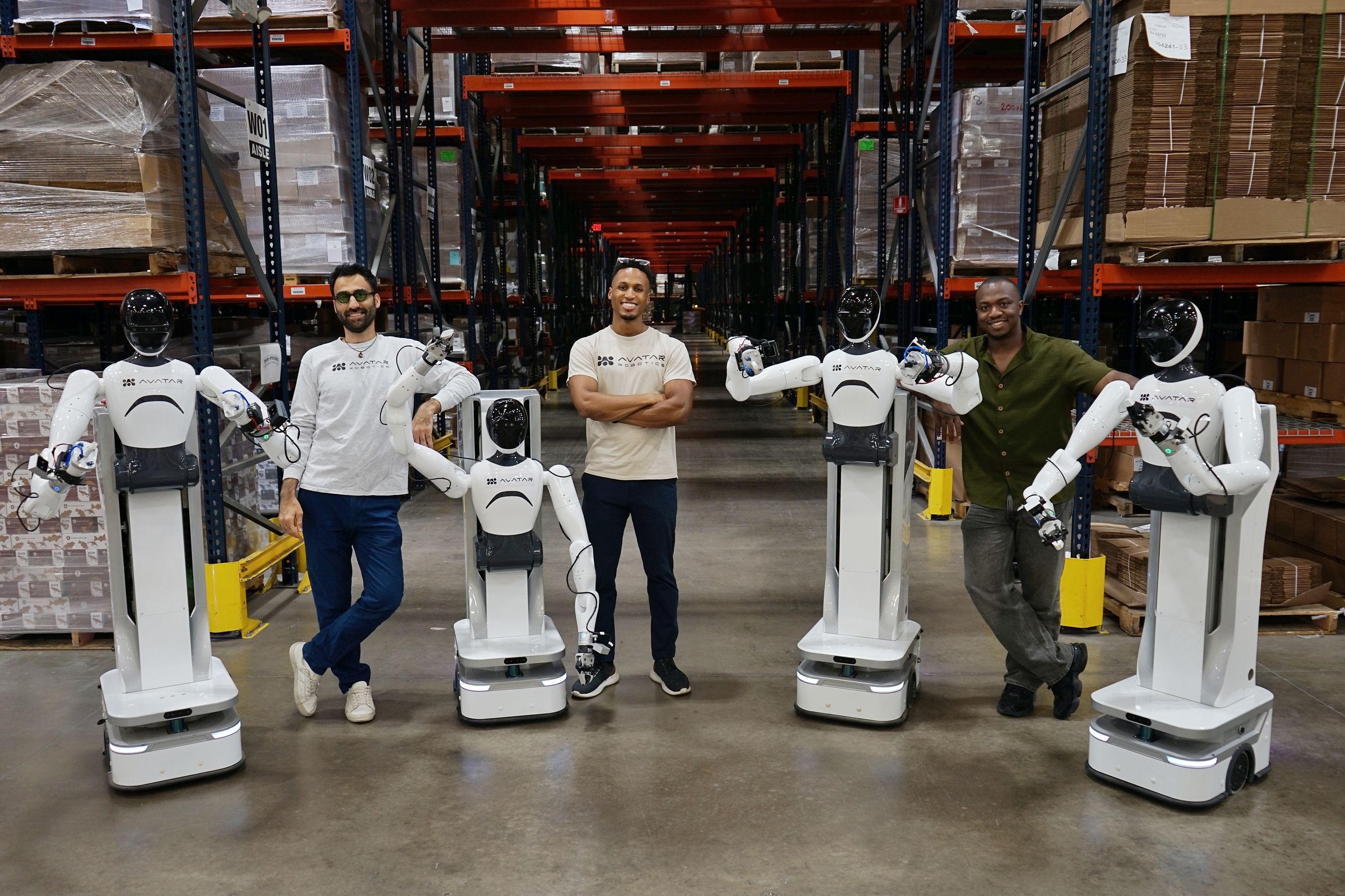
Avatar Robotics advances the humanoid robotics frontier by deploying VR-operated robots controlled remotely by human operators, effectively bridging immediate labor shortages while gathering data to enhance AI autonomy. Having packed and shipped over 900,000 products since launching in late 2025, the company recently raised $6.5 million to scale its fleet and accelerate autonomy development, aiming for one operator to manage entire robot teams. Their expanding partnerships with multi-billion-dollar warehouse operators underscore the growing industrial appetite for hybrid human-robot models to tackle persistent labor challenges.
Pilot deployments across Europe and the U.S. reveal a pragmatic shift toward wheeled humanoid robots tailored for logistics tasks, balancing mobility with manipulation to approach human-level efficiency. Companies like Motion are scaling their Humanoids-as-a-Service offerings by bundling robot selection, training, integration, and maintenance into predictable monthly fees, addressing key adoption barriers such as financing and compliance. With pilots underway involving crate loading and conveyor-line operations, and plans to expand via partner programs, this model exemplifies how integrated service platforms are accelerating the transition from experimental demos to scalable industrial applications.



Plug-and-Play Humanoids Win
Humanoid robots are gaining ground because they fit seamlessly into human-centric factories, leveraging familiar infrastructure and motion data for rapid, cost-effective deployment.
Humanoid robots have gained a significant advantage in industrial adoption due to their compatibility with existing human-shaped factory infrastructure, enabling seamless one-for-one substitution without costly retrofitting. This ease of integration is bolstered by the ability to leverage abundant human motion data for efficient model training, as demonstrated by deployments like Agility Robotics’ Digit in warehouses, which operate effectively within human-designed equipment and workflows.
The rapid scaling of humanoid robotics in industry is exemplified by Humanoid’s landmark $152 million Series A funding round and its unprecedented commercial deal to deploy thousands of wheeled humanoid robots at Schaeffler facilities by 2032. Strategic partnerships with industrial giants such as Schaeffler and Bosch, who will anchor deployment and manufacturing respectively, underscore the maturation of the market and the shift from prototypes to large-scale, real-world operations.
China’s aggressive push to industrialize humanoid robots, aiming for 10,000 units by the end of 2026, highlights labor shortages as a critical driver of adoption. Factories struggling with recruitment and retention are integrating robots incrementally—task by task—achieving meaningful productivity gains, such as a one-third reduction in task time on automotive safety lines. This approach is supported by extensive investments in robot training facilities providing real-world scenarios across multiple industries to accelerate deployment readiness.
The global industrial robotics market is experiencing record growth fueled by labor shortages and rising operational costs, with installations doubling over the past decade to 542,000 units in 2024 and market value hitting $16.7 billion. Companies like Foundation Future Industries and TechForce Robotics are rapidly scaling deployments, moving from pilot projects to contracts for thousands of robots, while Robotics-as-a-Service models and advanced fleet management software are lowering barriers to adoption and enabling multi-site, scalable operations with improved reliability and recurring revenue streams.
Warehouse robotics is a standout growth sector, projected to surge from $11.6 billion in 2024 to $61.8 billion by 2035, driven by e-commerce expansion, AI-powered automation, and acute labor shortages. Rising wages—such as the US warehouse worker hourly rate climbing 41% over the past decade—are pushing companies to automate physically demanding, repetitive tasks through flexible subscription-based Robotics-as-a-Service offerings. Enhanced AI and machine vision capabilities are making robots more intelligent and adaptable, enabling them to handle diverse warehouse operations and meet fast-delivery demands effectively.


Investors Bet on Embodied AI
OpenAI, top VCs, and tech visionaries are pouring capital into humanoid robotics, betting these machines will become the backbone of future infrastructure and outpace traditional AI hardware markets.
By mid-2026, OpenAI’s strategic pivot to building an in-house robotics team under Aditya Ramesh—who transitioned from the shuttered SORA video research group—signaled a maturation of the robotics ecosystem from academic partnerships to direct, infrastructure-focused development. This move aligns with a broader industry trend where AI leaders like Sam Altman and Elon Musk view humanoid robotics as essential for constructing and maintaining critical infrastructure, including ambitious projects such as orbital Dyson swarms, highlighting a shift toward embodied AI as a growth market potentially surpassing GPUs.
Investor confidence in humanoid robotics has crystallized around its vast economic potential and longevity compared to traditional AI hardware, with figures like Andrew Kang making bold early bets starting in late 2023. Kang’s conviction, despite widespread VC skepticism, led to a $19 million stake in Figure AI, driven by the belief that humanoid robots will productize the $50 trillion physical labor market much like LLMs revolutionized knowledge work, with significant workforce integration expected within 3 to 7 years fueled by rapid AI advancements.
Humanoid Robotics’ $152 million Series A round, led by Prime Movers Lab and featuring industrial titans Schaeffler and Bosch as anchor customer and manufacturer respectively, underscores the sector’s transition from speculative to industrial-scale deployment. Valued at $1.35 billion just two years post-founding, Humanoid’s landmark deal to deploy thousands of robots at Schaeffler facilities by 2032 represents the largest commercial contract in the humanoid robotics industry, with capital earmarked for mass manufacturing, AI development, and beta rollouts starting Q4 2026, positioning the company as a European leader in the global race.
Recognizing that scaling humanoid robotics requires sophisticated orchestration, Humanoid is investing heavily in fleet management software to enable multi-site deployments and improve operational reliability. This strategic focus aims to reduce friction in adoption, unlock higher-margin recurring revenue streams, and enhance competitive positioning by supporting diverse industrial applications, reflecting an ecosystem that, much like the automotive industry, will feature a variety of specialized robot models rather than a single dominant design. Investor enthusiasm remains robust as early deployments demonstrate clear ROI by replacing human labor, fueling ongoing funding and market expansion.



China and Europe Race Ahead
China’s state-backed push and Europe’s software-driven partnerships are accelerating humanoid robot deployment, transforming prototypes into essential factory assets and fostering cross-continental co-innovation.
By mid-2026, China has rapidly transitioned humanoid robotics from experimental prototypes to impactful factory floor deployments, targeting labor-intensive, repetitive tasks to alleviate severe workforce shortages. Companies like Aitu and PIABOT Robotics have demonstrated impressive efficiency gains—Aitu’s robots achieved a 97% success rate in fabric separation with sewing quality exceeding 98%, while PIABOT’s G2 robot boosted automotive seat-belt component tapping efficiency by about one-third. This industrial push is supported by government initiatives aiming for a 10,000-unit deployment scale by year-end, with training facilities in Zhejiang province leveraging real-world factory data to enhance robot adaptability across multiple sectors, signaling a strategic move to embed humanoids as integral productivity tools rather than mere novelties.
The synergy between European software innovation and Chinese hardware manufacturing is emerging as a cornerstone of global humanoid robotics advancement, exemplified by Siemens’ integration solutions that enable seamless human-robot collaboration across diverse industrial environments. European startups like the UK-based Humanoid Robotics focus on developing sophisticated AI and control software layers, aiming to complement and compete with Chinese hardware giants such as Unitry. This co-design approach addresses critical challenges like the sim-to-real gap, allowing algorithms to fully exploit hardware capabilities for faster, cost-effective production. Berlin’s Redstone venture capital is actively fostering this cross-border collaboration by raising $50 million to bridge European deeptech expertise with China’s rapid prototyping and scaling prowess, while regulatory frameworks like the EU’s Artificial Intelligence Act incentivize Chinese firms to 'Europeanize' their products through localized partnerships to maintain market access.
Europe is rapidly solidifying its position as a third major hub in humanoid robotics, marked by significant financial backing and innovative business models that address regional adoption barriers. Germany’s Neura’s recent $1.4 billion funding round and the emergence of startups like Northstar, founded by a former Tesla scientist, signal robust investor confidence and market interest. Belgium’s Motion exemplifies this momentum by pioneering a 'Humanoids-as-a-Service' model that bundles robot selection, training, integration, financing, and compliance into a single predictable monthly fee, effectively lowering entry barriers for manufacturers facing acute labor shortages—72% of European manufacturers struggle to fill machine and plant operator roles, according to a 2026 ManpowerGroup survey. Motion’s hardware-agnostic approach leverages complementary European software with flexible robot hardware, all while navigating stringent EU regulations such as the Machinery Regulation and AI Act, facilitating scalable, compliant deployments across the continent.


Europe’s Humanoid Leap
European startups are pioneering hardware-agnostic, compliance-ready robotics-as-a-service models, unlocking mass adoption for manufacturers facing critical labor shortages and strict regulations.
European startups are pioneering hardware-agnostic, compliance-ready robotics-as-a-service models, unlocking mass adoption for manufacturers facing critical labor shortages and strict regulations.