Hybrid guardrails push AI reliability to record highs
The gist
Hybrid guardrails combining deterministic checks with LLMs have catapulted AI reliability to record highs, setting new industry standards for accuracy, safety, and auditability.
What to know
- Structured AI output accuracy soared to 82% by early 2026 thanks to generate-validate-fix loops and reward-based fine-tuning—leaving GPT-4.1’s 58% in the dust.
- Real-time monitoring, kill switches, and multi-model guardrails have hiked AI agent success rates from a paltry 8% to an impressive 77% in production.
- Deep observability and legal frameworks now demand full AI decision chain transparency, but compliance gaps persist as rule triggers don’t always guarantee rule-based decisions.
Hybrid Validation Sets New Bar
AI reliability surged as emotionless, deterministic validators and reward-based fine-tuning transformed error-prone language models into context-aware engines capable of flawless, schema-true outputs.
By early 2026, the integration of deterministic validation systems with probabilistic large language models (LLMs) had become a cornerstone for enhancing AI output reliability. Techniques such as the generate-validate-fix loop—exemplified by running EXPLAIN commands on AI-generated SQL queries against safe replica databases—allow errors to be caught and fed back into the model iteratively until flawless logic is achieved. This approach addresses the fundamental limitation that LLMs, prone to confidently affirming incorrect outputs due to their 'people-pleasing' nature, cannot self-validate effectively; deterministic validators act as emotionless gatekeepers ensuring accuracy, as seen in tools like SonarQube’s plugin for Claude Code that applies fixed rule-based code analysis rather than probabilistic guesses.
Reward-based fine-tuning combined with deterministic validation has markedly improved the fidelity of structured AI outputs beyond what traditional supervised fine-tuning (SFT) can achieve. For instance, by employing a correctness-checking reward function that verifies schema compliance, models have elevated schema-valid JSON output rates from 62% to 82%, surpassing GPT-4.1’s 58% on the same evaluation. This hybrid generate-validate-fix strategy overcomes SFT’s tendency to optimize for superficially plausible outputs rather than truly valid ones, closing a critical gap in AI reliability for structured data generation.
The evolving paradigm in AI validation embraces a nuanced balance between probabilistic creativity and deterministic rigor, leveraging semantic modeling and ontologies to refine outputs contextually. As articulated in mid-2026 analyses, probabilistic models are now instrumental in constructing deterministic tools too intricate for manual human development, marrying AI’s generative strengths with rule-based reliability. This hybrid approach is further tailored by domain-specific quality thresholds—near-deterministic accuracy is imperative in healthcare, whereas lower-risk applications like sports chatbots can tolerate some probabilistic errors—signaling a mature, context-aware validation ecosystem.
Verification and guardrail mechanisms have emerged as vital components of hybrid validation frameworks, employing multi-model and multi-pass strategies to pressure-test AI outputs for accuracy and safety. By generating multiple drafts and cross-checking answers with smaller secondary models or rephrased queries, systems enhance reliability while mitigating harmful or inappropriate content through scoring-based guardrails, albeit at the cost of increased compute time. This layered approach, where a large primary model crafts the response and smaller verifier models audit it, exemplifies best practices that echo software engineering’s evolution toward structured, pattern-based design to constrain AI’s expressive freedom for the sake of trustworthiness.



Guardrails Reinvent Production AI
Layered oversight, real-time monitoring, and sharply limited agent autonomy have redefined safe AI deployment, turning hidden hallucinations into auditable gaps and boosting agent success rates by nearly tenfold.
By mid-2026, operational strategies to ensure AI agent reliability in production coalesced around combining probabilistic generation with deterministic verification, as seen in architectures where large language models propose candidates and deterministic systems sign off on them. This approach, coupled with retrieval-augmented generation (RAG) to anchor responses in curated knowledge bases, shifts errors from hidden hallucinations to visible gaps, enhancing auditability and trust. Furthermore, lifecycle management practices such as limiting the agent's operational horizon—from fifty steps down to five—dramatically improve reliability metrics, increasing success probability from a mere 8% to 77%, thereby trading some autonomy for safer, more consistent operation.
Continuous guardrails, real-time monitoring, and supervisory controls have become indispensable to manage AI agents safely in production. Industry experts like Rebecca Wettemann emphasize the necessity of ongoing simulations and kill switches that can automatically halt agents exhibiting anomalous behavior, such as canceling an excessive number of bookings in a short time frame. Vendors including NiCE Cognigy, Cyara, and Quiq have developed integrated platforms offering layered scrutiny—checking for sensitivity, accuracy, tone, and policy compliance—to maintain brand consistency and prevent unsafe outputs. These multi-layered verification steps often involve smaller, faster models acting as independent fact-checkers, mirroring journalistic data verification processes to catch errors before deployment.
The complexity of governing AI agents escalates when multiple autonomous agents interact, especially when some are third-party or externally developed, necessitating robust observability frameworks and immutable event logging. CIOs and CTOs are advised to implement durable logs that reconstruct agent timelines for auditing and decommissioning misbehaving agents, as highlighted by the need for both synchronous guardrails—such as toxicity filters and operational boundaries—and asynchronous kill switches. This 'constrained operational box' approach calibrates agent creativity within safe limits, with tighter constraints applied to critical tasks, ensuring that agents operate within verifiable and auditable domains.
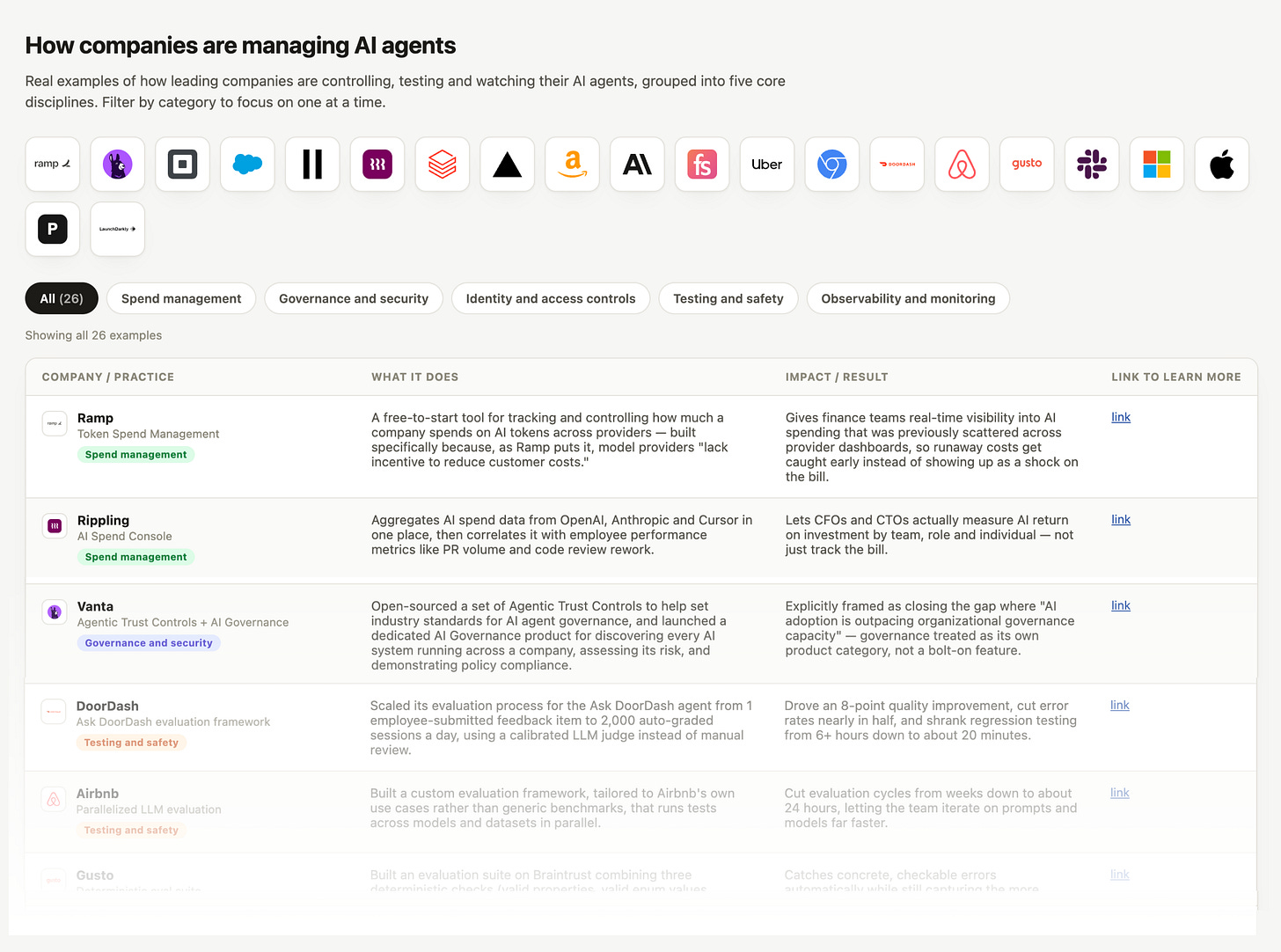
Emerging tools and frameworks from industry leaders like LaunchDarkly’s Agent Control, Microsoft’s agentic observability tooling, Notion’s admin controls, and Vanta’s open-source Agentic Trust Controls reflect a market shift from exploring AI agent capabilities to rigorous oversight of their real-world actions. This evolution addresses challenges such as model drift, knowledge base errors, and the need for continuous evaluation across complex multi-step workflows, as emphasized by experts like Sidhesh Badrinarayan. Simulation environments and detailed audit trails enable pre-deployment testing and post-deployment accountability, while adversarial training and calibrated confidence mechanisms teach agents when to escalate decisions to humans, collectively building defensibility and trust in AI systems amid a crowded and error-prone landscape.



Deep Observability Closes Gaps
Continuous, LLM-native telemetry and dual-brain enforcement now make every AI decision traceable, enabling enterprises to detect deviations, prevent unsafe actions, and ensure AI knows when to defer to humans.
By mid-2026, industry leaders emphasized that deep observability into AI agents' multi-step reasoning and context management is indispensable for ensuring consistent, compliant performance and detecting unexpected behaviors. Tools like ServiceNow’s 'kill switch' and Quiq’s Verified Intelligence platform, which scores responses for factual accuracy and policy compliance, exemplify how layered scrutiny and continuous monitoring guard against errors and misalignment. Mike Myer of Quiq highlighted the criticality of maintaining up-to-date knowledge bases, as outdated information can silently degrade AI decision quality, underscoring the need for auditability throughout the AI decision chain.
Closing the visibility gap in AI decision-making requires enterprises to instrument the entire decision chain with LLM-native telemetry that captures every internal context update, transforming opaque AI workflows into traceable ledgers. As detailed in late July 2026 analyses, observability systems must track four pillars—context continuity, guardrail integrity, groundedness, and hallucination mitigation—to pinpoint precisely when and how an AI agent deviates. The introduction of structured data layers like the Context Graph further ensures seamless conversation continuity and smooth human-agent handoffs, preventing redundant queries and preserving context fidelity.
Effective governance of autonomous AI hinges on proactive monitoring of safety guardrails through metrics such as false positives, false negatives, and bypass attempts like prompt injections, enforced via a dual-brain topology that combines flexible AI reasoning with immutable declarative rules. This system-level enforcement, rather than relying solely on AI model compliance, enhances accountability and reduces risk. Complementing this, comprehensive QA strategies advocate testing beyond ideal scenarios to include contradictory inputs and escalation protocols, ensuring AI agents know when to defer to humans, thereby bolstering reliability and safety.
As the agentic AI market approaches $139 billion, the demand for advanced observability and auditability infrastructure is surging, with the market for AI agent observability projected to grow from $0.4 billion in 2025 to $7.1 billion by 2035. This growth reflects a shift towards rigorous evaluation frameworks that capture the entire AI workflow—from tool selection and input processing to inferred context—rather than just final outputs. Simulated environments and tool-mocked testing have become vital pre-deployment practices, enabling engineers to detect multi-turn workflow failures and edge cases without risking real-world harm, thereby enhancing accountability and troubleshooting precision.


Auditability Demands Full Access
Regulatory pressure is forcing open the AI black box, with independent verifiers seeking raw data, model weights, and agent authoring logs to expose covert risks and enforce true accountability.
By mid-2026, it became clear that meaningful access to AI systems' internal workings and raw data is indispensable for credible safety evaluations and audits, mirroring regulatory practices in pharmaceuticals and aviation. Independent Verification Organizations (IVOs), as proposed in the US FRONTIER Act, are mandated to obtain unredacted materials and personnel access to prevent superficial, box-ticking assessments that merely dress up developer self-reports. Yet, ambiguity remains around whether evaluators will gain access to critical elements like full model weights or training data, essential for uncovering covert risks such as 'sleeper agent' backdoors, highlighting a pressing need for clearer legal standards to avoid ineffective oversight.
Traditional AI governance tools, which rely on evaluating only the final code artifacts, fall short in managing autonomous agent-written code because they miss the crucial authoring context and session-level metadata necessary for accountability. Effective governance frameworks must operate at the platform layer that runs these agents, ensuring that authoring records survive audits and enable enforcement controls that can block or roll back unauthorized actions, rather than merely reporting violations post-facto. However, a 2026 ACL study revealed that major coding assistants lack mechanisms to view, limit, or log gathered context, posing significant challenges for compliance and auditability in regulated enterprises.
Highly regulated organizations demand AI governance frameworks that eliminate black-box unpredictability by enforcing consistent, explainable, and reliable outputs, as even a single hallucination is unacceptable. Solutions like Guardian AI serve as critical guardrails to ensure trustworthy outcomes, but many enterprises still rely on ad hoc or undocumented governance workarounds that autonomous agents now expose, underscoring the urgent need for rigorous, documented compliance frameworks tailored to the complexities of autonomous AI.
The EU AI Act’s reliance on guard models and activation probes for compliance is fundamentally undermined by a phenomenon dubbed 'rule blindness,' where these models fail to truly read or apply regulatory rules, instead relying on superficial pattern matching. Sadhu et al.'s introduction of a crossed-rule benchmark in 2026 exposed that deleting or scrambling governing rules leaves detector verdicts statistically unchanged, revealing a critical accountability gap since audit trails can confirm guard activations but not whether decisions were logically grounded in actual rules. This exposes a profound vulnerability in current compliance frameworks that regulators must urgently address.


Error Propagation in High Stakes
Mission-critical sectors are battling cascading AI errors with strict guardrails, cross-model verification, and relentless integration testing—balancing operational efficiency against the unforgiving cost of mistakes.
In high-stakes domains such as healthcare, finance, and claims processing, balancing reliability and efficiency hinges on managing error propagation across complex, multi-step AI workflows. For instance, healthcare AI systems face the challenge that each of potentially 50 reasoning steps can introduce errors, necessitating strict yet flexible guardrails to reject incorrect outputs without rendering the system unmanageable or prohibitively expensive, as overly rigid hardcoding can lead to operational chaos. Similarly, claims processing firms implement cross-verification among multiple AI models and escalate ambiguous cases to human agents to prevent error inheritance, ensuring that only consensus outputs advance, which underscores the critical role of human oversight in maintaining accuracy.
The financial sector exemplifies the intricate risk of 'error inheritance,' where a single AI misrecognition in transcript generation can cascade through customer records, analytics, and compliance investigations, potentially skewing decisions for years. Benjamin Walker, CEO of Ditto Transcripts, emphasizes that banks must validate entire AI decision chains—from speech recognition to downstream systems—rather than isolated models, calibrating human review intensity based on the criticality of records to balance efficiency with risk mitigation. Despite widespread AI adoption, concerns about hallucinations and unreliable outputs persist, with only 20% of institutions deploying AI in compliance and a mere 5% in operations, reflecting the sector’s cautious approach amid regulatory scrutiny and the imperative for robust audit trails.
Across these high-stakes sectors, maintaining consistent AI performance demands rigorous, repeated integration testing with high pass rate thresholds—such as the 90% benchmark cited in claims processing—to address the inherent variability of large language models. This disciplined approach ensures that AI systems not only deliver timely and cost-effective outputs but also uphold the stringent accuracy standards essential in environments where errors can have profound consequences, illustrating the delicate trade-off between thoroughness and operational practicality.