Intel’s CPU power play: AI agent boom triggers global chip crunch and price surge
The gist
Intel is riding a global surge in AI agent workloads to reclaim CPUs as the backbone of next-gen AI infrastructure, sparking a chip crunch and soaring prices.
What to know
- Intel is repositioning CPUs at the heart of AI, forging partnerships and developing new accelerators to meet skyrocketing demand for AI inference and agentic workloads.
- A dramatic shift in CPU-to-GPU ratios—now nearing 1:1 for AI agents—has triggered a worldwide CPU shortage, with Intel’s server chips seeing 10-20% price hikes and its market cap doubling in six months.
- Analysts predict Intel will capture 47% of the AI server CPU market by 2030, as the company eyes acquisitions like Tenstorrent to boost its AI chip firepower.
Intel’s AI Hardware Overhaul
Intel is transforming CPUs from supporting actors to the backbone of AI infrastructure, layering in security features and new partnerships to meet the demands of next-gen inference workloads.
Intel is strategically leveraging its dominant position in CPU server chips to anchor AI inference workloads, recognizing that CPUs remain their 'bread and butter' with a lion’s share of the market. However, acknowledging limited traction in existing inference accelerators, Intel is actively developing new accelerator chips and forging partnerships, such as the deal with Samanova, to close hardware gaps and better address the unique demands of AI inference.
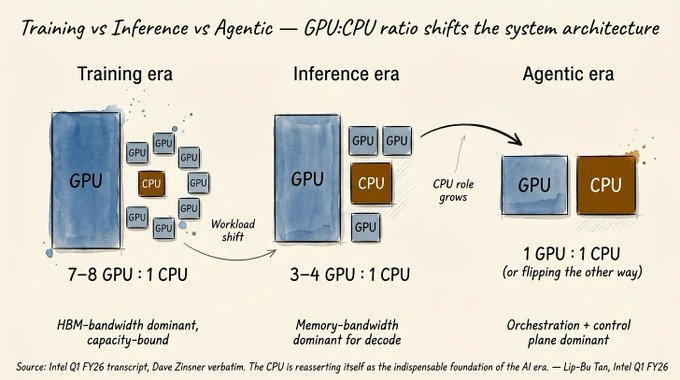
This strategic pivot repositions the CPU from a mere supporting role to the core of AI infrastructure, handling control, orchestration, task scheduling, and data flow management. Intel emphasizes that in AI inference and agentic workloads, CPU-to-GPU ratios shift significantly—dropping from 1:7 or 1:8 during training to around 1:3 or 1:4—highlighting the CPU’s growing prominence in managing complex AI tasks and reclaiming strategic control over the infrastructure stack.
Beyond hardware, Intel is embedding secure compute features like Intel Trust Authority into AI workloads via integrations such as SCRT Labs’ SecretVM, underscoring a commitment to verifiable and confidential AI inference. Complementing this, Intel’s multifaceted AI strategy includes acquiring AI chip startups like Tenstorrent, improving foundry yields, and forming high-profile partnerships with entities like McLaren Racing and Terafab, all aimed at expanding a secure, AI-ready compute ecosystem across data centers, edge devices, and third-party platforms.
Intel’s AI-centric CPU and foundry transformation aims to convert the rising demand for AI server CPUs and improved manufacturing yields into sustainable profitability, despite current market share challenges and execution risks. This mirrors a broader industry trend, with leaders like AMD also emphasizing diverse CPU portfolios optimized for AI inference, and investing heavily—over $10 billion—in supply chain partnerships and manufacturing capacity to address hardware gaps and support the expected 35% annual CPU market growth over the next five years.


CPU-GPU Ratios Flip the Script
Agentic AI is reversing decades-old compute hierarchies, pushing CPUs to the forefront as supply struggles to catch up with workloads that now demand near-equal or even CPU-favored ratios.
The CPU-to-GPU ratio in AI workloads is undergoing a profound transformation, shifting from traditional configurations of one CPU per eight GPUs to ratios approaching parity or even favoring CPUs. Intel CEO Lip Bu Tan highlights this evolution, noting a current ratio closer to one CPU per four GPUs, while industry experts like Evercore ISI's Mark Lapidus foresee a potential flip to eight CPUs per GPU driven by the rising complexity of agentic AI tasks that spawn numerous CPU-intensive workloads. This shift underscores CPUs' expanding role beyond mere support, as they increasingly handle inference, real-time reasoning, and multi-agent orchestration, fundamentally reshaping AI compute architectures.
Agentic AI workloads are a critical catalyst for increased CPU demand, as these systems rely on CPUs to manage multiple agents, orchestrate data flows, and interface with APIs—functions GPUs are less suited to perform. Leaders like AMD's Sarah Fryer and Lisa Su emphasize that as AI moves from large training models to inference and agentic systems, CPUs become indispensable for logic, security, and orchestration layers within AI stacks. This trend is reflected in market forecasts projecting server CPU total addressable markets growing over 35% annually, reaching upwards of $120 billion by 2030, signaling a structural tailwind for CPU-centric AI infrastructure.
Despite the growing CPU importance, the industry faces challenges from years of underinvestment in CPU infrastructure, which has led to potential shortages just as AI inference demands surge exponentially. Analysts like Doug from SemiAnalysis warn that while GPU budgets have been prioritized, CPU refresh cycles are ending, constraining capacity at a critical inflection point where inference compute requirements have increased by roughly 10,000 times. This supply-demand imbalance accentuates the strategic value of CPUs not only for raw compute but also for managing storage, security, and system recovery, roles underscored by Intel and Nvidia's collaborative efforts to build hybrid AI factory environments integrating x86 and GPU capabilities.
Current CPU utilization rates in AI systems remain relatively low, typically between 4% and 14%, but there is significant headroom to optimize and increase this to around 40% by better workload management across CPUs and GPUs. This underutilization suggests untapped potential in hybrid computing architectures championed by Intel and Nvidia, where CPUs serve as the orchestration and control plane for AI stacks, complementing GPU acceleration. Such hybrid models are poised to define the next generation of AI infrastructure, balancing the strengths of both processors to meet the surging demands of inference and agentic AI workloads.





Global CPU Shortage Ignites Market
Soaring demand for AI agents has triggered a worldwide CPU crunch, spiking Intel’s chip prices and market value while fueling aggressive moves to secure dominance in the AI server race.
The rapid rise of AI agent workloads, which demand both serial and parallel processing capabilities, is triggering an unprecedented surge in CPU demand that threatens to create a global shortage. As Dylan Patel from Semi Analysis highlighted, 'we have no more CPUs,' underscoring how reinforcement learning and agentic AI systems have shifted the bottleneck from GPUs to CPUs. This shift is compounded by projections that individual semiconductor footprints will expand roughly tenfold as users run hundreds to thousands of AI agents simultaneously, each requiring substantial CPU and memory resources.
Intel is at the epicenter of this supply crunch, grappling with billions of dollars in unmet server CPU demand that has driven price increases of 10 to 20 percent within months, fueling a doubling of its market capitalization over six months. CFO David Zinsner’s remarks about the 'billions of dollars of unmet demand' reflect the intense pressure on Intel’s supply chain to keep pace with the 1:1 CPU-to-GPU ratio now required by agentic AI workloads—a stark contrast to prior architectures that needed only one CPU per 12 GPUs. This new bottleneck is reshaping market dynamics and elevating CPUs as the critical component in AI infrastructure.
Market analysts are bullish on Intel’s prospects amid this CPU surge, with Citi forecasting the company will capture 47% of the AI server CPU market by 2030, signaling strong expected demand and dominance in AI-centric data centers. Benchmark’s Cody Acree raised Intel’s price target from $105 to $140, citing increased confidence in the company’s 2027–2028 earnings potential driven by AI workloads. Meanwhile, Intel’s strategic exploratory talks to acquire AI chip startup Tenstorrent indicate a proactive approach to augmenting its AI chip capabilities, which could further influence supply chain dynamics and competitive positioning in the evolving AI CPU and accelerator market.
The evolving architecture of AI agents, which perform a blend of simple and complex tasks requiring persistent memory and diverse processing, is reshaping semiconductor demand patterns and exerting upward pressure on CPU pricing and supply forecasts. As agents increasingly launch subordinate agents to handle multifaceted workloads, the semiconductor content per user rises significantly, intensifying power consumption and supply chain challenges. Companies like Intel are acutely aware of these trends and are actively strategizing to align production with this burgeoning demand to avoid the extreme shortages previously seen with GPUs.



