Iran’s chokepoint grip sends oil soaring, markets on edge
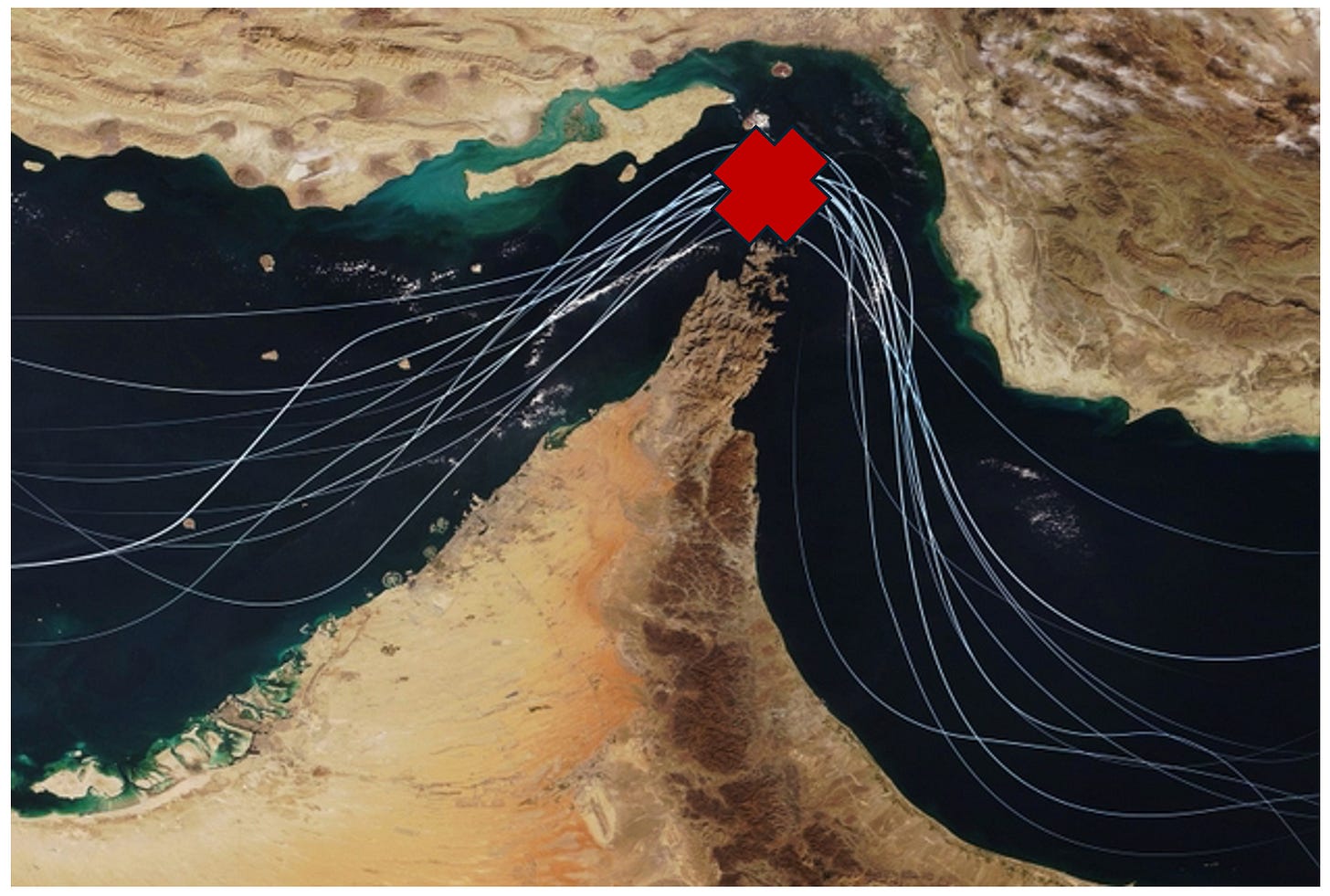
The gist
Iran’s near-total grip on the Strait of Hormuz has sent oil prices skyrocketing past $100, putting global markets on high alert for historic supply shocks.
What to know
- Iran’s Revolutionary Guards now control vital Strait of Hormuz flows, threatening to throttle oil shipments below 9 million barrels per day if tensions escalate.
- Simultaneous Red Sea blockades by Iranian-backed Houthis are choking off up to 5 million barrels a day of Saudi exports, with rerouting options limited and expensive.
- The U.S. Navy is leading emergency military escorts, while countries like Japan race to zero Gulf oil imports by mid-2026 to escape chokepoint chaos.
Iran’s Chokepoint Power Play
Iran’s Revolutionary Guards have transformed the Strait of Hormuz into a tightly controlled oil valve, using permit systems and production shutdowns to quietly squeeze global supply while their Houthi allies multiply the shock by blocking Red Sea routes.
Iran’s Revolutionary Guards Corps (IRGC) has effectively seized permanent control over the Strait of Hormuz, a chokepoint responsible for roughly 17 to 21 million barrels of oil and LNG daily—about one-fifth of global traded volumes. By throttling flows below the current net of 13.5 million barrels per day, Iran wields strategic leverage to create supply deficits and drive prices higher, with the potential to push flows below 9 million barrels per day to trigger acute market shocks. Despite appearances of normal tanker exit volumes, significant crude production remains shut-in, underscoring the ongoing supply risks tied to Iran’s chokehold and the IRGC’s permit mechanism that tracks and controls transit volumes meticulously.
Compounding the Strait of Hormuz crisis, Iran’s Houthi allies have escalated blockades in the Red Sea, notably shutting down ports critical for 4 to 5 million barrels per day of Saudi oil exports. This sequential disruption of both the Strait of Hormuz and Bab el-Mandeb chokepoints—carrying approximately 9 million barrels daily with nearly half structurally inelastic—creates a multiplicative supply shock with no modern precedent. The lack of viable rerouting options, such as the lengthy and costly voyage around Africa’s Cape of Good Hope, intensifies global supply vulnerabilities and drives up war risk insurance premiums and port congestion.
Heightened security risks have forced major players like India’s state-owned refiners to suspend Iraqi crude loadings, directly impacting Iraq’s oil revenues as the country relies exclusively on the Strait of Hormuz with no pipeline alternatives. The targeting of commercial vessels—even those operating with AIS transponders switched off—marks a dangerous escalation that invalidates previous assumptions about stealth transit safety. Meanwhile, the U.S. Navy has initiated unprecedented military escorts for commercial shipments, protecting approximately 6.5 million barrels per day through the strait, reflecting the extraordinary measures required to maintain any semblance of operational flow amid persistent Iranian drone and missile threats.
Efforts to counter Iran’s chokehold face significant geopolitical and logistical challenges, as the U.S. and allies are reluctant to deploy large-scale military forces to secure the Strait of Hormuz, while regional powers like the UAE, Saudi Arabia, and Qatar remain determined to prevent full Iranian control due to past economic damages. Diplomatic attempts have repeatedly failed to guarantee safe passage, leaving the strait effectively closed with physical threats such as mines still present. In response, alternative oil transit corridors through Jordan-Israel-Mediterranean and Syria-Turkey-Europe are under consideration, alongside speculation of potential naval operations to unblock the strait—though such actions would likely exclude Israel and underscore the enduring strategic importance of these maritime chokepoints.


Oil and Markets on a Knife Edge
Triple-digit oil prices and surging Treasury yields reveal how markets are bracing for a drawn-out crisis, with lean inventories and forced output cuts exposing the fragility of global energy security.
Oil prices have surged above $100 per barrel amid the ongoing Iran conflict, driven by heightened risk premiums linked to disruptions in critical chokepoints like the Strait of Hormuz and the Red Sea. Brent crude, more sensitive to Middle Eastern supply shocks, has seen a $6.40 spread over WTI, reflecting the vulnerability of seaborne cargoes, while market participants treat the conflict as a persistent risk rather than a transient crisis, sustaining elevated prices despite intermittent mediation efforts.
Despite the acute supply risks, current oil prices around $100–$105 per barrel remain below theoretical levels implied by a 10 million barrels per day production shortfall, suggesting market optimism about a near-term resolution and reopening of the Strait of Hormuz. However, with global inventories now very lean after extensive drawdowns and strategic reserve releases, storage constraints—particularly in Gulf producers like Iraq, Kuwait, and the UAE—are forcing output curbs, exacerbating supply vulnerabilities and embedding a persistent risk premium that could fuel renewed volatility.
The oil price surge has reverberated through financial markets, pushing U.S. Treasury yields to multi-year highs—10-year yields topping 4.7% and 2-year yields near 4.33%—as investors price in inflationary pressures and the likelihood of Federal Reserve rate hikes. This energy-driven inflation scare has dampened equity markets, with the S&P 500 experiencing its largest monthly decline since early July, reflecting investor concerns over tighter borrowing conditions and reduced consumer spending amid rising gasoline costs.
Looking ahead, experts warn of a delayed but severe supply shock within six to nine months due to damaged Gulf energy infrastructure, which will constrain production recovery and intensify shortages once storage buffers are depleted. Larry Fink of BlackRock encapsulates the extraordinary uncertainty, projecting oil prices could swing dramatically—from as low as $42 to above $200 per barrel—depending on conflict developments, while Goldman Sachs cautions that prolonged Strait of Hormuz disruptions could push prices toward $150, underscoring the precarious balance between geopolitical tensions, market sentiment, and physical supply realities.





Chronic Conflict, Not Crisis
Markets are recalibrating for a new normal of persistent US-Iran tensions, treating military strikes and blockades as background risk while fragile diplomacy and erratic political rhetoric keep volatility simmering.
The US-Iran conflict has evolved into a persistent geopolitical backdrop rather than a series of sudden shocks, with markets increasingly pricing in ongoing military escalations such as Iran's attacks on US assets and the Houthi blockade in the Red Sea as stable risk factors. Despite headline-grabbing events, including strikes on critical infrastructure in the UAE and Saudi Arabia, financial markets and crypto assets have shown surprising resilience, reflecting a nuanced investor sentiment that differentiates between chronic conflict and acute crises, as noted by the muted market reactions following recent escalations.
Military campaigns by the US and Israel have significantly degraded Iran's naval and missile capabilities, yet Iran's ability to reconstruct launchers and sustain drone and missile attacks complicates efforts to stabilize the region, sustaining a cycle of intermittent conflict. This dynamic, coupled with Iran's unified leadership under the Revolutionary Guard controlling strategic decisions like the Strait of Hormuz, underscores the entrenched nature of the conflict and the limited military options available to the US and allies, who face prohibitive troop deployment challenges and rely instead on coalitions such as planned naval escorts to secure vital energy transit routes.
Diplomatic efforts remain fraught, with Iran refusing direct negotiations with Washington and demanding guarantees against future strikes as a precondition for reopening the Strait of Hormuz, while intermediaries like Oman and India attempt to broker talks. These complexities are exacerbated by US political rhetoric, including President Trump's calls for regime change and aggressive military posturing, which undermine diplomatic coherence and heighten market uncertainty. As a result, oil prices fluctuate sharply in response to rhetoric rather than tangible changes on the ground, with analysts warning that the market’s current pricing of a peace scenario is premature and vulnerable to sudden spikes if tensions reignite.
The broader regional conflict has drawn in multiple actors and shifted geopolitical power balances, with Russia benefiting from lifted sanctions and high oil prices, and China leveraging the situation to expand its influence and military insights. Gulf states and major importers like Japan are recalibrating their energy security strategies by diversifying supply routes and reducing reliance on the Strait of Hormuz, while the fragmented and fluid alliances involving US military protection, Chinese technology, and Iranian trade create unpredictable dynamics that complicate energy market forecasts and amplify inflationary pressures through disrupted supply chains.




Pipeline Race and Maritime Peril
Gulf producers are scrambling to build costly bypass pipelines and slash reliance on Hormuz as insurance costs soar and tanker traffic collapses, but entrenched chokepoint risks and underused infrastructure threaten long-term energy stability.
The Iran conflict has sharply escalated risks and costs associated with maritime oil transport through critical chokepoints like the Strait of Hormuz and Bab al-Mandeb. Insurance premiums for vessels operating in these volatile Middle Eastern waters have surged to over 10% of cargo value, compounded by targeted Houthi attacks on Saudi-linked shipping that have necessitated armed guards and strict adherence to IMO-designated traffic lanes. This heightened threat environment has forced operators into a precarious calculus between navigating dangerous direct routes or undertaking costly, lengthy detours around the Cape of Good Hope, with tanker traffic through Hormuz plummeting by over 90% at mid-2026 lows, effectively closing a waterway responsible for roughly 20% of global oil and LNG supply. Meanwhile, vessels increasingly disable AIS transponders to evade detection, further complicating logistics and operational transparency.
In response to the strategic vulnerability exposed by near-total reliance on the Strait of Hormuz, Gulf producers and global importers are accelerating investments in alternative export infrastructure to diversify supply routes and mitigate chokepoint risks. The UAE and Saudi Arabia are expanding pipeline capacities to bypass Hormuz, with Saudi Arabia enhancing its east-west pipeline and the UAE aiming to minimize exports through the strait altogether. However, Iraq and Kuwait face geopolitical and logistical hurdles due to border crossings, complicating their diversification efforts. This infrastructural pivot is underscored by Japan’s dramatic reduction of Gulf oil imports from 95% exposure pre-conflict to an anticipated zero by July 2026, exemplifying a broader global shift toward supply chain resilience and diversification.
Despite the strategic imperative to build bypass pipelines around Hormuz, financing and guaranteeing their utilization remain formidable challenges, as these costly infrastructures may be underused outside crisis periods. As analysts note, consumer commitments to pipeline offtake are essential to justify investments, highlighting the complex interplay between geopolitical risk management and market economics. This renewed focus on pipeline infrastructure marks a reversal of decades-long reliance on maritime supertankers, which were previously favored for cost efficiency and perceived security. The current conflict has shattered such assumptions, prompting Gulf countries to 'step up their investment in defense and alternative export routes' to ensure long-term energy supply stability.
The unprecedented U.S. Navy military escort operation through the Strait of Hormuz, protecting approximately 6.5 million barrels of oil per day, represents a novel strategic response to secure commercial energy shipments amid escalating conflict. This military involvement underscores the criticality of the chokepoint and the extraordinary measures required to maintain flow, marking a peacetime precedent with no direct historical parallel. However, unpredictable presidential rhetoric and communication missteps, such as Secretary of Energy Chris Wright’s tweet about the strait’s reopening causing a 10% market plunge, have increased risk aversion and complicated capital deployment, further challenging strategic responses to supply disruptions.