Japan’s policy tug-of-war: BOJ tightening meets fiscal fireworks as yen sinks to historic lows
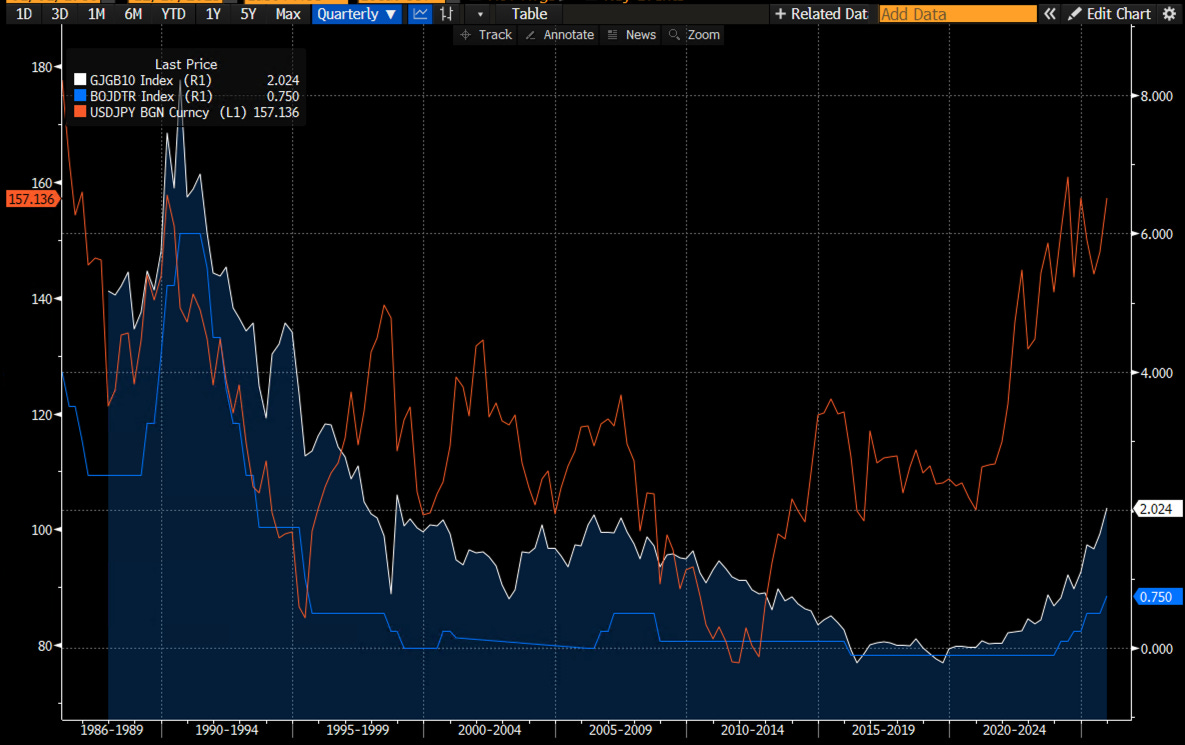
The gist
Japan’s central bank and government are locked in a high-stakes tug-of-war: BOJ rate hikes collide with massive fiscal stimulus, sending the yen to historic lows and shaking global markets.
What to know
- The BOJ began raising rates in December 2024, reaching 1% by mid-2026—the highest since 1995—while dismantling yield curve control.
- Prime Minister Takaichi slashed the consumption tax and unleashed a ¥21.3 trillion stimulus, fueling bond market volatility and political tension over economic strategy.
- Yen depreciation hit a 40-year low as Japanese investors repatriated capital, roiling global currency and bond markets and forcing pension funds to boost domestic bond holdings.
BOJ’s Tightrope Act
Japan’s historic rate hikes have upended decades of zero-rate policy, triggering bond market skepticism and a global repricing of risk as real yields remain negative and investors question the central bank’s credibility.
In December 2024, the Bank of Japan (BoJ) initiated a cautious departure from its decades-long ultra-low interest rate regime, marked by the first of multiple rate hikes and the gradual dismantling of yield curve control. Governor Ueda emphasized a measured approach, stating that rate hikes would "ease off the accelerator, not hit the brakes," supported by robust wage growth above 5% and tight labor markets. This shift disrupted the zero-rate, infinite liquidity environment, pushing the 10-year Japanese Government Bond (JGB) yield to nearly 1.9%, its highest since 2008, while domestic bond demand remained subdued due to persistently negative real yields and market skepticism about the BoJ’s policy clarity and credibility.
The early phase of Japan’s monetary normalization also triggered significant market dynamics beyond domestic bonds. The unwinding of the carry trade became evident in mid-2024 when the Fed cut rates as the BoJ raised them, coinciding with Bitcoin’s capitulation to new lows, illustrating the global ripple effects of Japan’s policy pivot. Meanwhile, the rising long-term yields and forward rates, such as the 15y15y forward rate reaching 5%, signaled a market repricing of Japan’s monetary outlook, even as real yields remained deeply negative and the BoJ maintained a politically motivated stance to keep the yen weak, risking economic imbalances.
By mid-2026, the BoJ’s gradual normalization gained momentum with the policy rate rising to 1%, the highest since 1995, symbolizing Japan’s exit from its deflationary era and prolonged economic stagnation. This milestone ended decades of near-zero rates and began to reverse the entrenched investor preference for foreign assets, as rising JGB yields made domestic bonds attractive again. Institutional investors started repatriating capital from overseas, reflecting renewed confidence in Japan’s bond market, while discussions emerged about potentially accelerating rate hikes beyond 2% to counter yen depreciation, underscoring the evolving and dynamic nature of Japan’s monetary policy shift.




Fiscal Firepower Unleashed
Prime Minister Takaichi’s sweeping tax cuts and stimulus, backed by a supermajority, have set off a political and market clash over whether bold spending can outpace debt risks without new borrowing.
By early 2026, Prime Minister Sanae Takaichi's bold fiscal agenda, including pledges to cut the consumption tax and ramp up spending without clear funding plans, sparked a surge in Japan's government bond yields and market turmoil. While some critics likened her approach to the UK's Liz Truss unfunded tax cuts, experts argue Takaichi’s strategy is more calculated, targeting long-term growth and defense amid mounting geopolitical pressures, especially from the United States, despite inherent fiscal risks.
Takaichi’s snap election call for February 8, 2026, was a strategic move to secure a supermajority mandate, which she achieved with the LDP coalition winning over two-thirds of the seats. This political capital empowered her government to pivot Japan’s fiscal policy away from the Ministry of Finance’s traditional austerity toward aggressive expansion, including suspending the 8% food consumption tax and launching a 21.3 trillion yen stimulus focused on defense, technology, and disaster resilience—an approach she framed as correcting the ‘fiscal timidity’ of previous administrations like Abe’s.
However, this simultaneous pursuit of tax cuts and large-scale spending without issuing additional debt represents a high-stakes political gamble, hinging on nominal GDP growth outpacing debt interest costs. This gamble has intensified volatility in bond markets, as investors worry about fiscal discipline loosening amid a macroeconomic clash between Takaichi’s fiscal dominance and the Bank of Japan’s efforts at monetary normalization—a historic confrontation in Japan’s economic policy landscape.
Adding to the political complexity, opposition parties merged to form a centrist block, increasing pressure on Takaichi’s government to address affordability concerns, which in turn influenced investor sentiment and bond market stability. Meanwhile, internal tensions surfaced within the Bank of Japan, with hawkish members like Naoki Tamura advocating for faster rate hikes conflicting with Takaichi’s preference for looser monetary policy. In response to these uncertainties, the government planned to explicitly affirm the BOJ’s independence in its economic blueprint, aiming to reassure investors and stabilize markets amid ongoing fiscal pressures.




Bond Market Whiplash
The BOJ’s retreat as bond buyer and the yen’s plunge are forcing Japanese investors to dump U.S. Treasuries, sending shockwaves through global rates and ending the era of easy carry trades.
The Bank of Japan’s gradual withdrawal from ultra-low interest rates and its reduced bond purchases have triggered a pronounced repricing of Japanese government bonds, with 10-year yields climbing to nearly 1.9% in mid-2024—the highest since 2008—and 30-year yields surging from a record low of 0.02% nine years ago to over 3.4%. This shift reflects a fundamental market recalibration as the BOJ’s holdings of JGBs fall to roughly 48% by early 2027, the lowest in eight years, while domestic investors remain hesitant due to persistently negative real yields, prompting curve steepening and volatility in yields. Meanwhile, the yen’s depreciation to historic lows on a trade-weighted basis, driven by skepticism about the BOJ’s policy amid aggressive fiscal expansion, has intensified carry trade dynamics and complicated the Federal Reserve’s policy calculus, as global liquidity conditions tighten and currency markets react to these interconnected shifts.
Japan’s massive holdings of approximately $1.1 trillion in U.S. Treasury securities, combined with the BOJ’s retreat as the buyer of last resort, have created significant ripple effects across global fixed income markets. As Japanese institutional investors—including the Government Pension Investment Fund and large insurers—begin repatriating capital to domestic bonds amid rising JGB yields and increased hedging costs, U.S. Treasury yields face upward pressure, particularly at the long end, evidenced by a bear flattener pattern in 2026. This reallocation disrupts the traditional carry trade that made U.S. debt attractive to Japanese investors, forcing a repricing of risk and liquidity globally, with the Federal Reserve potentially compelled to intervene to maintain market stability amid drying overnight funding liquidity.
The yen’s sharp depreciation to a 40-year low by mid-2026, alongside the BOJ’s rate hike to 1%—the highest since 1995—has intensified volatility in global currency and bond markets. This divergence between monetary tightening and fiscal expansion under Prime Minister Sanae Takaichi has created a policy dilemma for the BOJ, caught between combating inflation and supporting government debt, which fuels uncertainty in exchange rates and investor behavior. Market expectations of further yen weakness to 160–170 per dollar, as Goldman Sachs forecasts, underscore the destabilizing effects on global portfolios, where disruptions in the yen carry trade act as an invisible conduit transmitting shocks to commodities, equities, and risk assets worldwide.
Japan’s evolving monetary stance is reshaping global financial interconnections through complex webs of carry trades, collateral chains, and cross-border asset reallocations. Structural shifts in Japan’s policy stance transmit instantly across jurisdictions via exchange rates, interest rate differentials, and derivatives markets, linking the repricing of Japanese government bonds and yen movements directly to U.S. Treasury dynamics and global liquidity conditions. While Japanese investors’ reduced appetite for foreign bonds presents headwinds for U.S. Treasury demand, recent data suggest their impact is modest compared to previous decades, reflecting a broader trend of diminished foreign offsets to U.S. debt supply. Nonetheless, the ongoing recalibration in Japan remains a top macro risk for global markets, with potential to disrupt leveraged and passive investment positions worldwide.


Pensions Pivot to Home Turf
Japan’s government is steering massive pension funds to shift billions back into domestic assets, aiming to stabilize bonds and the yen while reshaping global capital flows.
In mid-2026, the Japanese government, led by Finance Minister Satsuki Katayama, launched a concerted effort to steer the Government Pension Investment Fund (GPIF) and other domestic pension funds toward significantly increasing their allocations to Japanese financial assets. This push aims to underpin a massive ¥370 trillion public and private investment roadmap through fiscal 2040, with an emphasis on boosting local government bond demand and strengthening the yen. The immediate market response was positive, as local government bonds rallied and the yen appreciated, reflecting investor confidence in this strategic repatriation of capital.
This reallocation by pension funds like the GPIF is not about injecting new money but rather rotating existing capital back into Japanese bonds, effectively supplying foreign bond holdings into the global market and dampening foreign demand for U.S. Treasuries. The shift is underpinned by a transformed yield landscape, with 10-year and 20-year Japanese government bond yields climbing to levels unseen since 1996—around 2.9% and 3.9%, respectively—making the traditional carry trade of buying U.S. Treasuries less attractive for Japanese investors. This dynamic is critical for absorbing Japan’s expanding bond issuance and maintaining market stability while bolstering yen strength through capital repatriation.
Beyond traditional fixed income, the government is also encouraging the GPIF to increase its allocation to alternative assets—from a modest 1.7% toward the 5% ceiling—to diversify its $1.8 trillion portfolio. This strategic pivot toward private equity, real estate, and other alternatives is designed to enhance long-term risk-adjusted returns and inject significant capital into private markets, reflecting a broader trend among large global pension funds. However, analysts caution that for this shift to materially influence yen strength and global currency markets, a more comprehensive reallocation across the entire Japanese asset base—ten times the size of GPIF—and other Asian funds would be necessary.
A hypothetical 5 percentage point increase in the GPIF’s domestic bond allocation could generate an additional ¥21 trillion in demand, dwarfing Japan’s monthly net JGB supply of approximately ¥5.5 trillion and even exceeding gross issuance of ¥11–12 trillion. This concentrated demand would likely bolster the intermediate segments of the yield curve, particularly the 10- and 20-year sectors, aligning with benchmark duration targets. While such a reallocation would support both the yen and the government bond market, its impact on U.S. Treasury demand is expected to be modest, as Japanese investors have recently played a less significant role in offsetting net Treasury supply, suggesting limited disruption to global fixed income markets.




Central Bank in a Bind
The BOJ faces an impossible choice between fighting inflation and enabling fiscal largesse, with its wavering strategy fueling volatility and exposing Japan’s policy contradictions.
By late 2025, the Bank of Japan's cautious yet ambiguous approach to monetary tightening—marked by its second rate hike without clear forward guidance—sparked market unease and underscored internal uncertainty about the pace of policy normalization. This hesitancy, coupled with a politically motivated stance to keep real interest rates negative to maintain a weak yen, raised concerns about potential inflation spirals and the erosion of the BOJ's monetary credibility, with implications extending beyond Japan to global financial markets.
Entering 2026, the BOJ found itself ensnared in a classic 'prisoner’s dilemma' between combating inflation and accommodating massive government debt issuance. The internal debate intensified over whether to uphold policy independence by aggressively raising rates—risking a fiscal crisis and market turmoil—or to yield to government pressure to suppress yields, which could undermine inflation control and cause the yen to depreciate sharply, potentially to levels as low as 160 or 170 against the dollar.
In a delicate balancing act, the BOJ adopted a tentative strategy by modestly increasing rates from 0.5% to 0.75% while maintaining partial yield curve control, a move that has introduced heightened market volatility and daily speculation about the central bank’s resolve and the government’s fiscal tolerance. This shift, culminating in the end of yield curve control, reflects a fundamental policy realignment driven by resurging inflation, a plunging yen, and dysfunctional bond markets, all of which expose Japan’s struggle with the 'impossible trinity' of capital mobility, monetary independence, and exchange rate stability.
By mid-2026, internal BOJ dynamics revealed a sharpening divide between hawkish policymakers like Naoki Tamura, who advocate for steady or accelerated rate hikes to firmly anchor inflation at the 2% target, and concerns voiced by Deputy Governor Ryozo Himino about the risks of delaying tightening. This debate highlights the central bank’s precarious position in balancing timely monetary action against political pressures favoring looser policy, underscoring the ongoing tension between achieving inflation goals and sustaining economic growth.
Japan’s Economic Reinvention
A generational shift is pushing Japan to leverage its tech strengths and overhaul its corporate and policy playbook, seeking to escape stagnation and reclaim global economic relevance.
By early 2026, Japan is navigating a profound generational transformation in corporate governance, monetary policy, and government strategy that marks a decisive break from three decades of economic stagnation. As Mark Rowan, CEO of Apollo Global Management, observes, this shift is driven by the country confronting unprecedented challenges among western democracies: an aging population, retirement pressures, and high government debt, all while recalibrating its traditionally conservative savings culture in response to a new 3% inflation environment and rising interest rates.
Japan’s nominal GDP decline from approximately US$5.1 trillion in 2016 to an estimated US$4.4 trillion in 2026 underscores deep structural headwinds, including yen depreciation, demographic shrinkage of the labor force, and a prolonged era of low inflation that dampened corporate risk appetite and investment. Compounding these challenges, Japan notably missed the explosive growth phase of the platform economy, signaling a critical need to pivot from its historical role as a reliable global supply-chain supplier toward becoming indispensable in value distribution through advanced industrial platforms.
Japan’s enduring competitive edge lies in its mastery of critical technologies such as semiconductor equipment, robotics, precision manufacturing, and industrial automation—fields that are gaining strategic importance amid rising AI hardware demand. The country’s economic revival hinges on its ability to convert these technological strengths into integrated industrial platforms that command pricing power, thereby fueling investment, wage growth, talent attraction, and enhanced international influence, effectively transforming technology into a sustainable growth engine for the future.