JD.com supercharges global robot push with 100,000 engineers
The gist
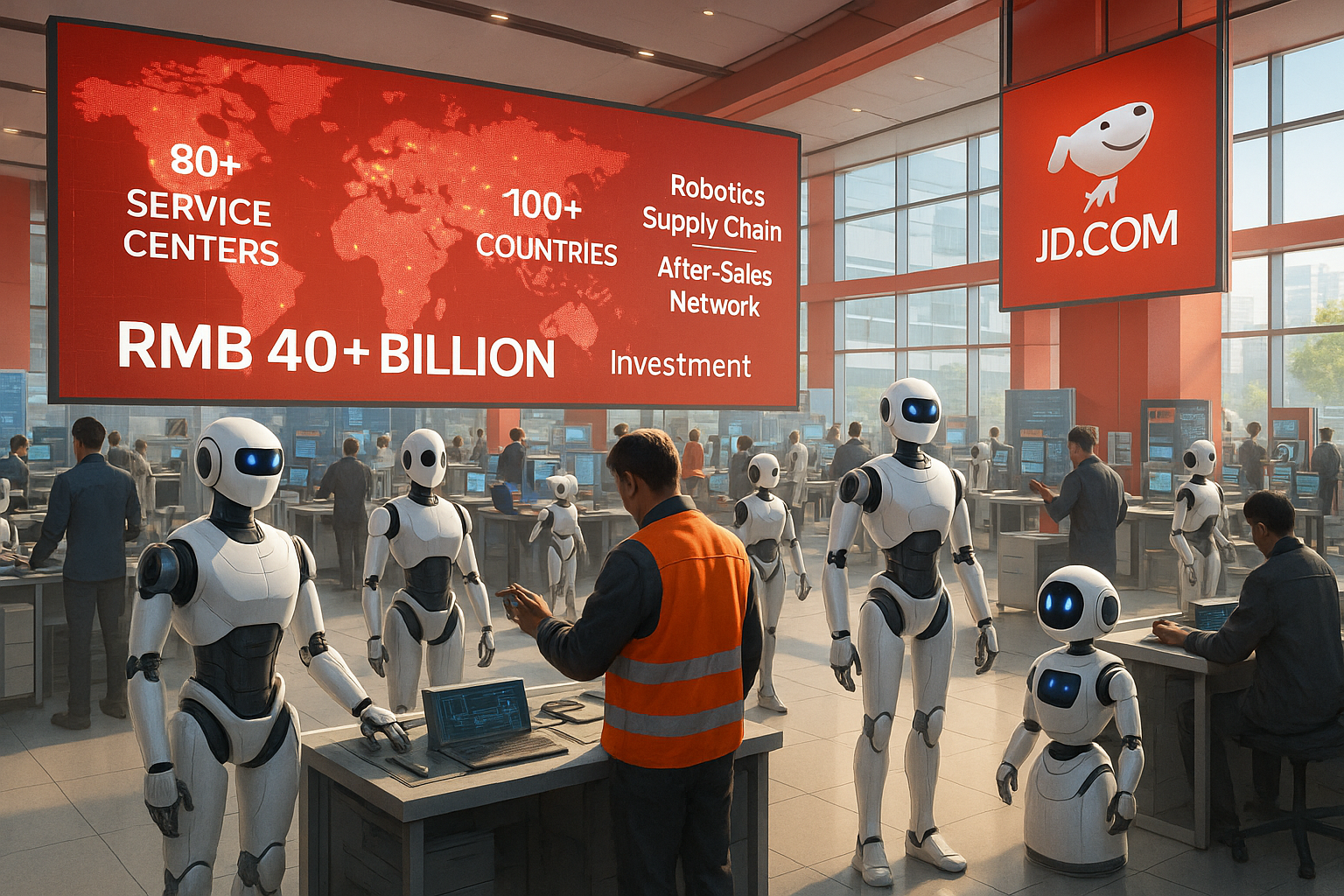
JD.com is betting big on global robot domination, investing RMB 10 billion to turn fragmented prototypes into a standardized, scalable industrial force across 100+ countries.
What to know
- JD.com will build 80 RoboBase centers and hire 100,000 engineers to power robot deployment worldwide.
- By integrating over 200 robotics brands into a single ecosystem, JD.com aims to crush industry fragmentation and accelerate commercialization.
- China leads the pack, shipping 97% of humanoid robots and pioneering business models like Robots-as-a-Service to lower adoption barriers.
Building a Global Robot Backbone
JD.com is creating a unified robotics ecosystem by launching 80 global service centers and integrating 200+ brands, bridging the gap between prototypes and scalable, commercial deployments.
JD.com is aggressively building a scalable industrial infrastructure to support the commercialization of robotics, exemplified by its plan to establish 80 RoboBase service centers worldwide. These facilities will offer comprehensive lifecycle services including product display, delivery, repair, maintenance, research, pilot assembly, data collection, manufacturing, and upgrades, creating an integrated platform that bridges the gap between prototype development and large-scale deployment. Complementing this physical infrastructure, JD.com aims to cultivate a global after-sales engineering workforce of over 100,000 professionals within five years, ensuring robust support and service capabilities across more than 100 countries.
Recognizing that the robotics industry is fragmented with scattered capabilities across supply chains, data management, and service operations, JD.com is strategically integrating over 200 robotics brands and component manufacturers into its ecosystem. This consolidation facilitates the transition from isolated product development efforts to standardized, reusable industry infrastructure, which is critical for scaling robotics beyond initial deployments. By organizing these disparate elements into a cohesive system, JD.com aims to overcome the challenges of scaling from laboratory prototypes to commercial operations at scale, addressing the industry's current lack of mature industrial capabilities.
JD.com's vision extends beyond infrastructure to encompass comprehensive support systems such as robot training platforms spanning data and models, component procurement networks, and extensive repair and maintenance services. This holistic approach acknowledges that sustainable robotics commercialization demands not only technological innovation but also mature supply chains, delivery logistics, and after-sales services. As JD.com's leadership candidly notes, while market enthusiasm for robotics is rising, the industry is still at the starting line of true commercialization, underscoring the necessity of building standardized ecosystem components to achieve economies of scale and reduce redundant efforts across the sector.
Automation’s New Business Models
Skyrocketing labor costs and innovative subscription models like Robots-as-a-Service are accelerating robotics adoption, making automation accessible even for sectors with limited technical expertise.
Rising labor costs and persistent shortages in warehouse workforces have accelerated the adoption of robotics to automate physically demanding and repetitive tasks such as loading trucks and picking merchandise for e-commerce fulfillment. With US warehouse wages climbing to an average of $26.85 per hour by mid-2026, companies find automation increasingly justifiable as a means to reduce supply chain costs and improve labor retention in less desirable roles.
To lower barriers for robotics adoption, manufacturers are innovating with flexible business models like Robots as a Service (RaaS), allowing firms to rent robots on subscription rather than purchase them outright. This approach, supported by Chinese government policies offering subsidies and insurance for leasing humanoid robots, enables sectors such as hospitality to outsource technical complexities and scale capacity during peak periods without heavy upfront investments or in-house expertise.
Humanoid robots are being actively piloted in factories and warehouses across China, aiming to integrate seamlessly into human-centric environments without costly retooling. Despite impressive demonstrations of fine motor tasks like sorting parcels and assembling electronics, their commercial viability remains constrained by software reliability, limited battery life, and operational speeds that lag significantly behind human workers. Consequently, while humanoids show promise in niche consumer-facing roles such as pharmacies and hotels, conventional industrial robots and wheeled systems continue to dominate large-scale deployments.
Beyond warehouses, robotics commercialization is advancing in practical, non-humanoid applications including retail food service automation and quadruped robots deployed in construction, mining, and security sectors. Notably, China’s hospitality industry is pioneering fully robot-managed hotels, exemplified by Pudu Robotics’ upcoming 44-room facility on West Island that leverages AI platforms to coordinate multi-robot collaboration for reception, cleaning, and catering. This shift addresses labor shortages and aims to transform tourism infrastructure into a smart ecosystem, though it raises questions about the irreplaceable value of human interaction in service settings.

China’s Robotics Powerhouses
Market consolidation and AI breakthroughs are driving China’s dominance in industrial robotics, with firms like Spirit AI turning theoretical advances into large-scale factory automation.
China's robotics sector is undergoing rapid consolidation, shrinking from over 150 humanoid robot companies to a handful of dominant players as the market matures. While humanoid robots have captured attention, their limited commercial utility compared to specialized forms has driven firms to pivot toward more practical designs like upper torso models that better meet industrial demands.
Chinese firms lead global industrial robot deployment, operating more than half of the world's industrial robots and pioneering 'dark factories' that run with minimal human oversight. This dominance is fueled by demographic pressures such as labor shortages stemming from the one-child policy, compelling factories to automate extensively.
Chinese start-up Spirit AI has emerged as a formidable competitor in embodied AI, surpassing Nvidia on the RoboArena leaderboard with its Spirit v1.6 model and securing a strategic partnership with Bosch China to embed its 'Universal Brain' into large-scale manufacturing and logistics operations. This collaboration marks a critical transition from AI theory to practical industrial deployment, positioning Spirit AI at the forefront of robotics commercialization.
The geopolitical rivalry between the US and China has intensified within embodied AI and robotics, with Chinese companies like Spirit AI closing the gap on sophisticated vision-language-action models and physical autonomous machines. Despite US embargoes on Chinese robots, global supply chains remain deeply interconnected, as components routinely cross borders, underscoring the complex interdependence shaping the robotics landscape.

Humanoids Go Mainstream—China Leads
China commands over 97% of global humanoid robot shipments as new service-based business models and aggressive policy support fuel rapid market growth and leave Western rivals trailing.
The global humanoid robotics market is experiencing explosive growth, with shipments expected to nearly triple to 60,000 units in 2026 and industry revenue reaching approximately $1.6 billion. China overwhelmingly dominates this expansion, accounting for over 97% of shipments in the first half of 2026 and more than 85% of global demand, driven by aggressive industrial policies targeting large-scale deployments in over 100 high-value scenarios. Chinese companies like AGIBOT have surged ahead to become the world’s largest vendors, while US firms hold less than 5% market share, underscoring China’s leadership not only in humanoid but also industrial robots, where it boasts the largest installed base globally with over 2 million units.
Emerging business models such as Humanoids-as-a-Service (HaaS) platforms are reshaping robotics commercialization by addressing the non-technical barriers to adoption, including financing, risk, and compliance. Brussels-based Motion exemplifies this trend by offering an AI-powered, OEM-agnostic platform that bundles robot selection, task training, IT integration, fleet management, and compliance into a single predictable monthly fee, enabling manufacturers to deploy humanoid robots without dedicated robotics teams. This approach not only simplifies scaling fleets with adaptive fees and secure data ownership but also aligns with broader European industrial policy goals to enhance manufacturing efficiency and climate technology deployment, as highlighted by venture capital backers like Extantia Capital.