Junior tech jobs shrink as learning debt grows
The gist
AI is gutting junior tech jobs, fracturing talent pipelines and leaving a future leadership gap that no chatbot can fill.
What to know
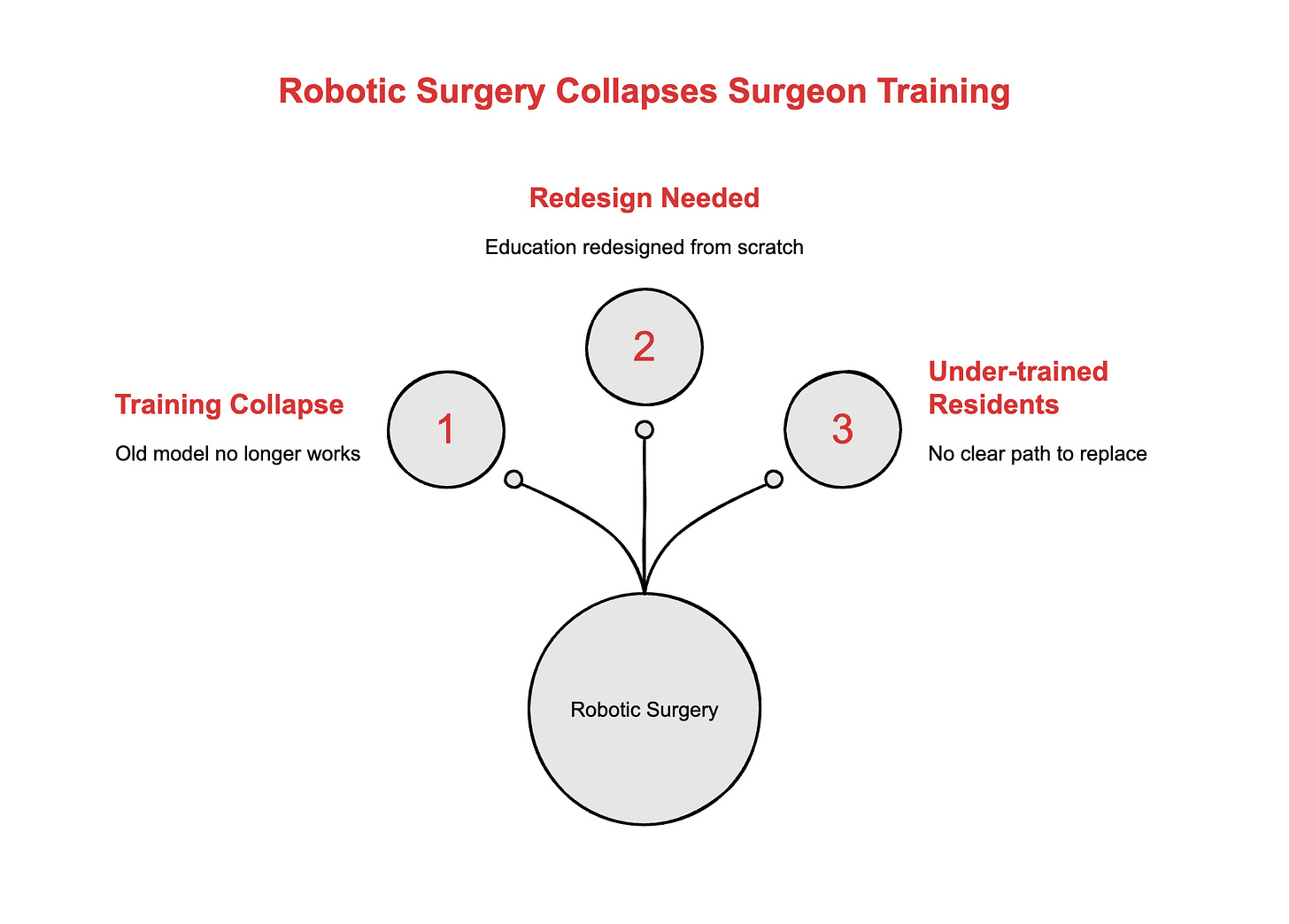
- By late 2025, entry-level tech postings dropped 67% and junior software developer employment fell 20% as AI automation wiped out traditional starter roles.
- Despite heavy AI training, 85% of workers couldn’t apply what they learned, fueling a ‘learning debt’ where nearly half admit hiding knowledge gaps.
- Leadership is scrambling—half of C-suite leaders lack clarity on future skills, while critical human roles like expert data labelers remain undervalued and precarious.
The Broken Talent Ladder
AI-driven automation is erasing entry-level roles, breaking the cycle of mentorship and hands-on learning that once created future experts and threatening the very foundation of tech’s senior talent pipeline.
By late 2025, AI automation—especially through large language models—began eliminating traditional entry-level roles such as quality assurance agents and junior software developers, creating a 'weird equilibrium' where experienced staff manage AI agents but new junior hires are scarce. This shift disrupts the organic talent pipeline, as companies halt hiring new graduates despite investing heavily in training, leading to a looming 'talent debt' that threatens the cultivation of future senior expertise. Analysts warn that without juniors gaining hands-on experience, the pool of experts needed to train and improve AI systems will shrink, potentially stalling AI innovation itself.
By the end of 2025 and into 2026, data revealed a sharp decline in junior hiring across AI-exposed fields: Stanford reported a nearly 20% drop in software developer employment aged 22-25 since 2022, while entry-level tech postings plummeted 67%. This contraction is not merely a short-term cost saving but a structural risk, as the loss of junior roles removes critical experiential learning opportunities—stretch assignments, stakeholder interactions, and low-stakes failures—that build judgment and leadership skills essential for future senior roles. Wharton researchers and industry leaders alike caution that this pipeline break will manifest visibly within a few years, creating a shallow leadership bench and a mid-level talent gap by 2028-2029.
The paradox of AI reliance deepens as juniors initially benefit from AI tools that boost productivity and accelerate learning, but ultimately face job elimination when AI attains sufficient autonomy to perform their tasks independently. This dynamic results in faster output but shallower understanding, as junior engineers often lack the domain knowledge to effectively guide or validate AI outputs, leading to frustration and inefficiency. Senior engineers increasingly absorb tasks once delegated to juniors, further narrowing growth opportunities and exacerbating the talent pipeline crisis. Experts emphasize that without deliberate redesign of apprenticeship models—shifting from repetitive task execution to structured exposure to decision-making and human-AI collaboration—the development of critical judgment and expertise will falter.
By mid-2026, the consequences of cutting junior roles are evident beyond tech, with professions like paralegal work experiencing a bifurcation: junior paralegal salaries dropped 10–15% amid reduced hiring, while senior associates augmented by AI enjoy 20–30% pay increases. This 'missing rung' in the talent ladder threatens the future development of expertise, as foundational training tasks vanish and firms prioritize maintaining margins with smaller, senior-heavy teams. HR leaders and analysts advocate for urgent strategic responses, including skill-based hiring, cross-organizational ecosystems, and mentoring frameworks that preserve human judgment and emotional intelligence—capabilities AI cannot replicate—to rebuild early career pipelines and sustain long-term organizational adaptability.




Learning Debt Deepens
Despite massive investment in AI training, most workers can’t use what they’ve learned on the job, fueling hidden skill gaps and undermining productivity as AI outpaces traditional workforce development.
Rapid AI adoption has paradoxically both enhanced and undermined workforce readiness, particularly for junior roles. A Stanford economist’s field experiment demonstrated that AI tools initially boost junior customer service agents’ productivity and learning speed, yet aggregate data from 62 million workers reveal a sharp decline in junior employment as AI automates many entry-level tasks. This 'seniority-biased technological change,' detailed by Lichtinger and Maasoum, disrupts the traditional training ladder by reducing hiring and on-the-job learning opportunities critical for developing future senior expertise, risking a long-term shortage of qualified professionals to supervise AI systems.
Despite widespread AI training initiatives, a significant disconnect persists between learning and practical application, fueling a growing 'learning debt' that threatens productivity and quality. By mid-2026, surveys showed that 85% of workers could not relate AI training to their actual job roles, with 78% reporting that training occurs in systems disconnected from their daily work environments. Compounding this, 56% of employees felt overwhelmed by manual pre-AI tasks, leaving little time to engage meaningfully with AI tools designed to alleviate their workload. TalentLMS CEO Dimitris Tsingos warns that this rush to deploy AI tools without adequately building workforce capabilities masks skill gaps and risks a decline in work quality and organizational knowledge.
The rapid pace of AI-driven role evolution outstrips formal training programs, forcing employees to rely heavily on informal, on-the-job learning that often falls short of developing robust skills. By June 2026, 53% of workers reported learning new skills by trial and error at work, while 44% admitted that work priorities frequently sidelined learning. This dynamic fosters a hidden 'learning debt' where employees deliver work they cannot fully explain—29% confessed to this—and 47% remain silent about their knowledge gaps to avoid appearing incompetent. Such reliance on AI-generated outputs, which can be error-prone and low-quality, accelerates 'knowledge decay' and forces managers into labor-intensive verification processes, further straining workforce readiness.
Addressing AI skill gaps requires a holistic, integrated approach that transcends piecemeal training and acknowledges diverse employee readiness levels. Experts emphasize the need for training that builds understanding, comfort, and ethical use of AI, rather than simply adapting to rapidly evolving tools that risk obsolescence by the time they are deployed. Embedding learning into workflows with targeted, just-in-time training and fostering a culture that treats skill gaps as learning opportunities—not failures—can mitigate the hidden 'learning debt.' Moreover, emerging strategies like returnship programs and enhanced managerial change management skills are critical to closing the AI readiness gap and ensuring sustainable workforce productivity in an era where talent scarcity and human-machine collaboration dominate strategic priorities.





Leadership’s AI Blind Spots
AI adoption is exposing the cracks in organizational decision-making, forcing leaders to confront unclear roles, tacit authority, and the urgent need for explicit systems to manage complex human-AI collaboration.
By early 2026, AI integration was revealing how much organizational coherence had previously relied on informal authority, tacit understanding, and personal influence rather than explicit systems. As noted in January analyses, AI does not merely extend existing structures but exposes hidden gaps, demanding tailored leadership approaches that address the specific coordination challenges inherent to each leadership role. Techniques such as decision provenance mapping and assumption walkthroughs emerged as vital tools to enhance collective legibility and shared context in increasingly complex AI-driven environments.
The rapid acceleration of AI-driven outputs strained traditional decision-making frameworks, exposing unclear decision rights and diffuse accountability that leadership had not fully anticipated. Organizations found that roles once governed by tacit authority became bottlenecks as decisions arrived faster than consensus could form, leading to risks being escalated without clear human ownership—as exemplified by unstaffed 'Responsible DRI' roles. This visibility of authority gaps underscored the urgent need for leaders to redefine decision rights and embrace new capabilities to navigate ambiguity, stand behind AI-influenced decisions, and design deliberate coordination and accountability systems.
AI adoption also disrupted traditional organizational learning pathways by automating junior roles that historically served as critical exposure points for developing judgment and tacit knowledge. Without intentional redesign, this erosion threatens long-term adaptive capacity. Forward-thinking organizations are shifting from accidental apprenticeship models to structured learning architectures that provide transparent escalation logic and explicit responsibility, thereby building resilience and sustaining leadership maturity amid AI-driven transformation.
A persistent leadership misalignment between CEOs and CTOs emerged as a key source of AI-driven workplace toxicity and cultural divides. While CEOs often celebrated accelerated output, CTOs confronted increased complexity, security risks, and burnout, leading to engineers feeling gaslit and leadership perceiving resistance. This disconnect highlighted that mature AI adoption challenges are less about tooling and more about leadership maturity, requiring honest engagement with the tensions AI introduces and a shift from operational stability toward transformation leadership focused on learning velocity and controlled experimentation.
By mid-2026, research underscored a widening gap between AI adoption pace and workforce strategy, with half of surveyed C-suite leaders lacking clarity on future skills and roles needed. Experts like Carolyn Dewar of McKinsey emphasized that traditional execution disciplines are inadequate for AI-driven uncertainty, urging leaders to develop judgment, strategic imagination, and adaptability. Leaders such as Mark Lobosco stressed the importance of firsthand AI experience to build credibility, while Okta’s Eric Kelleher highlighted the necessity of redesigning workflows and decision rights around human-digital collaboration rather than layering AI onto legacy structures.
The McKinsey 7S model crystallizes the multifaceted leadership challenge in AI integration, showing that misalignments across strategy, structure, systems, skills, staff, style, and shared values collectively undermine adoption efforts. As Lindy Greer, Jennifer Jordan, and Maxim Sytch point out, clear decision rights are crucial to prevent confusion and accelerate execution, especially in complex matrixed organizations. Meanwhile, thought leaders like Melissa George and Rositsa Genovska advocate embracing ambiguity and cultivating curiosity and courage, recognizing that AI leadership demands ongoing adaptive tension management rather than neat solutions.


The Human Backbone of AI
Expert data labelers—essential for AI breakthroughs—face precarious, undervalued work conditions, revealing the ethical contradictions at the heart of the AI industry’s rapid progress.
By early 2026, expert data labelers emerged as vital yet undervalued contributors to AI advancement, performing intricate tasks such as correcting reasoning traces in mathematical problem-solving models—a process crucial to breakthroughs like gold medals at the 2025 IMO. Despite earning advertised rates of $50 per hour, workers like 'R' often faced precarious conditions, including unpaid labor due to task structures, highlighting a troubling ethical paradox where the AI industry simultaneously depends on and undermines its human workforce.
The ethical challenges surrounding AI labor practices became increasingly apparent as these expert workers experienced gig-like precarity, with pay disparities such as receiving half rates for reviewing prompts and no compensation if models responded too quickly. This scenario underscores the absurdity of an industry engineering its own obsolescence while relying heavily on human expertise, calling for urgent recognition and protection of these indispensable roles amid automation pressures.
By mid-2026, thought leaders like Zain emphasized that certain human roles—expert data labeling, evaluation, and forward-deployed engineering—constitute a permanent moat against full automation, with major players like OpenAI, Anthropic, xAI, and Google investing real money to pay professionals such as surgeons, lawyers, and PhDs for these tasks. This strategic insight led to recommendations for organizations to categorize roles into those replaced by AI, augmented by AI, and permanently human, urging firms to develop transition plans within six months for roles at risk of displacement to safeguard critical human contributions during AI integration.


Rethinking Apprenticeship for AI
Replacing juniors with AI may save costs short-term, but only structured, AI-enhanced apprenticeship preserves tacit knowledge and ensures organizations don’t pay a steep price in lost expertise later.
By early 2026, financial analyses underscored the pitfalls of replacing junior roles entirely with AI, highlighting the hidden long-term costs such as loss of tacit knowledge and increased replacement expenses that often outweigh immediate savings. The concept of a 'new guild' of AI-enhanced apprenticeship emerged as a sustainable alternative, advocating for structured learning pathways where juniors handle foundational tasks and receive informal knowledge transfer, thereby preserving workforce resilience and enabling continuous role reinvention despite higher upfront investments.
The rapid evolution of AI technologies demands a fundamental redesign of learning pathways, moving away from traditional linear models toward continuous learning and deliberate role reinvention. With entry-level engineering positions dropping 67% since 2022 and AI automating routine tasks that once served as critical training grounds, organizations face a mentorship vacuum as managers are stretched thin or cut, necessitating new approaches that emphasize judgment-building, social pairing, and apprenticeship to cultivate the nuanced skills AI cannot replicate.
Sustainable human-AI collaboration hinges on fostering a symbiotic relationship where junior employees’ technological fluency complements experienced staff’s contextual judgment, as premature reliance on AI risks creating 'development debt'—a workforce proficient in generating but not critically evaluating AI outputs. Experts urge organizations to slow AI adoption to thoughtfully redesign work, clarifying human-AI boundaries in roles and investing in mentorship and breathing room for juniors to use AI as a booster rather than a replacement, thus maintaining essential skills and relational knowledge.
To keep pace with AI’s exponential advancement, companies like QuantHub emphasize the necessity of rapidly refreshing curricula every six months and investing heavily in educator training across all levels. Complementing this, HR leaders are urged to redesign early career pipelines around skill-based advancement and cross-organizational ecosystems that promote continuous role reinvention, critical thinking, and emotional intelligence—qualities AI cannot replicate. Engaging leaders and learners in hands-on AI experiences, as demonstrated in six-week boot camps using tools like Claude, fosters a culture where AI augments rather than diminishes human work, empowering employees to own workflows and adapt fluidly to evolving AI capabilities.



Mandates Without Meaning
A disconnect between executive AI ambitions and front-line realities is fueling confusion, low-quality work, and mistrust—leaving employees adrift without clear guidance or credible leadership.
By early 2026, a glaring disconnect emerged between leadership's AI adoption mandates and employees' ability to effectively integrate AI into their daily work. Despite high training attendance, as Kate Niederhoffer and Jeff Hancock observed, the absence of clear guidelines and role definitions led to widespread 'workslop'—low-quality AI output that undermined team morale and efficiency. This gap was exacerbated by the 'curse of knowledge,' where leaders assumed their AI vision was self-evident, leaving employees confused about responsibilities and success metrics, resulting in vague mandates that felt more like abandonment than empowerment.
By mid-2026, surveys revealed that 85% of workers struggled to connect AI training to their actual job roles, with 56% overwhelmed by manual tasks that left no time to learn AI tools, and 78% receiving training disconnected from their work environments. This misalignment highlighted a systemic failure to tailor AI readiness programs to diverse employee needs and workflows, as organizations prioritized rapid AI tool deployment over developing human capabilities. The result was a workforce equipped with AI access but lacking the practical skills and contextual understanding to leverage it effectively.
By July 2026, the trust gap between executives and employees had widened dramatically, with 61% of leaders trusting AI for complex decisions versus only 9% of workers. This chasm fueled resistance rooted not in opposition but in fear of job obsolescence and unclear integration guidance, as Gallup research linked such resistance to loss of control and ambiguous expectations. Industry leaders like Mark Lobosco stressed that effective AI transformation hinges on employees viewing AI as a career growth tool rather than a threat, a shift requiring organizational trust, clear role definitions, and leadership credibility—executives must themselves be proficient with AI to authentically empower their teams.
The rapid proliferation of AI-related roles since 2022 has outpaced organizational clarity, with 82% of C-suite leaders acknowledging uncertainty about future workforce structures. Traditional management approaches, focused on optimizing human headcount rather than orchestrating human-digital collaboration, are ill-suited for this new reality, as Okta COO Eric Kelleher noted. This calls for a cultural and organizational redesign that bridges the gap between AI adoption and employee empowerment by embedding tailored, continuous learning, critical thinking development, and holistic training within daily workflows—otherwise, firms risk creating an 'AI underclass' where only a subset of employees are truly AI-enabled.