KelpDAO hack fallout: DeFi’s $13b ‘single point of failure’ crisis sparks security soul-searching
The gist
A single-point-of-failure in KelpDAO’s LayerZero bridge let hackers drain $292 million in rsETH, triggering a $13 billion DeFi liquidity crisis and forcing the entire ecosystem to confront its weakest security links.
What to know
- Attackers exploited KelpDAO’s 1-of-1 LayerZero bridge verifier—despite repeated warnings—by poisoning RPC nodes and faking cross-chain deposits, stealing $292 million in rsETH in under an hour.
- The hack saddled Aave with $293 million in bad debt, maxed out lending pools, and sparked over $8 billion in rapid depositor withdrawals as confidence in restaking tokens evaporated.
- Emergency actions like Arbitrum’s Security Council freezing $71 million in stolen funds fueled fierce debates over decentralization versus safety, exposing how nearly half of Omnichain Apps rely on dangerously fragile bridge setups.
A Billion at One’s Mercy
KelpDAO’s decision to entrust over a billion dollars to a single LayerZero verifier, despite industry warnings, handed attackers a devastating one-click exploit that erased all lines of defense in under an hour.
The KelpDAO exploit starkly exposed the critical vulnerability inherent in LayerZero's single-verifier bridge architecture, which relied on a 1-of-1 signature scheme—a single point of failure where only one Distributed Validator Network (DVN) node was responsible for authenticating cross-chain messages. Despite LayerZero's repeated warnings that this baseline setup was risky, KelpDAO opted for this minimal configuration, entrusting over a billion dollars in client deposits to a single verifier. As one analyst put it, "Kelp with over a billion in client deposits... can do better than a one of one," underscoring how this design choice left the system dangerously exposed.
Attackers exploited this fragile setup by first compromising the verifier’s data sources through poisoning two RPC nodes and launching a DDoS attack on fallback nodes, effectively forcing the verifier to rely solely on malicious inputs. This sophisticated attack vector allowed the hackers to fabricate cross-chain deposit events on the source chain, which the single verifier then erroneously validated, triggering the unauthorized release of 116,500 rsETH—approximately 18% of the circulating supply—in a single transaction worth $292 million. The bridge, operating exactly as designed, "approved a lie," highlighting the dangers of lacking independent validation layers.
The entire exploit unfolded with alarming speed and precision, completing within 46 minutes before the attackers destroyed their software to erase forensic traces, complicating investigation efforts. This rapid execution was facilitated by the single-verifier model’s inability to detect or halt fraudulent messages once the verifier’s data sources were compromised. The attack sequence—saturating the legitimate verifier with thousands of fake calls to overwhelm it, then impersonating it to send forged withdrawal instructions—demonstrates how the single point of failure was weaponized to devastating effect.
Beyond KelpDAO, this exploit illuminated a systemic risk across the DeFi ecosystem, as nearly 40-45% of Omnichain Apps and OFT deployments similarly employed the vulnerable 1-of-1 verifier configuration. This widespread reliance on single-verifier bridges without multi-signature safeguards or independent validation layers signals a pervasive exposure to analogous exploits, raising urgent questions about the operational security standards and default configurations promoted within LayerZero’s protocol and the broader cross-chain infrastructure landscape.




Aave’s Cascading Contagion
The exploit’s unbacked collateral triggered a $293 million black hole in Aave, exposing how DeFi’s interconnected risk pools and weak validation rapidly turned one protocol’s failure into a systemic liquidity crisis.
The KelpDAO exploit precipitated a severe financial shock to Aave, generating approximately $293 million in bad debt as attackers used unbacked rsETH collateral to borrow real assets like wrapped ETH. This led to a liquidity crisis with Aave’s core lending pools, including USDT, USDC, and WETH, reaching 100% utilization and depositors withdrawing over $8 billion in just days, reflecting a rapid erosion of confidence in bridged and liquid restaking tokens. As detailed by multiple analyses, including Shaunda Devens’ breakdown of Aave’s unified pool design, the concentration of risk in a monolithic collateral pool amplified the exploit’s financial impact, underscoring critical vulnerabilities in collateral validation and risk isolation within DeFi lending protocols.
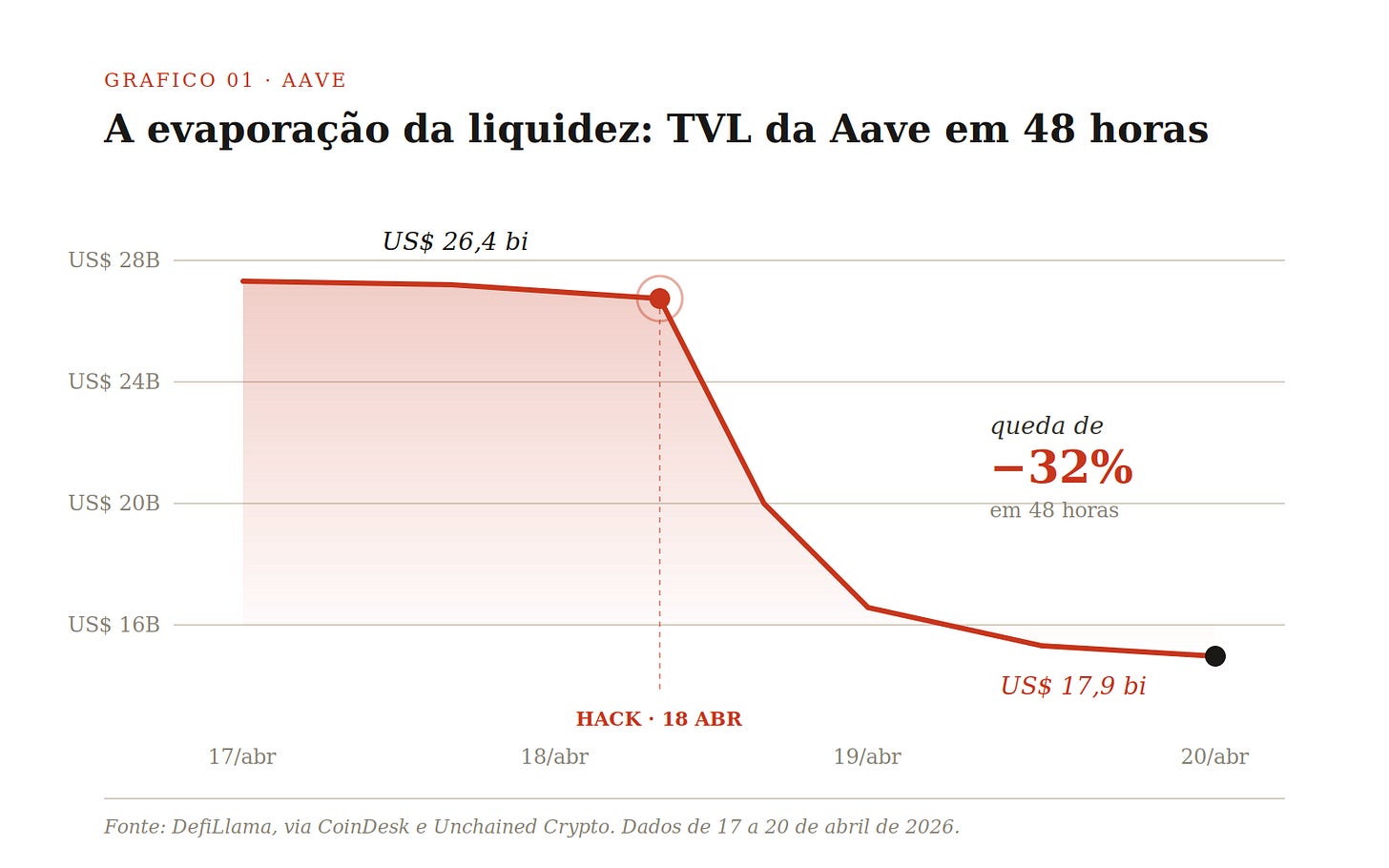
Beyond Aave, the exploit triggered a systemic liquidity crunch across the DeFi ecosystem, with total value locked (TVL) dropping more than 12%—over $13 billion—within two days as investors fled amid fears of composability risks and collateral mispricing. Protocols like Lido, Morpho, Spark, and Solana’s Kamino experienced parallel liquidity stresses, with Kamino’s USDC pool also hitting full utilization, illustrating that the crisis transcended Ethereum and exposed the fragility of interconnected DeFi architectures reliant on complex restaking tokens and cross-chain bridges. This contagion effect revealed how a single compromised verifier in LayerZero’s cross-chain bridge could cascade through multiple layers of DeFi, draining liquidity far beyond the initial exploit.
Aave now confronts a governance and risk management dilemma: whether to impose losses on WETH depositors or socialize the $140 million shortfall through its Safety Module, which currently holds only about $50 million in collateral. This predicament highlights the limitations of existing DeFi safety nets and the challenges of managing second-order risks inherited from centralized collateral protocols like KelpDAO, which lacks decentralized governance. As noted by analysts, this situation underscores the broader systemic risk embedded in DeFi’s composability and the urgent need for improved risk frameworks, capital buffers, and faster crisis response mechanisms, especially given that yield innovation continues to outpace risk management capabilities.
The KelpDAO exploit starkly illustrates that DeFi’s architectural complexity is outstripping its risk management frameworks, with mispriced collateral and insufficient safeguards around oracle valuations and restaking logic creating hidden systemic vulnerabilities. Investors must now move beyond simply understanding yield sources to scrutinizing the underlying assumptions enabling that yield, as failures like LayerZero’s permissive default settings and Aave’s failure to flag risky collateral demonstrate how interconnected protocol dependencies can transform a single-point failure into a cascading financial crisis. This event serves as a cautionary tale that even ‘blue-chip’ protocols like Aave are not immune to the systemic contagion risks inherent in DeFi’s composability.





Market Panic and Flight
The hack unleashed a chain reaction of panic withdrawals and frozen lending pools, shattering confidence in DeFi yields and pushing billions in capital to traditional finance as borrowing rates soared overnight.
The KelpDAO exploit triggered a swift and severe market upheaval, with Aave's token price plummeting 16% and its total value locked (TVL) shrinking by over 21%, translating to an $8.45 billion deposit loss within 48 hours. This shockwave rippled through the broader DeFi ecosystem, causing a 12-13% drop in total DeFi TVL—approximately $13 billion—and sparking cascading freezes across multiple protocols, notably in USDT, USDC, and WETH lending pools which reached full utilization, trapping depositors and fueling panic withdrawals.
Investor confidence in DeFi yields and bridged assets took a significant hit as the exploit exposed vulnerabilities in liquid restaking tokens and collateral practices. High-net-worth individuals began reallocating funds from DeFi to traditional banking institutions offering safer yields, with some opting for Swiss banks yielding 6%, underscoring a growing risk aversion. This capital flight, exceeding $13 billion, was exacerbated by panic-driven behaviors such as trapped lenders resorting to max-borrowing other assets, thereby amplifying systemic liquidity spirals and borrowing rates—WETH borrowing surged to 8%, and stablecoins spiked from 3.4% to 14%.
The crisis intensified scrutiny on DeFi security protocols, particularly the reliance on one-on-one multisignature wallets, prompting projects like LayerZero to abandon such single-signer setups to mitigate future risks. Market sentiment grew increasingly skeptical about DeFi's safety, with ongoing debates highlighting a divide between protocols capable of absorbing shocks and those likely to generate systemic risks. This cautious stance was reflected in frozen markets for tokens like rsETH, with platforms such as SparkLend and Fluid halting operations, and Lido pausing deposits into its EarnETH product due to exposure concerns.
Following containment efforts, Aave's token price rebounded, signaling market approval and a perception of operational maturity in crisis management. However, broader DeFi sentiment remained cautious, especially regarding restaking protocols, as the community grappled with balancing decentralization against security. The emergency intervention by Arbitrum’s Security Council to freeze $71 million in exploiter funds sparked a polarized debate—Curve Finance founder Michael Egorov warned of dangerous precedents, while security researcher Taylor Monahan lauded the decisive action—highlighting the complex governance challenges in navigating DeFi crises.
Decentralization Versus Survival
Emergency freezes and high-stakes governance battles have forced DeFi to confront whether centralized interventions and socialized losses are the only way to survive catastrophic bridge failures.
In the immediate aftermath of the KelpDAO exploit, governance bodies like Arbitrum’s Security Council took unprecedented emergency measures, including a 9/12 supermajority vote to freeze approximately $71 million in stolen ETH. This decisive intervention, while effective in halting further fund movement, ignited a heated debate within the DeFi community about the tension between decentralization ideals and pragmatic security needs, as such centralized governance actions challenge the immutability ethos foundational to blockchain technology. The systemic nature of the vulnerability—affecting 47% of LayerZero applications using the same insecure single-verifier bridge configuration—further complicated these governance decisions, underscoring the urgent need for robust risk management frameworks across interconnected protocols.
Resolution efforts have been mired in complex liability debates among LayerZero, KelpDAO, and Aave, with each party deflecting responsibility amid what some describe as a 'Mexican standoff' of legal posturing. While LayerZero’s default insecure configurations and KelpDAO’s undercapitalization are acknowledged weaknesses, Aave, as the lending protocol operator closest to user funds, faces mounting pressure to absorb losses and implement stronger risk controls. This has sparked intense governance discussions on whether to socialize losses uniformly across all RS ETH holders or isolate them to affected Layer 2 users, with scenarios ranging from a modest 1.54% loss on Ethereum mainnet lenders to a staggering 71% loss on Mantle users. These debates highlight the difficulty of balancing user protection, decentralization, and accountability in a rapidly evolving DeFi landscape.
Amidst the fallout, community-driven initiatives like DeFi United, spearheaded by Aave founder Stani Kulechov, have mobilized significant fundraising efforts—garnering contributions such as 25,000 ETH from Aave and 5,000 ETH each from EtherFi and Stani personally—to stabilize the ecosystem and support affected users. These coordinated efforts, alongside ongoing collaboration with governance bodies like the Arbitrum Security Council to recover frozen assets, illustrate a multi-layered approach to crisis resolution that blends centralized intervention with decentralized community action. However, conditional pledges, such as Lido’s offer to donate 2,500 ETH only if the community meets a 116,500 ETH fundraising target, reveal the complexities and negotiations inherent in socializing losses while striving to uphold decentralization principles.
The KelpDAO exploit has catalyzed broader governance debates about the fundamental trade-offs between decentralization and security, with many voices calling for enhanced safeguards like rate limiting, transfer delays, and more rigorous risk assessments to prevent rapid cascading failures in DeFi protocols. As Jack Hirsch notes, the incident 'opens a bunch of philosophical questions about what decentralized finance actually means,' emphasizing that assumptions made for efficiency and competitive advantage can align to create systemic vulnerabilities. Moving forward, protocols like Aave are expected to adopt stricter risk mitigation measures, setting new industry norms that reconcile user trust, protocol immutability, and pragmatic governance intervention in a complex, interconnected DeFi ecosystem.
