Kennedy’s vaccine cuts blamed as measles deaths spark fury
The gist
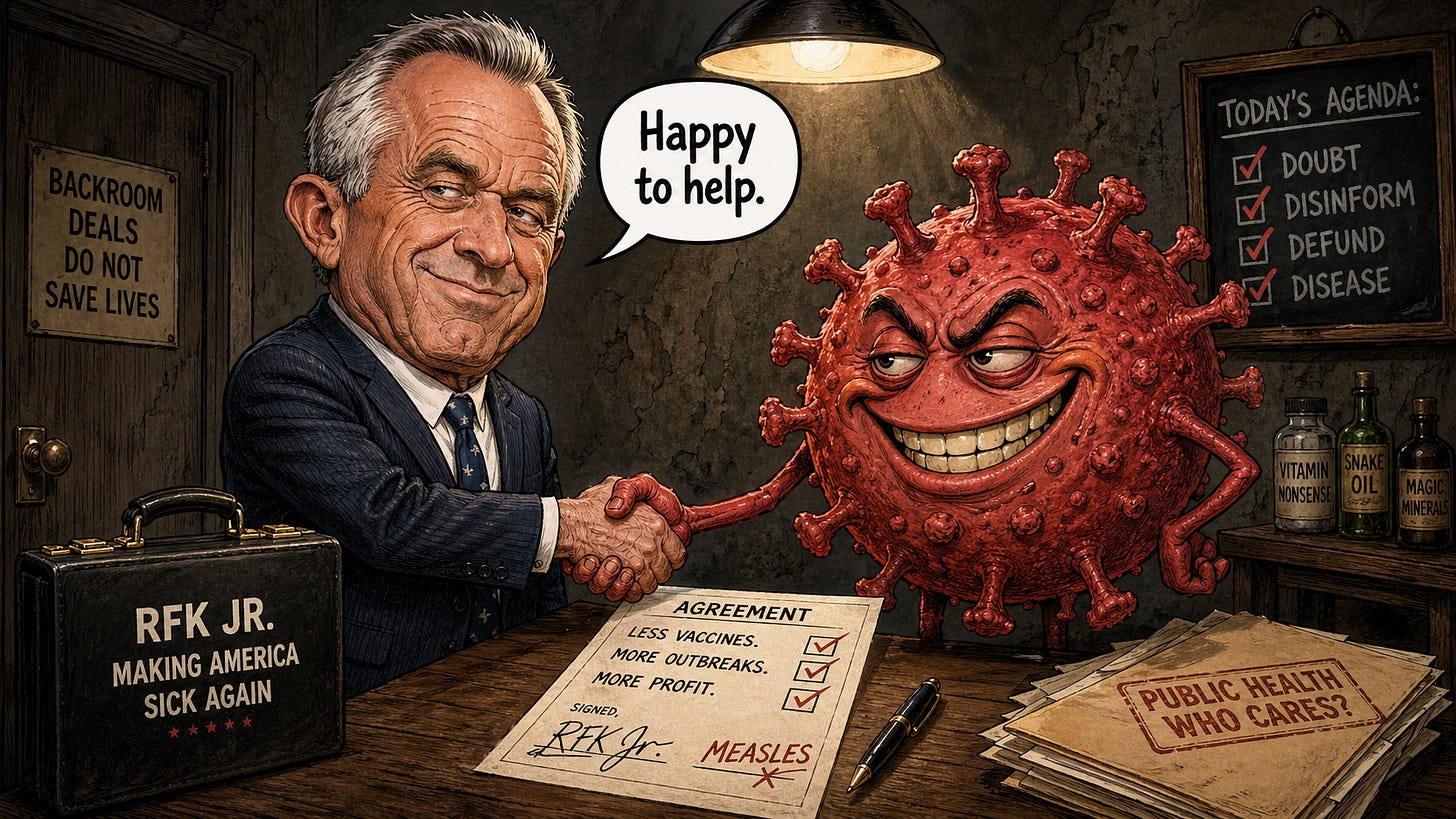
Measles deaths are surging and blame is landing squarely on Kennedy’s vaccine cuts and anti-mRNA messaging.
What to know
- RFK Jr.'s HHS axed 22 mRNA vaccine projects worth $500 million in August 2025, halting federal investment in the platform.
- U.S. measles cases hit a 35-year high in 2026—2,295 confirmed—after childhood MMR coverage slid from 95.2% to 92.5%.
- Two unvaccinated Pennsylvanians have died and the fallout has ignited a fierce debate as Kennedy claimed the deaths were 'Possibly Fabricated.'
A Historic Policy Reversal
Kennedy’s abrupt shutdown of mRNA vaccine funding broke with years of bipartisan investment, weaponizing health policy against scientific evidence just as new data affirmed mRNA’s effectiveness.
Before the rollback, the federal baseline ran in the opposite direction: in May 2020, the Trump administration launched Operation Warp Speed, an HHS-Defense Department partnership that poured large-scale support into vaccine development, including mRNA platforms, and by November 2020 BARDA had committed $10.8 billion to seven manufacturers. That matters because it shows Kennedy was not merely trimming a marginal program; he was reversing an established federal strategy when HHS on Aug. 5, 2025 killed 22 mRNA vaccine development projects worth roughly $500 million and ordered a halt to federal investment in the platform.
STAT News reported that Kennedy paired that rollback with explicit public claims that mRNA technology posed more risks than benefits and could prolong pandemics, turning a budget decision into a broader anti-vaccine message from the country’s top health official. The timing sharpened the rupture: five weeks before Kennedy abandoned mRNA research, Moderna had reported Phase 3 influenza results in 40,805 adults on June 30, 2025, meaning his assertion that mRNA fails against influenza came 36 days after data showing the opposite, a pattern later underlined when the FDA approved mFlusiva on Aug. 6, 2026 after a unanimous advisory vote on its benefits.

Confidence Crisis Fuels Outbreak
A sharp drop in public trust and immunization rates directly triggered the record measles surge, turning preventable illness into a costly, system-wide public health breakdown.
The record outbreak is best understood not as a freak epidemiological event but as the measurable result of trust collapse and weakened immunization. Geddry’s Newsletter captured the mechanism early: “The United States recorded more than two thousand confirmed measles cases in 2025… By the middle of April 2026, it had already recorded well over a thousand more,” while CDC figures later showed national MMR coverage among kindergartners fell from 95.2% in 2019-2020 to 92.5% in 2024-2025, leaving roughly 286,000 kindergartners without protection and pushing coverage below the level experts say is needed to stop outbreaks, even though measles is entirely preventable with the MMR shot and two doses are 97 percent effective in preventing a measles infection.
That erosion in confidence translated directly into who got sick and how costly containment became. CDC data showed that as of July 17, 93% of confirmed cases involved people who were unvaccinated or had unknown status; by July 21, the U.S. had recorded 2,295 confirmed measles cases in 2026, the highest caseload since 1991, and a Yale-linked study estimated outbreaks cost $244.2 million in 2025 alone in medical treatment, public-health containment, and lost productivity—evidence that misinformation and policy disruption were producing both disease spread and system failure, even as officials urged everyone to confirm their immunity and get the vaccine if needed.

Deaths Ignite Political Firestorm
Instead of prompting unity, measles fatalities became flashpoints for misinformation and blame, underscoring how politicized rhetoric deepened the nation’s vulnerability.
The measles resurgence is no longer an abstract epidemiological warning; it has produced documented deaths. STAT News reported that Pennsylvania health authorities announced that two unvaccinated people had died from “measles-associated causes” (reported in a related Stat News piece dated Aug. 25, 2026), and Gov. Josh Shapiro used the moment to draw a direct line between rhetoric and harm, saying at a press conference that “there’s real-life consequences to spreading misinformation.”
What makes the crisis look like a public health failure, rather than a tragic but contained outbreak, is that even the deaths became a site of political dispute instead of a trigger for unified response. On Aug. 26, 2026, the headline states Kennedy called the Pennsylvania infant measles deaths “Possibly Fabricated,” and the text describes him calling Gov. Shapiro as Byline Times summed up the broader toll through Brad Woodhouse’s warning: “What they’ve accomplished is a huge dip in vaccination rates and the worst measles crisis in 35 years.”