Korean crypto power shift: institutions snap up exchange stakes as retail retreats
The gist
South Korea's crypto market is undergoing a seismic power shift as retail investors retreat and heavyweight institutions like Hana Bank and Samsung muscle in to snap up major exchange stakes ahead of new regulations.
What to know
- By early 2026, financial giants including Hana Bank and Samsung affiliates grabbed over 14% equity in top exchanges like Dunamu, signaling an institutional land grab.
- Crypto spot trading volumes plunged from nearly $2 trillion in October 2025 to $679 billion by April 2026—a 48% year-on-year drop in retail activity.
- With custody services gaining regulatory approval but stablecoins and STOs stuck in limbo, institutions are scrambling to dominate Korea's fragmented but fast-evolving digital asset infrastructure.
Altcoin Craze Redefines Market
South Korean crypto traders are shifting from traditional coins to a surge in AI, Layer-2, and meme tokens, spotlighting a new wave of speculative and sector-driven strategies.
By early to mid-2026, South Korea’s leading cryptocurrency exchanges, Upbit and Bithumb, witnessed a pronounced surge in altcoin trading volumes, particularly within AI, Layer-2, and meme coin categories. This upswing was not only broad but also highlighted specific tokens such as XRP, which topped the volume charts alongside others like ONDO and INFINIT, signaling a diversification of investor interest beyond traditional cryptocurrencies. The heightened activity underscores a dynamic shift in South Korean crypto market preferences, reflecting evolving investor strategies and a growing appetite for innovative and niche altcoin projects.
This surge in altcoin trading volumes during May 2026 illustrates a broader transformation in South Korea’s crypto landscape, where investors increasingly pivot towards emerging sectors within the market. The sustained interest in AI-driven tokens, Layer-2 solutions, and meme coins suggests that market participants are not only chasing speculative gains but are also responding to technological advancements and community-driven momentum. As these trends gain traction, they mark a significant evolution in investor behavior, emphasizing a more nuanced and sector-specific approach to cryptocurrency trading in the region.

Liquidity Crunch Hits Hard
A steep drop in spot trading volumes signals not just a retail retreat but a fundamental downturn in market liquidity, challenging Korea’s dominance despite its global ranking.
South Korea's crypto spot trading volumes have experienced a dramatic contraction from late 2025 into 2026, plummeting from a peak near $2 trillion in October 2025 to just $679 billion by April 2026—the lowest monthly figure since October 2023. This steep decline underscores a sharp reduction in market liquidity, signaling a cautious shift among traders amid a grinding bear market that has sapped activity across both spot and futures segments. Despite this downturn, South Korea maintained its status as the world's second-largest cryptocurrency market in early 2024, though it faced a notable 28% drop in spot volumes during Q1, reflecting broader challenges in sustaining trader engagement.
Institutions Race for Control
Korean financial giants are using rapid-fire equity acquisitions in top exchanges to secure licenses, user bases, and regulatory leverage, reshaping the power structure of crypto finance.
By early 2026, major Korean financial institutions such as Hana Bank, Hanwha Investment & Securities, and Samsung affiliates had aggressively acquired significant equity stakes in leading crypto exchanges like Dunamu, with Hana Bank alone securing a 6.55% share for about 1 trillion KRW. This rapid accumulation of ownership stakes within a short span—less than ten days between key acquisitions—signals a strategic institutional shift from mere MOUs to concrete business operations aimed at controlling the digital asset market's future front-end.
These acquisitions are not merely financial investments but tactical moves to indirectly obtain Virtual Asset Service Provider (VASP) licenses, secure user bases, and capture liquidity, positioning institutions to dominate emerging digital asset infrastructure. The competition among banks and securities firms is intensely focused on three core areas—stablecoins, security token offerings (STOs), and custody services—reflecting a multipronged battle to control the foundational pillars of Korea’s evolving crypto finance ecosystem.
Institutional entry into the crypto market is also reshaping the regulatory landscape, as these financial giants strategically stake out favorable arrangements ahead of final regulatory frameworks, effectively influencing policy outcomes. Concurrently, domestic infrastructure builders are gaining prominence by developing Korea-native crypto rails aligned with the Bank of Korea’s CBDC initiatives and tailored regulations, reducing reliance on foreign technology and becoming a new core axis of institutional business.
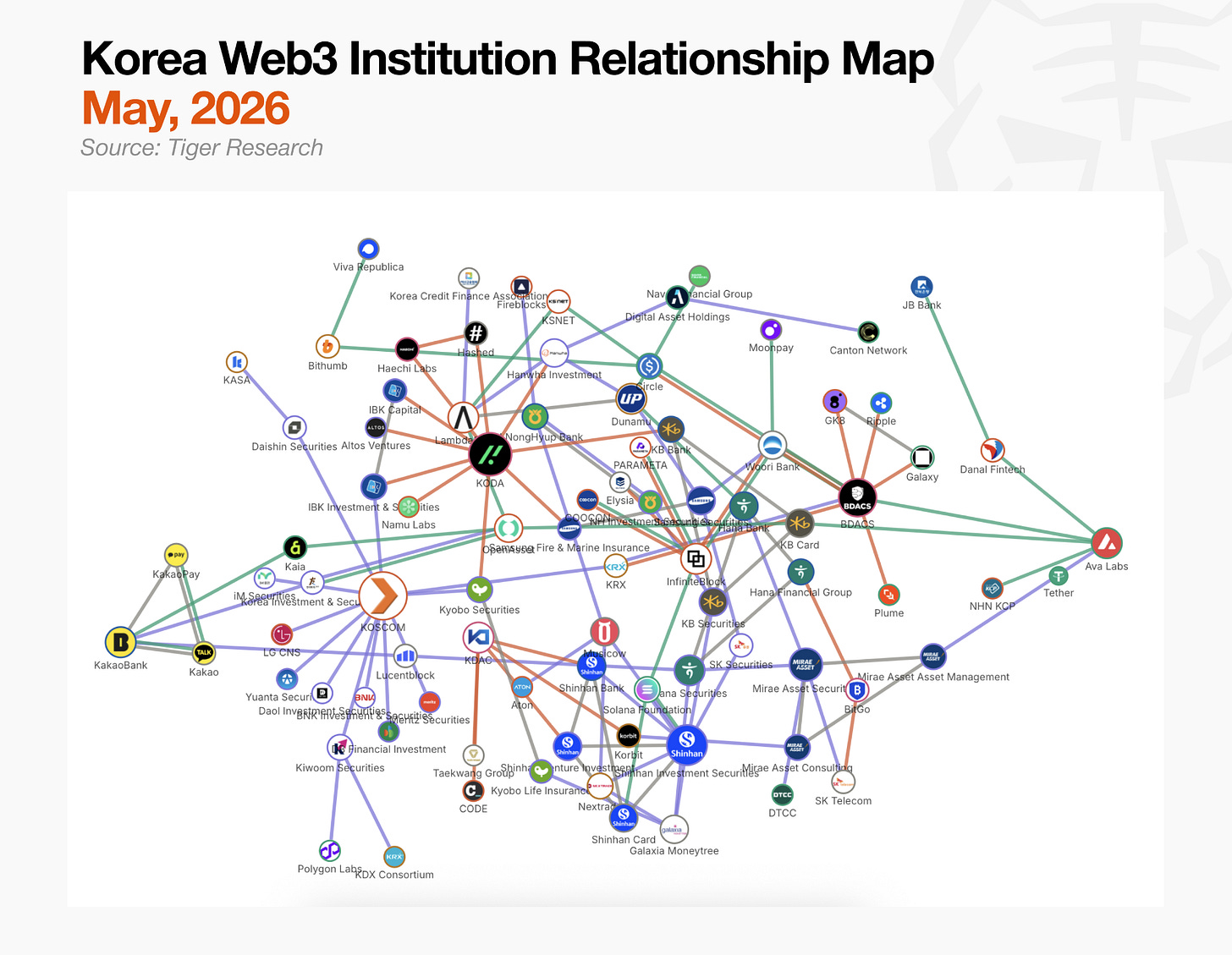
Despite this surge in institutional activity and partnerships—evidenced by Tiger Research’s mapping of 150 institutions and 196 partnerships—the Korean crypto market remains fragmented with no single dominant hub. This fragmentation coincides with a 48% year-on-year decline in retail trading volume, highlighting a clear shift from retail-driven liquidity to institutional dominance and a changing engagement model where overseas crypto foundations now prioritize partnerships with financial institutions and large corporates over retail community meetups.

Regulatory Gridlock Spurs Innovation
Fragmented progress in custody, STOs, and stablecoins is forcing institutions to build alliances and pursue overseas deals, intensifying the race to define Korea’s crypto infrastructure.
By mid-2026, South Korea's regulatory landscape for crypto exhibits stark unevenness: custody services have surged ahead with multiple players operating live under existing frameworks, while real-world assets (RWA) and security token offerings (STO) remain largely stalled at contract or MOU stages pending enabling legislation. Stablecoins face a similar regulatory limbo, lacking a dominant standard operator to steer market leadership. This fragmented progress has shaped a competitive environment where institutions aggressively position themselves across these three fronts—custody, STOs, and stablecoins—seeking to establish foundational dominance before regulations fully crystallize.
In response to regulatory bottlenecks, market participants have adopted divergent strategies: some consolidate domestic alliances to strengthen their foothold while awaiting regulatory clarity, whereas others, like Mirae Asset Securities, bypass domestic delays by pursuing overseas opportunities, exemplified by their digital bond issuance and retail license acquisition in Hong Kong. This dual approach underscores a pragmatic adaptation to Korea's uneven regulatory environment, as players simultaneously fortify local coalitions and carve out alternative pathways abroad.
Institutional players are not merely waiting for regulations but actively shaping the market structure through strategic equity acquisitions and consortium formations. Notably, Hana Bank’s KRW 1 trillion (USD 720 million) purchase of a 6.55% stake in Dunamu, followed by Hanwha Investment Securities and Samsung affiliates acquiring additional shares, signals a fierce race to control digital asset financial front-ends. These moves, coupled with the rise of domestic infrastructure builders developing Korea-native rails aligned with Bank of Korea CBDC frameworks, reflect a market evolving towards institutional dominance and reduced reliance on foreign technology.
The institutional shift and regulatory evolution are expected to be prominently showcased at KBW 2026 in Seoul, where the focus will pivot from token-incentivized community events to substantive business discussions led by traditional finance figures. This transition highlights the maturing Korean crypto market’s adaptation to an uneven regulatory landscape, emphasizing strategic partnerships and infrastructure development over retail-driven hype.
Korea-Native Rails Take Center Stage
Domestic blockchain builders and financial titans are moving to replace foreign tech with homegrown infrastructure, forging new alliances and accelerating institutional dominance.
By early 2026, Korean financial institutions such as Hana Bank, Hanwha Investment & Securities, and Samsung affiliates aggressively acquired significant stakes in domestic crypto exchanges like Dunamu, collectively securing over 14% ownership. This strategic consolidation not only grants them indirect access to VASP licenses but also ensures control over user bases and liquidity, positioning these institutions to dominate the digital asset financial front-end amid ongoing regulatory uncertainty. As one analysis put it, the current 'share acquisition battle' is essentially a contest over who will command Korea's future digital asset finance landscape.
Simultaneously, Korean blockchain firms are spearheading the development of native infrastructure tailored specifically to the Bank of Korea's CBDC framework and stringent local regulations, marking a decisive move away from foreign technology dependence. These domestic infrastructure builders have emerged as a new core pillar of institutional crypto business, constructing Korea-native rails that align with regulatory demands and institutional needs, thereby solidifying the foundation for sustainable growth within the local market.
International partnerships have evolved markedly, with overseas Web3 foundations shifting focus from grassroots retail community building to strategic collaborations with large Korean corporates and financial institutions. This transition accelerates a market restructuring led by traditional finance players, facilitating institutional growth and smoother regulatory compliance. Notably, firms like Mirae Asset Securities have pursued independent overseas strategies by securing digital asset retail licenses in Hong Kong and planning local MTS launches, exemplifying a dual approach of domestic infrastructure development complemented by global standard alignment.
Institutional Era Arrives
With retail sidelined, traditional finance is taking the spotlight—staking claims in exchanges, driving regulatory talks, and turning Korea Blockchain Week into an institutional showcase.
By early 2026, South Korea’s crypto market is undergoing a profound institutional transformation, marked by a nearly 48% year-on-year decline in retail trading volume and a decisive shift toward institutional dominance. This evolution is epitomized by major financial players like Hana Bank acquiring a 6.55% stake in Dunamu for about 1 trillion KRW, followed swiftly by Samsung entities collectively securing 4.0%, signaling a strategic race to control digital asset finance frontends ahead of regulatory finalization. The upcoming Korea Blockchain Week (KBW) 2026 in September will underscore this shift, featuring a speaker lineup dominated by traditional finance figures and emphasizing substantive business dialogue over token-incentivized community events, reflecting the market’s maturation from retail enthusiasm to institutional gravitas.
Institutional competition in South Korea’s crypto space is intensely focused on three critical financial infrastructure sectors: stablecoins, security token offerings (STOs), and custody services. While custody solutions have already gained regulatory approval and operational traction, STOs and real-world asset (RWA) tokenization remain constrained by pending legislation, leaving many players in the MOU or contract phase. Stablecoins, meanwhile, suffer from a lack of a clear market leader, creating a dynamic yet uncertain battleground where institutions jockey for strategic positioning before regulatory clarity emerges.
A notable trend reshaping the institutional landscape is the rise of domestic infrastructure builders who are crafting Korea-native blockchain rails tailored to the Bank of Korea’s Central Bank Digital Currency (CBDC) framework and local regulatory demands. This strategic pivot away from reliance on foreign technology not only enhances national sovereignty over crypto infrastructure but also establishes these domestic builders as pivotal pillars in the evolving institutional ecosystem, further reinforcing South Korea’s competitive edge in the global crypto arena.
Despite the accelerated pace of partnerships, equity acquisitions, and infrastructure development, South Korea’s institutional crypto market remains fragmented and fiercely competitive, with no single entity yet achieving dominant control. Tiger Research’s tracking of 150 institutions and 196 partnerships illustrates a complex web of alliances and rivalries, setting the stage for a dynamic market environment that will likely crystallize around key milestones such as KBW 2026. This fragmentation ensures that while traditional finance accelerates its market takeover, the ultimate market structure remains fluid and open to strategic shifts.