KOSPI plunges into bear market as chip stocks roil global tech
The gist
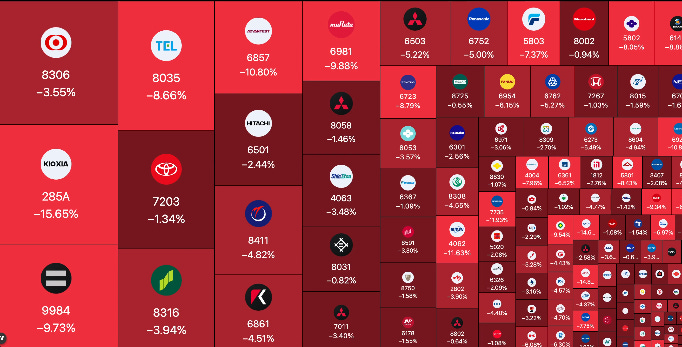
South Korea's KOSPI index has plunged into a bear market, as wild swings in SK Hynix and Samsung ripple across the globe and turn Seoul into the nerve center of AI-driven tech volatility.
What to know
- SK Hynix and Samsung Electronics now make up 66% of KOSPI’s value, and their meltdown has dragged the index down over 20% since June—triggering margin calls on 1.2 million accounts and sparking global tech selloffs.
- SK Hynix’s $26.5 billion Nasdaq IPO and leveraged ETFs have fueled retail trading mania, sending daily stock swings as high as 20% and making the market a hotbed of volatility.
- Despite the chaos, SK Hynix’s 58% global share in high-bandwidth memory and multi-year AI chip deals keep South Korea’s market a must-watch bellwether for global tech—now tightly coupled to Wall Street’s every move.
Semiconductor Selloff Shakes KOSPI
A sentiment-fueled plunge in chip stocks, spurred by AI financing fears and China’s tech advances, has triggered technical signals of deeper losses and global market contagion.
The KOSPI index has plunged into a technical bear market, falling over 20% from its June peak, primarily driven by an intensified selloff in memory-chip stocks such as SK Hynix and Samsung Electronics. SK Hynix experienced its largest one-day drop on record, with Samsung also sinking sharply, collectively accounting for about 66% of the index and exerting outsized pressure on the market. This semiconductor selloff, exacerbated by concerns over AI financing, China’s expanding semiconductor capacity, and valuation resets rather than fundamental demand collapses, has triggered a broader sector correction that is spilling over into global markets, including U.S. chipmakers like Nvidia and AMD.
Despite the severity of the selloff, the downturn appears largely sentiment-driven, reflecting a revaluation and sector rotation rather than a fundamental breakdown in semiconductor demand. Companies like SK Hynix and Micron are attempting to mitigate cyclical volatility by securing multi-year supply deals tied to AI demand, signaling confidence that supply will not catch up with demand soon. However, risks remain, including potential slowdowns in high-bandwidth memory orders and the impact of China's breakthrough in mass-producing deep-ultraviolet lithography machines, which threatens to intensify price competition and accelerate capacity expansion globally.
The concentrated selloff in Samsung and SK Hynix has not only dragged the KOSPI into a bear market but also raised the prospect of further downside, with analysts warning of potential declines of up to 20% or more for these stocks. Technical indicators such as lower lows, lower highs, and a potential head and shoulders pattern suggest a challenging environment ahead, with the KOSPI possibly testing critical support levels near its 200-day EMA around 6,000 to 7,187 points. Failure to reclaim these levels could deepen the semiconductor sector correction and amplify negative sentiment across both South Korean and global equity markets.
The semiconductor selloff in South Korea has triggered a regional contagion effect, with selling pressure shifting to Japan during South Korea’s market holiday and contributing to a $350 billion loss in the Nikkei, which also entered a technical correction. This interconnectedness underscores the global nature of the semiconductor sector correction, as highly correlated trading patterns between South Korean and U.S.-listed chip stocks reveal synchronized declines. Nevertheless, this correction is viewed more as a sector rotation within equities rather than a broad market risk-off event, with major indices like the S&P 500 maintaining relative resilience amid the turmoil.




AI Mania Drives Volatility
SK Hynix’s HBM dominance and blockbuster IPO, combined with South Korea’s aggressive AI expansion, have turned the KOSPI into a rollercoaster of leveraged trades and bullish bets despite wild price swings.
The KOSPI's intermittent rallies and heightened volatility are largely driven by the surging demand for AI-related semiconductor components, particularly high-bandwidth memory (HBM) where SK Hynix holds a commanding 58% global market share. This leadership, underscored by multi-year deals with Nvidia and pioneering shipments of advanced HBM4E samples, positions SK Hynix and Samsung as central beneficiaries of structural AI investment cycles, fueling short-term market surges despite ongoing valuation debates and selloffs.
SK Hynix’s landmark $26.5 billion NASDAQ IPO, which was oversubscribed sevenfold and initially surged 13%, alongside the launch of leveraged ETFs like SKUU and SKDD, has amplified retail investor participation and magnified daily price swings. This dynamic, coupled with South Korea’s massive ₩1,100 trillion AI expansion plan and proprietary packaging innovations like the MR-MUF stacking process, has intensified volatility, making memory packaging yield the critical bottleneck in AI scaling as highlighted by CEO Kwak Noh-jung.
Despite sharp selloffs and margin call-induced corrections—where 1.2 million Korean brokerage accounts faced forced liquidations—analysts and strategists remain bullish on AI-driven semiconductor stocks, citing attractive P/E ratios between 5 and 8 and sustained multi-year AI capex investments. Market watchers like Tom Lee view recent pullbacks as healthy resets that reduce speculation ahead of earnings, suggesting that the AI memory trade is far from over and poised for rebounds later in the year.
The growing dominance of SK Hynix and Samsung, which together constitute about 60% of the KOSPI and roughly 120% of South Korea’s GDP in market cap, has transformed the Korean equity market into a global bellwether for AI and semiconductor sentiment. The KOSPI’s correlation with the Nasdaq 100 has surged to nearly 0.50, reflecting intertwined U.S.-Korean tech fortunes, with fund managers like JPMorgan’s Hani Redha now closely monitoring Korean market moves and SK Hynix ADRs almost around the clock to gauge AI demand trends.



Retail Frenzy Fuels Wild Swings
Leveraged ETFs and surging margin debt have unleashed unprecedented volatility, with millions of retail investors facing forced liquidations as speculative trading amplifies every move in SK Hynix and Samsung.
The SK Hynix Nasdaq IPO, executed through ADRs under the ticker SKHY, has ignited a surge of retail investor activity, fueled further by the immediate introduction of 2x leveraged ETFs like GraniteShares’ SKUU and SKDD. This combination has created a speculative trading environment marked by extreme volatility, with SK Hynix’s stock experiencing daily swings up to 20%, far exceeding volatility seen in Western peers such as Micron and Western Digital. The IPO’s structure, offering U.S. investors access to an already publicly traded Korean stock, alongside cross-market arbitrage opportunities and regulatory nuances, has intensified retail participation but also heightened risk exposure.
Retail-driven leverage has not been confined to SK Hynix alone; even blue-chip giants like Samsung have seen intraday price swings exceeding 5%, signaling an unusual level of market instability. This frenzy is partly attributed to the proliferation of leveraged ETFs and zero-day trading options—dubbed 'push-button liquidity'—which have amplified both rallies and selloffs. The resulting environment has raised alarms among market watchers who interpret the surge in retail leverage and corporate equity selling as potential indicators of a market top, foreshadowing a painful consolidation phase.
The rapid escalation in margin debt—up 54% annually and representing one of the largest surges in six decades—has precipitated widespread margin calls affecting approximately 1.2 million brokerage accounts, or 10% of South Korea’s investor base. This forced deleveraging has exacerbated market corrections, particularly in AI and semiconductor stocks closely tied to SK Hynix’s fortunes. Moreover, the company’s recent announcement to slow its AI memory business triggered the Kospi’s fifth worst daily plunge, underscoring how retail investor sentiment and regulatory factors intertwine to magnify market sensitivity around bellwether names.
As SK Hynix’s stock price retraces nearly half from its recent highs—down 48% from all-time peaks reached just weeks ago—retail investors face a strategic dilemma amid a market that remains up 45% year-to-date. The upcoming earnings report is poised to act as a critical catalyst, with potential to either stabilize or further roil the KOSPI index. This tension between strong year-to-date gains and recent sharp declines encapsulates the broader challenge for retail traders weighing whether to dollar-cost average into the AI-memory sector or await clearer market direction.


Korea Becomes Global Tech Barometer
The Kospi’s AI-driven giants now dictate global tech sentiment, with their moves tightly synced to Wall Street and systemic risks rising as Korea’s market becomes a near-24/7 indicator for worldwide investors.
South Korea’s AI-driven equity market, anchored by semiconductor giants Samsung Electronics and SK Hynix—which together constitute over half of the Kospi Index—has evolved into a pivotal early indicator for global stock markets and investor sentiment. This transformation is underscored by JPMorgan Asset Management’s renewed focus on Korea after 14 years and Japanese traders’ heightened attention, with PineBridge Investments’ Hani Redha remarking, “We are all Korean investors now.” The market’s influence is so pronounced that downturns in the Kospi now trigger outsized reactions in global indices, with Nasdaq 100’s sensitivity to Korean market weakness reaching levels unseen since 1990, signaling South Korea’s AI-heavy market as a bellwether for worldwide tech sentiment.
The intertwining of South Korea’s AI-centric Kospi with U.S. tech markets has deepened significantly, as evidenced by the 60-day correlation with the Nasdaq 100 surging to approximately 0.50—nearly triple its five-year average—reflecting Korea’s emergence as a de facto semiconductor index. This linkage means that Samsung and SK Hynix not only dominate the Korean market but also serve as the first liquid barometer for overnight global AI demand shifts, effectively proxying Wall Street’s response when U.S. markets are closed, as noted by Fibonacci Asset Management’s Jung In Yun. However, this convergence diminishes traditional geographic diversification benefits, raising systemic risk for investors exposed to both markets, with Rayliant Global Advisors’ Phillip Wool cautioning that a slowdown in hyperscaler capital expenditure could disproportionately impact Korea’s AI-heavy equity landscape.
Global investors now engage in near-continuous monitoring of South Korea’s AI-driven market, beginning with Seoul’s trading hours and seamlessly transitioning to U.S. trading of SK Hynix’s American depositary receipts and Korea-focused ETFs on Wall Street. This “almost 24-hour tracking,” as described by Hani Redha, highlights the market’s integral role in shaping global sentiment across time zones, further cementing South Korea’s position as a critical nexus in the global AI hardware supply chain and equity market ecosystem.