Lasers and AI go live in counter-drone defense
The gist
Lasers, AI, and electromagnetic power have officially joined forces as the U.S. and allies move next-gen counter-drone defenses from lab demos to real-world deployments.
What to know
- Directed-energy weapons like the AMP-HEL laser and ASELSAN’s EJDERHA system proved their worth in late 2026, neutralizing swarms and cartel drones in live operations.
- Integrated, AI-driven command systems are now fusing detection, tracking, and response into single kill chains, with DHS and Electro Optic Systems leading layered architecture tests.
- NATO and partners are putting their money behind interoperability, with $40B+ in spending planned and major contracts awarded to scalable, integrated C2 solutions like NiDAR.
AI Fuses With Lasers
Autonomous drones using fiber optics forced militaries to pair AMP-HEL lasers with AI-driven multi-sensor fusion, exposing how legacy tech is outmatched by low-signature threats.
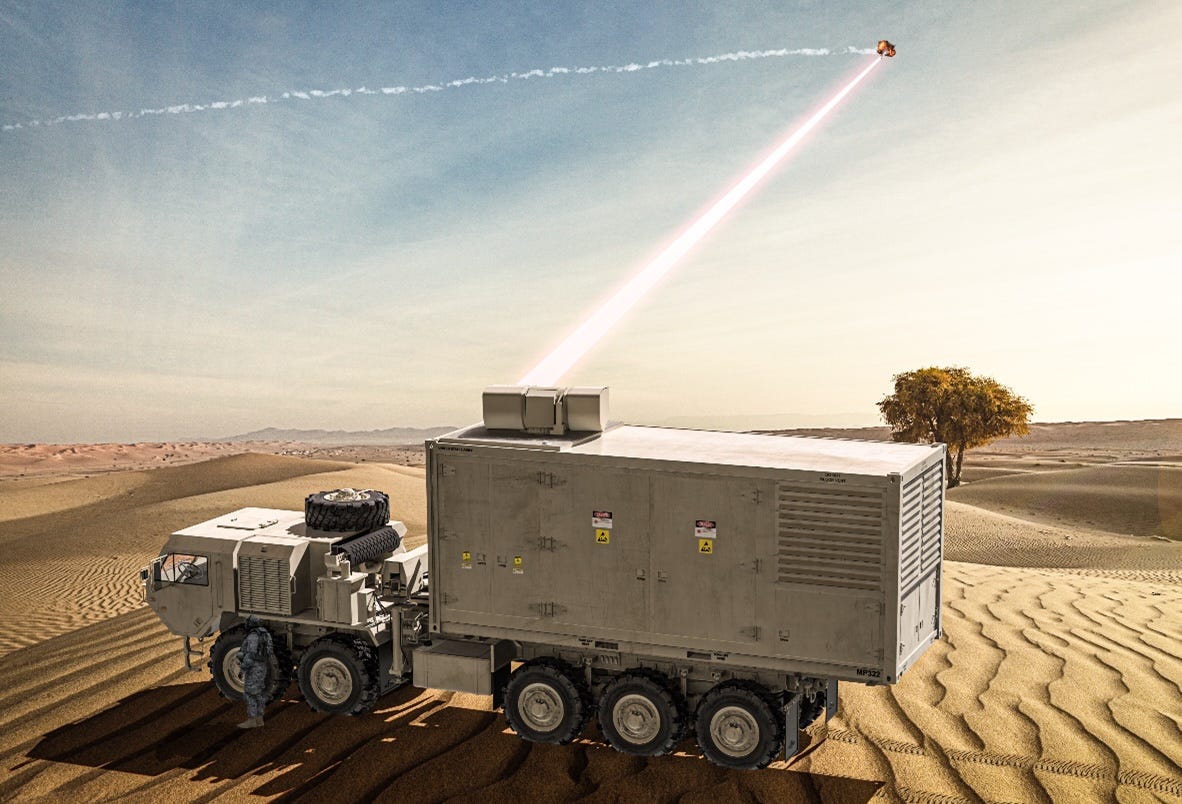
Between August and November 2026, U.S. military and homeland security units operationalized directed energy weapons such as the AMP-HEL laser and paired them with kinetic and electronic warfare effectors. The push reflected a threat picture in which 1 warned that fully autonomous drones and fiber-optic-controlled systems can emit little or no detectable RF, making legacy detection inadequate and driving AI-enabled, multi-sensor fusion and more capable detection-and-response systems.
That urgency was reinforced by Ukraine, where fiber-optic drones became widely deployed beginning in 2024 and, by early 2026, more than 35 Ukrainian manufacturers were producing them. On Sept. 14, 2026, Arbe said its Alerion radar had been successfully field-tested for defense applications and was being evaluated by counter-unmanned aircraft systems integrators worldwide, while evidence from 2023–2025 showed AI-enabled interception using radar cueing and the model on the device, including claims of more than 5,000 confirmate Russian drone strikes and more than 1,000 shut down in December, supporting the maturation of integrated AI-enabled C2 platforms through multinational exercises and new contracts.


Kill Chain Becomes the Weapon
Modern counter-drone systems now merge detection, classification, and response into a single AI-powered architecture, with economic realities driving a shift to modular, scalable defense layers.
Integrated counter-UAS now treats the kill chain as the weapon, fusing sensors, AI classification, command software, and multiple effectors into one responsive architecture. DHS’s October 14, 2026 entry, “From Detection to Response: First Responders Test Counter-Drone Technology,” frames counter-drone capability as two linked jobs: Detection, Tracking and Identification and threat response, reinforcing the need to connect sensing and action in one system. Electro Optic Systems says bringing those inputs together into a clear operating picture and connecting that information with available countermeasures is critical, while machine learning supports threat classification and behavioural analysis, allowing layered systems to assign kinetic, laser, or electromagnetic responses fast enough to match different threats, scales, and operating environments rather than relying on any single interceptor or sensor.
That architecture matters because economics and adaptability are inseparable: using those systems against every $30,000 drone does not make economic sense, so another defense layer is being built underneath them. A 2025 DHS feature article pointed to operational evaluation, describing a three-day SAVER assessment at two launch sites around New York’s Hudson Yards, where five platforms from the Blue List were evaluated. Fieldable directed energy fits that lower-cost layer when it is maintainable and scalable, with modular and maintainable field architectures, a quick disconnect for rapid part swaps, and power growth from 30 kilowatt to 50 kilowatt expanding options and supporting repeated engagements without consuming conventional magazines.




Lasers Earn Combat Cred
Field successes against cartel drones on the U.S. border triggered a procurement surge, marking the moment lasers moved from experimental demos to real-world military acquisition.
The late-2026 inflection point for directed-energy counter-drone weapons was that procurement began following validated performance, not ahead of it. Laser Wars captured that shift in one headline: “Lockheed, nLight Win $86M Pentagon Laser Contracts After White Sands Demo Downs Cruise Missiles,” explicitly tying new Pentagon buying to a successful field-relevant engagement and showing lasers were no longer confined to experimental trials but had entered an operational acquisition cycle shaped by demonstrated results.
That transition became unmistakable once lasers were used in real missions on the southern border: Aviation News.eu reported, “AeroVironment Laser Zaps 3 Cartel Drones in Texas, Marking U.S. Military Border Defense First,” linking a directed-energy effect to military border defense—evidence of movement from demonstration to field use in the late-2026 timeframe. The Defense Watch then sharpened the point with “Army’s 20kW AMP-HEL Laser From AeroVironment Downs Cartel Drones in First US Combat Use,” identifying a 20kW AMP-HEL Laser tied directly to Army operational employment against cartel drones.

EJDERHA’s Swarm Shutdown
ASELSAN’s electromagnetic system halted 51 drones with one activation, proving that ammunition-free, high-power defeat is now operational and scalable beyond lab scenarios.
High-power electromagnetic defeat now has a stronger claim to operational relevance because ASELSAN is no longer presenting EJDERHA as a lab curiosity but as a fieldable system. Defence Security Asia reports that EJDERHA “neutralized 51 simultaneously launched drones within seconds” and frames it as “ammunition-free swarm defense,” while ASELSAN CEO Ahmet Akyol said it is “the world’s first system to successfully neutralize 51 drones with a single push of a button,” a result that directly supports the idea that one electromagnetic effector can suppress a swarm without firing interceptors.
Just as important, the reported test profile suggests EJDERHA scales across target sets rather than only excelling in a single showcase scenario. Defence Security Asia says the system “reportedly disabled two wired drones at approximately 1,000 meters” alongside the swarm event near Ankara, and describes how “EJDERHA uses vacuum electronics to generate high-power electromagnetic waves that affect onboard circuits,” adding that it “can interrupt several aircraft in a short interval,” with all 51 drones taking off simultaneously and being neutralized within seconds after one activation.
Integration, Not Just Spending
NATO’s $40B investment is driving a market for interoperable, production-ready C2 systems, with scaling now hinging on integration readiness rather than hardware alone.
Procurement is scaling because buyers are building acquisition channels around compatibility and repeatability, not one-off kit. On July 7, NATO allies announced that they intend to invest more than $40 billion in counter-drone capabilities over the next five years, while also creating a marketplace for NATO-tested, NATO-compatible systems; that model directly addresses the long-standing gap between prototype and government purchase and fits a broader shift, visible in production moves such as CACI’s $500 million SkyValor IDIQ and the Army’s $127 million TITAN production order, from experimentation toward procurement and production.
The same pattern shows up in how systems are being fielded: BAE Systems selected MARSS’s NiDAR as the command-and-control layer for BATS at Eurosatory 2026, calling it the “intelligent nerve centre” and highlighting its “agnostic architecture,” while NiDAR is already deployed in over 60 locations protecting military assets, critical infrastructure, and borders. That is why scaling now looks like integration work rather than simple unit buys: EOS’s purchase of the MARSS defence business created a “vertically integrated counter-UAS group,” and the Army’s phased 2032 C2 rollout requires coordinated hardware, software, and sequencing across non-standardized units, underscoring that scaling interoperable counter-drone and C2 capabilities is constrained by integration readiness rather than the purchase of standalone systems.
