Leaders reclaim time: delegation, AI, and the power of stillness
The gist
Leaders are reclaiming up to 20 hours a week—and a sharper edge—by delegating, automating, and fiercely protecting time for deep thinking.
What to know
- Andrea, an AI automation founder, boosted revenue and clarity by delegating email management and embracing the 'buyback principle' to prioritize high-impact work.
- Experts say automating trivial choices—like meals and wardrobes—slashes decision fatigue, with routines freeing up mental energy for courageous, creative decisions.
- Leaders such as Jeff Bezos and Brandon Zobel credit device-free reflection and advanced automation for driving innovation, while challenging the stigma that stillness signals laziness.
Delegation as a Growth Engine
Leaders who overcome the urge to control every detail and strategically delegate low-value tasks not only reclaim hours but also unlock higher revenue and creative capacity.
Delegating low-value administrative tasks is essential for leaders to preserve their cognitive energy and focus on high-impact work that drives business growth. As early as March 2026, it was noted that spending up to 60% of a workweek on routine tasks like scheduling and emailing not only drains mental resources but also leads to decision fatigue, leaving leaders creatively depleted by mid-afternoon. This phenomenon is compounded by the addictive nature of completing clear, finite tasks, which can feel safer than tackling uncertain creative challenges, creating a psychological barrier to delegation.
The 'buyback principle' crystallizes the opportunity cost of not delegating: every hour spent on low-value work is an hour lost from revenue-generating activities only the leader can perform. Andrea, founder of an AI automation company, exemplifies this by reclaiming 20 hours weekly through delegating email management, which not only reduced her overwhelm but directly boosted her revenue. Calculating a 'buyback rate'—typically a quarter of one’s hourly wage—helps leaders determine the maximum they should pay others to take over tasks, ensuring a strong return on investment and reinforcing delegation as a strategic financial decision.
Overcoming trust barriers and the reluctance to relinquish control is a critical step in effective delegation. Leaders often hold onto tasks due to competence or fear of imperfect execution, yet as Andrea admits, this self-imposed bottleneck leads to overwhelm. The solution lies in daring to delegate even disliked or low-value tasks to interns, family members, or virtual assistants, embracing imperfection to reclaim time and cognitive bandwidth. This mindset shift is echoed by entrepreneurs who prioritize character over skills in their first hires, recognizing that skills can be taught but trustworthiness cannot.
Successful delegation is not just about offloading tasks but about creating systems and clarity to optimize team efficiency and personal productivity. Leaders like Rob Dyrdek have developed comprehensive automation frameworks—such as his 'Rhythm of Existence'—that delegate everything from household chores to content production, enabling him to increase output dramatically while spending only 4% of his time on production. Similarly, fostering a culture where team members understand the cost of their time, supported by data-driven clarity on resource drains, empowers proactive delegation and sustainable growth, allowing leaders to focus on strategic thinking rather than administrative minutiae.





Routines: The Hidden Power Move
Standardizing everyday decisions—like meals and attire—builds a mental fortress against decision fatigue, enabling leaders to reserve their best thinking for what actually moves the needle.
By mid-2026, thought leaders and neuroscientists converged on the idea that establishing routines functions as a cognitive infrastructure akin to corporate SOPs, enabling leaders to conserve mental energy by automating trivial decisions. As articulated in the July 30 analysis "Boring at the Edges," routines close minor decision loops—such as choosing the same breakfast daily—freeing the brain from costly context switching and preserving scarce attention for high-impact, courageous judgments. This approach mirrors how companies standardize processes to protect focus for exceptions and critical calls, underscoring that what appears as monotony externally is a strategic allocation of cognitive resources internally.
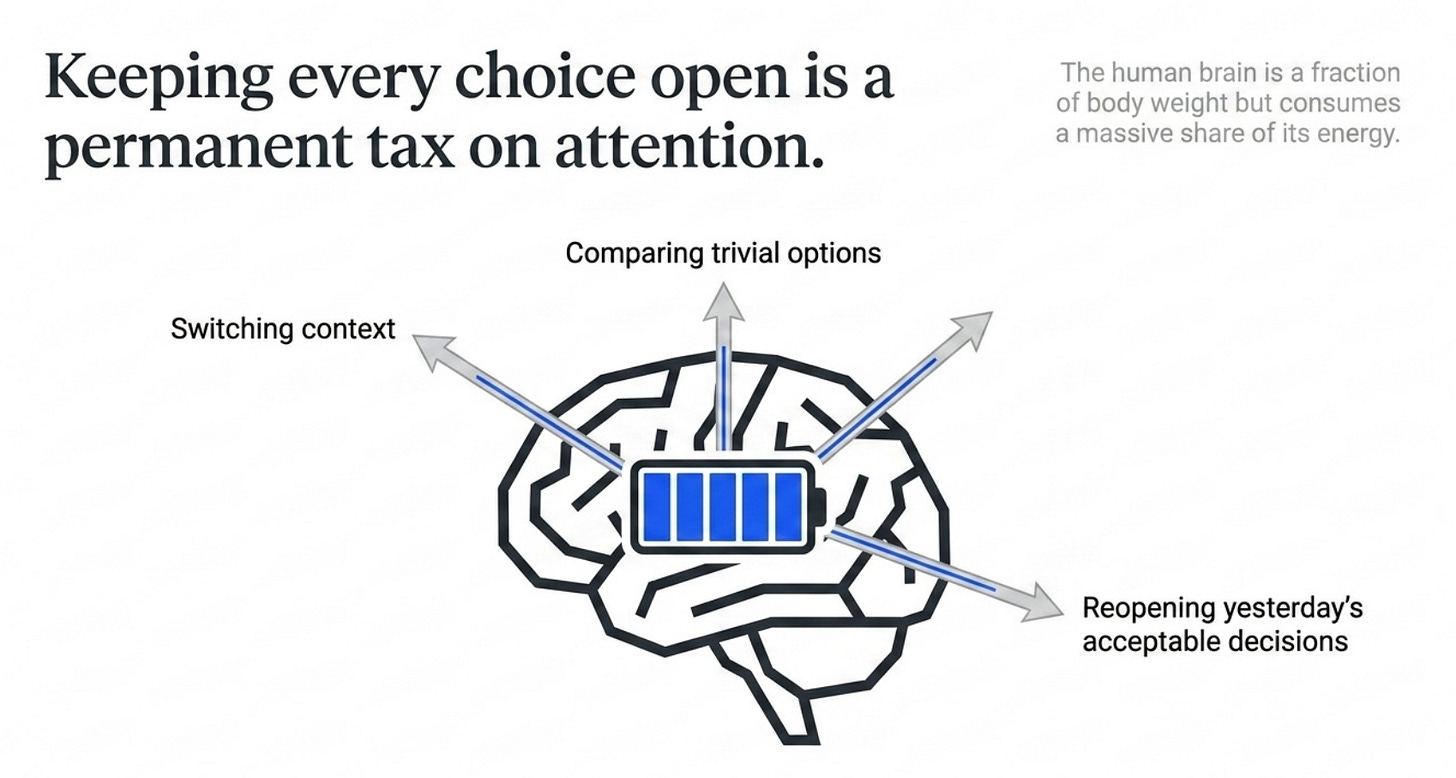
The brain’s voracious energy appetite—consuming a disproportionate share of bodily resources despite its small size—makes decision fatigue a tangible threat to productivity and well-being. By early August 2026, experts emphasized that automating or minimizing low-stakes choices, such as wardrobe or lunch options, significantly reduces mental exhaustion. Techniques like satisficing, championed by Nobel laureate Herbert Simon, encourage selecting 'good enough' options rather than perfect ones, thereby reserving cognitive bandwidth for decisions that truly matter. Studies cited note that individuals make approximately 122 informed decisions daily, highlighting the imperative to streamline trivial choices.
Innovative strategies to combat decision fatigue include embracing randomness for low-stakes decisions, a method gaining traction by August 2026. Simple tools—coin tosses, card draws, or apps—help bypass mental overanalysis when options are similar, conserving energy for consequential judgments. Intriguingly, pausing to observe one’s emotional reaction to the random outcome can reveal subconscious preferences, guiding the final choice. This blend of automation and mindful awareness exemplifies a nuanced approach to cognitive energy management that balances efficiency with introspection.
Beyond routines and randomness, thought leaders like Neil Pasricha advocate breaking overwhelming tasks into manageable chunks to alleviate stress linked to decision fatigue. His two-minute practice, highlighted in early August 2026, transforms daunting projects—such as a book deadline or starting exercise—into small, actionable steps, reducing cognitive overload. This technique complements routine-building by not only conserving mental energy but also fostering a sense of progress and control amid complex responsibilities, especially relevant for leaders juggling multifaceted roles.



Automation: From Tasks to Transformation
AI-driven automation is shrinking teams and freeing leaders from the tyranny of busywork, letting them channel their energy into strategic, high-impact work that scales.
By early 2026, Brandon Zobel illustrated how automation transcends mere task delegation by freeing leaders and teams from repetitive duties, enabling a sharper focus on high-impact, creative work that drives revenue. His experience scaling Entrepreneurs on Fire with fewer staff yet stable revenue underscores automation's scalability benefits, where streamlined processes not only reduce team size—from 13 to 5—but also minimize costly human errors, amplifying operational efficiency.
For solo entrepreneurs and leaders seeking autonomy, AI tools have become pivotal in reclaiming time and agency, as highlighted in mid-2026 reflections contrasting high-paying tech roles with the freedom of bootstrapped ventures. This shift allows individuals to avoid the trap of trading time for money and instead prioritize creative and strategic activities without the constraints of investor pressures or back-to-back meetings, fostering both business growth and personal fulfillment.
Practical AI integration frameworks, such as those demonstrated in late June 2026, empower leaders to audit calendars against quarterly goals, identify low-value meetings, and generate mock schedules that optimize time allocation and delegation. This methodical approach, which can reclaim over 20 hours weekly, ensures that reclaimed time is intentionally invested in revenue-generating and energizing tasks, preventing external demands from encroaching on valuable cognitive bandwidth.
Rob Dyrdek’s Rhythm of Existence system exemplifies advanced life and content automation, where delegating routine tasks to assistants and standardizing workflows dramatically boosts productivity. By increasing his content output from two to six episodes daily and reducing shooting time for 250 episodes to just 4% of his annual schedule, Dyrdek demonstrates how comprehensive automation not only scales business operations but also preserves work-life balance through extraordinary optimization.



Stillness: The Leader’s Secret Weapon
Protected, device-free thinking time isn’t laziness—it’s the crucible where bold ideas and sound judgment are forged, defying a culture obsessed with constant motion.
By early 2026, the critical role of protected thinking time in leadership was underscored by leaders like Jeff Bezos, who practiced 'puttering'—unstructured, device-free morning routines that allow the mind to transition from reactive to deliberate thinking. This slow, reflective approach, often involving activities such as walking or extended breaks, enables leaders to 'marinate' on complex problems, fostering better judgment and innovation despite the prevailing cultural push for constant productivity.
Modern work culture often stigmatizes stillness as laziness, creating a significant barrier to the deep reflection leaders need for cognitive clarity and sound decision-making. Yet, as noted by historical figures like Tesla, Einstein, and Marcus Aurelius, intentional isolation and mental rest have long been essential for profound insight, reminding today’s leaders that sometimes 'the most productive thing you could do is nothing'—a vital counterbalance to the relentless pace of contemporary work life.
Deliberate, distraction-free thinking sessions are a game changer for cultivating leadership judgment, as emphasized by Keith Cunningham’s practice of dedicating 45 minutes to sit with challenging questions without interruptions. This deep focus activates the prefrontal cortex, helping leaders overcome the brain’s natural energy-conserving shortcuts and develop epistemological self-awareness—critically examining their own beliefs and assumptions to refine their worldview and leadership approach beyond superficial confidence.
The accelerating pace of technological change and the historical challenge of taking time to think—highlighted by IBM’s Tom Watson slogan 'Think'—make protected thinking time more essential than ever for leadership excellence. As rapid innovation compresses decision cycles, leaders must resist the cultural impulse to rush and instead carve out deliberate stillness to maintain judgment quality and strategic clarity in an increasingly complex environment.