Legal AI goes agentic: vertical SaaS platforms turbocharge law firm productivity by up to 85%
The gist
Agentic AI baked into vertical SaaS is rocketing legal productivity by up to 85%, turning once-clunky law firm software into proactive workflow engines.
What to know
- Platforms like Harvey AI, GC AI, and EvenUp embed legal-specific AI directly into lawyers’ daily tools, slashing routine work and boosting productivity by 50–85%.
- By 2026, legal SaaS platforms have morphed from passive data vaults to hands-on systems of action—automating everything from contract review to invoicing, with minimal manual input.
- Law firms using advanced agentic AI now triple case volumes and revenue without hiring more staff, freeing attorneys for high-value strategy and client work.
AI Wedges Break Barriers
Vertical, domain-specific AI tools sidestep legacy tech hurdles, delivering instant value and unlocking rapid adoption in legal markets that resisted digitization for decades.
Agentic AI tools have emerged as critical vertical SaaS wedges that finally break through entrenched adoption barriers in highly regulated legal markets, where digitization had stalled for decades. Unlike generic horizontal AI, these industry-specific wedges deliver immediate, domain-contextual value by integrating selectively with existing systems of record, thus avoiding costly system replacements and drastically reducing time-to-value from months to minutes. This strategic approach transforms AI from a 'nice to have' into a 'must have,' with productivity gains soaring between 50-80% in focused legal workflows, far surpassing the 10-20% improvements seen with generic tools.
Early exemplars like Harvey AI illustrate the wedge strategy in legal tech by initially targeting high-pain points such as legal research before expanding into contract drafting, due diligence, and regulatory compliance, following a phased framework that unfolds over three years. This phased evolution—from launching a focused AI wedge to capturing rich data and ultimately expanding into a broader platform—enables sustained growth and deeper integration within legal workflows.
By early 2026, case studies such as Supio and tire retail platforms demonstrate how agentic AI embedded in vertical SaaS not only simplifies complex, industry-specific workflows but also makes advanced software accessible to traditionally non-tech-savvy users. Supio’s innovation in extracting schema from legal documents empowers firms to automate intricate tasks like generating demand letters and real-time case analysis, commanding premium pricing and unlocking vast total addressable markets in industries previously untouched by software, including legal and medical records processing.


Specialization Drives Legal AI Growth
Startups that pivoted from generic to deeply specialized legal AI saw explosive revenue growth and product-market fit by embedding automation directly into lawyers’ daily workflows.
Startups like GC AI and Eve exemplify a strategic evolution from broad horizontal AI tools to deeply specialized legal AI solutions that automate high-volume, repetitive workflows tailored to legal professionals’ actual work environments. GC AI’s pivot away from law firms toward in-house legal teams—who manage a $300B+ annual spend and are growing twice as fast as law firm lawyers—enabled it to scale rapidly from $1M to $10M ARR within a year by embedding AI directly into Microsoft Word, aligning with lawyers’ daily practices rather than forcing document uploads to proprietary platforms. Similarly, Eve’s decisive early-2023 pivot from a horizontal NLP startup to a legal-specific AI provider focused on deep workflow automation, such as plaintiff intake calls and bankruptcy document processing, unlocked rapid product-market fit and growth, demonstrated by conversion rates soaring from 1% to 40% in cold outreach and 90% demo-to-pilot success.
The timing and technical approach of these pivots were critical to their success. Eve’s shift coincided with the operational disruptions of the COVID-19 pandemic in 2020, which exposed law firms’ urgent need for automation in complex, high-volume document processing tasks like contract data extraction. By building specialized AI architectures that pushed accuracy beyond standard computer vision and GenAI capabilities—targeting the leap from 99% to 99.9% accuracy—Eve addressed the trust and precision demands unique to legal workflows. This focus on deep workflow integration rather than generic AI models allowed Eve to automate nuanced legal processes effectively, such as early case evaluations and client intake, which had previously been bottlenecks.
Spellbook’s journey further illustrates the broader industry trend toward vertical SaaS legal AI products that embed seamlessly into lawyers’ workflows and adopt bottoms-up go-to-market strategies. After years of experimentation culminating in over 100 product experiments, Spellbook achieved product-market fit around 2022 by positioning itself as an AI copilot for contract review and drafting—a ‘Cursor for lawyers’—primarily through a Microsoft Word plugin, arguably the largest of its kind. This approach contrasts with the typical top-down sales motions in legal tech, enabling rapid adoption among individual legal professionals and firms alike, and underscoring the value of deeply integrated, workflow-centric AI solutions in the legal sector.



Systems of Action Replace Records
Legal SaaS platforms have evolved into proactive, autonomous systems that execute complex workflows, eroding traditional data lock-in and demanding new defensibility through AI-driven decision layers.
By early 2026, vertical SaaS platforms have undergone a fundamental transformation from passive systems of record—merely storing historical data—to proactive systems of action that autonomously govern and execute complex workflows. Scott Hoke of AQL Growth encapsulates this shift: “A system of record stores what happened. A system of action decides what happens next—and then does it.” This evolution is exemplified by AI’s ability to perform end-to-end processes such as creating and sending invoices, running multi-step follow-up cadences, and reconciling accounts, marking a leap beyond traditional BI tools that could only issue alerts.
The traditional competitive moat of data stickiness is rapidly eroding as AI-enabled tools simplify data harmonization and migration, enabling seamless switching between systems of record. Nic’s experience of effortlessly migrating an internal system underscores this trend, prompting vertical SaaS providers to cultivate new defensibility through proprietary context layers—often called 'context graphs' or 'decision layers'—that capture the rationale behind thousands of workflow decisions. This embedded decision intelligence forms a sticky foundation, training AI models to autonomously take subsequent steps and deeply integrating AI into operational workflows.
Legal tech platforms like Filevine and Cleo exemplify this paradigm shift by evolving into AI-native operating systems that eliminate manual data entry and automate complex legal workflows across the client journey. Filevine’s transition to vectorized databases for data ingestion has all but erased the need for keyboard input, with expectations that manual entry will become rare within the year. Meanwhile, Cleo positions itself as the operating system for law firms, embedding AI that not only provides answers but actively intakes, schedules, analyzes, drafts, and tracks legal tasks, signaling a new era where AI acts decisively on behalf of lawyers rather than passively supporting them.

Agentic AI Matures in Law
Legal AI has advanced from single assistants to fleets of specialized agents, automating multi-step legal tasks while preserving oversight and transparency through customizable, reviewable workflows.
By early 2026, agentic AI applications in legal workflows had matured significantly, exemplified by LegalOn Technologies’ launch of five specialized AI agents that automate complex, multi-step tasks such as contract review and document drafting, enabling in-house legal teams to save up to 85% of time on routine work while maintaining human oversight. This shift toward seamless integration and customization within existing workflows marked a pivotal step in enhancing productivity without sacrificing control.
Harvey’s evolution from a simple AI assistant to a comprehensive platform coordinating multiple specialized agents illustrates the rapid acceleration of agentic AI infrastructure in legal tech, driven by improved AI models and growing market demand. Legal enterprises are now actively categorizing workflows by levels of AI involvement—from fully agentic to hybrid human-AI collaborations—highlighting a nuanced approach to deploying AI across diverse legal processes, including complex multi-party negotiations supported by synthetic data generation to overcome confidentiality barriers.
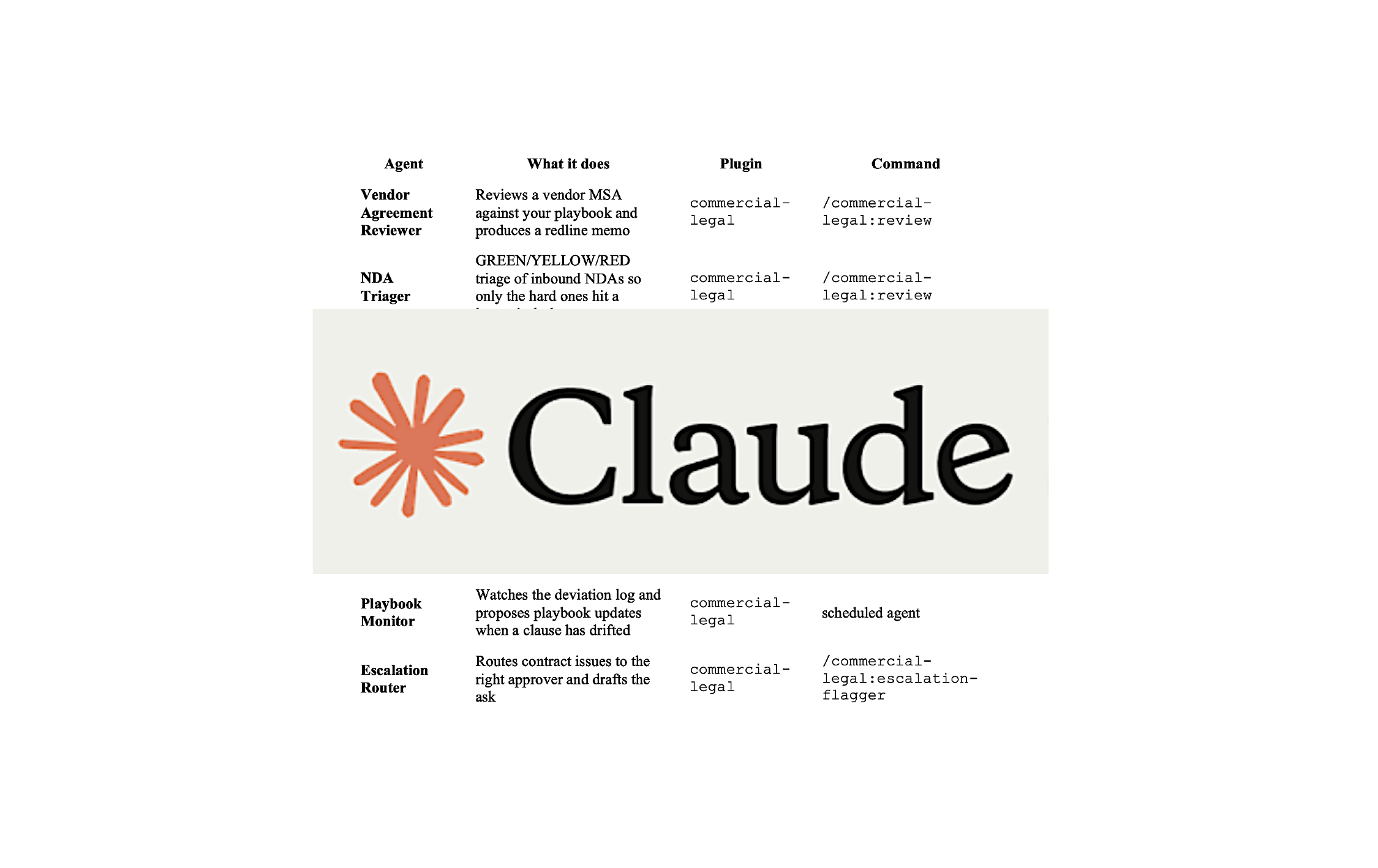
Platforms like Litify ACE and Anthropic’s Claude for Legal showcase the diversification and granularity of agentic AI applications, with Litify ACE autonomously managing multi-step case lifecycle tasks and Claude offering over 90 named, customizable agents that run continuously on incoming data streams. These developments emphasize deep workflow integration, transparency through source attribution, and built-in review gates to ensure reliability, signaling a maturation from broad AI capabilities to highly specialized, practical tools tailored to varied legal functions.
Anytime AI’s Talk to Teddy epitomizes the vertical specialization of agentic AI by consolidating multi-step litigation tasks—such as liability identification, demand letter drafting, and deposition summarization—into a unified workspace focused on plaintiff and personal injury law. This targeted approach, supported by event-driven go-to-market strategies and strong client case studies, reflects a disciplined maturation that not only embeds AI deeply into specialized practice areas but also positions the company for premium pricing and recurring revenue by addressing tight demand deadlines and reducing administrative burdens.


AI Supercharges Legal Firms
Law firms leveraging AI-driven SaaS platforms have tripled case volumes and revenue without hiring, as automation slashes turnaround times and shifts lawyers toward high-value client work.
By mid-2026, AI-driven vertical SaaS platforms have demonstrated transformative business impact across legal practices, markedly boosting productivity and profitability. Firms like Passalacqua & Associates and Moet Law Group reported staggering increases in case volume—300% growth—and revenue gains up to 300%, achieved without expanding staff, by leveraging EvenUp’s AI suite to streamline workflows from intake through litigation. These platforms automate labor-intensive tasks such as medical record review, demand letter generation, and time capture, reducing administrative burdens and accelerating case resolution times from days to mere minutes, as exemplified by Moet Law Group’s reduction of settlement demand letter production from seven days to 30 minutes.
The integration of AI tools has not only enhanced operational efficiency but also fundamentally shifted attorneys’ roles toward higher-value client engagement and strategic work. Taylor Wessing’s recent deployment of AI in their employment law department illustrates this evolution, where AI provides rapid, precise legal answers and streamlines litigation processes, enabling lawyers to spend less time drafting and more time in strategic discussions with clients. This shift is echoed across firms adopting AI, with attorneys reporting increased client interaction time and a surge in workload driven by higher client demands, underscoring AI’s role in expanding both capacity and value delivery.
Customization and seamless integration of AI solutions have emerged as critical factors for realizing tangible ROI in diverse legal environments. Forward deployed engineering teams tailor AI tools to firm-specific workflows, ensuring that no single off-the-shelf product limits adoption or effectiveness. This bespoke approach, highlighted by the need to satisfy varied use cases across firms, enables sustained productivity gains and embeds AI deeply into daily legal operations, as seen with Anytime AI’s unified assistant 'Talk to Teddy' that consolidates multiple litigation tasks into a single platform, driving recurring SaaS revenue through niche market penetration.
AI-powered platforms also enhance client engagement and negotiation effectiveness by providing real-time support during critical interactions. For instance, EvenUp’s Companion AI assistant aids attorneys during live adjuster calls by verifying treatment details without disrupting negotiations, fostering trust and enabling attorneys like Rohan Dosaj to efficiently produce comprehensive supplemental demands in under 30 minutes—a task that traditionally took a full day. This capability not only boosts case value but also reduces attorney workload, illustrating AI’s dual impact on financial performance and client service quality.
Lawyers’ Roles Transformed by AI
Agentic AI now handles complex, data-heavy legal work at unprecedented speed and accuracy, freeing lawyers to focus on strategy and client relationships while making AI adoption a reputational necessity.
By mid-2026, AI has evolved from a supportive tool to an indispensable partner in legal workflows, dramatically enhancing lawyer productivity by automating complex, data-intensive tasks such as mapping relationships, detecting contradictions, and running simulations on vast case files. This agentic AI capability enables lawyers to reduce task completion times by factors of 10 to 20, allowing them to manage more cases simultaneously and significantly improve access to justice, as highlighted by the ability to process what once took hours in mere minutes with auditable, reasoned outputs rather than mere guesses.
The integration of AI is reshaping the lawyer’s role from drafting and routine document handling toward higher-value strategic engagement with clients. Lawyers now spend more time advising and strategizing, supported by AI systems that autonomously monitor emails, redline documents, and draft diligence memos, thereby accelerating turnaround times and enabling deeper client interaction. This shift also reflects client expectations for transparency and AI usage in legal services, making AI adoption a reputational imperative within the profession.
The future of AI in legal practice hinges on eliminating human friction in cleaning up AI outputs, thereby unlocking new markets and expanding human capabilities rather than creating dependencies. Customization and forward deployed engineering play critical roles in tailoring AI tools to diverse firm needs, while domain-specific AI legal assistants, trained on legal materials and fortified with security architectures, ensure accuracy and confidentiality. This evolution has rapidly transitioned AI legal assistants from experimental novelties to core infrastructure embedded in leading firms’ workflows, enabling junior associate-level work to be completed in a fraction of the time without sacrificing quality.
Although lawyers currently lag slightly behind engineers in AI adoption, the trajectory points to a future where legal professionals manage multiple AI agents simultaneously, exponentially expanding their capacity and transforming legal deal workflows. This anticipated evolution underscores a profound paradigm shift: rather than replacing lawyers, AI empowers them to focus on judgment, strategy, and client counsel, fundamentally redefining the practice of law over the next decade.