LG and Nvidia unveil seoul robot 'bootcamp' for humanoids
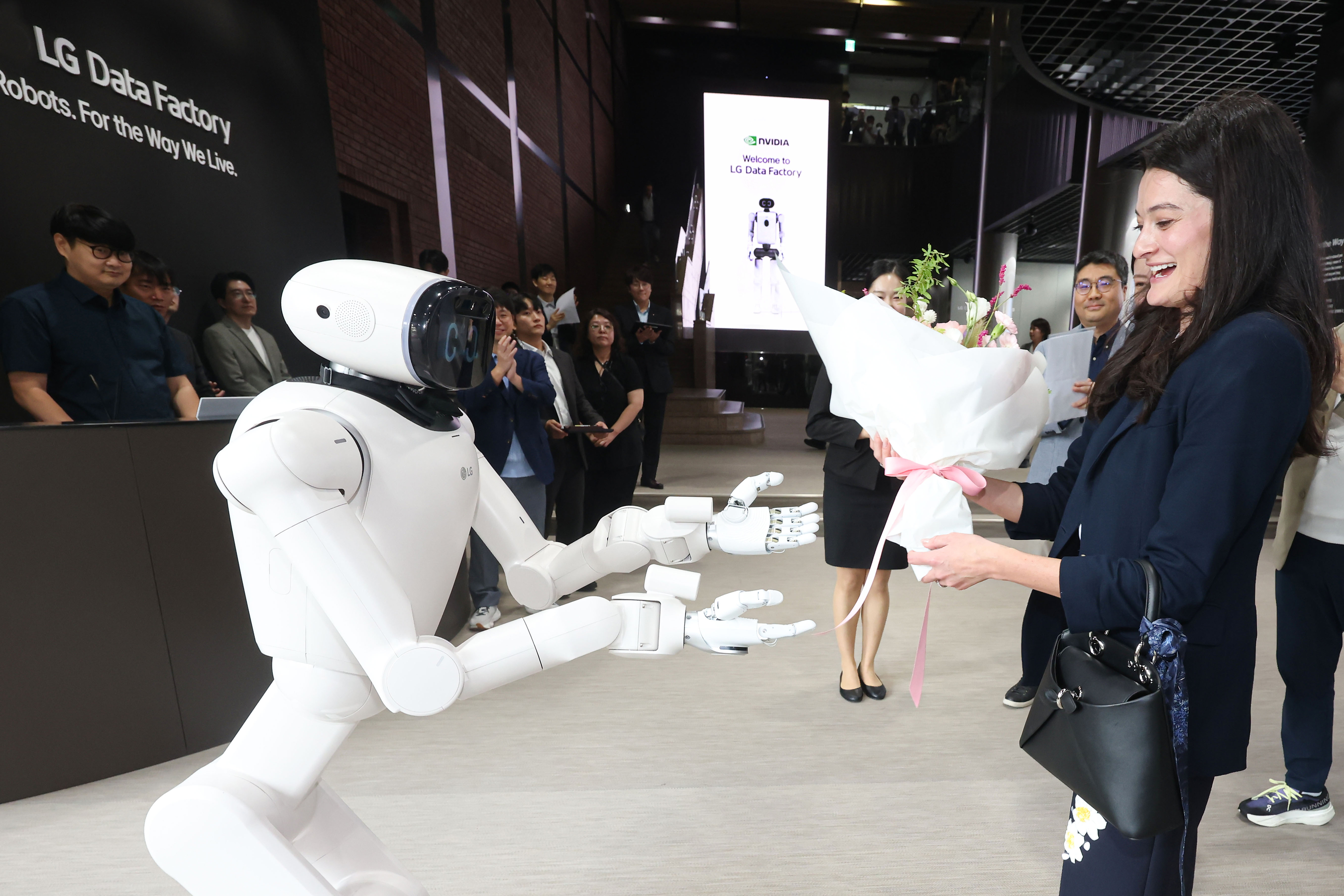
The gist
LG and NVIDIA just kicked off the world’s largest ‘robot bootcamp’ in Seoul, fast-tracking humanoid robots from lab curiosity to factory floor MVP by 2027.
What to know
- LG’s new 10,000m² Robotics Data Factory in Seoul will house hundreds of robots, aiming to amass 100,000 hours of real and synthetic training data by 2026.
- The partnership taps NVIDIA’s Omniverse, Cosmos, and Isaac platforms to supercharge robot learning and build next-gen Robot Foundation Models for complex physical tasks.
- With global robot installations surging to 542,000 in 2024 and humanoids projected to take 50% of manufacturing roles by 2030, South Korea is betting $1.67B on domestic robot dominance.
Inside LG’s Robot Bootcamp
LG’s four-story Seoul facility simulates homes and manufacturing lines, fueling a closed-loop data flywheel to train hundreds of robots for real-world readiness.
LG Electronics has operationalized a sprawling 10,000m² Robotics Data Factory in Seoul’s Yangjae campus, designed as a multifaceted 'robot bootcamp' spanning four floors and housing several hundred robots by the end of 2026. This facility replicates diverse real-world environments—from home cleaning scenarios to manufacturing lines modeled after LG’s Tennessee plant—creating a dynamic ecosystem where robots continuously collect and refine training data to accelerate learning and performance.
In a strategic partnership formalized through a memorandum of understanding in August 2026, LG and NVIDIA are combining LG’s hardware expertise—including sensors from LG Innotek, batteries from LG Energy Solution, and actuators from LG Electronics—with NVIDIA’s advanced robotics software stack, featuring Omniverse, Cosmos, and Isaac platforms. This collaboration enables large-scale simulation and synthetic data generation, allowing the partners to efficiently amass a targeted 100,000 hours of robot training data—equivalent to roughly twelve years of experience—by the end of 2026, surpassing comparable industry efforts.
The Robotics Data Factory embodies LG’s innovative 'data flywheel' approach, where real-world data collected by deployed robots is continuously supplemented with synthetic scenarios generated via NVIDIA’s tools, creating a closed-loop training cycle that progressively enhances robot capabilities. This methodology underpins LG’s Physical AI strategy and the development of its Robot Foundation Model (RFM), a foundational AI framework designed to learn movement sequences akin to how large language models learn language, with plans to debut a bipedal humanoid robot by early 2027.

Hybrid AI: Real Meets Synthetic
LG and NVIDIA are fusing physical robot trials with advanced simulations to create massive, multimodal datasets—laying the groundwork for bipedal humanoids that learn and act autonomously.
LG and NVIDIA are pioneering a hybrid approach to robot training that combines real-world physical task execution with synthetic data generation, aiming to amass an unprecedented 100,000 hours of training data by the end of 2026. This massive dataset, collected at LG’s 10,000m² Robotics Data Factory in Seoul, is essential because robot training requires time-aligned streams of multimodal sensor data that simply do not exist online and must be physically generated or synthetically derived. NVIDIA’s robotics software stack—including the Isaac GR00T foundation model and Jetson Thor compute modules—forms the technological backbone enabling LG’s Physical AI strategy, integrating vision, language, and action capabilities into advanced Robot Foundation Models that underpin humanoid robot performance.
The Robotics Data Factory operates as a sophisticated 'robot bootcamp' featuring multiple specialized environments such as replicated home spaces, manufacturing simulations, logistics zones, and robotic-hand training areas. This setup allows LG to deploy hundreds of CLOiD units to iteratively refine training data, accelerating the development of Vision-Language-Action (VLA) models that enable robots to perceive, analyze, and act autonomously in real time. By integrating NVIDIA’s Omniverse simulation platform, Cosmos world models, and Isaac robotics development tools, the partnership creates a continuous learning cycle where real-world operational data is augmented with synthetic scenarios, dramatically enhancing training efficiency and safety before physical deployment.
This collaboration marks a pivotal shift toward agentic AI and comprehensive physical AI ecosystems, where robots transcend mere perception to autonomously navigate and interact within complex physical environments. NVIDIA CEO Jensen Huang heralded this as the 'ChatGPT moment' for robotics, emphasizing that Physical AI demands not only sophisticated AI 'brains' but also precise hardware 'bodies' and vast real-world data. NVIDIA’s ecosystem—including dedicated chips like Jetson Thor, humanoid robot foundation models such as Isaac GR00T, and physics-based simulation platforms like Omniverse—extends AI infrastructure beyond data centers into physical automation, enabling next-generation bipedal humanoid robots to transition seamlessly from virtual training to real manufacturing floors.
Humanoids: From Hype to Factory Floor
Soaring robot adoption and falling operational costs are pushing humanoids from prototypes to practical labor solutions, with some U.S. factories already deploying dozens for critical tasks.
Global industrial robot installations have surged to 542,000 units in 2024, more than doubling over the past decade as acute labor shortages, particularly in sectors like food production, drive companies to automate. For example, the U.S. saw an 11% rise in robot deployments in 2025, with food industry adoption alone jumping 30%, underscoring how workforce gaps are catalyzing rapid automation investments.
Humanoid and AI-enabled robots are transitioning from experimental prototypes to practical deployments, especially in manufacturing and warehousing where repetitive tasks and predictable layouts prevail. This pragmatic shift is exemplified by a Georgia automotive OEM deploying 150 humanoid robots within compact factory cells to handle labeling and quality control, reflecting a broader industry trend toward scalable, real-world applications that embrace iterative problem-solving over hype.
Economic pressures from rising wages and persistent labor shortages are making humanoid robots increasingly attractive despite their upfront costs. JPMorgan forecasts demand will soar as operating costs for humanoid robots drop below $10 per hour—roughly a third of warehouse worker wages—and projects these robots could fill up to 50% of manufacturing roles by 2030, serving as cost-effective complements to human labor amid a projected rise in unfilled U.S. manufacturing jobs from 462,000 to 1.6 million.
Investor confidence in humanoid robotics is robust, driven by demonstrated returns from deployments that reduce labor costs and improve operational efficiency. The rise of Robotics-as-a-Service models further lowers barriers to adoption by shifting expenses from large capital outlays to manageable subscriptions, enabling companies to scale automation more flexibly. As a result, market players who prove repeatable, scalable deployments with paying customers are increasingly favored over those focused solely on technology validation.

Asia’s Billion-Dollar Robot Race
China and South Korea are pouring billions into humanoid robotics, with China flaunting record-breaking feats and Korea launching a government-backed push for technological independence and mass deployment.
China is aggressively leveraging robotics and AI to counteract demographic challenges such as an aging population and shrinking workforce by developing humanoid robots capable of adaptive, human-like task performance across sectors like manufacturing, logistics, and services. This strategic push is backed by a massive $20 billion investment aimed at integrating advanced AI into mass-produced robots, positioning China to rival the US and solidify its status as a global manufacturing powerhouse. The emphasis on robots that can dynamically respond to changing environments, rather than merely executing pre-programmed tasks, aligns with broader global ambitions in physical AI.
The World Humanoid Robot Games in Beijing, featuring over 2,000 robots from 16 countries, have evolved into a high-profile arena showcasing rapid advancements in humanoid robotics and reflecting intense geopolitical competition. China's robots demonstrated extraordinary physical feats—such as sprinting faster than Usain Bolt and leaping three times human height—highlighting the nation's technological leap and raising critical questions about the intended applications of such capabilities, including concerns over potential military or security uses versus humanitarian roles.
South Korea is mounting a robust governmental initiative to develop its humanoid robotics ecosystem with a 2.3 trillion won (~$1.67 billion) investment through 2030 aimed at boosting domestic production of key components from 45% to 80% and reducing reliance on foreign platforms. This comprehensive strategy includes developing homegrown technologies such as actuators, robotic hands, AI semiconductors, and a dedicated humanoid robot operating system, alongside a 2.8 trillion won physical AI demonstration program deploying robots across eight sectors. By fostering collaboration between demand-side giants like Samsung Display, LG Electronics, and CJ Logistics with robot manufacturers and training 20,000 interdisciplinary experts, South Korea is positioning itself to secure technological sovereignty and stimulate market growth by purchasing and deploying 5,000 domestically produced robots, including over 1,000 humanoid units, by 2030.
