Locked out and tuned out: why young americans are losing faith in the system
The gist
Young Americans are losing faith in the system as soaring housing costs, eroding social trust, and bleak prospects for upward mobility fuel a generational crisis of confidence.
What to know
- Despite some real income gains, Millennials and Gen Z face record-high first-time homebuyer ages (now 40) and decade-high youth unemployment, making wealth-building feel out of reach.
- By late 2025, only 35% of young people trusted those with opposing views and less than 30% believed they'd surpass their parents financially, reflecting a collapse in social trust and optimism.
- Economic anxiety and social disconnection have driven risky behaviors—from crypto investing to gambling—and pushed young adults to seek fragile new communities online as traditional institutions falter.
The Vibe vs. Reality Gap
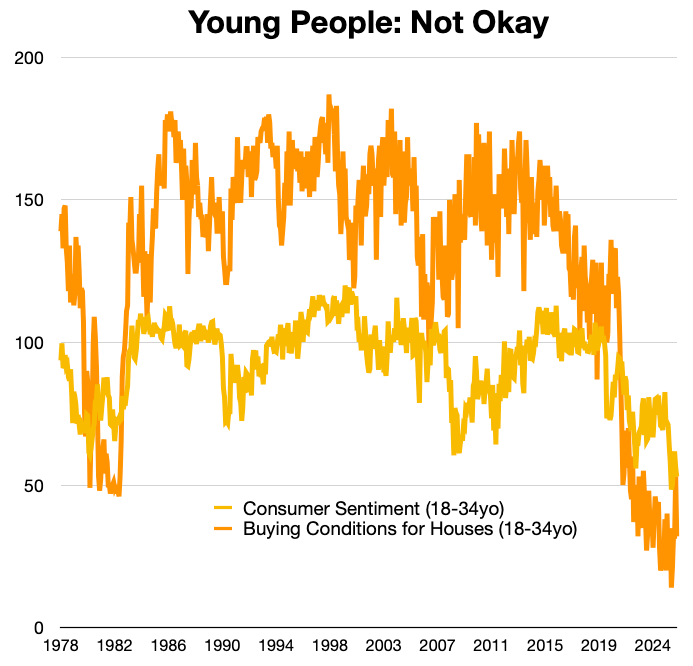
Millennials and Gen Z report record-low economic confidence despite outpacing previous generations in real income, revealing a disconnect between perceptions of decline and nuanced economic data.
While the narrative that Millennials and Gen Z are economically 'screwed' resonates widely, especially given the record-high average age of first-time homebuyers hitting 40 due to soaring prices and mortgage rates, the reality is more nuanced. Analyses from late 2025 highlight that although young adults face deteriorating employment prospects—with unemployment for ages 20 to 24 reaching a decade high excluding the pandemic—the evidence behind the doom-and-gloom narrative is often incomplete or partially incorrect, suggesting a complex interplay between objective challenges and perception.
The so-called 'vibecession' phenomenon, spanning 2023-2024, encapsulates a striking disconnect between strong macroeconomic indicators and persistently bleak consumer sentiment among younger generations. Despite economists reporting historically robust conditions, indices like the Survey of Consumers and Gallup Economic Confidence show that 18-to-34-year-olds' economic 'vibes' have plunged to all-time lows, worse than during stagflation or the Great Recession. This paradox is partly fueled by transient real wage declines during inflation spikes and a lag in sentiment crashing until COVID, underscoring how subjective feelings of being 'permanently locked out of opportunity' diverge sharply from objective data.
Contrary to popular belief, Millennials and Gen Z have achieved real median household income gains comparable to or exceeding those of previous generations at similar ages, with studies showing Millennials earning 20% more than their predecessors and even surpassing income benchmarks in their 20s—albeit later due to extended schooling. However, these income gains are overshadowed by wealth accumulation challenges, especially housing affordability, where assets deflated by soaring home prices reveal millennials’ purchasing power to be roughly half that of boomers. This housing squeeze, coupled with skyrocketing rents for new tenants in major cities, creates a tangible barrier that income data alone fails to capture.
Public perception increasingly aligns with the lived economic hardships of younger generations, as reflected in surveys showing a sharp rise in the belief that key financial milestones—finding a job, buying a home, paying for college, and covering basic expenses—are harder today than for previous generations. By mid-2026, 64% of adults said finding a job is more difficult, and an overwhelming 87% viewed homeownership as less attainable, mirroring data revealing lower rates of full-time employment, financial independence, and independent living among 21-year-olds compared to 1980. This convergence of subjective sentiment and objective socioeconomic indicators validates the economic anxieties of Millennials and Gen Z, challenging stereotypes that dismiss their concerns as mere 'vibes.'





The High Cost of Belonging
Skyrocketing housing, childcare, and social expectations have raised the baseline cost of adulthood, fueling risky financial bets and amplifying anxiety even as material wealth increases.
The housing affordability crisis has become a central driver of generational economic anxiety, as restrictive zoning and anti-growth policies in highly desirable metro areas have severely limited supply, pushing prices beyond the reach of many young people. Compounding this, many existing homeowners cling to historically low mortgage rates—often under 4% compared to today’s 6%+ rates—further constricting the market and forcing younger renters to delay homeownership. This scarcity and financial pressure have nudged lower- and middle-income renters toward risky speculative behaviors like crypto investing and sports betting, as documented by Northwestern and University of Chicago researchers who describe this as 'gambling for redemption' in hopes of achieving the elusive dream of owning a home.
Rising social and economic expectations, amplified by social media and shifting family dynamics, have dramatically increased the perceived and actual costs of essential life components such as housing, childcare, and education. Economists like Paul Krugman and John Burn Murdoch highlight how Baumol’s Cost Disease inflates labor-intensive sectors, while the rollback of public subsidies shifts more financial burden onto households. Meanwhile, the traditional single-earner family model no longer suffices to maintain a middle-class lifestyle, forcing dual incomes and altering family roles, especially among right-wing males who perceive this as a loss of status. Despite material wealth gains—owning 2.5 times more goods than previous generations—these do not compensate for the heightened expectations and social pressures that fuel economic anxiety.
The Revolution of Rising Expectations and Rising Requirements has reshaped modern life by making previously accepted compromises—such as tolerating unpleasant jobs, material shortages, or lower living standards—unacceptable to younger generations. Legal and social mandates, including stringent child supervision laws and higher housing standards, have raised the baseline cost of living beyond inflation or wage growth, creating a disconnect between improving economic indicators and lived experience. Social media exacerbates this by constantly exposing young people to curated images of wealth and success, fostering a 'visibility asymmetry' that distorts perceptions of relative poverty and success, and intensifies feelings of economic insecurity despite objective gains in real wages and goods quality.
These affordability challenges have profound social consequences, including delayed family formation, extended adolescence, and political upheaval. Declining marriage rates correlate with lower homeownership among Millennials, who are 80% more likely to live with parents or roommates at age 30 than previous generations. The frustration over slowed upward mobility and unmet status expectations—rather than absolute affordability—drives much of the economic anxiety, as highlighted by commentators like Random Walk and Adam Ozimek. Personal stories, such as Jolene Simecek’s struggle to secure a home and balance work, childcare, and education debt, illustrate how the traditional social contract of hard work leading to economic security is fraying under these pressures.



Trust Collapse and Social Fracture
A breakdown in institutional and interpersonal trust, fueled by misinformation and rising costs, has left young adults doubting both the system and their own prospects for advancement.
By late 2025, a pervasive erosion of social trust and institutional confidence was fueling deep social fragmentation and economic pessimism, particularly among younger Americans. Only 35% of young people believed that those with opposing views sought the country's best interests, while half viewed mainstream media as a threat, and less than 30% expected to be better off financially than their parents. This distrust extended beyond interpersonal relations into a broader epistemic crisis, where misinformation and skepticism about traditional institutions led to weakened collective responsibility and a sense that hard work no longer guarantees success, encapsulated by the sentiment, 'The institutions lie!'
Economic stress compounded by cognitive overload created a vicious cycle undermining collective norms and social trust, as articulated in December 2025 analyses describing a 'compound crisis' where economic deterioration and mental fatigue mutually reinforce societal malaise. This dynamic was exacerbated by rising costs in essential but low-productivity sectors like healthcare and education—driven by Baumol’s Cost Disease—and the simultaneous privatization and defunding of social services, forcing households to absorb costs that institutions once subsidized. Paul Krugman highlighted how the erosion of economic inclusion, security, and fairness made it increasingly difficult for individuals to believe they could afford basic life milestones, deepening distrust in institutional efficacy.
Political polarization and tribalism intensified the fragmentation of shared reality, undermining democratic governance and social cohesion by early 2026. Analyses from January 2026 described institutions shifting from conflict resolution to managing appearances, eroding accountability and legitimacy, while governance devolved into performance driven by provocation and identity politics. Jordan Schwartz of Harvard warned that Gen Z’s growing distrust threatened American democracy’s stability, a sentiment echoed by widespread disengagement as citizens 'check out, numb out, drop out' when they lose faith in the system. Social media’s rise since 2013 amplified these divides by exposing vulnerable individuals to radicalizing content, fueling conspiracy theories and social isolation, especially among young men without college degrees.
By mid-2026, the consequences of declining social trust manifested not only in political gridlock and social fragmentation but also in tangible community and economic dysfunction. Distrust in institutions and among citizens disrupted market transactions, with businesses demanding upfront payments due to fear of nonpayment, while poorly conceived policies like 'defund the police' initiatives backfired, worsening public safety and trust—as seen in San Francisco’s retail closures linked to unchecked shoplifting. Scott Galloway’s reflections in Amsterdam underscored the fragility of American democracy, drawing parallels to Weimar-era Germany and warning that the weaponization of legal systems and demonization of immigrants risked catastrophic outcomes if trust and empathy continued to erode. He emphasized that trust is critical social infrastructure—often invisible until it fails—highlighting the urgent need to rebuild transparency, accountability, and shared values to prevent societal collapse.



Disengagement and the Meaning Void
As traditional anchors like work, family, and faith lose relevance, young adults face a surge in loneliness and meaninglessness, with social media and economic precarity deepening the crisis.
Over the past quarter-century, young adults in the US and UK have become increasingly disengaged from traditional economic and social roles, with the share of 20-24 year olds neither working, studying, nor caregiving nearly doubling, as noted by James Burn-Murdoch. This disengagement coincides with a marked decline in the importance of traditional social anchors such as patriotism, marriage, and family, which a 2023 Wall Street Journal poll found are now largely supplanted by money as the dominant 'virtue,' reflecting a moral vacuum where market values fill the void left by eroding communal ties.
Mental health struggles, particularly feelings of meaninglessness, have surged most sharply among liberal, non-religious teens, doubling since the early 2000s, with psychologist Jon Haidt highlighting that religion and conservatism seem to offer some protection against this rise in negative affect. This suggests that the loss of traditional moral frameworks deepens social disconnection and exacerbates anxiety and depression among youth, compounding the broader crisis of identity and belonging.
Since around 2013, social distrust and isolation have intensified, especially among young men without college degrees who suffer from prolonged lack of affectionate touch—a fundamental human need—contributing to worsening health outcomes and social pain. This period also saw the rise of mobile social media, which correlates with increased conspiracy theories and antisemitism, further eroding community trust and cohesion, while economic precarity driven by a slow but steady wealth transfer from younger to older generations fuels radicalization and fragmentation, as older voters consolidate resources at the expense of youth.
By early 2026, the breakdown of traditional institutions that historically manufactured community and identity—such as schools, print media, and the nation-state—has accelerated, with younger generations spending significant time in decentralized digital spaces like gaming and Discord servers. Filipinos earning more than the national minimum wage through games like Axie Infinity find not only income but vital social bonds and belonging in these virtual guilds, highlighting how technology, including AI as an 'identity solvent,' simultaneously offers economic opportunities and deepens the crisis of human identity and community in an increasingly fragmented world.

Anxiety’s Political Aftershocks
Economic fears and shifting gender norms are driving political radicalization and social fragmentation, as youth gravitate toward populist anger and delay traditional milestones.
Economic anxiety, often rooted in genuine feelings of declining living standards and social alienation, profoundly shapes political attitudes, especially among younger generations. Despite debates over claims like the $140,000 poverty line, analysts such as Michael Green emphasize that the perception of hardship is real and influential. This anxiety is compounded by shifting household economic dynamics, where Matt Bruenig highlights that rising median incomes owe more to increased female workforce participation than wage growth for men, fostering a sense of falling behind for traditional single-earner families. Moreover, Matthew Yglesias warns that mischaracterizing these economic challenges risks misleading policy debates and complicating democratic governance by obscuring the nuanced realities behind affordability and social expectations.
The interplay of economic anxiety and cultural debates, particularly around gender roles and workforce participation, intensifies political polarization and social fragmentation. Yglesias notes that some conservative currents subtly advocate for restricting women's career opportunities as a solution, reflecting how economic concerns are entangled with cultural identity politics. Social media exacerbates these tensions by fostering a 'condition of universal poverty,' as John Ganz describes, where constant comparison inflates feelings of inadequacy even among the affluent. This distorted perception drives youth to delay major life milestones like marriage and parenthood and fuels risky financial behaviors, deepening generational divides and complicating social cohesion.
By early 2026, economic and social anxieties have catalyzed a shift toward more aggressive, populist political messaging that channels youth frustration into anger and activism. Ross Smith identifies that Democratic messages emphasizing a fight against corporate power resonate far more than traditional appeals to economic stability or the American Dream, which are met with disdain. This emotional manipulation, while energizing political engagement, risks escalating polarization and undermining democratic governance, as evidenced by the rejection of moderate outreach efforts like Kamala Harris's 'Kamala HQ.' The generational gap in political communication reflects deeper cultural disconnects that challenge the building of broad social trust.
Widespread distrust in institutions, fueled by perceptions of systemic rigging favoring elites and exacerbated by social media’s relentless display of wealth, erodes patriotism and undermines belief in the American Dream. Polls reveal that only 26% of young adults feel proud of the US or believe the Dream is attainable without collective support, with economic concerns like housing affordability and job security in an automated economy topping their worries. This disillusionment drives rising support for socialism among Millennials and Gen Z, not out of ideological fervor but as a reaction to exclusion from economic opportunity, as analysts note that those burdened by student debt and unaffordable housing feel alienated from capitalism. The resulting political fragmentation and cynicism pose significant challenges to democratic stability and social cohesion.



Rebuilding Trust and Community
The path forward demands revitalizing high-trust social networks—both offline and online—as decentralized communities and renewed local institutions become lifelines in an era of identity dissolution.
Rebuilding trust hinges on cultivating high-trust environments where cooperation becomes the most advantageous and least costly choice, enabling communities to self-regulate without heavy-handed oversight. As early 2026 analyses highlight, such societies thrive on a shared belief in a better collective future, fostering entrepreneurship and collaboration rather than zero-sum competition. Conversely, low-trust settings breed inaction and tolerance of harmful behaviors due to perceived impunity, underscoring the critical need for mechanisms that restore accountability and mutual responsibility to break cycles of neglect and mistrust.
Institutional renewal must prioritize revitalizing local community pillars—especially religious and civic organizations—that have historically provided role models and pathways to prosperity. By 2026, a notable resurgence in religious engagement among Gen-Z, with belief in a supernatural deity doubling since 2021, signals a fertile ground for these institutions to serve as moral communities that bolster mental health and social capital. Investing in innovative tools to support fragile institutions like churches and youth groups can preserve decades of accumulated social capital, while new models such as Alcoholics Anonymous demonstrate how dense adult networks channel status incentives toward prosocial outcomes, enhancing individual productivity and societal well-being at minimal cost.
In a rapidly decentralizing world where traditional nation-state identity mechanisms erode under the pressures of digital technologies and AI, community itself has become a scarce and precious asset. Emerging decentralized virtual communities—such as blockchain gaming guilds in the Philippines and Venezuela—offer not only economic opportunity but also vital social belonging and identity reconstruction. Recognizing this shift reframes the crisis from purely economic to fundamentally one of human identity and community, demanding new frameworks that address the social void left by weakening traditional institutions and the 'identity solvent' effects of AI.
Restoring trust and opportunity also requires confronting political and media dysfunction that fuels division and erodes civic engagement. Despite national narratives of chaos, local communities remain largely cohesive and trusting, suggesting institutional renewal should emphasize fostering 'civic friendship'—robust debate without hatred—as exemplified by the friendship of Justices Scalia and Ginsburg. This entails reforming media away from identity adjudication toward investigative reporting and rebuilding political culture to treat civic participation as a broad-based responsibility. With 71% of Americans demanding major political reforms—including term limits for Supreme Court justices and electoral changes—there is a ripe opportunity to dismantle systemic roadblocks that hinder economic progress and to connect economic realities with political power to revive the American Dream.
Finally, reviving belief in the American Dream for younger generations requires creating tangible opportunities amid rising affordability challenges and income inequality. By mid-2026, surveys reveal Americans are redefining the Dream around financial stability rather than wealth accumulation, with 84% prioritizing protection over growth. Yet, a significant gap remains between optimism and preparedness: while 70% believe they can improve financially, only 30% have protective measures in place. Employer-sponsored retirement plans emerge as critical platforms where financial advisors can help individuals balance growth with risk reduction, addressing the widespread demand for guidance that integrates wealth building with resilience.