Marketers race for AI certification as skills gap widens
The gist
Marketers are scrambling for AI certifications as platforms, governments, and new laws make AI literacy the ticket to staying relevant—and compliant—in 2026’s digital marketing landscape.
What to know
- LinkedIn, Adobe, Google, and Meta have rolled out multi-stage AI certification programs for marketers to drive skills, engagement, and regulatory compliance by early 2026.
- A 2026 survey shows 69% of US marketing leaders report their teams lack AI know-how, making upskilling and formal certification a must to close the talent gap.
- Marketers’ roles are evolving from tool users to AI system architects and governors, with human strategic judgment still vital to keep campaigns smart—and ethical—despite the automation boom.
AI Credentials: The New Currency
Major platforms are racing to define rigorous AI certification standards, but struggle to measure real skills as vendor-led programs blend business incentives with upskilling.
By early 2026, major platforms such as LinkedIn and Adobe have launched joint training initiatives to tackle the widening AI literacy gap among marketing professionals, reflecting a broader industry trend toward formal certification as a key solution. These structured programs typically follow a rigorous four-stage process—starting with task-level audits and skills taxonomy mapping, progressing through tailored learning paths, and culminating in assessments that award official credentials. However, many programs struggle to define measurable competencies beyond vague labels like 'data literacy,' highlighting a critical challenge in creating truly effective certification frameworks.
Industry giants including Google, Meta, and LinkedIn dominate the formal certification landscape by offering role-based courses and exams that not only validate AI and digital marketing skills but also incentivize platform spending and partner status. For example, Google’s Skillshop provides free certification exams that require renewal every 12 months, Meta’s Blueprint courses are free but charge $99 to $150 for certification, and LinkedIn’s Ads Agency Certification, launched in May 2026, serves as a trusted verification layer for agency competence. This vendor-led model thrives because certified account managers tend to spend more confidently and heavily on the platforms that certify them, creating a symbiotic relationship between education and business growth.
The urgency of formal certification programs is underscored by recent research revealing that 69% of senior US marketing leaders report limited AI knowledge within their teams, while 46% cite insufficient training as a major barrier to AI adoption. This skills gap is further compounded by emerging regulatory frameworks like the EU AI Act, which mandates training obligations for AI system providers and deployers, effectively turning upskilling into a compliance imperative. As a result, formal certification programs are poised to become not only educational tools but also essential components of legal adherence and risk management in marketing AI deployment.
Academic institutions are also stepping into the formal training arena with comprehensive, blended certification programs designed to equip marketers with end-to-end AI capabilities. For instance, the American University of Cairo’s AI for Marketers program, launching in October 2026, offers a mix of live-online and on-campus sessions that cover the full marketing lifecycle—from customer data analysis and workflow automation to AI-assisted content creation and advertising strategies. Notably, the curriculum includes a dedicated module on the ethical limits of AI in marketing, reflecting a holistic approach that balances technical proficiency with responsible AI use.

Leadership: The Real AI Bottleneck
Marketing’s AI transformation hinges on leaders who can drive cross-functional change, break down silos, and embed AI governance—proving that technology is only as strong as the culture behind it.
By early 2026, 87% of senior marketing executives identified organizational readiness—not technology access—as the primary barrier to AI adoption, underscoring the critical role of leadership in driving cultural change and fostering cross-functional collaboration. Leaders are urged to cultivate distinctly human qualities such as curiosity, collaboration, and higher-order thinking to complement AI capabilities, as mundane tasks become automated and teams must adopt new mindsets to thrive.
Effective AI integration demands breaking down silos and encouraging collaboration across marketing, technology, data, commerce, creative, and customer-service teams rather than confining AI efforts to isolated innovation units. Leadership must balance growing internal talent to preserve institutional knowledge essential for AI automation while managing reliance on external agencies, ensuring that AI initiatives are sustainable and deeply embedded within the organization.
Organizational AI readiness hinges on robust governance and execution capabilities that transform AI outputs into trusted, actionable outcomes, a point emphasized by Phil Alexander, CEO of AnswerMyQ, who notes that readiness is measured by reliability rather than volume of AI deployment. To support this, companies are establishing AI Centers of Excellence as dynamic repositories featuring internal use cases, live learning recordings, and AI news, making AI adoption tangible and accessible for marketing teams.
Leadership engagement is pivotal in fostering AI literacy and adoption, with C-suite executives actively demonstrating AI use themselves to model behavior and align AI initiatives with business KPIs. Programs like the AI Answers series in partnership with Google Cloud, alongside personalized learning journeys such as SmarterX’s AI Academy offering department-specific certificate courses, exemplify how organizations are creating supportive cultures and tailored education pathways that meet employees where they are, easing resistance through practical, relatable AI use cases embedded in existing workflows.

AI Literacy Goes Mainstream
From federal mandates to grassroots bootcamps, both public and private sectors are making practical AI education a workforce requirement, democratizing skills far beyond tech teams.
Government agencies like the National Geospatial Intelligence Agency (NGA) are embedding AI literacy into workforce development by mandating AI and data management training for both new hires and existing employees, reflecting broader federal priorities outlined in the White House AI action plan and the Pentagon AI acceleration strategy. As Rear Admiral Michael Baker emphasizes, this comprehensive approach ensures the entire workforce attains the fluency necessary to meet strategic objectives, a sentiment echoed by Udemy's Chris Wilson who highlights AI literacy as a critical element for successful plan execution.
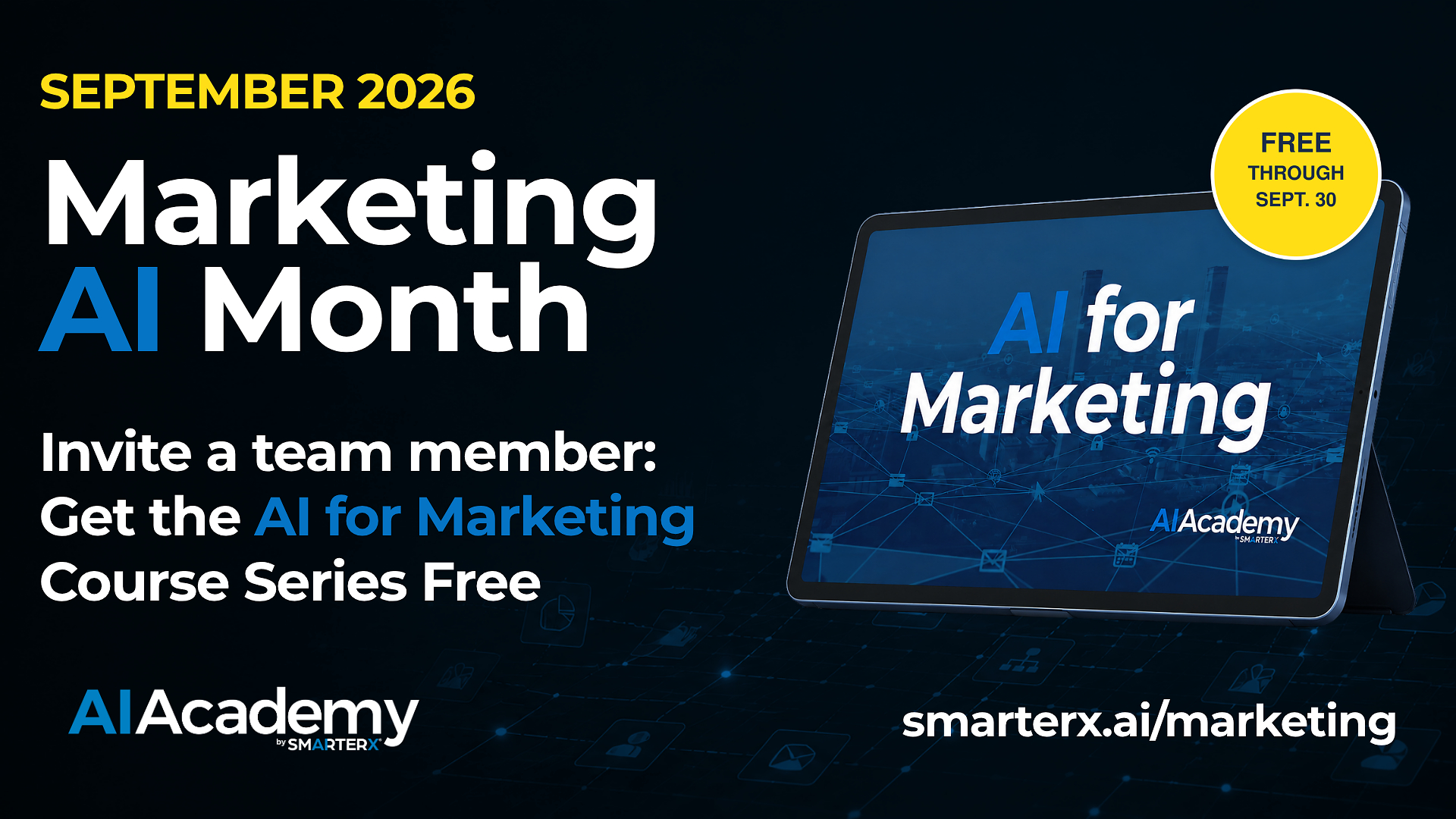
Complementing formal government efforts, SmarterX’s Marketing AI Month exemplifies community-driven initiatives that democratize AI marketing skills through accessible, practical education. Offering a free, self-paced five-course series delivering 3.5 hours of focused learning, the program guides marketers from foundational AI understanding to actionable application, culminating in an AI for Marketing Professional Certificate that validates newly acquired skills and empowers participants to implement AI strategies effectively.
Beyond structured coursework, Marketing AI Month fosters dynamic learner engagement through interactive elements like a live Ask-Me-Anything session, enabling direct dialogue between participants and AI experts. This community-centric approach not only enhances knowledge retention but also builds a collaborative environment where marketers can clarify challenges and deepen their practical AI fluency, reinforcing SmarterX’s commitment to making high-quality AI education widely accessible and shareable across professional networks.


Marketers Become AI Architects
As media buyers evolve into system designers and ethical stewards, human oversight and strategic judgment remain essential to keep automated campaigns aligned with business goals.
The evolving role of media buyers in AI-driven marketing is shifting from merely operating tools to architecting and governing AI systems, a transformation underscored by Ankit Desai's vision of the 'AI-led buyer' who creates the system's architecture and defines its guardrails. This shift places marketers at the helm of system design and accountability, ensuring that while agencies and publishers execute campaigns, ultimate responsibility for the parameters and ethical boundaries of AI usage rests with the marketer who signs off on these guardrails.
Despite AI's capacity to automate reporting and campaign execution rapidly, human strategic judgment remains indispensable in the planning phase to ensure that AI-driven media plans address the correct business questions and hypotheses. As Desai cautions, machines may generate plans quickly but lack the nuanced understanding necessary to validate the underlying business rationale, highlighting that human oversight is critical to maintain alignment between AI outputs and strategic marketing goals.