Marketers demand rigorous AI metrics amid data chaos
The gist
Marketers are demanding real, revenue-driven proof from AI vendors as fragmented data and weak processes threaten to turn AI optimism into operational chaos.
What to know
- 77% of B2B marketers say AI metrics in RFPs are weak, fueling frustration and muddling vendor selection.
- Despite a 650% surge in AI adoption, only 9% of organizations have scalable content management—and 60% are stuck with content silos.
- While 64% of marketers believe in AI’s promise, less than half rate their teams or data as actually ready, exposing a yawning gap between confidence and reality.
Revenue Over Vanity Metrics
Marketers are shifting focus from superficial KPIs to financial metrics like customer lifetime value and churn, but the speed of AI-driven experimentation is overwhelming teams with unreliable data and 'hallucinated' insights.
By early 2026, a pronounced shift has emerged in AI-driven marketing measurement, moving away from traditional KPIs like open and click-through rates toward financial and revenue-based metrics that more accurately reflect customer behavior and business growth. This evolution is exemplified by marketers focusing on metrics such as customer lifetime value, churn reduction, and increased spend per customer, which not only make attribution conversations more tangible but also align marketing objectives with broader organizational goals. As one analyst noted, reframing measurement around 'more revenue figures that are more financial aspects of how they're influencing their customers' behavior' fosters a common goal across teams.
AI's capacity to rapidly iterate and personalize marketing content at scale has accelerated the velocity of campaigns, enabling marketers to test myriad micro-segment variations with unprecedented speed. However, this rapid experimentation often outpaces human capacity to process results effectively, raising challenges in managing and interpreting the flood of data. Despite these advances, the reliability of AI analytics remains a critical concern; as one expert cautioned, dashboards can be riddled with 'hallucinated' insights that necessitate painstaking forensic validation, underscoring the ongoing tension between speed and accuracy in AI-driven marketing measurement.

RFPs: The AI Blind Spot
A lack of rigorous AI evaluation standards in vendor selection is leaving marketers unable to distinguish hype from real performance, fueling frustration and undermining ROI measurement.
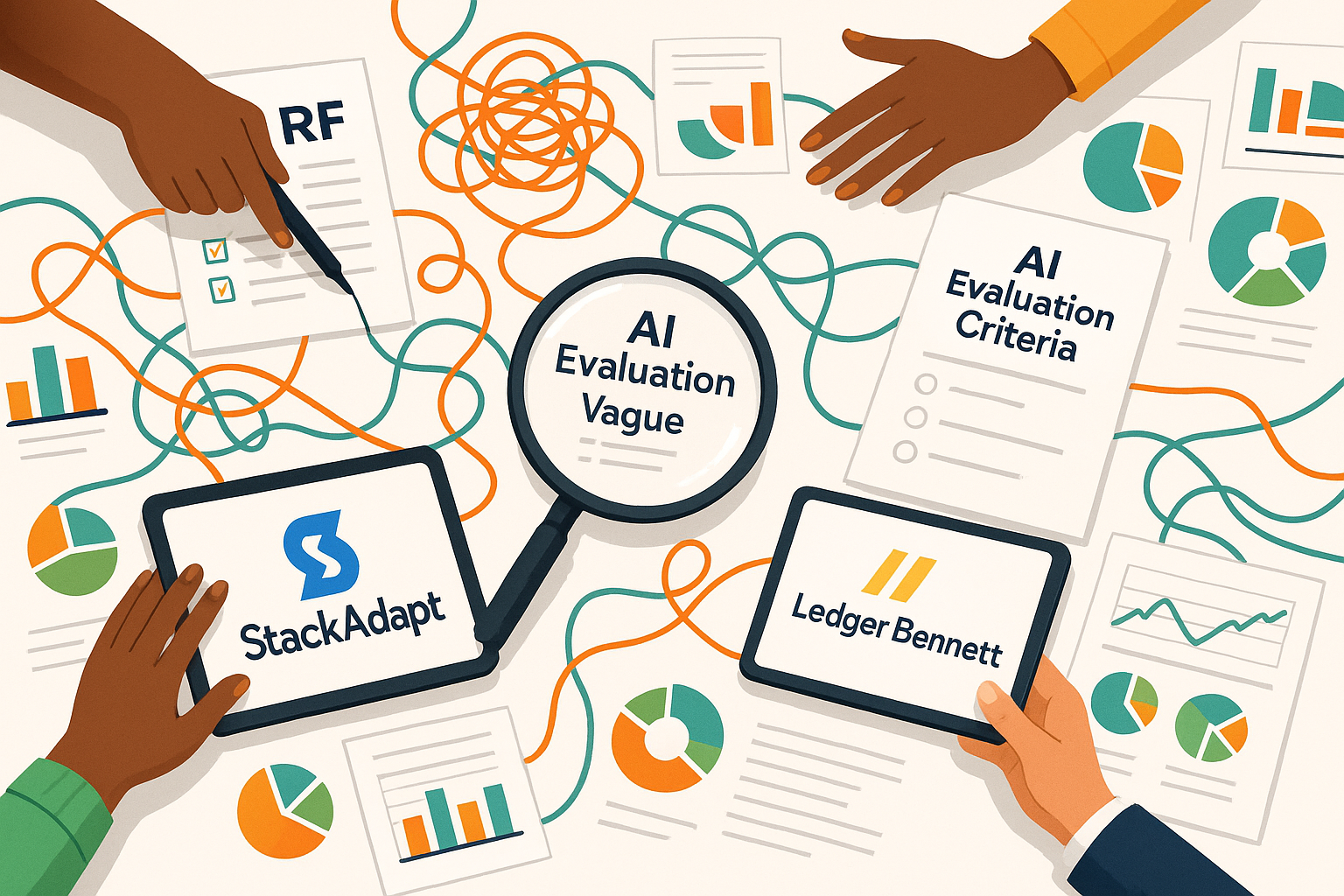
By early 2026, a striking 77% of B2B marketers surveyed by StackAdapt voiced frustration over the inadequate scrutiny of AI capabilities during the RFP process, revealing a critical gap in how vendors are evaluated. This widespread dissatisfaction underscores a systemic issue: the absence of clearly defined criteria to assess AI functionalities leaves marketers ill-equipped to differentiate between vendor promises and actual performance. Consequently, this lack of rigorous evaluation standards perpetuates ongoing struggles in accurately measuring the impact of AI-driven marketing initiatives, hampering efforts to optimize ROI and operational effectiveness.
Data Chaos Blocks AI Scale
Despite explosive AI adoption, fragmented data and siloed content are stalling innovation, forcing marketers to rely on gut instinct and patchwork tools instead of trusted, integrated insights.
By early 2026, the rapid surge in AI adoption—such as the 650% increase reported across European organizations—has starkly outpaced the maturity of foundational data infrastructure, with 54% of these companies admitting their data remains too messy or scattered for reliable AI use. This fragmentation is compounded by widespread content silos, with 60% of organizations acknowledging barriers to critical information access and innovation, while only 9% have achieved fully federated, scalable content management systems. John Newton of Hyland aptly summarizes this paradox: "Europe is pouring money into AI while the information foundation beneath it erodes," underscoring how the neglect of content services maturity (which declined 13 points to 56/100) undermines AI readiness and trust.
Fragmented data environments and immature infrastructure not only hinder AI governance but also stall innovation initiatives, with 57% failing to progress beyond pilot stages due to disconnected silos spread across geographies and processes. As Skykick's CEO highlights, building semantic layers atop integrated data is critical to contextualizing information and unlocking practical AI applications like Finance.360 or Customer360, yet nearly 70% of enterprises struggle to operationalize trusted data to link AI efforts to business outcomes. This illustrates that without foundational integration and governance, scaling AI remains an elusive goal.
Marketing teams exemplify the operational challenges of data fragmentation, juggling an average of six disparate tools to piece together performance metrics, which fosters a visibility gap where 56% rely more on gut instinct than data-driven insights. Bitly CMO Tara Robertson notes the pressure to move quickly often sidelines thoughtful measurement and data leverage, reflecting a broader industry struggle where inconsistent data definitions and siloed ownership degrade AI model accuracy and trust. As one analysis starkly puts it, "AI doesn’t distinguish between disciplined and inconsistent business processes; it learns from both with equal confidence," highlighting the urgent need for standardized governance before vendor or technology selection.
Effective AI readiness hinges on leadership’s ability to clarify data provenance, assign accountability, and establish shared definitions—a foundation often missing in current marketing operations. Manual reconciliation routines may mask fragmentation temporarily, but true confidence arises only when organizations pause to agree on common data ownership and semantics. As one expert advises, before considering platforms or vendors, leaders must answer: Can we plainly explain where data comes from, and is there a named individual accountable? This back-to-basics approach echoes the analogy of early automotive innovation, reminding us that the current 'Model T phase' of AI demands patience and foundational rigor to climb the steep readiness curve.





Workflow Bottlenecks Stall AI Gains
AI has yet to fix marketing’s deep workflow and governance flaws, as fragmented processes, tool sprawl, and lack of accountability keep teams stuck in inefficiency and prevent true scaling.
Despite widespread confidence in AI's transformative potential—64% of marketers express optimism about achieving AI-enabled goals—a significant readiness gap persists, with only 42% and 36% rating their people and data/process capabilities as high, respectively. This paradox is underscored by operational realities: 85% of marketing teams missed campaign launch dates last year due to bottlenecks in approvals, creative production, and cross-team coordination, revealing that AI adoption has improved initial creative drafts but failed to resolve deeper workflow inefficiencies. As Matt Spiegel of TransUnion emphasizes, AI acts as a force multiplier rather than a shortcut, making strong foundations in trusted data, identity, and measurement essential to closing this gap and enabling effective scaling.
Marketing’s struggle to scale AI effectively contrasts sharply with industries like defense and finance, where heavy bureaucracy and defined processes create fertile ground for AI to thrive. Dan Gardner highlights this paradox, noting that marketing’s inherently creative and less structured nature hampers systematization, often trapping teams in an efficiency mindset focused on cost reduction rather than strategic, financially measurable outcomes. Without moving beyond pilot phases into genuine orchestration and integration, AI risks becoming just another tech debt, a sentiment echoed by practitioners warning that fragmented, reactive efforts lacking strategic governance undermine readiness and long-term value.
Fragmented workflows and lack of transparency further exacerbate the confidence-readiness gap, with over half of marketers relying on multiple disconnected tools and informal communication channels like email and Slack for approvals, causing costly delays. Less than half (48%) report sufficient visibility into AI platforms to make confident optimization decisions, while data fragmentation—especially blind spots within walled gardens and across channels—limits the ability to evaluate AI effectiveness comprehensively. These operational and governance challenges highlight that without clear accountability and integrated processes, AI adoption remains stymied, reinforcing the need for leadership-driven AI champions and robust governance frameworks leveraging existing finance and audit controls.
Successful AI scaling in marketing demands more than technology deployment; it requires embedding AI training directly into real projects and workflows, removing small blockers like limited AI usage capacity, and fostering leadership visibility alongside grassroots champions to drive adoption. McKinsey’s research underscores that many companies remain in experimentation phases without fundamentally changing how work is done, while the amplification effect of AI on unclear processes can worsen inefficiencies. Thus, process clarity and operational readiness are prerequisites for AI to deliver measurable business impact beyond mere efficiency gains, which currently dominate success metrics over advanced methodologies like marketing mix modeling or incrementality testing.