MCP and agent protocols reshape enterprise AI
The gist
Anthropic's Model Context Protocol (MCP) and a wave of agent orchestration breakthroughs are rewriting the rulebook for secure, scalable enterprise AI integration—setting new open standards and exposing fresh challenges in trust, governance, and interoperability.
What to know
- MCP, launched by Anthropic in late 2024 and now backed by OpenAI, Google, and Microsoft, standardizes how AI agents connect with diverse tools and data sources—powering over 110 million monthly SDK downloads by mid-2026.
- Agent orchestration has leapt ahead with modular subagents and secure execution sandboxes, enabling parallel, reliable workflows and fueling major productivity gains—like Cloudinary’s 203% ROI and Duco’s fourfold process speedup.
- Despite industry alignment around open protocols like MCP and Google’s A2A, only 25% of large EU firms feel fully prepared for AI integration, and true portability across cloud platforms remains an unsolved challenge.
Origins of MCP: Securing Autonomy
MCP was born from the need to solve agent authorization at runtime, transforming early SRE agent experiments into a global standard for secure, interoperable AI actions.
Arcade.dev’s origins trace back to pioneering attempts to create an autonomous Site Reliability Engineering (SRE) agent capable of solving bugs, which exposed a critical gap in AI agent authorization. As Sam Partee recounts, early AI models struggled with consistent JSON output and lacked established tool-calling methods, making Arcade’s initial work groundbreaking in developing a runtime authorization protocol inseparable from agent actions—a challenge distinct from traditional business logic authorization. This foundational insight drove Arcade’s evolution into what is now an MCP platform, managing both execution and authorization environments to safely enable AI agents to act on users’ behalf across distributed servers worldwide.
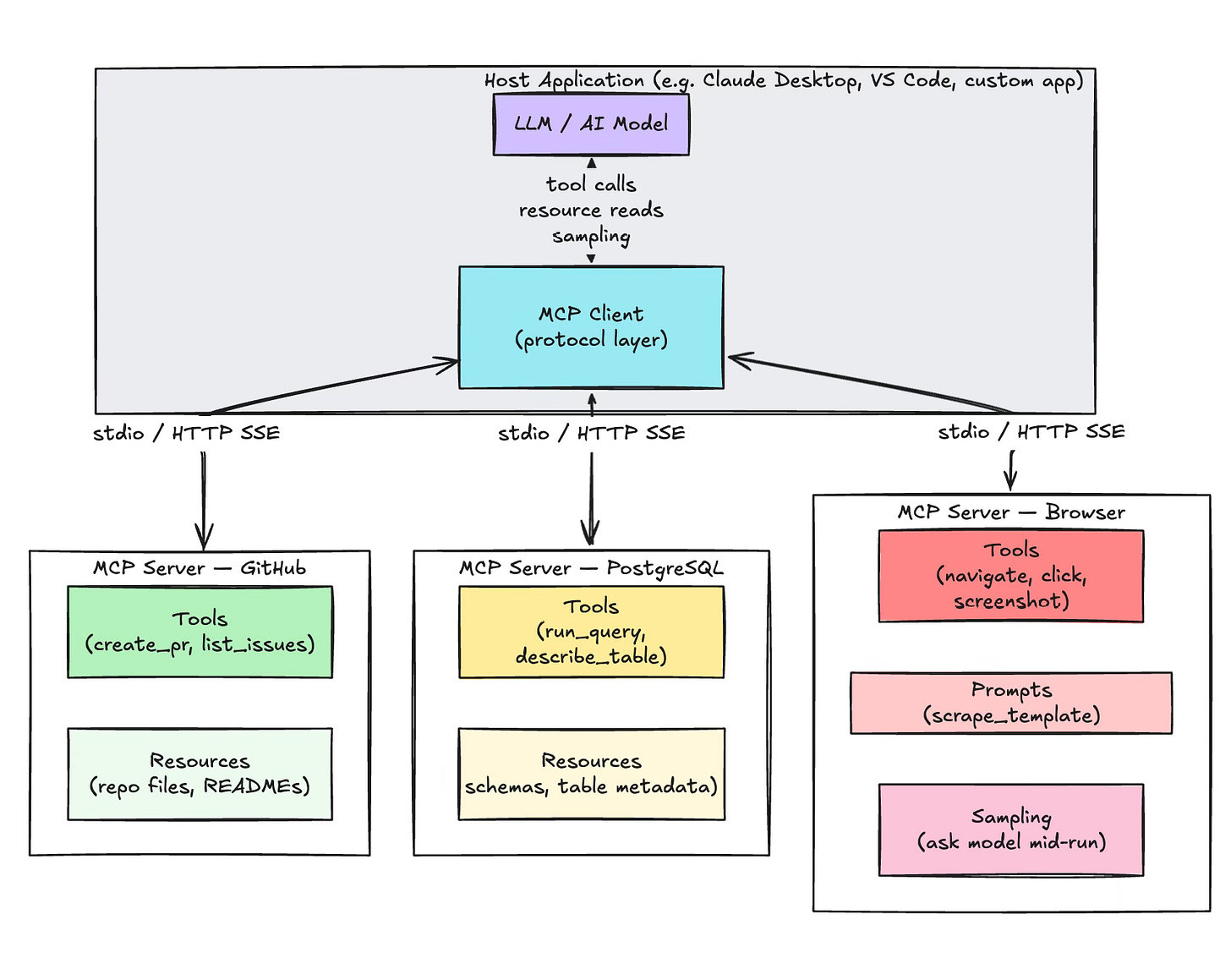
The Model Context Protocol (MCP) emerged from a shared recognition among Anthropic and collaborators like David Soriapara and Justin Spur Summers that AI applications faced a classic N times M integration problem—multiple AI clients needing standardized access to diverse data sources and tools. Initially conceived around early 2023 and officially introduced by Anthropic in November 2024 as an open-source standard, MCP was designed to transcend brittle, bespoke integrations by providing a universal, interoperable 'plug' for AI systems. Its clean client-server architecture using JSON-RPC 2.0 enables dynamic discovery and secure execution of external tools without hardcoded knowledge, effectively transforming AI integration into a scalable, standardized ecosystem.
MCP’s design philosophy prioritizes universal connectivity over optimizing individual components, akin to the standardization of fire hydrant hookups, fostering a network effect that outweighs minor efficiency gains. This approach allows AI systems like ChatGPT and Anthropic’s Claude to seamlessly connect with and control external software—ranging from creative tools like Canva to specialized research platforms—without retraining underlying models. As Ray Poynter highlights, this interoperability is catalyzing a paradigm shift where AI increasingly functions as the operating system for domains such as market research, enabling real-time data access, cross-platform synthesis, and enhanced usability.
The early collaboration between Arcade.dev and Anthropic was instrumental in defining and solidifying the authorization protocols that underpin MCP today. Sam Partee emphasizes that their joint efforts helped transition from bespoke, fragile integrations to a robust, open protocol framework that securely governs AI agent actions on behalf of users. This partnership not only influenced MCP’s formalization but also established foundational standards for safe, scalable AI agent authorization across distributed environments.


Modular Agents, Real Workflows
Subagents and open protocols like MCP and A2A have turned agent frameworks into composable, parallelized systems, powering a thriving ecosystem of enterprise-scale AI integrations.
The rapid evolution of agent frameworks like Claude Code and OpenAI Codex has been driven by the modularization of AI capabilities into subagents and skills, enabling scalable, efficient, and context-isolated task execution. Subagents act as specialized tools with their own isolated contexts, personas, and scoped permissions, allowing complex workflows to be parallelized and token-heavy operations to be offloaded without polluting the main agent’s conversation. For instance, Claude Code’s subagents are configured via metadata-driven YAML files that specify model choice and tool access, enabling cost-effective task specialization such as using smaller models like Haiku for research tasks, while ensuring final outputs are seamlessly integrated back into the main agent’s context.
The Model Context Protocol (MCP), launched by Anthropic in late 2024, has become the foundational open standard for AI agent interoperability, achieving over 110 million monthly SDK downloads by mid-2026 and adoption by industry leaders including OpenAI, Google, Microsoft, and Nvidia. MCP standardizes how AI hosts connect to external servers exposing resources, tools, and prompts, enabling seamless vertical integration of AI models with diverse data and action endpoints. Its design philosophy, likened to a universal fire hydrant or USB-C port, prioritizes broad compatibility and user consent over optimization, fostering a vibrant ecosystem of thousands of servers and SaaS integrations that power real-world autonomous AI applications.
Complementing MCP, Google’s Agent-to-Agent Protocol (A2A), introduced in April 2025, facilitates horizontal communication and collaboration among autonomous AI agents, enabling task delegation, sharing of intermediate results, and coordination of multi-step workflows across organizational boundaries. With over 150 ecosystem partners including Atlassian, Salesforce, and ServiceNow by mid-2026, A2A and MCP together form the backbone of the autonomous AI ecosystem—MCP handling agent-to-tool vertical integration, and A2A enabling agent-to-agent horizontal interoperability. This dual-protocol architecture replaces the previously fragmented, bespoke integrations with a composable, scalable infrastructure reminiscent of the web’s early standardization era.
The expansion of reusable AI skills as modular, self-contained folders with YAML metadata and markdown instructions has further accelerated ecosystem growth by enabling agents to load complex capabilities on demand, drastically reducing context window usage and promoting cross-platform interoperability. Over 25 tools have adopted this open skills standard, allowing agents to conditionally invoke workflows such as code reviews or data analysis only when relevant, and even run skills as independent subagents with dedicated models. This modularity, combined with hierarchical agent architectures that assign heavyweight models to planning and lighter models to execution, optimizes cost and performance while supporting parallelism, recursive feedback, and fine-grained tool specialization.




Enterprise AI: From Demos to Duty
MCP bridges the gap between AI prototypes and mission-critical business operations, enabling governed, auditable agent workflows that deliver measurable ROI across industries.
By early 2026, the Model Context Protocol (MCP) emerged as a foundational infrastructure enabling AI agents to integrate deeply and securely within enterprise systems. MCP standardizes how AI agents discover, access, and act upon curated, permissioned data sources—ranging from Snowflake data warehouses to APIs in platforms like Microsoft Dynamics 365, which supports up to 650,000 automated actions via MCP. This protocol bridges the gap between AI demos and real business workflows by addressing critical challenges such as fuzzy permissions, auditability, and trust, thereby transforming AI from isolated experiments into reliable, governed components of enterprise operations.
Enterprises across diverse sectors have leveraged MCP-powered AI agents to automate complex workflows and enhance productivity, with notable examples including Cloudinary’s AI agents that streamline visual media management and deliver up to 203% ROI, and Duco’s autonomous post-trade platform that slashed process build time from two days to four hours while ensuring regulatory compliance through provable accuracy. Similarly, Greenhouse’s MCP integration offers hiring teams governed, permission-aware AI tool access, securing audit trails and compliance in recruitment workflows. These implementations underscore MCP’s role in enabling scalable, secure, and high-impact AI orchestration in real-world business contexts.
The evolution from personal AI assistants to enterprise-wide multiplayer AI agents has introduced new collaborative workflows where agents share learnings and automate cross-departmental processes, such as sales lead qualification and CRM updates, as highlighted by Gabriel Hubert. However, this shift raises governance challenges, with only 25% of large EU enterprises feeling fully prepared for AI integration, emphasizing the need for robust data access controls and new roles like 'AI operators' to rethink workflows fundamentally. Platforms like Dust exemplify solutions that maintain strict data permissions at the agent and workspace level, ensuring security while enabling broad agent deployment.
Despite rapid adoption and significant productivity gains—such as OpenAI Codex’s deployment to 45,000 Nvidia employees within two weeks—scaling agentic AI in enterprises remains complex, requiring a balance between meeting immediate demand and building long-term safe, reliable infrastructure. MCP’s open standard approach, supported by major cloud providers and tool vendors, facilitates flexible, model-agnostic integration with diverse systems, but also introduces challenges around security, performance, and governance. As AI agents become integral to production systems, embedding accountability, human-in-the-loop oversight, and ethical considerations around transparency and bias amplification are critical to sustaining trust and unlocking durable business value.




Subagents and Secure Sandboxes
The rise of subagents and micro-VM sandboxes enables scalable, reliable agent orchestration—unlocking persistent memory, planning, and autonomous workflows at enterprise scale.
The evolution of agent orchestration has been marked by the introduction of subagents—isolated execution units with narrowly defined scopes and permissions—that enable complex workflows to be decomposed into manageable, parallelizable tasks. Platforms like Claude Code exemplify this approach by allowing users to spawn subagents through configuration files, specifying distinct models, personas, and tool access to optimize cost and performance while preventing context pollution. This granular control not only enhances reliability and scalability but also supports sophisticated use cases such as transcribing segmented Instagram reels or managing token-heavy operations without overwhelming the main agent’s context window.
A pivotal breakthrough in orchestration layers is the deployment of autonomous AI agents within isolated micro virtual machines or execution sandboxes, effectively giving each agent its own secure 'computer' to dynamically execute tasks with full access to traditional Unix programming capabilities. This architecture, highlighted by platforms supporting thousands of simultaneous agents connected via secure tunnels, underpins the scalability and reliability essential for production environments. As one expert noted, 'Agents perform better when you give them tools. If I give this agent its own computer, that is effectively like the most powerful tool,' illustrating how these runtimes transform agents from reactive models into autonomous operators.
The orchestration layer has emerged as the architectural cornerstone of the Agentic Era, shifting enterprise focus from raw AI intelligence to sophisticated coordination capabilities that enable multi-agent workflows with persistent memory, planning, and autonomous decision-making. Meta’s $2 billion acquisition of Manus in late 2025 underscores this strategic pivot, as orchestration platforms unlock scalable, reliable production workflows that generate substantial revenue, rather than merely piloting intelligence. This coordination-centric paradigm is further validated by industry leaders like AWS and IBM, who liken agent orchestration to Kubernetes for containers, emphasizing its critical role in distributing tasks, routing information, and aligning agents toward shared goals.
Despite widespread adoption of AI agents, enterprise deployments face a significant bottleneck in orchestration maturity, with only 7-8% of firms reporting robust governance and many projects at risk of cancellation due to coordination failures. Research from IBM and Gartner highlights the costly operational irregularities stemming from poor orchestration, while case studies from EY and Zapier demonstrate that advanced orchestration platforms supporting hundreds to thousands of agents can achieve high AI adoption and reliability. Effective orchestration platforms must therefore provide runtime governance, context persistence, conditional branching, human-in-the-loop controls, and interoperability standards like MCP and A2A to ensure scalable, explainable, and auditable multi-agent workflows that enterprises can trust.




Trust Infrastructure for Autonomous Agents
Building trust for autonomous AI demands web-scale identity, cryptography, and open standards to ensure agents can act reliably and securely without direct human oversight.
By early 2026, experts recognized that building trust infrastructure for autonomous AI agents necessitates foundational components mirroring those of the World Wide Web—namely a DNS-like system, cryptographically secure certifying authorities, interoperability standards, and attestation mechanisms akin to financial benchmarking. Precision in communication standards is paramount to prevent misunderstandings among agents, as highlighted by the analogy to the telephone game, ensuring that agreements between agents remain unambiguous and reliable.
Given the high autonomy of AI agents operating without human oversight, trust and security frameworks must rely heavily on cryptographic methods and decentralized hierarchies. This shift addresses the unique challenges posed by autonomous decision-making, where traditional centralized controls fall short, underscoring the urgency for robust identity fabrics that can dynamically manage complex inheritance chains of permissions and relationships across humans, applications, and agents alike.
The emergence of open standards such as OpenAI's API standard, Anthropic's Model Context Protocol (MCP), and Google's Agent2Agent (A2A) protocol—supported by industry leaders like Salesforce and the Linux Foundation—illustrates a concerted effort to foster interoperability, governance, and accountability in multi-agent ecosystems. While MCP is already widely adopted for automating discrete tasks, broader use of A2A is anticipated as enterprises scale, though challenges remain in orchestrating control, transparency, and prioritization across organizational boundaries.
Pilot Protocol exemplifies practical trust and identity infrastructure by assigning autonomous agents persistent virtual identities via a UDP-level networking stack, enabling encrypted peer-to-peer communication in a zero-trust environment. This network has demonstrated rapid organic growth—adding up to 16,000 agents in a single day—and is pioneering agent-to-agent economic interactions, including autonomous tool installation and forthcoming payments without human intervention, signaling a scalable, secure foundation for a machine-driven economy.



Standardization and the Portability Gap
While MCP and A2A protocols have unified the agentic AI stack, true portability across cloud platforms remains elusive, as enterprises face vendor lock-in and await open-source solutions.
The emergence and rapid industry alignment around two foundational open protocols, Model Context Protocol (MCP) and Agent-to-Agent (A2A), have been pivotal in standardizing agentic AI infrastructure. MCP, introduced by Anthropic in late 2024 and open-sourced under the Linux Foundation by December 2025, acts as a transport-agnostic, bidirectional 'USB-C for AI tools,' enabling secure, platform-agnostic access for AI models to external capabilities. Complementing this, Google's A2A protocol, launched in April 2025 with over 50 ecosystem partners and also managed by the Linux Foundation, functions as 'HTTP for Agent Collaboration,' allowing AI agents to discover, delegate, and collaborate across diverse frameworks and vendors without exposing internal processes, thus preserving autonomy and privacy within the ecosystem.
By mid-2026, major cloud providers—Amazon, Microsoft, and Google—had converged on a common enterprise agent architecture featuring components such as runtime, memory, tool gateways, identity, observability, and governance, exemplified by Amazon's AgentCore and Microsoft's Foundry platforms. Despite this convergence signaling maturation, the ecosystem still lacks an open-source project or standardized contract akin to PaaS platforms like Cloud Foundry, leaving enterprises vulnerable to vendor lock-in as migrating agent workloads requires rebuilding entire assemblies. This gap underscores the urgent need for unified standards to enable true portability and interoperability across cloud environments.
The launch of Agent Plugins in August 2026, a vendor-neutral open standard collaboratively developed by OpenAI, Amazon, Microsoft, Vercel, and others, represents a strategic shift toward infrastructure standardization by packaging AI agent extensions into modular, portable units. Combining MCP servers and reusable Agent Skills within a simple folder structure governed by a plugin.json manifest, this initiative simplifies integration and discovery across competing AI platforms. While deliberately excluding complex areas like marketplaces and permissions, Agent Plugins aims to democratize access for smaller developers and foster ecosystem growth, though it may also reinforce the dominance of established platforms due to network effects.
Looking ahead, the future landscape of agentic AI infrastructure is shaped by a tension between consolidation and proliferation, with standardized protocols enabling scalable, interoperable multi-agent systems while organizational adoption remains nascent and governance challenges loom large. Experts highlight the transition from personal agents to multiplayer AI workflows that automate coordination across teams, yet emphasize the critical need for embedded governance, accountability, and cross-departmental orchestration to manage data access and prioritization effectively. As Julie Linn Teigland from EY notes, transparency alone is insufficient without control and clear prioritization, signaling that the evolution of these open standards must address not only technical interoperability but also robust governance frameworks.