MercadoLibre doubles down: logistics, fintech, and ads supercharge latin america’s e-commerce titan
The gist
MercadoLibre is turbocharging Latin America's digital economy by fusing e-commerce, fintech, and advertising into one high-powered, growth-fueled ecosystem.
What to know
- MercadoLibre's marketplace generated nearly $80 billion in GMV and Mercado Pago hit 78 million monthly active users, cementing its lead as the region's e-commerce and digital banking juggernaut.
- Its proprietary logistics network now runs 14 distribution centers and nearly 1,000 electric vans, processing over 80% of shipments internally and slashing unit shipping costs by 17% in Brazil.
- Mercado Ads grew retail media revenue by 67% year-over-year in Q4 2025—surpassing $1 billion annually—by leveraging 26 years of first-party data and AI-powered ad tech.
Synergy Powers MELI’s Moat
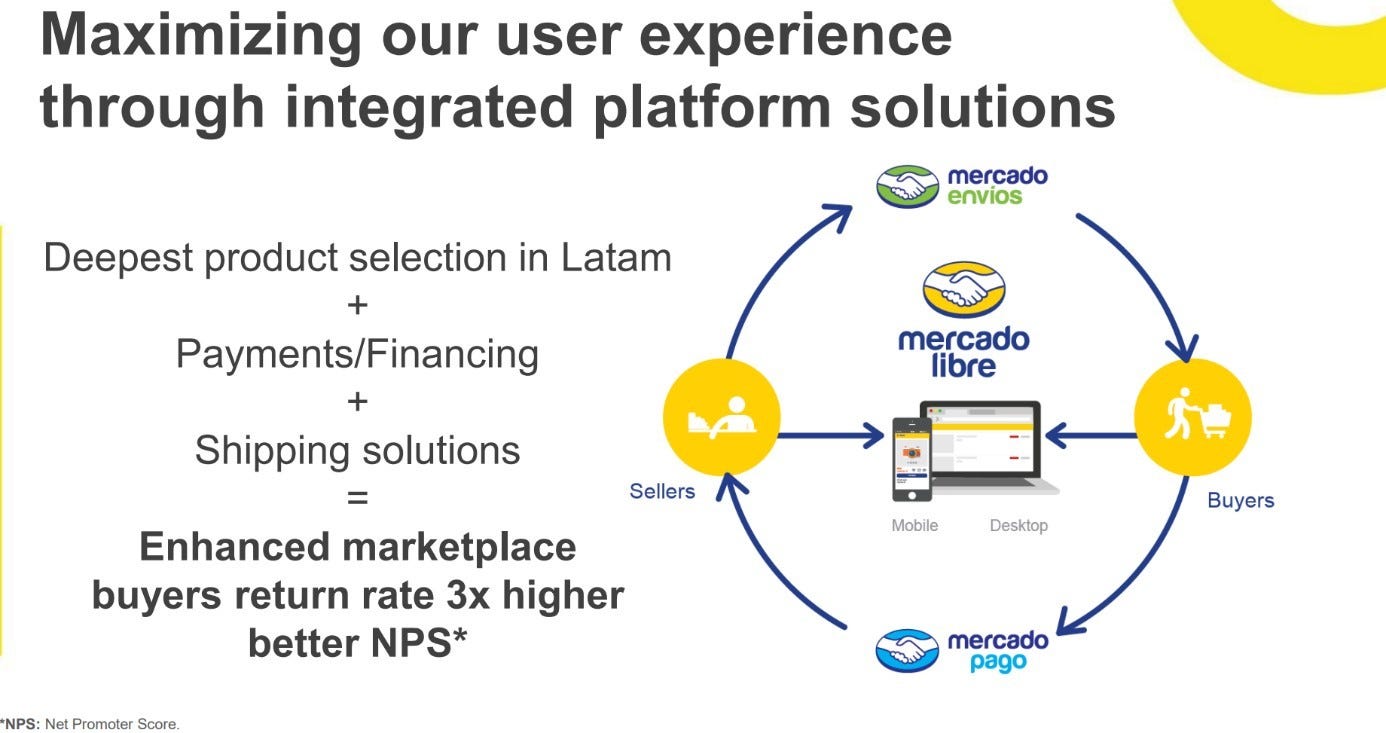
MercadoLibre’s tightly integrated marketplace, fintech, and ad businesses create self-reinforcing growth flywheels, enabling bold, margin-sacrificing bets that competitors struggle to match.
MercadoLibre’s integrated ecosystem masterfully intertwines its marketplace, fintech platform Mercado Pago, and advertising arm Mercado Ads to create synergistic flywheels that fuel growth, engagement, and profitability across Latin America. The marketplace alone generates nearly $80 billion in annual GMV, bolstered by strategic initiatives like first-party retail, Meli+ subscriptions, and cross-border trade to fend off competitors such as Temu and Shein. Meanwhile, Mercado Pago transforms marketplace payment flows into a comprehensive financial ecosystem with 78 million monthly active users and $18.8 billion in assets under management, aiming to become the region’s largest digital bank by leveraging transaction data to extend credit and deepen user loyalty. Complementing these, Mercado Ads capitalizes on MELI’s 26 years of first-party data and AI-driven tools like GenAds to grow retail media revenue at four times the global industry rate, achieving a 67% year-over-year increase in Q4 2025 and surpassing $1 billion in annual revenue by 2025 with near 100% contribution margin, thus reinforcing the ecosystem’s robust revenue streams and competitive moat.
The proprietary logistics network, Mercado Envios, is a critical pillar underpinning MercadoLibre’s ecosystem by enabling reliable, cost-efficient delivery that enhances customer satisfaction and marketplace growth. Operating 14 distribution centers in Mexico and nearly 1,000 electric vans providing same-day delivery across 25 cities, the logistics arm processes over 80% of shipments internally, resulting in a 17% year-over-year reduction in unit shipping costs in Brazil alongside a 41% volume surge in Q1 2026. This extensive coverage, reaching over 94% of the population in key Latin American markets, not only outpaces traditional retailers but also feeds valuable data back into fintech and advertising segments, creating a virtuous cycle of operational excellence and ecosystem stickiness.
MercadoLibre’s deliberate strategy of prioritizing long-term market dominance over short-term profitability is evident in its ecosystem investments, such as expanding free shipping and scaling the first-party retail business, which have compressed operating margins from 12.9% to 6.9%. The rapid 87% year-over-year growth in Mercado Pago’s credit portfolio, while temporarily impacting profitability due to accounting provisions for expected lifetime losses, reflects a bold fintech expansion aimed at financial inclusion by leveraging proprietary data and machine learning to serve underserved populations without traditional collateral. This 'time arbitrage' approach, encapsulated by management’s mantra 'The best is yet to come,' underscores a visionary commitment to building a durable digital economy that few emerging market companies can rival.




Free Shipping Supercharges Growth
Slashing Brazil’s free shipping threshold ignited a surge in unique buyers and GMV, with MercadoLibre recapturing profitability through scale and operational discipline.
By early 2026, Mercado Libre's strategic decision to lower the free shipping threshold in Brazil from R$79 to R$19 catalyzed a remarkable acceleration in growth, doubling the rate of items sold over four quarters and boosting total GMV by 38% on a FX-neutral basis. This bold move not only drove unique buyer growth up 32% YoY but also enhanced customer engagement metrics such as conversion rates and retention, with daily active users growing faster than monthly active users—translating into an estimated one million additional buyers monthly.
Despite the increased costs associated with expanding free shipping and growing its first-party assortment, Mercado Libre has strategically improved unit economics by reducing unit shipping costs by 17%, recovering roughly half of the profitability impact through scale, productivity gains, and pricing adjustments. CEO Ariel Szarfsztejn emphasized that free shipping is viewed as a long-term investment in user behavior rather than a short-term promotional tactic, reflecting the company's deliberate approach to balancing growth with sustainable profitability.
Mercado Libre's aggressive expansion of its Mercado Pago credit card portfolio, which surged 87% YoY to $14.6 billion, underscores its strategic push into financial services as a core growth driver. While this rapid credit portfolio growth has led to short-term margin compression due to upfront accounting provisions for expected loan losses, management remains confident that these investments will deepen customer engagement and position the company for substantial long-term opportunities across key Latin American markets.

Logistics: The Unseen Advantage
Owning the physical delivery network lets MercadoLibre slash costs, accelerate shipping, and lock in a logistics edge that global rivals can’t easily replicate in Latin America.
By early 2026, MercadoLibre had solidified a formidable competitive moat through its proprietary logistics infrastructure, which includes fourteen distribution centers in Mexico, nearly 1,000 electric vans operating same-day delivery in 25 cities, and a cargo aircraft fleet. This extensive network enables the company to process over 95% of its shipments internally, driving down unit shipping costs by 17% year-over-year in Brazil while shipment volume surged 41%, underscoring the efficiency and scale advantages that smaller rivals relying on third-party logistics cannot match.
MercadoLibre’s strategic decision to own the physical movement of goods across Latin America allowed it to circumvent the region’s historically unreliable postal and logistics systems. Launching Mercado Envios in 2013 as a coordination layer, the company evolved it into a fully integrated logistics operation with fulfillment centers and a proprietary delivery fleet, now covering over 94% of the population in key markets. This control not only ensures consistent, faster deliveries that traditional brick-and-mortar retailers struggle to replicate but also enhances the overall customer experience, reinforcing MercadoLibre’s market leadership.
The company’s logistics network is finely tuned for control and scalability: 55% of shipments originate from MercadoLibre’s own fulfillment centers, granting greater inventory oversight and faster dispatch, while the remaining 45% ship from sellers’ warehouses but still rely on MercadoLibre’s last-mile delivery. This hybrid model, combined with rapid infrastructure expansion—such as the upcoming 100,000 m² fulfillment center in Argentina—continues to deepen the company’s moat, enabling a 39% year-over-year increase in same- and next-day shipments and maintaining resilience against aggressive competitors like Temu, Shein, and Shopee.
Fintech Flywheel in Action
Mercado Pago’s data-driven credit ecosystem is transforming payment flows into tailored financial products, driving explosive growth while outmaneuvering traditional banks on risk and speed.
Mercado Pago's evolution from a simple escrow payment feature into a comprehensive fintech ecosystem epitomizes MercadoLibre’s strategic foresight in leveraging transaction data across both e-commerce and physical retail. By expanding off-platform through QR codes and POS terminals, Mercado Pago transformed its identity, enabling tailored credit products and deposit accounts that traditional banks struggle to match due to their lack of real-time, granular cash flow insights. This shift allowed Mercado Crédito to offer merchant loans repaid automatically as a percentage of future sales, consumer loans priced on behavioral data, and a credit card product that continuously feeds spending data back into underwriting models, creating a self-reinforcing financial ecosystem.
By early 2026, Mercado Pago had firmly established itself as a digital bank with a rapidly expanding credit portfolio that grew 87% year-over-year to $14.6 billion, driven largely by a credit card book that doubled to $6.6 billion and now comprises 46% of the portfolio. CEO Ariel Szarfsztejn underscored the credit card’s strategic importance, likening its launch to the pivotal rollout of MercadoLibre’s managed logistics network a decade prior. Despite this rapid growth, Mercado Pago improved asset quality, with the 15-90 day non-performing loan ratio for credit cards falling 80 basis points year-over-year, demonstrating disciplined risk management and a short average loan duration of 2.7 months that allows swift portfolio adjustments amid macroeconomic shifts.
Mercado Pago’s fintech profitability remains robust, boasting a Net Interest Margin After Losses (NIMAL) of 17.8%, roughly triple that of Brazil’s largest traditional bank Itaú, even after margin compression from regulatory provisions and longer loan terms. The company strategically lowers spreads to attract lower-risk customers previously underserved by credit, aiming to increase adoption without sacrificing asset quality. This prudent approach is especially evident in challenging markets like Argentina, where Mercado Pago’s credit portfolio exhibits resilience with stable or improving non-performing loan ratios and rising spreads, contrasting favorably with the broader financial system’s deteriorating credit conditions.
The comprehensive fintech transformation of Mercado Pago is not merely a product evolution but a testament to MercadoLibre’s long-term vision of building a trusted financial institution in Latin America, where consumer distrust of traditional banks is pervasive. By converting idle wallet balances into yield-bearing accounts through Mercado Fondo, the platform deepens customer engagement and locks in liquidity, reinforcing ecosystem stickiness. While this rapid credit expansion has temporarily compressed margins and net income due to upfront provisioning for expected lifetime losses, these are deliberate investments signaling a focus on sustainable growth rather than short-term profitability.
Ads: The Profit Engine
AI-powered retail media is now MercadoLibre’s fastest-growing, highest-margin business, leveraging unmatched commerce data to outpace Amazon and dominate Latin America’s digital ad market.
By early 2026, Mercado Libre's advertising segment had emerged as the company's highest-margin business, expanding at a remarkable pace—growing four times faster than the broader Latin American ad market in 2025 with a 73% year-over-year increase in USD terms. This surge was fueled by the strategic deployment of AI-powered search technology launched in Q1, which shifted the platform from traditional keyword queries to large language model (LLM) search, significantly boosting both organic conversion rates and click-through rates for sponsored listings, thereby enhancing overall advertising effectiveness.
Mercado Libre’s commanding position in Latin America’s digital advertising landscape is underpinned by its vast first-party commerce data and superior attribution capabilities, enabling it to capture over 50% of the region’s retail media ad market. As offline advertising budgets gradually migrate to digital channels, Mercado Libre has not only absorbed this shift but also actively wrested market share from formidable competitors like Amazon, solidifying its dominance and exemplifying the power of its integrated ecosystem strategy.
Ecosystem Dominance Amid Disruption
MercadoLibre’s ecosystem approach, trust-building fintech, and relentless long-term investments have built a resilient digital empire that global competitors and macro volatility have yet to crack.
MercadoLibre has solidified its dominant position in Latin America's largely untapped e-commerce and fintech sectors by evolving into a fully integrated ecosystem that merges marketplace, payments, logistics, and advertising services. By 2026, it operates as the Amazon, PayPal, JPMorgan Chase, and Google Ads of the region simultaneously, serving a population of 660 million still in the early stages of digital commerce and financial inclusion. Its proprietary logistics network—comprising fourteen distribution centers in Mexico, nearly 1,000 electric vans, and the capacity to process over 80% of shipments internally—creates formidable network effects and competitive moats that global giants like Amazon have struggled to replicate locally.
Rooted in lessons from the 2001 Argentine crisis, MercadoLibre’s fintech arm, Mercado Pago, has built trust among Latin American consumers traditionally wary of financial institutions by offering accessible, data-driven credit solutions. Leveraging proprietary data and machine learning, Mercado Pago extends credit to underserved populations without requiring traditional collateral, effectively turning users’ digital footprints into financial access and addressing the region’s vast underbanked demographic. This trusted alternative financial infrastructure underpins MercadoLibre’s resilience amid intensifying competition from global entrants like Temu, Shein, and Shopee, as well as regulatory challenges.
Despite mounting pressure from international competitors and a volatile macroeconomic environment, MercadoLibre’s strategic emphasis on long-term growth through bold investments—its so-called 'time arbitrage' approach—positions it to cement market leadership for years to come. Management’s mantra, 'The best is yet to come,' encapsulates a deliberate choice to prioritize infrastructure-heavy expansion and ecosystem integration over short-term profits, ensuring that the company’s self-reinforcing flywheel of marketplace, fintech, logistics, and advertising services continues to drive sustainable dominance across Latin America.