AI ROI stalls as culture clashes with innovation drive
The gist
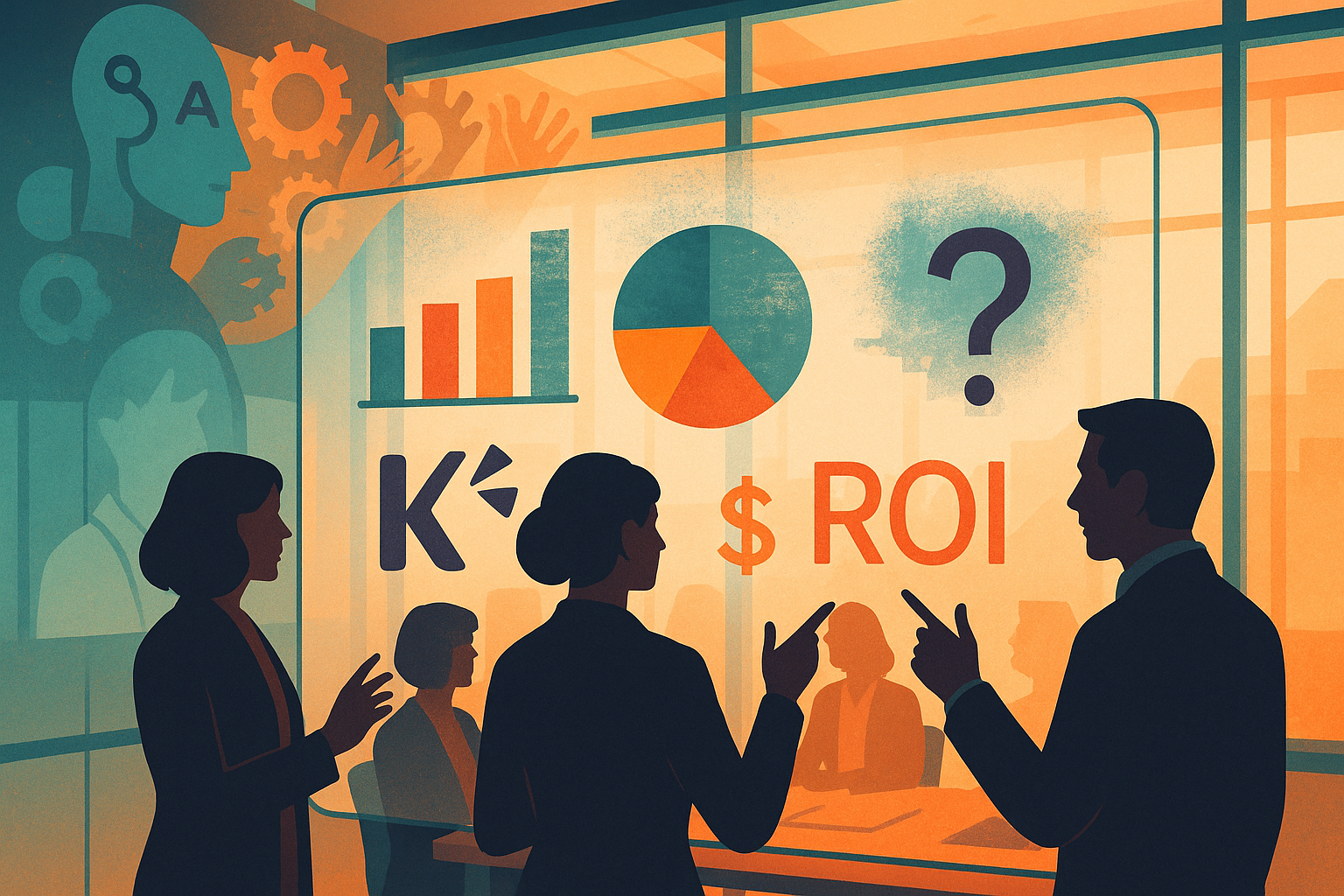
AI’s promise to supercharge business is running headlong into cultural gridlock, with bold experimentation clashing against executive caution and elusive proof of real financial returns.
What to know
- Younger marketers are charging ahead with AI tools, but execs remain skeptical until Fortune 100s show months of sustained revenue gains.
- AI is saving companies like Globe 3-4 hours per employee each week and enabling the creation of over 30 new AI-powered apps, yet fewer than 20% of firms can actually measure financial ROI.
- True innovation hinges on embedding AI literacy and agents into daily workflows, as AI-native firms like Bolt.new hit $1.3M ARR per employee—while most organizations still struggle to bridge the culture and skills gap.
Culture Wars Stall Progress
Generational divides and executive risk aversion are slowing AI adoption, as organizations struggle to balance youthful innovation with entrenched priorities and a persistent gap in critical life skills.
Younger marketers are driving AI adoption by actively experimenting with emerging tools and recognizing AI's evolving potential, yet their efforts often clash with executive resistance rooted in legacy budgeting frameworks and risk aversion. As one industry observer noted in mid-2026, executives hesitate to disrupt proven marketing funnels despite AI’s promise, wary of reallocating what is often the company’s largest expense. However, this resistance begins to wane once Fortune 100 companies observe sustained monetization over several months, shifting AI from a branding novelty to a measurable revenue driver.
The cultural challenge in AI adoption extends beyond technology acquisition to fostering an organizational mindset of continuous learning and adaptability, as emphasized by Bausch & Lomb’s CEO in July 2026. Their enterprise-wide, mandatory AI literacy program—developed with Coursera—aims to bridge the generational divide by equipping all knowledge workers with foundational AI skills, transforming AI fluency from a niche technical capability into a core business competency. Empowering frontline employees with knowledge and permission to innovate has proven critical in overcoming entrenched cultural barriers and unlocking grassroots AI-driven improvements.
A pronounced generational and cultural gap persists between executives and younger talent regarding AI and life skills, complicating workforce readiness and AI integration. While 44% of C-suite leaders acknowledge recent graduates’ strong AI skills, only about 17% believe these newcomers possess adequate life skills—attributes executives still prioritize heavily in hiring and promotion decisions. This tension reflects deeper organizational values that favor traditional human-centric competencies over emerging AI fluency, a divide further complicated by the inherent difficulty in teaching and assessing intangible life skills such as social functionality and hope, as noted by experts like Roberto Rigobon.

AI Boosts, Not Replaces, Talent
AI augmentation is creating more productive, leaner teams and new roles across sectors, with companies that embrace human-AI collaboration reporting both workforce growth and higher performance.
AI augmentation is reshaping workforce roles across industries by enhancing human capabilities rather than replacing jobs, as seen in consulting, radiology, and customer support. For example, the 'augmented consultant' leverages AI tools to focus more on value generation and creative thinking, while radiology has experienced job growth due to increased scan accessibility and reduced costs, contradicting fears of layoffs. This trend is echoed in customer support, where AI automates repetitive tasks, enabling employees to engage in higher-value activities that improve customer satisfaction and revenue, illustrating a broader shift toward human-AI collaboration and talent redeployment.
Businesses adopting AI report significant productivity gains and workforce expansion rather than contraction, with small businesses using AI being four times more likely to hire than cut staff, according to the 2026 AI Impact Report from Intuit QuickBooks. Companies like Globe have empowered over 80% of their employees with AI tools and training, resulting in an average weekly time savings of three to four hours and the creation of more than 30 AI-powered applications across diverse functions. This approach emphasizes continuous learning and responsible AI adoption, positioning AI as an enabler of human potential rather than a threat to jobs.
In sales and go-to-market teams, AI enables leaner, more effective operations by automating routine tasks such as research, CRM management, and communication drafting, allowing a smaller number of senior sellers to manage deals end-to-end. AI-forward companies with $10M to $25M ARR operate with roughly 43% fewer GTM employees yet achieve higher quota attainment rates—67% versus 59% for peers—highlighting how AI-driven role redesign and reduced handoffs prevent context loss and boost performance. However, merely adding AI tools to bloated teams without restructuring risks inefficiency, underscoring the need for thoughtful workforce transformation.
As AI takes over simpler, repetitive tasks in customer service and vault management, the remaining human work involves increasingly complex problems requiring enhanced training and new job designs. Companies like Carvana have seen diminishing cost savings as AI handles 'the easy calls,' leaving messier cases for humans, while radiologists continue to provide final judgment despite AI assistance. This evolving dynamic demands separating AI-resolved cases from human-handled ones to accurately measure performance and avoid masking unresolved issues, emphasizing that workforce transformation must include talent redeployment and upskilling rather than layoffs to handle the harder problem mix effectively.





Training Gaps Undercut ROI
Insufficient enablement and resistance to workflow redesign are stalling AI’s impact, as most firms lack the governance and cultural change needed to move beyond isolated tool use to measurable business value.
A critical barrier to capturing AI’s full value lies in inadequate training and enablement, which hampers teams’ ability to leverage AI effectively. As highlighted in the 2026 analysis on common AI failures, organizations often lack standardized platforms and sufficient context for prompt engineering, resulting in fragmented personal use rather than integrated automation. This learning curve, coupled with insufficient leadership commitment to redesign workflows rather than merely overlaying AI on legacy processes, perpetuates underwhelming productivity gains and stalled initiatives.
Measuring AI ROI remains elusive for most organizations, with fewer than 20% able to quantify clear financial returns, according to Zip’s survey and a Keka poll revealing only 23% of HR leaders can prove ROI. Success correlates strongly with the depth of AI deployment across multiple processes and institutionalization into workflows, as Builders—who integrate AI broadly and govern it effectively—experience less shadow AI use and better outcomes. This underscores the importance of governance tailored to organizational risks rather than generic 'governance theatre,' as well as leadership’s willingness to invest in the 'messy, painful, expensive work' of process redesign and learning from failures.
Cultural resistance and change management challenges often overshadow technical hurdles in AI adoption, with experienced professionals reluctant to abandon familiar workflows and reward systems favoring immediate manual task completion over longer-term AI-driven automation. This friction delays ROI realization and fosters a paradox where AI’s efficiency gains translate into heightened output expectations rather than genuine time savings, as evidenced by studies showing employees save hours daily yet feel pressured to increase productivity. Consequently, organizations face the hidden costs of increased cognitive labor to evaluate AI outputs, leading to 'workslop'—fast but low-value work—and highlighting the need for leadership to recognize and manage these trade-offs.
Effective AI implementation demands senior leadership engagement beyond IT, focusing on reshaping culture, accountability, governance, and workflows to foster human-AI collaboration that drives innovation, customer experience, and resilience. Leaders must move away from traditional efficiency metrics and design AI systems aligned with business priorities, compliance, and trust, orchestrating ecosystems that integrate employees, AI agents, data, and digital workflows. As Brookfield’s deployment experience illustrates, foundational investments in data and systems are prerequisites for realizing AI’s value, and leadership’s role is pivotal in navigating this complex transformation landscape.




AI Literacy Reshapes Organizations
AI-native enterprises are embedding agents and skills into every workflow, collapsing product cycles and redefining operational models to drive agility, innovation, and unprecedented per-employee revenue.
AI literacy has rapidly emerged as a foundational business capability essential for strategic innovation and operational transformation, akin to proficiency in English or productivity tools, as emphasized by Shilpa Dua, CHRO at NIIT. However, the challenge lies not in access to AI knowledge but in aligning skill development with business priorities, embedding learning into daily workflows, and measuring impact through outcomes like agility, productivity, and leadership readiness rather than traditional training metrics. This holistic approach integrates skills intelligence, workforce planning, and talent mobility to build scalable, measurable AI capabilities that drive sustained innovation across industries.
AI-driven enterprises are redefining organizational models by integrating AI agents as core operational nodes alongside human teams, enabling unprecedented acceleration in product development and market responsiveness. As Paul Cheek of MIT Sloan highlights, the product lifecycle has shrunk from years to mere milliseconds, with AI-native companies like Bolt.new achieving $1.3 million in annual recurring revenue per employee shortly after founding. This shift fosters a networked enterprise where every team member, from developers to client success staff, actively uses AI tools or manages AI agents, exemplified by Dark Matter Technologies’ comprehensive AI adoption that fuels both efficiency and innovation.
Agent-based automation is transforming internal workflows by empowering employees to implement rapid, data-driven changes with AI agents handling complex, multi-step tasks autonomously. AssemblyAI’s CEO illustrates this with their AI agent 'Dylan claw,' which creates and merges slide decks within 20 minutes and enables real-time website updates by anyone in Slack, dramatically enhancing organizational agility. Similarly, Synthflow’s conversational AI agents manage customer service workflows lasting over 30 minutes, performing end-to-end problem resolution while maintaining memory across interactions, marking a leap from simple triage to comprehensive operational transformation.
Despite AI’s transformative capabilities, human judgment remains indispensable for steering AI integration effectively, ensuring quality, and managing risks. Jeff Dean underscores the critical human skill of possessing 'incredibly good taste' to identify and prioritize the right problems for AI to solve, a nuance AI models have yet to master. This is echoed in engineering and tax due diligence contexts where professionals must interpret AI outputs through first principles thinking and domain expertise, balancing automation with critical oversight. Developing AI literacy that includes directing, challenging, and evaluating AI-generated work is thus vital to maximize AI’s strategic value and foster robust human-AI collaboration.