Microsoft bets big on off-grid gas: AI data center power play sparks new energy era
The gist
Microsoft and Chevron are rewriting the AI energy playbook with a $10 billion, off-grid natural gas gambit in West Texas—sidestepping grid bottlenecks to power the next wave of AI data centers.
What to know
- Project Kilby will transform stranded Permian Basin gas into 2.67 GW of power—enough for over 530,000 homes—starting in 2028, all dedicated to Microsoft's AI campus.
- GE Vernova's industrial gas turbines, sold out through at least 2028, anchor this off-grid model amid a $163 billion order backlog fueled by AI’s surging electricity demand.
- Microsoft is promising community wins—funding grid upgrades, replenishing water, and investing in local job training—to tackle the environmental and social friction of hyperscale AI growth.
Off-Grid Power Revolution
Microsoft and Chevron are turning stranded Permian gas into a 20-year, off-grid energy stream for AI, bypassing grid bottlenecks and setting a new standard for data center power procurement.
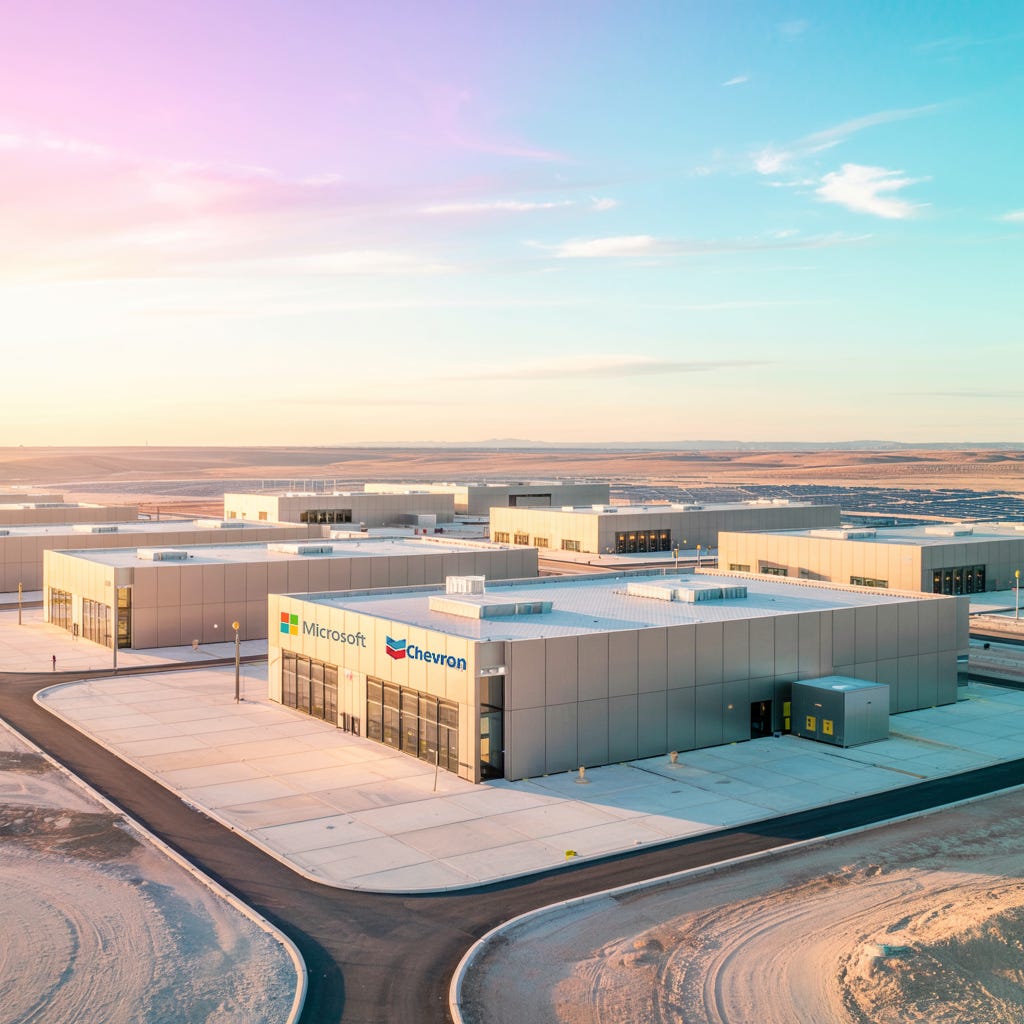
Project Kilby, the landmark 20-year Chevron-Microsoft partnership, epitomizes the strategic pivot to behind-the-meter natural gas power by transforming stranded Permian Basin gas—once flared due to pipeline bottlenecks—into a vital energy source for AI infrastructure. With a massive 2.67 gigawatt capacity set to power over 530,000 homes starting in 2028, this initiative highlights the scale of AI data center power demands driving localized generation solutions that bypass traditional grid constraints.
By situating the power plant directly adjacent to Microsoft’s West Texas data center, Project Kilby operates entirely off-grid, sidestepping ERCOT interconnection queues and avoiding competition with local electricity consumers—a political and operational advantage emphasized by Jeff Gustavson. This behind-the-meter model leverages stranded natural gas with near-zero opportunity cost, converting a disposal liability into a stable, upfront-paid 20-year revenue stream, and exemplifies a financially attractive, repeatable blueprint for AI power procurement.
The broader energy market transformation is underscored by the US grid’s rapidly diminishing capacity headroom, projected to turn negative by 2027, while AI data center capacity is forecasted to surge from 21GW in 2026 to 84GW by 2030. This imbalance makes behind-the-meter natural gas power plants not just a strategic choice but a necessity, providing reliable, firm capacity that the constrained grid cannot supply, and positioning long-term contracted assets as infrastructure investments appealing to a wider investor base beyond traditional energy sponsors.
Microsoft’s pragmatic departure from its 100% renewable energy goal for 2030 underscores the operational urgency imposed by AI’s unprecedented energy appetite, which current renewable technologies cannot meet at scale within relevant timeframes. This reality reinforces the strategic shift toward behind-the-meter natural gas power, which offers a faster, more reliable, and economically viable path to powering AI workloads without exacerbating grid stress or political friction.



GE Vernova’s Turbine Takeover
With a $163 billion order backlog and turbines sold out through 2028, GE Vernova’s industrial gas engines have become the backbone of AI’s off-grid energy surge, reshaping the global power market.
GE Vernova's gas turbines are the linchpin of off-grid AI data center power solutions, exemplified by Chevron's Project Kilby, which will deliver 2.7 gigawatts—enough to power approximately 3 million homes—directly to Microsoft's West Texas facility without relying on the public grid. This massive deployment underscores GE Vernova's dominant market position, with a backlog soaring to $163 billion by early 2026 and expected to hit $200 billion by 2027, driven largely by AI's insatiable energy appetite and the company's sold-out status on heavy-duty turbines through at least 2028.
The strategic use of GE Vernova turbines in behind-the-meter natural gas plants like Project Kilby highlights their critical role in mitigating grid stress while delivering firm, scalable power essential for hyperscale AI workloads. As Pablo Koziner, GE Vernova's chief commercial and operations officer, emphasizes, industrial gas turbines remain one of the leading solutions for reliable, large-scale power, a necessity given AI's unprecedented demand that Bernstein analyst Sunaina Ocalan describes as an 'enormous power demand' driving the energy market transformation.
GE Vernova is not only meeting the AI sector's explosive power needs but also advancing turbine efficiency and sustainability, producing machines that are twice as efficient as those from two decades ago. This technological evolution addresses growing environmental concerns while supporting the AI energy surge, ensuring that as demand escalates—with turbine orders extending into 2030 and beyond and prices tripling in three years—GE Vernova remains at the forefront of powering the AI infrastructure revolution.
AI’s Power Bottleneck Shift
Soaring AI data center demand is shifting the industry’s biggest constraint from chip supply to electricity, with hyperscalers pouring hundreds of billions into securing reliable power as the new competitive edge.
AI's explosive power demands are catalyzing a transformative expansion of hyperscale data centers across the United States, from Texas to the Mountain West, signaling that the AI infrastructure buildout is still in its infancy rather than approaching saturation. This surge has shifted the primary bottleneck from semiconductor manufacturing to the availability of reliable electrical power, as tech giants like Microsoft and Google hold stockpiles of advanced AI chips they cannot deploy due to insufficient grid capacity, underscoring how power infrastructure now dictates AI growth timelines and geography.
The energy market is undergoing a historic realignment as hyperscalers funnel hundreds of billions of dollars into power infrastructure, with Goldman Sachs projecting $736 billion in 2025 spending alone—60-70% of which targets data center and power capacity. This unprecedented capital flow dwarfs previous renewable energy investments and reflects a strategic pivot where securing gigawatts of reliable, dispatchable electricity has become the ultimate competitive moat, with companies like Microsoft locking in 20-year natural gas deals with Chevron to guarantee baseload power essential for AI workloads.
As AI workloads evolve from generative to agentic forms, power requirements could multiply by a thousandfold, potentially pushing data centers to consume over 11% of U.S. electricity by 2035—more than triple current levels. This looming surge necessitates grid expansions estimated at 445 GW by 2030 and could drive over $1 trillion in upgrades, highlighting the critical urgency of overcoming physical constraints such as land, water, and regulatory bottlenecks that complicate AI infrastructure scaling beyond mere chip supply.
The AI-driven energy demand is spawning novel cross-sector alliances and business models, exemplified by Microsoft's long-term power deal with Chevron and Bitzero's 15-year lease securing gigawatt-scale electricity, reflecting a market where power procurement strategies range from owning generation assets to leasing and balancing intermittent renewables with firm gas or nuclear supply. Meanwhile, government policies and grid interconnection approvals have become pivotal levers shaping the pace of AI infrastructure deployment, signaling a new era where energy policy and AI development are deeply intertwined.



Microsoft’s Community Playbook
Microsoft is rewriting the social contract for AI infrastructure by funding grid upgrades, replenishing water, and investing in local job training to preempt community backlash and secure long-term support.
Microsoft's community-first approach to AI data center development marks a significant shift in addressing local concerns over resource use and infrastructure costs. By pledging to cover not only the electricity consumption but also the capital expenses for grid upgrades that typically burden ratepayers, and committing to replenish more water than consumed, Microsoft aims to mitigate environmental and financial impacts that have previously sparked backlash. This transparency and financial responsibility come as a direct response to community pushback, such as the canceled Caledonia, Wisconsin project, where electricity prices and water usage fueled opposition.
Beyond infrastructure and environmental commitments, Microsoft is investing deeply in local workforce development and education to ensure sustainable community benefits from its AI data centers. Partnering with labor unions, the company has launched training programs and AI education initiatives designed to create long-term economic opportunities rather than transient jobs. This holistic strategy reflects lessons learned from earlier community resistance and underscores a broader effort to build trust and shared prosperity around its AI infrastructure expansion.