Bitcoin eyes bottom as ETF inflows fuel rally hopes
The gist
Bitcoin is flirting with a $40,000 bottom as technical signals, ETF inflows, and Fed policy suspense set the stage for a possible monster rally into 2027.
What to know
- Long-term timing cycles and a 14-week RSI rebound suggest Bitcoin is primed for a bounce, potentially launching a rally toward $160,000–$170,000 by 2027.
- With a liquidity-beta of 9.5x, Bitcoin is hypersensitive to Fed moves—rate pauses, inflation data, and geopolitical drama are driving big price swings.
- ETF inflows are at a nine-month high and regulatory limbo in the U.S. could be a make-or-break catalyst, but institutions are cautiously optimistic as market sentiment improves.
Bottoming Signals Intensify
Historic timing cycles, technical momentum, and the 200-week average converge to suggest Bitcoin’s bottom may be just weeks away, setting the stage for aggressive accumulation and a multi-year rally.
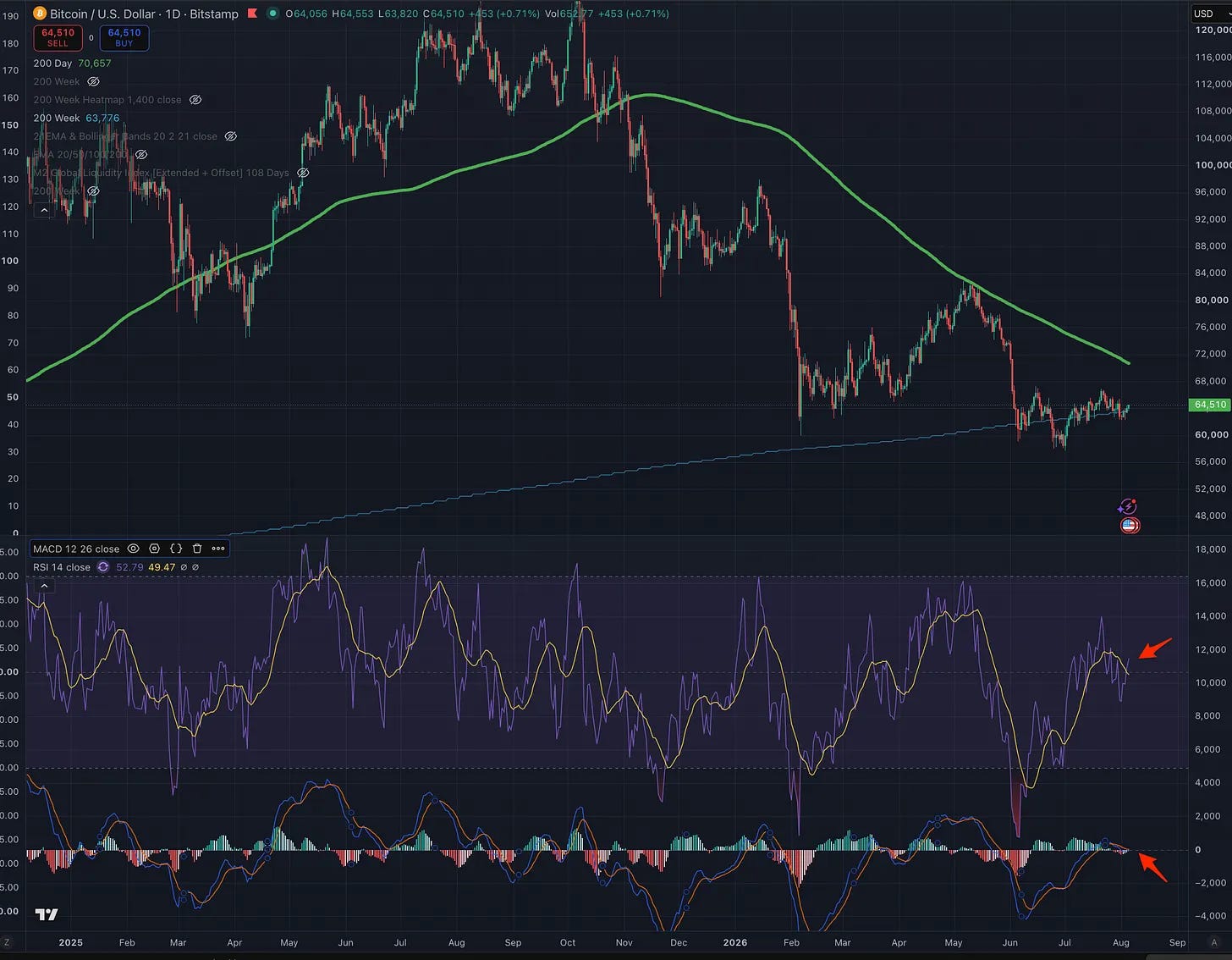
Bitcoin's long-term timing cycles, as analyzed by Sheldon, reveal a pattern of bottoms approximately every 1,400 days, with the current cycle suggesting a near-term bottom may be forming within the next few weeks. This aligns with projections of a potential flush to around $40,000 before a significant rally begins, possibly extending into 2027, indicating that while volatility remains, the market is gearing up for a major bounce.
Technical momentum indicators, including the 14-week and monthly RSI, are signaling improving risk-reward dynamics for Bitcoin. The monthly RSI has nearly bounced off its lowest ever reading at 39.87, and recent higher lows in RSI mirror previous cycle bottoms, suggesting a potential upside surge within the next two weeks. This is further supported by analysts actively taking long positions, reflecting growing confidence in a market bottom and imminent rally.
Bitcoin's price hovering near the 200-week moving average—a historically reliable marker for bear market bottoms—underscores the strengthening technical support at current levels. Analysts note that Bitcoin typically spends minimal time below this average, and the current bear market duration is approaching its typical length, implying that the worst phase may be ending. This buy zone, spanning roughly 5% above the 200-week moving average down to the $40,000 range, is being recommended for accumulation, with some deploying 10-15% of capital accordingly.
Additional rare, slow long-term indicators—such as Bitcoin's price relative to the NASDAQ and gold, its realized price, and its position within broader Bitcoin cycles—converge to suggest that the market is in the latter stages of a macro bottom rather than early bear phases. Furthermore, Bitcoin's downside volatility has been decreasing over successive cycles, dropping from 90% to potentially 50-60% this time, highlighting increasing market resilience and setting the stage for a strong but possibly more moderate rally targeting $160,000 to $170,000.




Liquidity Drives Wild Swings
Bitcoin’s record-high liquidity sensitivity and shifting stablecoin flows are amplifying price volatility as the Fed’s unpredictable policy and global shocks shake short-term demand.
Bitcoin stands out among asset classes for its extraordinary sensitivity to global liquidity conditions, exhibiting a long-run average liquidity-beta loading of 9.5 times—far surpassing other cryptocurrencies and traditional assets. This sensitivity is not static but mean-reverts, meaning periods of diminished responsiveness are typically followed by heightened reactions to liquidity shifts. Historically, when global liquidity expands alongside rising sensitivity coefficients, Bitcoin and other crypto assets have delivered spectacular returns, positioning them as potent hedges against future monetary inflation risks.
Federal Reserve policy decisions remain a critical driver of Bitcoin’s price volatility and market dynamics, with recent rate pauses at 3.5%–3.75% contributing to Bitcoin’s consolidation in the low $60,000 range. However, the Fed’s departure from its traditional 30-year playbook under Chair Kevin Warsh—marked by a lack of forward guidance—has left Bitcoin vulnerable to surprise rate hikes, intensifying market uncertainty. Each FOMC meeting tends to trigger heightened volatility, as traders react to the complex interplay of inflation data, geopolitical tensions like the US-Iran conflict, and energy price shocks that ripple through global liquidity conditions.
Liquidity flows within the crypto ecosystem itself further influence Bitcoin’s price trajectory; for instance, a bearish divergence in USDT stablecoin dominance signals that stablecoin liquidity is actively entering the Bitcoin market, supporting the formation of a near-term price bottom. Yet, despite the Federal Reserve’s rate pause fostering macroeconomic stability, Bitcoin demand remains tepid, evidenced by a negative 30-day spot demand and a widening Coinbase premium discount to -68.7, reflecting fading US demand amid cautious investor sentiment and underwater short-term holders.
The broader macroeconomic and regulatory landscape adds layers of complexity to Bitcoin’s outlook. Geopolitical risks such as the US-Iran conflict have driven Brent crude prices up by roughly 22%, fueling inflation uncertainty that feeds into Bitcoin’s volatility. Meanwhile, regulatory clarity, particularly the stalled Clarity Act, alongside the Federal Reserve reaching peak hawkishness, is expected to unlock renewed leverage and liquidity inflows into crypto markets. This is underscored by the alignment of crypto market makers with bullish equity market momentum—evidenced by new all-time highs in the S&P 500 and NASDAQ—suggesting that improving macro liquidity conditions and regulatory resolution could catalyze a strong Bitcoin rally.




Institutions Weigh Regulatory Risks
ETF inflow streaks and cautious optimism persist despite regulatory limbo in the US and Europe, with legislative delays and strict approvals shaping institutional confidence and market tone.
Bitcoin's institutional market sentiment is showing cautious improvement, underscored by the longest ETF inflow streak in nine months and a positive long-term trend despite short-term volatility. As noted in recent interviews, Bitcoin ETFs have demonstrated resilience by efficiently managing billions in inflows and outflows, reinforcing the ETF structure's liquidity and validity for crypto assets. Market participants with long-term conviction remain optimistic about a near-term bottom and improved conditions by year-end, reflecting a tempered but growing institutional confidence.
Regulatory clarity remains a pivotal yet uncertain factor shaping institutional engagement, with the U.S. Digital Asset Market Clarity Act aiming to delineate oversight between the SEC and CFTC to reduce legal ambiguity. Although the Senate Banking Committee advanced the Act with bipartisan support, ongoing negotiations around stablecoin rewards, DeFi regulation, and political conflicts have delayed a final vote, now unlikely before the August recess. This legislative limbo has not triggered a significant Bitcoin selloff, suggesting the market has largely priced in the delay, yet the Act’s eventual passage or failure could act as a major catalyst or risk, potentially influencing Bitcoin’s price trajectory toward a lower low if stalled.
In Europe, regulatory rigor remains high, as evidenced by Spain’s MiCA authorization process where only 20 of 77 applicants—including six banks—have been approved, with many others denied or withdrawn. This stringent environment continues to shape institutional participation, emphasizing the challenges of navigating evolving crypto frameworks globally. Meanwhile, shifts in stablecoin liquidity, particularly bearish divergences in USDT dominance, alongside ETF inflows, are providing positive technical signals that support a cautiously improving market sentiment amid these regulatory headwinds.
Traditional market strength is bolstering institutional optimism toward crypto, as the S&P 500 and NASDAQ reach new highs, aligning with crypto market makers’ tendencies to follow equities trends. Public endorsements, such as former President Trump urging Senate passage of the Clarity Act, further fuel this sentiment. However, Bitcoin’s recent rejection at its 200-day moving average signals that institutional investors remain prudent, balancing enthusiasm with caution amid evolving regulatory landscapes and Federal Reserve rate pauses.