Modular lasers power pentagon’s shift from demos to deployment
The gist
The Pentagon’s laser weapons just leapfrogged from flashy demos to real-world deployments, powered by modular hardware and billion-dollar budgets.
What to know
- Attalon’s kWIC Disconnect turns complex laser amplifiers into field-swappable units, finally making lasers maintainable like classic Pentagon gear.
- After July’s successful White Sands test, Lockheed and nLight scored an $86 million contract, and Army lasers downed cartel drones in Texas—a U.S. combat first.
- Laser weapons are scaling up fast: new deals could hit $847 million, with prototypes shooting from 20 kW to 500 kW-class systems ready for trucks and containers.
Modularity Breaks the Logjam
Turning high-tech laser amplifiers into plug-and-play modules is ending decades of field maintenance headaches and finally making battlefield lasers as serviceable as Cold War jets.
The mechanism behind laser weapons’ move into real operations is not just more power, but maintainability: Analysis reported that Attalon’s kWIC Disconnect “effectively converts an exquisite and highly sophisticated laser amplifier into a line-replaceable unit (LRU), a major step towards building laser systems that the US military can actually field at scale.” That matters because defense contractors “have been chasing the idea of a truly field-serviceable laser weapon for nearly two decades,” including early efforts like Firestrike and a 2014 Air Force push for field-swappable fiber connections that avoid clean-room repairs. Analysis also links LRUs to the “American defense industrial base since the 1950s,” citing the Air Force’s adoption of “modular, self-contained electronics components on the flight line” to make advanced systems maintainable in operational settings.
The second enabling mechanism is acquisition and integration built around modular scaling rather than one perfect breakthrough: Analysis said the Pentagon is “seeding a bunch of parallel efforts… They’re essentially doing series A rounds for laser systems,” while the Navy progressed from “a 30 kilowatt system” to higher-power steps through separate contracts, not a monolithic program. That approach supports multi-domain adoption because the aim is to “get a prototype on a ship or a truck,” with examples including the USS Ponce and a “50 kilowatt laser mounted on a Stryker vehicle,” while “a pilot program run by the Pentagon’s counter-drone task force is planning to live fire directed-energy weapons later this year, which could be bought on the spot if they perform well.” It adds: “JIATF-401 is going to” run those events, reinforcing the push for rapid operational adoption.




Contracts Follow Real Combat
Laser weapons crossed from demonstration to deployment when Pentagon dollars followed a successful missile shootdown, immediately leading to U.S. forces downing cartel drones in operational scenarios.
The inflection point came in July, when procurement followed proof: Laser Wars reported the headline “Lockheed, nLight Win $86M Pentagon Laser Contracts After White Sands Demo Downs Cruise Missiles,” tying named contractors, a Pentagon award, and an $86 million commitment directly to a successful government test. That sequence matters because it shows directed-energy no longer sitting in the lab as a promising concept; once the White Sands demonstration produced a credible intercept result, the department responded not with another experiment, but with contract action that began converting validation into acquisition.
By late August and into September, that procurement turn was matched by operational use against drones, collapsing the old gap between prototype and mission system. Task & Purpose said the Army was expected to add counter-drone laser weapons to base defenses, while Aviation News.eu reported, “AeroVironment Laser Zaps 3 Cartel Drones in Texas, Marking U.S. Military Border Defense First,” and The Defense Watch sharpened the point with “Army’s 20kW AMP-HEL Laser From AeroVironment Downs Cartel Drones in First US Combat Use” — evidence that fielding had begun, not merely been planned.
Big Money, Bigger Lasers
Pentagon laser weapon deals now approach a billion dollars and leap from 20 kW to 500 kW-class systems, signaling a new era of scalable, high-powered defenses.
The size of the shift shows up first in the money: AOL reported that “Recent Pentagon-awarded contracts could be worth as much as $847 million,” even though the Pentagon press release listed an “initial award value of $86 million,” making clear these are no longer boutique science projects but programs with ceilings in the high hundreds of millions. That July 9, 2026 Golden Dome procurement put hard numbers on the jump, with two agreements to Lockheed Martin Aculight and nLIGHT Defense carrying a combined initial value of $86 million and a program ceiling of $847 million, while nLIGHT alone disclosed $44 million immediately with far larger option value behind it.
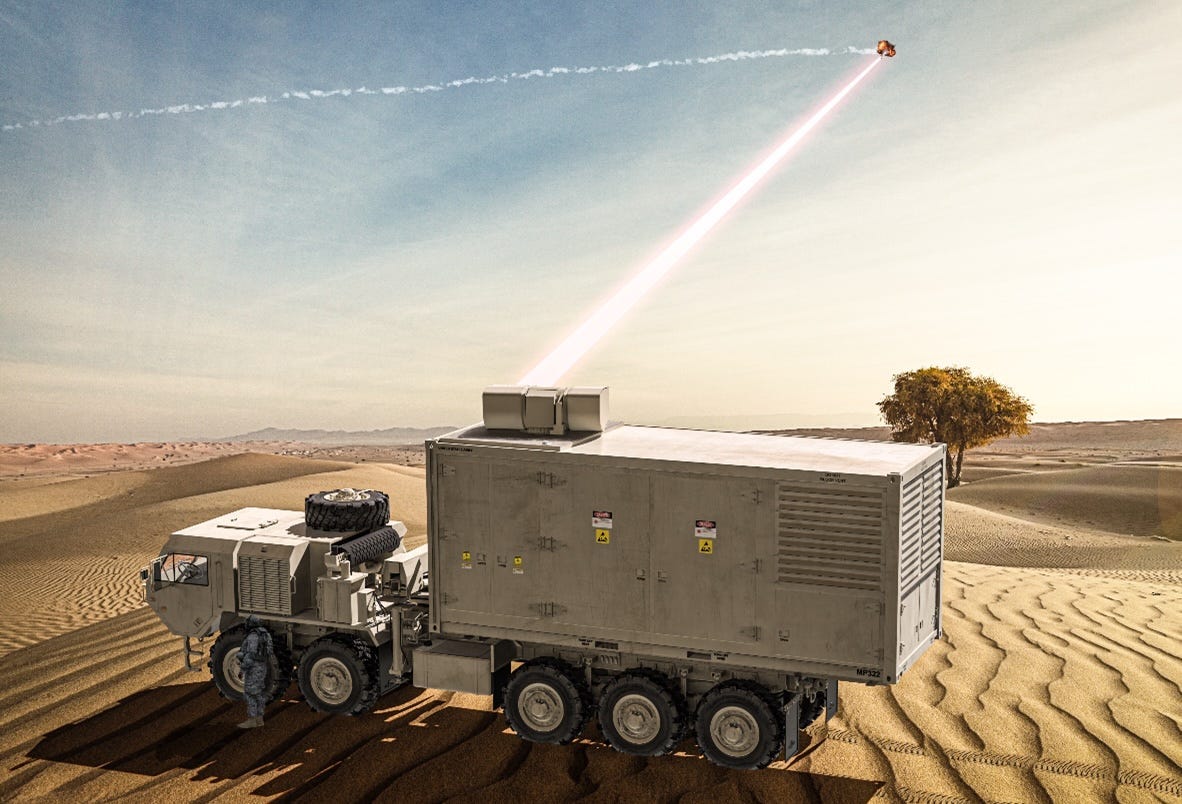
The scale is just as visible in power classes, where systems are moving decisively beyond 20 kW-era hardware toward much larger operational bands. Interesting Engineering reported 20 kW systems delivered to the Army as a baseline, but AOL cited the Pentagon saying “the first JLWS prototypes will generate about 150 kilowatts, while later versions are expected to reach 300 to 500 kilowatts for more effective cruise missile defense,” with 150-kilowatt systems aimed at drones and indirect-fire threats, and the same July 9 award ordering a Lockheed “tactical containerized 500-kilowatt laser weapon system” that the company called “the highest-power laser ever packaged in a transportable container.”
