Mortgage meltdown: FICO's 'ficopoly' faces heat as sky-high credit scoring fees spur calls for competition
The gist
FICO’s monopoly on mortgage credit scoring has triggered a fierce industry backlash, as its jaw-dropping 1400% fee hikes ignite calls for competition and regulatory action.
What to know
- Industry groups like CHLA and MBA accuse FICO of running a 'ficopoly' after a tenfold surge in credit scoring costs over just three years.
- Federal regulators and trade groups are pushing to approve VantageScore—potentially saving $600 million a year—but operational delays and FHFA leadership shakeups are stalling progress.
- New models like FICO 10T and VantageScore promise broader access and lower costs, while FICO’s stock has plunged nearly 40% amid mounting pressure and fintech disruption.
FICO’s Price Power Play
Unprecedented fee hikes—up to 1400%—reveal how FICO’s near-monopoly lets it extract massive profits from lenders, fueling calls for regulatory intervention and new alternatives.
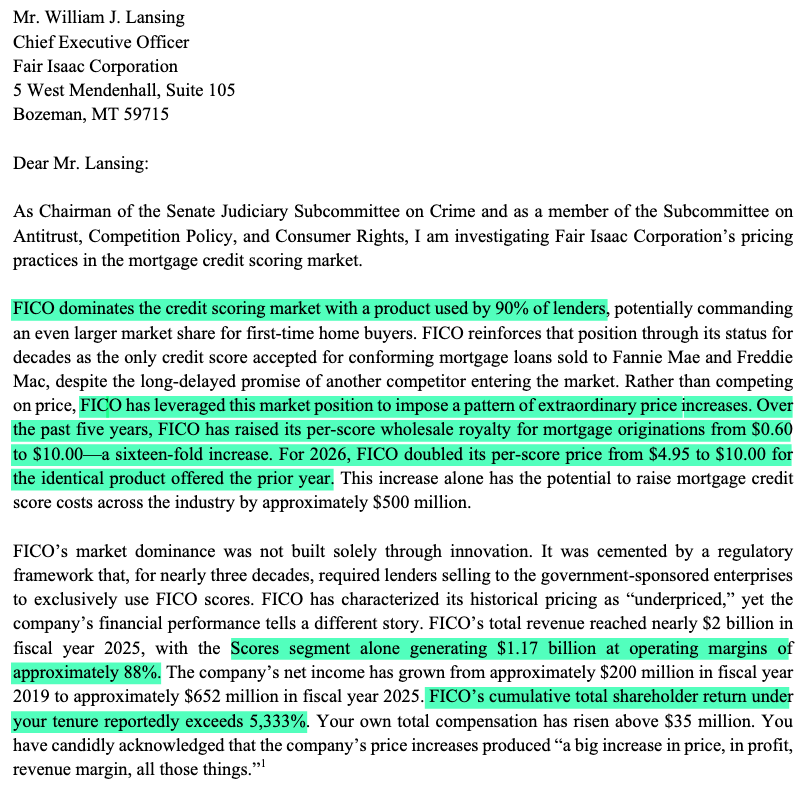
Over the past several years, FICO has dramatically escalated mortgage credit scoring prices, with increases reaching 1400% over three years and a 725% hike since 2022 alone, contributing to a tenfold surge in mortgage credit costs as reported by CHLA. Despite these steep price rises, FICO’s credit score royalties remain a small fraction of overall mortgage production costs, underscoring that its pricing power stems from a near-monopolistic market dominance rather than regulatory mandates.
Industry groups like the California Housing Loan Association (CHLA) have coined the term 'ficopoly' to describe FICO’s dominant and unchecked pricing power, which they argue functions as a monopoly in the mortgage credit scoring market. This dominance has sparked calls for regulatory scrutiny and efforts to introduce competition, with advocates pushing for the approval of alternative models such as VantageScore and suggesting that entities like the FHFA and GSEs develop their own credit scoring capabilities to challenge FICO’s grip.
The financial stakes of introducing competition are significant: CHLA estimates that approving VantageScore as a valid alternative could save the mortgage industry and homebuyers nearly $600 million annually by reducing reliance on FICO’s costly scores. Meanwhile, FICO reportedly embraces its mortgage credit scoring business as a lucrative 'cash cow,' showing little incentive to moderate prices despite mounting public criticism and regulatory attention.



Industry Demands a Shakeup
Mortgage trade groups and regulators are uniting to challenge FICO’s dominance, but bureaucratic gridlock and leadership changes stall real competition and keep costs high for borrowers.
Industry groups such as the California Housing Loan Association (CHLA) and the Mortgage Bankers Association (MBA) are vocally pressing for increased competition in mortgage credit scoring to counteract FICO's dominant 'ficopoly' and its staggering 1400% price hikes over the past three years. CHLA advocates for FHFA to consider developing its own credit scoring capabilities or impose price caps on FICO, while MBA CEO Bob Broeksmit underscores the importance of modernizing credit report requirements and reducing borrower costs by embracing alternatives like VantageScore. This collective push reflects a growing consensus that fostering competition could save the industry and homebuyers nearly $600 million annually, signaling a critical juncture in credit scoring policy debates.
Regulatory and operational complexities continue to challenge the adoption of FICO direct scores, as Freddie Mac and Fannie Mae have yet to approve receiving scores derived from FICO's direct program or the proposed delivery methods by credit reporting agencies. Credit resellers stand ready to offer these scores upon approval, but lenders face potential score variations depending on whether scores originate directly from FICO or through traditional bureaus, complicating underwriting processes. Meanwhile, credit reporting agencies are actively evaluating cost structures amid rising pricing pressures, seeking viable delivery options that balance affordability and compliance.
FHFA Director Bill Pulte has publicly criticized FICO’s pricing strategies, aligning with industry concerns and signaling regulatory appetite to address monopolistic practices in credit scoring. However, despite broad support from both industry leaders like MBA’s Bob Broeksmit and regulatory officials, actual policy implementation remains stalled amid competing priorities within the administration. This delay underscores the complex interplay between political leadership changes and the urgent need to operationalize credit score competition, such as the anticipated FHFA announcement to adopt VantageScore for Fannie Mae and Freddie Mac.


New Models, New Uncertainty
Cutting-edge credit scoring tools like FICO 10T and VantageScore promise wider access and lower costs, but inconsistent data, unclear pricing, and fintech disruption are shaking lender confidence and market stability.
Emerging credit scoring models like FICO 10T and VantageScore are reshaping mortgage lending by integrating trended data and expanding coverage to consumers with thinner credit files, thus broadening lending opportunities. As highlighted in interviews from early April 2026, FICO 10T moves beyond static snapshots to analyze borrower behavior over time, while VantageScore incorporates non-traditional data such as rental and utility payments, although questions remain about data consistency and scoring accuracy. Industry stakeholders are actively educating lenders to prepare for these transitions, aiming to mitigate disruption as adoption grows.
VantageScore’s entrance as a competitive alternative to FICO introduces both promise and complexity: owned partly by the three major credit repositories, it initially offers attractive pricing incentives to encourage adoption, potentially lowering mortgage credit scoring costs. However, experts caution that pricing advantages may diminish by 2027 as the market stabilizes, and the lack of established pricing grids and predictive reliability metrics currently hampers lender confidence. This evolving landscape fuels strategic score shopping and confusion among lenders and borrowers until broader standardization occurs.
Technological innovation is further accelerating disruption in mortgage credit scoring and lending workflows, with AI-driven platforms like JazzX offering end-to-end automation from application through underwriting to boost productivity and scalability. Meanwhile, fintech challengers and large banks are developing proprietary AI credit models that could upend FICO’s long-standing dominance—currently used in 90% of lending decisions—raising investor concerns as evidenced by a nearly 40% drop in FICO’s stock price. This shift toward AI and fintech innovation signals a potential redefinition of credit risk assessment in the near future.
Blockchain tokenization is emerging as a promising, though nascent, solution to specific challenges in mortgage finance, with early traction anticipated in residential real estate markets. Industry voices like OFA Group’s Thomas Gaffney emphasize the importance of assessing regulatory risks and platform credibility as lenders navigate this evolving technology, underscoring the cautious optimism surrounding blockchain’s potential to enhance transparency and efficiency in mortgage transactions.


Politics Cloud Progress
Leadership turmoil and shifting federal housing priorities are stalling credit scoring reforms, leaving lenders and borrowers in limbo as affordability challenges and demographic shifts intensify.
By early 2026, political leadership and federal housing policies have signaled clear intentions to reduce borrower costs through measures such as lowering GSE loan level price adjustments, cutting FHA mortgage insurance premiums—justified by the Mutual Mortgage Insurance Fund's robust 11.47% capital ratio—and modernizing credit report requirements beyond the outdated tri-merge report. Despite this broad support, MBA CEO Bob Broeksmit acknowledges that administrative action has lagged, with the FHFA expected to soon operationalize VantageScore for Fannie Mae and Freddie Mac to foster credit scoring competition, though competing priorities have slowed progress.
The leadership transition at the FHFA under Director Bill Py has introduced significant uncertainty within GSEs like Fannie Mae and Freddie Mac, where employees reportedly fear for their jobs amid shifting regulatory signals. Py's push to adopt alternative credit scoring models such as VantageScore, while aimed at innovation, has caused confusion and operational delays, illustrating how political dynamics can disrupt mortgage lending processes even as they seek to promote competition.
Broader federal housing policies and political distractions continue to divert attention from critical issues like credit scoring costs and housing affordability, with industry insiders expressing frustration over the FHFA's focus on disruptive initiatives rather than stabilizing cost concerns. Compounding these challenges, demographic trends such as an aging population, declining birth rates, and stagnant immigration contribute to geographically uneven housing supply problems, complicating efforts to implement uniform affordability solutions across the United States.