Multi-model routing gains ground across AI platforms
The gist
Enterprises are ditching single-model AI for dynamic multi-model routing, slashing costs and unlocking smarter, more specialized deployments.
What to know
- AWS, IBM, and startups now offer multiple models—like Anthropic, Llama, Mistral, and Nova—letting companies balance cost, speed, and task fit in real time.
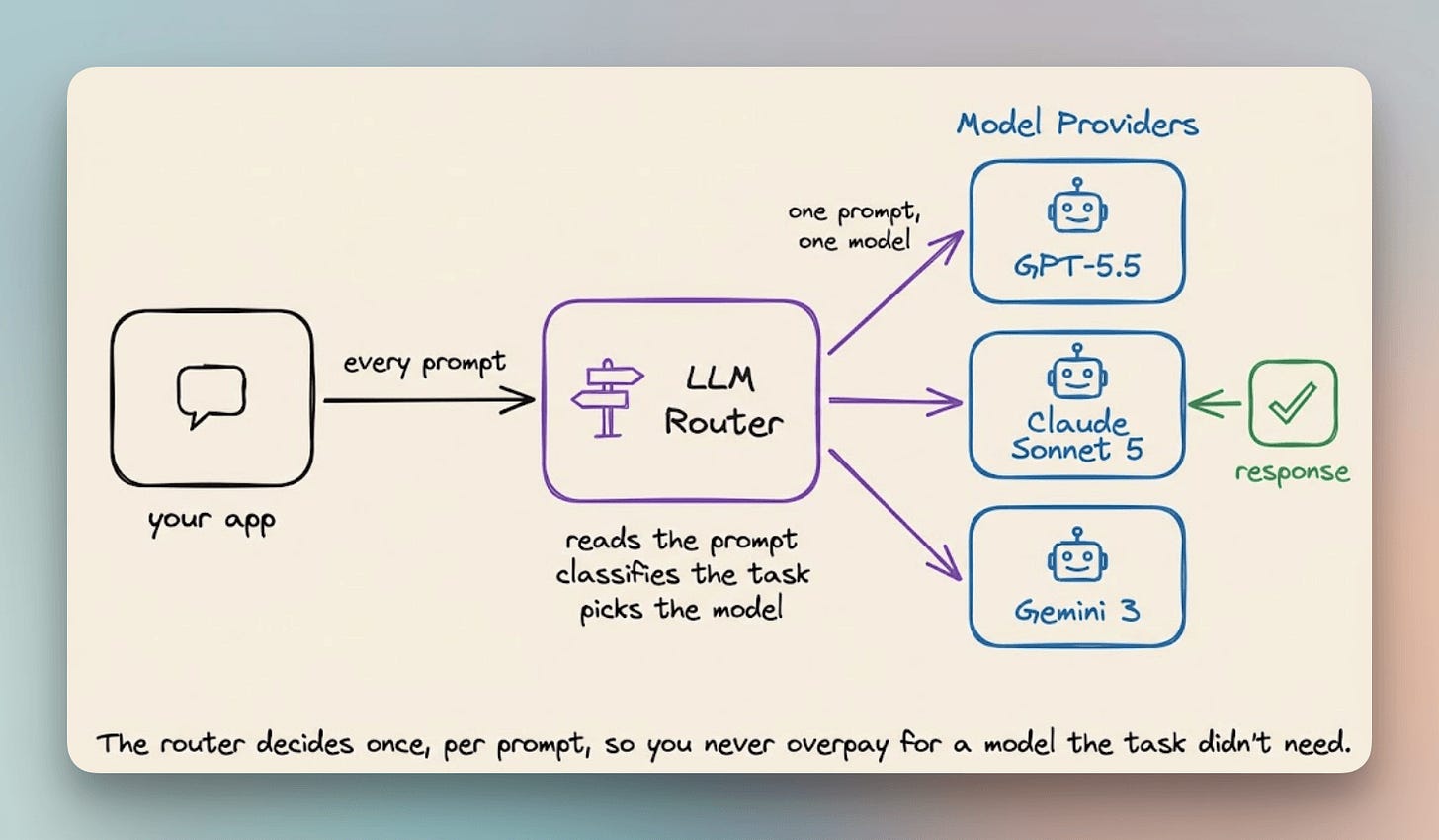
- AI routing layers from One Intelligence and Kilo cut per-request costs by up to 85%, with hybrid architectures and semantic routing picking the best model for each job.
- Unified governance is now mandatory, with platforms like IBM Model Gateway and ServiceNow AI Control Tower enforcing security, compliance, and audit trails across every model.
Hybrid AI Strategies Win
Enterprises now combine frontier and specialized models—sometimes adversarially—to maximize accuracy, agility, and cost control, moving beyond single-model dependence.
By early 2026, enterprises began embracing multi-model AI strategies to balance cost, performance, and task specialization, moving away from reliance on a single large model. AWS exemplifies this trend by offering a diverse portfolio including frontier models like Anthropic, open models such as Llama and Mistral, and cost-effective, low-latency proprietary models like Nova, which plays a crucial role in controlling costs and accelerating feature development. This multi-model approach acknowledges that effective generative AI applications require more than just a strong model; significant refinement at the application endpoint is essential, necessitating flexibility to deploy multiple models within a single application to meet varied needs.
The strategic shift toward hybrid architectures combining frontier and domain-specific models reflects enterprises’ desire to optimize both general AI capabilities and specialized accuracy. As one expert noted, frontier models excel at broad, generic tasks, but customized models with strong product-market fit are indispensable for highly specialized use cases. Companies like Resolve employ adversarial multi-agent systems where different models—sometimes from competing providers—collaborate and verify each other's outputs, enhancing quality and outcomes. This dynamic model selection, continuously evaluated and adjusted, underscores the operational agility required for effective multi-model governance.
Enterprises increasingly recognize the competitive advantage of owning and customizing specialized AI models tailored to their proprietary data and domain expertise rather than relying solely on large frontier models. Leaders from sectors like banking emphasize the risks of depending on general-purpose frontier labs for critical tasks such as risk analysis, advocating for in-house intelligence that leverages institutional knowledge. This approach not only delivers better results and lower costs but also enables faster performance improvements, as enterprises can fine-tune models continuously on their own data, a capability frontier labs cannot easily replicate.
By mid to late 2026, the multi-model paradigm solidified as enterprises adopted orchestration layers and harnesses to route tasks intelligently across a spectrum of AI models, balancing cost, latency, and accuracy. Platforms like IBM’s Model Gateway and Amazon Bedrock provide unified interfaces to access diverse models from multiple providers and deployment environments, simplifying integration and centralizing governance. This architectural evolution addresses the reality that no single model excels at all tasks, enabling enterprises to deploy specialized small language models for edge and domain-specific workloads while reserving large frontier models for complex or unpredictable queries. However, this fragmentation introduces governance and security challenges, making centralized control and auditability essential to manage policies and protect sensitive data effectively.





Orchestration Layers Take Charge
Intelligent routing frameworks are redefining AI economics and reliability, dynamically matching each task to the right model and slashing enterprise costs by up to 85%.
The rise of intelligent AI model routing and orchestration layers marks a pivotal shift in enterprise AI, moving away from reliance on monolithic, expensive foundation models toward dynamic, multi-model ecosystems. Startups and major players alike are building orchestration frameworks that evaluate task-specific needs using proprietary datasets and real-time performance metrics, enabling them to assign workloads to the most cost-effective and capable models. This commoditization of base models has shifted competitive advantage to the orchestration layer, where companies like One Intelligence with its AI Control Plane and Kilo with its Gateway demonstrate substantial cost savings—up to one-third per request—by routing simpler tasks to cheaper models while reserving frontier models for complex work.
Effective AI model routing hinges on sophisticated, often multi-tiered architectures that balance cost, quality, and operational constraints. Frameworks such as Microsoft’s three-layer LLM routing with RouteLLM and OpenRouter’s Fusion system employ semantic and AI-driven routing to dynamically select or parallelize models based on task complexity, achieving up to 85% cost reductions without degrading output quality. These systems incorporate observability, cost visibility, and fallback mechanisms to maintain governance and reliability, while also addressing challenges like session consistency and minimizing quality loss when switching model families mid-task. Enterprises like Coinbase and Snowflake have reported cost reductions of 50% or more by integrating such routing layers, which also improve cache hit rates and reduce redundant processing.
The orchestration of AI models is evolving into a complex, system-level engineering challenge that extends beyond simple model selection to include context management, compliance, security, and infrastructure optimization. Companies like Telnyx leverage private global networks to optimize routing decisions for latency and compliance, while enterprises such as T-Mobile emphasize use-case fit over cost alone, dynamically assigning premium models for latency-sensitive tasks and open-source or smaller models for routine internal workflows. This approach mitigates risks of vendor lock-in and pricing volatility, with routing layers serving as critical control planes enforcing policies, rate limits, and auditability. The integration of multi-provider scheduling and serverless GPU pricing models further enhances cost efficiency and scalability in production environments.
Looking ahead, enterprises are embracing multi-model AI strategies that combine frontier, proprietary, and open-weight models orchestrated through intelligent routing layers to optimize performance, cost, and innovation speed. This trend is supported by the rapid closing of quality gaps between open-source and flagship models, enabling large-scale deployment of cost-effective solutions tailored to specific domains such as coding, legal, and recruiting. The orchestration harness not only routes tasks but also integrates tools, memory, and multimodal inputs, creating a flexible AI ecosystem that adapts to evolving workloads and business needs. As Lin Qiao and others forecast, token costs could drop tenfold in the coming years, fueling a hundredfold increase in AI usage, making cost-optimized orchestration indispensable for sustainable enterprise AI adoption.


Governance Becomes the Moat
Unified, principle-based governance frameworks with clear accountability and continuous monitoring are now the backbone of safe, scalable, and compliant multi-model AI operations.
By early 2026, IBM pioneered a controlled enterprise-wide AI governance framework that balances innovation with risk management through mechanisms like an 'AI license,' ensuring responsible AI development and operational control across multi-model environments. Their unified AI platform integrates proprietary and partner technologies under strict cybersecurity policies, enabling secure, opinionated configurations that facilitate rapid experimentation while maintaining compliance and trust across organizational boundaries.
Emerging platforms such as One Intelligence's AI Control Plane and Snowflake’s Cortex AI Gateway exemplify the critical role of unified governance frameworks in addressing operational complexity, vendor lock-in, and multi-model orchestration. These platforms provide deterministic execution, versioned workflows, dynamic routing, and built-in observability, combining development velocity with robust operational controls and cost visibility to maintain trust, regulatory adherence, and comprehensive oversight in scalable AI deployments.
Comprehensive governance frameworks like ARMCF establish a holistic, principle-based infrastructure that spans the entire AI lifecycle—from governance and risk identification to protection, detection, response, and recovery—anchored by clear accountability with named owners and risk-tiered proportional controls. This approach emphasizes security-by-design, auditability, and continuous monitoring, ensuring that AI systems are managed safely and consistently with observable evidence beyond policy declarations.
As enterprises increasingly adopt multi-model AI environments, unified governance frameworks have become indispensable for managing the complexity and fragmentation inherent in diverse AI deployments. Leaders like IBM’s Manish Goyal and Okta’s Dan Mountstephen stress the necessity of a single governance layer that applies consistent policies, audit trails, and operational controls across all models, agents, and APIs, while governance committees and cross-functional oversight bodies ensure accountability, transparency, and risk management. This orchestration layer, often realized through secure API gateways and AI harnesses, enforces least-privilege access, dynamic routing, and continuous monitoring, transforming governance from a compliance exercise into a strategic enabler of scalable, trustworthy AI adoption.



AI Gateways Standardize Control
Platforms like AI Control Plane and Kilo Gateway give enterprises plug-and-play flexibility and granular cost management by abstracting model complexity across providers.
By early 2026, platforms like One Intelligence’s AI Control Plane emerged to unify visibility, governance, and integration across diverse AI models, addressing operational complexity and vendor lock-in that previously hindered AI production deployment. This platform’s capabilities—such as deterministic execution, versioned workflows, and dynamic routing—enable enterprises to orchestrate multi-model AI applications at scale without rebuilding infrastructure, ensuring operational discipline and cost management.
AI gateways such as Kilo Gateway have become indispensable operational assets by standardizing requests across hundreds of models, allowing enterprises to switch providers with minimal code changes. Their mode-based routing enforces precise policies and cost optimization by mapping task-specific modes to appropriate models, achieving significant cost savings—up to a third reduction in average AI request costs—while maintaining quality through tiered routing strategies that reserve expensive models for demanding tasks.
The integration of AI gateways with serverless orchestration platforms like Modal further enhances enterprise flexibility and cost efficiency by abstracting provider-specific details and enabling pay-for-use GPU-time pricing. This combination supports diverse deployment models—from proprietary to open weights served as a service or self-hosted—allowing organizations to align AI operations with their build-versus-buy strategies while seamlessly switching between models like Gemini, OpenRouter, and Modal without altering core application logic.
As enterprises scale AI adoption, secure API gateways and layered control planes have become critical for enforcing governance, policy, and compliance across multi-model architectures. Unlike relying on a single large model with broad access, these gateways enable least-privilege access, audit trails, and task-specific model assignments—such as small LMs for intent classification and reasoning-optimized models for compliance-sensitive tasks—thereby ensuring security and operational control essential for regulated production environments.
Leading vendors like IBM have recognized that enterprises will not standardize on a single AI model, prompting solutions like IBM’s Model Gateway that centralize visibility, policy enforcement, and unified access across providers and deployment environments. This approach addresses the growing complexity of managing permissions, data flows, and security across multiple AI tools, a challenge underscored by Manish Goyal’s observation that fragmentation, rather than capability, is the primary constraint in enterprise AI governance.
Industry experts emphasize that governance, observability, and cost controls are now table stakes for running AI in production, with platforms like ServiceNow’s AI Control Tower providing continuous oversight across the AI lifecycle. These operational platforms enable organizations to reduce fragmentation by committing to unified ecosystems and foster trust through multi-tiered governance involving board-level oversight, risk compliance, and internal audit, all accessible via AI control towers that offer real-time monitoring and policy enforcement tailored to diverse organizational roles.
The evolution of enterprise AI gateways from simple API proxies to comprehensive inline control points reflects their critical role in authenticating, routing, metering, risk inspection, and logging every AI request. This maturation is mirrored in the market consolidation where standalone AI security layers have been acquired by major cybersecurity firms like Cisco and Palo Alto Networks, integrating AI governance into broader security platforms and underscoring the strategic importance of AI gateways in enterprise security architectures.
To maintain flexibility and avoid vendor lock-in, enterprises are adopting AI abstraction layers and open-source gateways such as LiteLLM and Portkey, which simplify routing and integration of diverse AI models with minimal engineering effort. However, operational orchestration must also address deeper behavioral portability challenges—including prompt tuning, vector compatibility, and tool calling conventions—that require ongoing governance and adaptation to ensure seamless switching and consistent AI performance across evolving vendor ecosystems.
Partnerships combining AI transformation expertise with operational platform capabilities, exemplified by Capgemini and ServiceNow, are enabling enterprises to transition from broad AI ambitions to controlled, scalable adoption. By aligning governance frameworks with practical operational realities, these collaborations provide organizations with the tools and guidance needed to enforce accountability, measure business value, and integrate AI governance consistently across multiple functions, platforms, and workflows.


Competitive Edge Shifts Upstack
With models commoditized, true differentiation comes from orchestration, proprietary data, and domain-driven workflows—areas where internal expertise outpaces AI labs.
As AI models become increasingly commoditized and interchangeable, enterprises are shifting their competitive focus to the orchestration and application layers where startups and internal teams build multi-model systems that dynamically route tasks to the most suitable models. This approach, exemplified by companies like OpenAI with GPT-5’s built-in router, enables cost optimization by assigning routine queries to cheaper models while reserving premium models for complex tasks, thereby balancing performance and economic efficiency. Such multi-model orchestration layers abstract away the underlying model commoditization, allowing enterprises to continuously integrate the latest AI capabilities without being locked into a single provider or technology.
Beyond model orchestration, enterprises derive sustainable competitive advantage from their proprietary data, domain expertise, and operational assets that are deeply embedded in their verticals and regulated industries. Firms like Higgsfield leverage vast proprietary performance data to create feedback loops that optimize AI orchestration without exposing sensitive information to model providers, while banks and financial institutions capitalize on decades of institutional knowledge to build specialized AI models tailored for risk analysis and stock evaluation. This domain-specific customization and continuous in-production improvement create a moat that frontier AI labs, despite hiring domain experts, struggle to replicate due to their lack of operational context and proprietary datasets.
The true differentiation in a commoditized AI landscape increasingly lies not in the base models themselves but in how enterprises integrate AI into their unique operational workflows, decision-making processes, and governance frameworks. Competitive advantage emerges from owning proprietary methods, context, and junction points—composing models, bots, skills, and routines into coherent systems that drive real work completion rather than just generating answers. Well-designed AI governance, as highlighted in recent analyses, acts as a durable moat by enabling safe experimentation, scalable deployment, and consistent controls that prevent fragmentation and inefficiency, thereby fostering trust and accelerating enterprise-wide AI adoption.
Enterprises are embracing a strategic shift toward flexible, multi-model AI environments that prioritize workload portability, cost predictability, and operational resilience. Companies like Adidas exemplify this trend by employing diverse LLMs under predictable commercial models, empowering their teams with a variety of AI tools while maintaining governance guardrails. This flexibility allows organizations to continuously redirect investments, redesign processes, and build new skills in response to evolving AI capabilities and cost structures, ensuring they remain agile and competitive as the AI landscape rapidly changes.