Nasdaq, BlackRock push tokenization into mainstream
The gist
Wall Street titans like Nasdaq and BlackRock are turbocharging tokenized finance, turning blockchains like Ethereum into the backbone of mainstream markets.
What to know
- Nasdaq and BlackRock kicked off the institutional tokenization race, filing with the SEC and launching a $3 billion tokenized money market fund on Ethereum by early 2026.
- Tokenized assets exploded: Figure issued $12 billion in on-chain private credit, DTCC pioneered $10 billion in tokenized Treasuries, and NYSE debuted native on-chain securities platforms.
- New tech and regulatory clarity—plus big names like JPMorgan and Franklin Templeton—are driving tokenization from experiment to essential financial infrastructure.
Wall Street’s Tokenization Playbook
Financial giants are rewriting market rules as tokenization slashes costs, speeds up settlements, and earns regulatory buy-in from the SEC.
The early institutional adoption of tokenization was spearheaded by financial giants like Nasdaq and BlackRock, who took formal steps to integrate tokenized securities into mainstream markets. Nasdaq’s filing with the SEC to enable tokenized securities trading and BlackRock’s launch of Bidd, a $3 billion tokenized private money market fund, underscored a growing recognition of tokenization’s potential to revolutionize asset management. Larry Fink of BlackRock highlighted tokenization as a secular theme alongside Bitcoin, signaling a strategic commitment to this innovation. These moves were complemented by Nasdaq’s regulatory engagement, requesting rule changes to create compliant frameworks that would facilitate broader market acceptance and operational legitimacy.
Operational efficiencies became a compelling driver for early adoption, particularly in private credit markets where tokenization dramatically reduced processing times and costs. Figure’s IPO, issuing $12 billion on-chain, cut loan processing from the industry average of 40 days to just 10, while slashing costs to 30% of traditional levels. This tangible value proposition was echoed by BlackRock’s strategy to leverage tokenization’s 24/7 real-time settlement and global interoperability, enabling investors to maintain liquidity without sacrificing yield—transforming money market funds into digitally native, highly liquid instruments. Such innovations not only enhanced investor experience but also aligned with evolving regulatory standards like the US Genius Act, ensuring compliance and fostering institutional confidence.
Institutional momentum extended beyond asset managers to banks and clearinghouses, with entities like DBS, J.P. Morgan, and the DTCC pioneering interoperable and compliant tokenized deposit frameworks. These initiatives enabled seamless movement of tokenized deposits across permissioned and public blockchains such as Ethereum and Base, bypassing traditional intermediaries like SWIFT. The SEC’s unprecedented approval of a three-year DTCC pilot to tokenize US capital market securities on Ethereum marked a watershed moment, signaling regulatory endorsement of blockchain’s role in mainstream finance. Concurrently, Franklin Templeton’s deployment of $798 million in tokenized mutual funds on the Canton Network demonstrated institutional alignment on privacy and compliance, reinforcing tokenization’s practical viability.
By early 2026, Ethereum emerged as the foundational blockchain platform underpinning institutional tokenization, with BlackRock explicitly endorsing its security and developer ecosystem as critical for Wall Street’s digital asset infrastructure. This endorsement reflected a broader shift from private permissioned blockchains to open public chains and Layer 2 solutions, signaling growing institutional trust in transparent, liquid blockchain systems. Regulatory clarity deepened globally, exemplified by the UK Treasury’s launch of a tokenization task force involving BlackRock, Goldman Sachs, and JPMorgan, focused initially on tokenized repurchase agreements to enhance settlement speed and reduce counterparty risk. Supported by the Financial Services and Markets Act 2023, this initiative marked a transition from experimental pilots to mainstream regulatory acceptance, with operational tokenized markets anticipated within 12 to 18 months.





Asset Classes Go On-Chain
From private credit to treasuries, tokenization is transforming how assets are traded, settled, and managed—fueling 24/7 markets and blockchain-native infrastructure.
The expansion of tokenized asset classes has accelerated dramatically through 2025 and into 2026, with private credit emerging as the fastest-growing segment, exemplified by Figure’s $12 billion on-chain issuance that slashed loan processing times from 40 to 10 days and cut costs to 30% of industry averages. This momentum is bolstered by interoperable blockchain protocols like Ethereum, Solana, Algorand, and Hedera that enable 24/7 trading and composability, creating a robust technological foundation for scaling tokenized securities and enhancing the underlying networks’ utility.
Institutional giants such as BlackRock and JPMorgan have catalyzed market infrastructure development by launching tokenized money market funds and treasury products on public blockchains, primarily Ethereum and its EVM-compatible Layer 2s. BlackRock’s Bidd fund, managing nearly $3 billion, exemplifies how tokenization delivers real-time settlement and liquidity, while JPMorgan’s move from private ledgers to Ethereum mainnet signals a strategic embrace of open blockchain ecosystems. This institutional adoption is further underscored by BlackRock’s endorsement of Ethereum as the foundational infrastructure for Wall Street’s tokenization efforts, highlighting a shift from speculative crypto assets to core financial rails.
The tokenization of traditional asset classes is becoming increasingly diverse and sophisticated, spanning equities, credit, treasuries, and commodities. Platforms like DTCC and Canton have pioneered tokenized U.S. Treasuries with a $10 billion market by early 2026, enabling on-chain native holding and stablecoin backing, while Figure’s OPEN platform introduces blockchain-native public equities with 24/7 liquidity and improved capital efficiency. Despite regulatory and legal fragmentation—such as the distinction between economically backed tokens and regulated canonical shares—market infrastructure is evolving with SEC-approved pilots and Nasdaq’s plans to list tokenized securities, signaling growing mainstream acceptance.
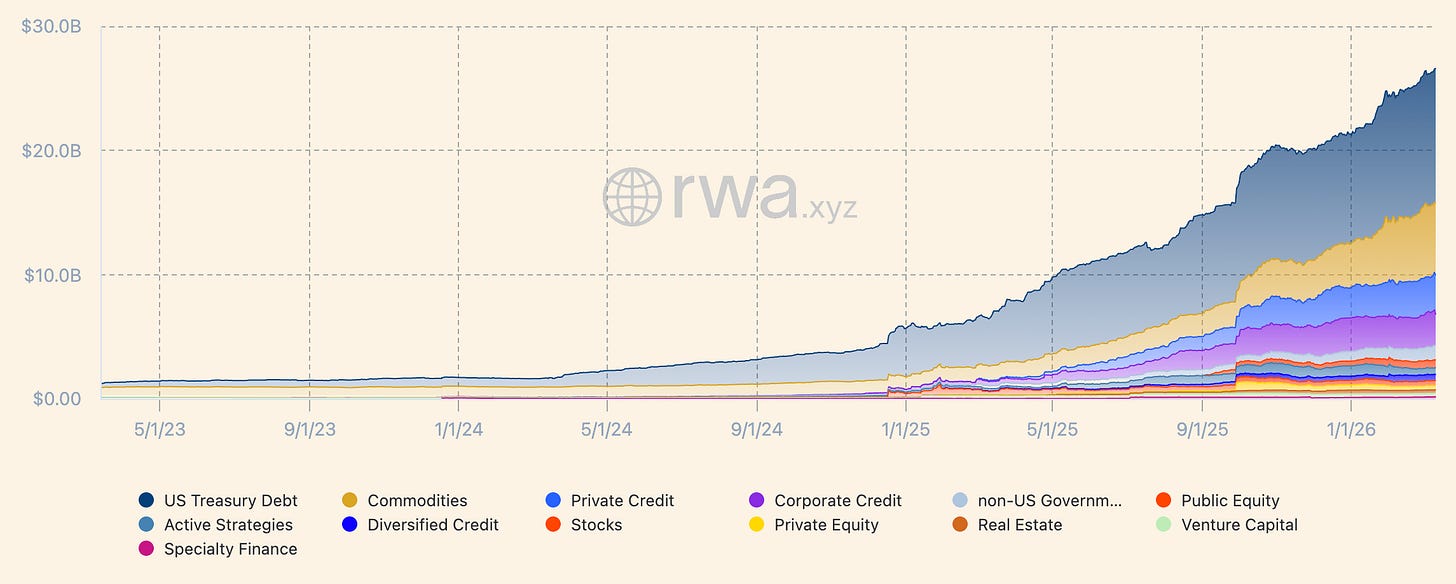
While tokenized real-world assets have surged to approximately $65 billion by mid-2026, representing a 44% increase since January, the market remains in an early scaling phase relative to global fixed income and equity markets. The growth is driven by a confluence of institutional partnerships, technological upgrades like Ethereum’s Fusaka network enhancement, and a regulatory 'ceasefire' following the Ondo Finance SEC probe resolution, which together have fostered confidence to expand offerings beyond simple treasuries to include yield-bearing gold, tokenized S&P 500, and private credit. This maturation is reflected in the shift from private permissioned blockchains to open, interoperable public ecosystems, as institutions seek scalable, compliant, and composable market infrastructure.

Traditional Finance Embraces Crypto
Legacy institutions and exchanges are moving beyond pilot projects, acquiring crypto platforms, and launching tokenized securities for round-the-clock, permissionless trading.
By late 2025, traditional financial giants like Charles Schwab signaled a decisive embrace of crypto markets, with plans to launch Bitcoin and Ether spot trading in early 2026, reflecting a broader institutional appetite for integrating tokenized assets. This momentum was fueled by a record-breaking $8.6 billion in crypto mergers and acquisitions, led by Coinbase’s strategic acquisitions including the $2.9 billion Deribit deal, as firms anticipated regulatory clarity from legislation like the Clarity Act. Such acquisitions allowed traditional finance players to rapidly onboard crypto-native infrastructure rather than build from scratch, accelerating the mainstreaming of tokenized finance.
The entrance of legacy exchanges into tokenized securities marked a pivotal maturation phase, with the NYSE launching a platform for native issuance and on-chain settlement of tokenized securities by early 2026. This initiative aims to eliminate traditional intermediaries, unlocking the benefits of blockchain-based capital markets while emphasizing investor and issuer protections. Meanwhile, Nasdaq partnered with Kraken to create a 'non walled garden' ecosystem allowing tokenized stocks to trade permissionlessly across multiple decentralized exchanges and wallets, signaling a complementary rather than competitive approach to traditional market infrastructure.
Institutional adoption of tokenized assets extended beyond traditional venues as BlackRock pioneered integrating tokenized funds into decentralized finance by listing its $2.2 billion tokenized U.S. Treasury fund, Biddle, on Uniswap. This move enabled pre-qualified investors to trade 24/7 with compliance managed by Securitize, overcoming prior resistance to continuous market hours and signaling a shift in traditional finance’s acceptance of DeFi trading models. BlackRock’s acquisition of UNI tokens further underscored institutional confidence in altcoins, marking a bullish milestone for crypto integration.
Despite surpassing a $1 billion market capitalization, tokenized equities remain fragmented between custodial-backed tokens and regulated 'canonical shares' that preserve shareholder rights, reflecting ongoing legal and structural challenges. Market concentration is pronounced, with one platform commanding approximately 60% market share, while regulatory bodies in the U.S. adopt a technology-neutral stance that paves the way for exchanges like Nasdaq to launch regulated tokenized stock trading by early 2027. This evolving landscape, highlighted by the DTCC’s pilot tokenizing the Russell 1000 and the SEC’s 2026 staff statement equating tokenized equities with traditional securities, signals a gradual but decisive integration of tokenization into mainstream finance.



On-Chain Infrastructure Revolution
Direct blockchain issuance, programmable token standards, and new accounting models are collapsing financial intermediaries and redefining global asset ownership.
By early 2026, DTCC's collaboration with Canton blockchain marked a pioneering leap in native on-chain issuance by tokenizing US Treasuries, enabling holders to maintain assets directly on-chain without traditional proof of reserves. This innovation supports fully back-to-back stablecoin issuance native to the blockchain, demonstrated through multiple production trades including repurchase agreements, signaling a robust phased rollout aimed at integrating traditional securities into decentralized infrastructure.
The evolution from synthetic tokens to issuer-based tokenization represents a fundamental market shift, as issuer-based models enable actual assets to migrate onto new blockchain rails rather than merely replicating price exposure. This transition is propelled by younger investors accustomed to continuous, instant-settling crypto markets, challenging legacy fragmented structures and hinting at a profound transformation in global ownership, liquidity, and market access.
The introduction of programmable token standards like ERC-8056 revolutionizes corporate actions by using a display multiplier to handle stock splits and similar events without minting new tokens or requiring transfers, preserving transaction history and balances seamlessly. This standard, alongside native issuance models such as Superstate’s SEC-registered transfer agent service, collapses traditional intermediaries and reconciliations into a single authoritative on-chain ledger, embodying Ian Grigg’s concept of triple-entry accounting and fundamentally upgrading financial market infrastructure.
Hyperliquid’s HIP-1 update further advances on-chain corporate actions by introducing the 'scaleWei' function, which automates proportional token distributions like dividends and stock splits directly at the balance layer, eliminating manual claims and individual contract calls. Additionally, it ensures order book integrity by automatically canceling and recreating orders to reflect new token denominations post-corporate actions, exemplifying a seamless, programmatic approach to managing complex corporate events on-chain.