Nvidia turns AI factories into cash machines as rivals race to catch up in the great compute crunch
The gist
Nvidia is turning AI factories into unstoppable cash engines by fusing chips, networking, and software into vertically integrated super-systems—leaving rivals scrambling to keep up in a global compute arms race.
What to know
- Nvidia’s Vera Rubin and Blackwell architectures combine multiple chips, advanced networking, and proprietary software to deliver up to 10X better AI inference and slash costs for hyperscalers.
- With over 50% of TSMC’s advanced CoWoS capacity and a $2 billion bet on CoreWeave, Nvidia’s supply chain dominance is fueling exponential revenue growth and outpacing Google, AMD, and Microsoft.
- Soaring demand for GPUs and memory is making centralized data centers the new AI powerhouses, as chip shortages and hardware alliances reshape the future of global computing.
AI Factories Get a Brain
Nvidia’s Vera Rubin system fuses multiple chips and advanced memory architectures to enable AI models with richer context and reasoning, marking a shift from single-chip power to integrated, system-wide intelligence.
The evolution from discrete GPUs to unified, vertically integrated AI compute platforms is exemplified by Nvidia's collaboration with Vast Data on the Vera Rubin system. Rather than focusing on a single chip, this architecture weaves together multiple chips and systems, fundamentally rethinking how AI models handle context and memory at scale. As John Mile explains, 'I wouldn't call it a chip because it's many chips and it's many systems... reinventing how you do things like KV cache,' highlighting how this integrated approach is essential as AI models grow larger and require more sophisticated reasoning capabilities.

Systems-First Powers Profit Surge
By treating the AI factory as the core unit of innovation, Nvidia’s system-level integration is driving radical efficiency gains, lower costs per token, and business models that turn infrastructure spending into recurring revenue.
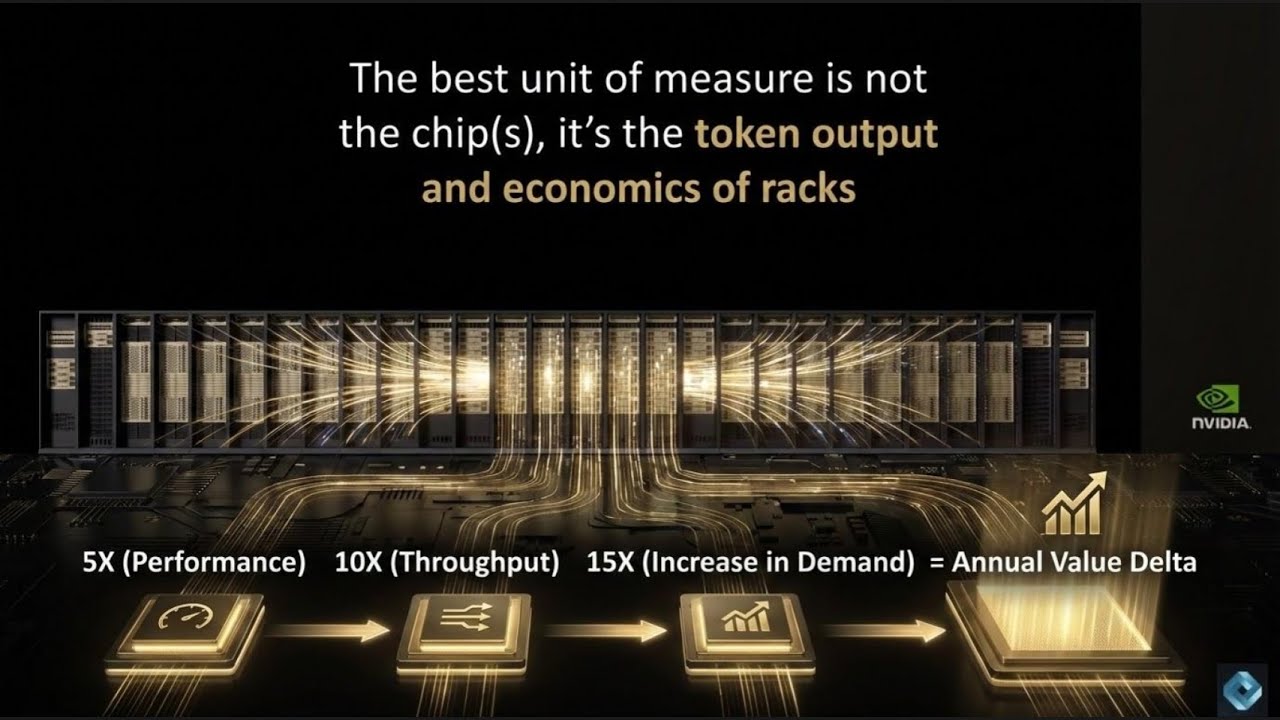
Nvidia’s move toward vertically integrated AI compute platforms has fundamentally redefined the economics of AI factories by shifting focus from incremental chip improvements to holistic system-level optimization. By treating the AI factory as the unit of competitiveness—combining advanced architectures, rack-scale integration, and high-performance networking fabrics like NVLink-72 and Spectrum-X Ethernet—Nvidia has driven dramatic gains in efficiency, utilization, and revenue per dollar spent. As Jensen Huang puts it, 'we don't just build chips, we build systems,' and this systems-first approach has enabled hyperscalers and enterprises to achieve multiples in performance and lower costs per token, with Q2 results showing that each architecture flip compounds a 'spend more, make more' flywheel, turning capital expenditures into recurring revenue growth.
The operational impact of these integrated platforms is especially pronounced as AI workloads shift toward reasoning and agentic tasks, which are 100 to 1000 times more compute-intensive than traditional inference. Efficiency and utilization improvements are now mission-critical, with companies like CoreWeave reporting '10X better inference on reasoning in production.' This has been enabled by innovations such as Blackwell’s NVFP4 4-bit floating point format, which slashes memory bandwidth requirements while preserving accuracy, and by continuous software optimizations—like those in TensorRT-LLM—that have delivered up to 2.8x inference performance increases and 40% higher training throughput in just a few months, all without hardware upgrades. As a result, enterprises and cloud providers can scale services more economically, deferring costly hardware refreshes while meeting surging demand.
This relentless drive for efficiency has enabled new business models and pricing strategies across the AI infrastructure landscape. Lower costs per token allow providers to expand revenue by reducing prices, leveraging the elasticity of AI compute demand—mirroring historical trends seen in the PC and cloud markets. The integration of AI hardware and software, as seen in Nvidia’s rack-scale GB200 NVL72 systems and Lightning AI’s merger with Voltage Park, supports enterprise-grade reliability and performance at 'neocloud' prices, making advanced AI capabilities accessible to both startups and large institutions. With over 35,000 GPUs and deep software integration, these unified, AI-native clouds optimize speed, value, and simplicity, fundamentally transforming how AI infrastructure is consumed and monetized.
Beyond Nvidia, the broader ecosystem is embracing vertically integrated, high-density data center solutions to further cut operational costs and boost efficiency. Companies like 3 E Network Technology are deploying modular AI data centers with advanced cooling and IoT-powered predictive maintenance, reducing Power Usage Effectiveness (PUE) by up to 15% and minimizing downtime. Integrated AI-driven security further enhances reliability and cost-effectiveness, underscoring how the next generation of AI infrastructure is as much about intelligent operations and resilience as it is about raw compute power.



The Race to Break Nvidia’s Moat
Nvidia’s relentless stack-level innovation is forcing rivals like Google, AMD, and Microsoft to build custom chips and open networking solutions, igniting an industry-wide battle over the future of AI compute.
Nvidia’s competitive moat has deepened through a relentless cadence of vertically integrated, system-level innovation that fuses chip design, proprietary software, and high-performance networking. Beginning with the 2024 Hopper launch and accelerating through Grace Blackwell, Vera Rubin, and beyond, Nvidia’s annual release cycle has driven exponential leaps in AI performance—such as a staggering 72.3x improvement from Hopper to Blackwell in just one year—while its expansion into networking hardware like Spectrum X Ethernet has made its Ethernet business the fastest growing in the world. This holistic approach not only amplifies AI throughput and slashes token generation costs, but also cements Nvidia’s position as the architect of the most unified and efficient AI compute platforms available.
Nvidia’s unique strategy of ‘extreme code design’—simultaneously optimizing model algorithms, system architecture, and chips—has allowed it to transcend the traditional limits of Moore’s Law, creating a formidable competitive advantage that rivals have yet to match. By co-designing every layer of the stack and pioneering technologies like CUDA, Nvidia has redefined what it means to be a systems company, evolving from a pure semiconductor player into a data center-scale powerhouse. This shift is reinforced by the exponential growth in AI token generation, which demands continuous, system-wide innovation to keep compute costs in check and further fortifies Nvidia’s leadership.
However, the competitive landscape is rapidly evolving as hyperscalers and chipmakers mount increasingly sophisticated responses. Google’s TPU, built on Broadcom’s open standard Ethernet fabric, offers a credible alternative to Nvidia’s tightly integrated stack, with Broadcom also supplying competitive networking solutions to players like Meta. Meanwhile, AMD is positioning itself as the essential second source for silicon, partnering with Broadcom to offer modularity and flexibility, while Microsoft’s Maia 200 chip—boasting over 100 billion transistors and outpacing both Amazon’s Trainium and Google’s TPU in key metrics—underscores a broader industry pivot toward custom, vertically integrated AI hardware. These moves signal a more fragmented, collaborative, and competitive ecosystem, where proprietary and open alternatives are gaining momentum, especially for inference workloads.
Despite these challenges, Nvidia’s dominance remains pronounced, buoyed by massive capital expenditures—$660 billion in AI infrastructure buildouts led by Meta, Amazon, Google, and Microsoft—and its central role in powering both proprietary and open AI labs like OpenAI and Anthropic. Yet, cracks are beginning to show: severe chip supply constraints at TSMC, where Nvidia now commands over 50% of advanced CoWoS capacity, are creating openings for rivals, particularly in inference. While customers face hurdles with early Blackwell chip rollouts and must sometimes revert to older hardware, their continued dependence on Nvidia’s integrated platform underscores both the company’s enduring moat and the growing appetite among hyperscalers to develop their own alternatives.






Supply Chain Wars Go Boardroom
Nvidia’s massive bets on CoreWeave and TSMC, plus deep memory alliances, are redrawing the global AI hardware map as supply crunches force tech leaders into high-stakes, direct negotiations for survival.
Nvidia’s aggressive $2 billion investment in CoreWeave and its ascension to TSMC’s top customer spot underscore how strategic partnerships are now the linchpin of AI infrastructure scaling. By fast-tracking 5GW of AI data centers and securing early access to next-gen Vera Rubin chips, Nvidia is not just hedging against supply chain and logistical risks—it’s actively shaping the resource landscape. This shift is mirrored in TSMC’s own strategy, with the foundry investing up to $56 billion to expand capacity and meet surging AI-driven demand, as Nvidia is projected to contribute $33 billion (22%) of TSMC’s revenue in 2025, overtaking Apple’s long-held dominance.
The deepening web of manufacturing alliances—exemplified by Nvidia’s collaboration with Samsung to integrate HBM4 memory modules into Vera Rubin accelerators—shows how technical bottlenecks are being tackled through synchronized supply chain orchestration. Samsung’s readiness to mass-ship HBM4 modules by February 2026, after completing verification for both Nvidia and AMD, highlights the precision timing and mutual dependency required to keep AI hardware innovation on track. These partnerships are not just about capacity, but about jointly navigating the technical and operational hurdles that define the next generation of AI systems.
Yet, even as these alliances deepen, the acute supply crunch at TSMC is exposing the fragility of the AI compute ecosystem. By early 2026, TSMC’s advanced-node capacity is three times short of aggregate customer demand, with the most advanced nodes sold out through the year. This scarcity has prompted high-stakes maneuvers from industry titans—OpenAI’s Sam Altman and Apple’s Tim Cook have both made direct overtures to TSMC executives, underscoring how geopolitical and logistical risks are now boardroom-level concerns for the world’s leading tech firms.
Strategic investments like Nvidia’s backing of CoreWeave are not just about scaling infrastructure—they’re about fortifying the entire AI supply chain against geopolitical shocks and operational bottlenecks. By jointly developing reference architectures and securing critical resources such as land and power, these partnerships are building resilience into the AI compute ecosystem, ensuring that infrastructure growth can keep pace with the sector’s relentless demand.
Edge vs. Data Center Showdown
While edge AI supercomputers push real-time intelligence to the user, explosive demand and memory shortages are making centralized data centers the inevitable heart of global AI computing.
By early 2026, the future of AI computing is being shaped by a dual movement: on one hand, companies like GIGABYTE are pushing the boundaries of edge computing with AI-native personal supercomputers such as the AI TOP ATOM, which delivers up to 1 petaFLOP FP4 performance and supports models as large as 405 billion parameters. These edge solutions empower real-time intelligence and data privacy by eliminating cloud latency and subscription costs. At the same time, the emergence of vertically integrated AI hardware—exemplified by Nvidia’s Vera Rubin architecture—signals a decisive shift toward centralized data center platforms, where custom CPUs and GPUs are co-designed for low-latency, high-throughput workloads. This hardware-software synergy is enabling a new wave of AI-native applications, from autonomous vehicles to real-time agents, fundamentally redefining where and how AI intelligence lives.
However, the exponential surge in AI computational demand is creating acute shortages in critical components like DRAM, as most of the world’s memory and GPU resources are funneled into data centers rather than local PCs. As a result, it is becoming increasingly uneconomical for enterprises and individuals to rely on traditional, souped-up client devices for advanced AI workloads. As one analyst put it, 'The memory shortage being created by AI infrared deployment is sucking all the oxygen out of the PC space,' reinforcing the inevitability of the data center as the new de facto form factor for global computing.

