Nvidia’s $2b bet lifts marvell’s AI push
The gist
Nvidia just crowned Marvell the next trillion-dollar kingmaker in AI, igniting a Wall Street frenzy as AI infrastructure enters a new era.
What to know
- Nvidia’s $2 billion investment and strategic partnership with Marvell, announced March 2026, targets custom AI silicon and advanced interconnect tech—with CEO Jensen Huang declaring Marvell 'the next trillion-dollar company.'
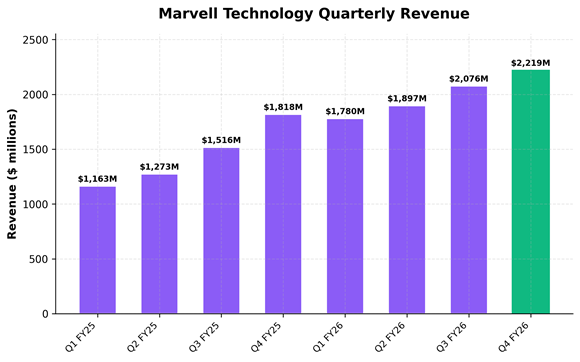
- Marvell’s Q1 CY2026 revenue soared 27.6% to $2.42 billion, helping fiscal 2026 revenue jump 42% to $8.195 billion on the back of a custom silicon business that doubled to $1.5 billion.
- With over 60% market share in optical DSPs and deep partnerships with Amazon, Google, and Microsoft, Marvell now leads AI data center interconnect innovation, sending its stock up 20% and analyst targets above $400.
Marvell Becomes AI’s Custom Backbone
Nvidia’s $2B partnership transforms Marvell into the hyperscaler’s go-to architect for custom AI silicon and interconnects, unlocking a new era of tailored infrastructure for cloud giants.
Nvidia's $2 billion investment in Marvell, announced in March 2026, cements a strategic partnership that goes beyond capital infusion to include collaborative development of custom AI silicon and advanced interconnect technologies such as NVLink Fusion and silicon photonics. Nvidia CEO Jensen Huang’s public endorsement of Marvell as 'the next trillion-dollar company' underscores the depth and ambition of this alliance, positioning Marvell as a pivotal partner in Nvidia’s push to dominate the custom AI chip market and address the growing compute deficit faced by hyperscalers.
Marvell’s collaborative approach with hyperscalers like Google, Amazon, and Microsoft—who sources 100% of its optical chips from Marvell—reflects a broadening footprint in hyperscale AI infrastructure. By co-designing custom silicon solutions, including memory chips for Google’s TPUs and photonics fabrics for Amazon, Marvell is effectively bridging Nvidia’s integrated AI infrastructure with hyperscalers’ bespoke ASIC needs, enabling complete fungibility and customization across rack-scale data center networks.
Mirroring Broadcom’s strategy, Marvell’s custom silicon business model emphasizes deep partnerships with hyperscalers and technology companies rather than off-the-shelf chip sales. This approach, supported by a comprehensive portfolio spanning XPUs, optical and copper interconnects, and switches, allows Marvell to offer end-to-end rack-scale infrastructure solutions tailored to diverse customer requirements, thereby expanding its total addressable market and reinforcing its leadership in AI infrastructure.


Surging Profits, Subtle Risks
Marvell’s explosive revenue growth and bullish forecasts mask emerging operational pressures, as scaling supply and inventory management become critical to sustaining its AI momentum.
Marvell demonstrated robust financial performance in Q1 CY2026 with revenue reaching $2.42 billion, a 27.6% year-over-year increase that met Wall Street expectations, and provided Q2 guidance of $2.7 billion, surpassing analyst estimates by 3%. Adjusted EBITDA also beat estimates by 4.3%, hitting $942.3 million with a 39% margin, while adjusted EPS aligned with forecasts at $0.80 per share, underscoring strong underlying profitability despite some operational challenges.
Fiscal 2026 marked a record year for Marvell with total revenue soaring 42% to $8.195 billion, fueled notably by the custom silicon business which doubled to $1.5 billion and now accounts for 10-15% of total revenue. Management’s optimistic guidance for fiscal 2027 anticipates accelerating year-over-year revenue growth each quarter, targeting nearly $11 billion in full-year revenue, reflecting confidence in sustained demand from AI infrastructure and next-generation interconnect products.
Despite strong top-line growth and margin expansion, Marvell faces near-term operational headwinds including a decline in free cash flow margin from 24.4% to 11.7% and increased inventory days, signaling some risks in supply chain and cash conversion efficiency. Nevertheless, management’s ability to scale supply and meet accelerating AI infrastructure demand has reassured investors and analysts, supporting a positive outlook amid these challenges.
Investor and analyst optimism has surged following Marvell’s robust financial results and Nvidia CEO Jensen Huang’s endorsement, who dubbed Marvell 'the next trillion-dollar company.' This bullish sentiment is reflected in a 20% stock price jump post-earnings and significant price target upgrades, with some analysts raising fair value estimates to $400 and beyond, driven by expectations of sustained double-digit sequential revenue growth and a 70% projected increase in interconnect product revenues for Q1 fiscal 2027.


Interconnect: The New AI Bottleneck
Marvell’s dominance in optical and photonics tech redefines AI data center performance, with connectivity—not compute—now setting the pace for the next wave of AI scale.
Marvell has strategically transformed into a dual-engine AI infrastructure leader by integrating custom silicon (ASIC) with a dominant interconnect business, effectively addressing the evolving bottlenecks in AI data centers. CEO Matt Murphy highlights that interconnect—comprising optical and switching technologies—now represents the largest segment of their data center business, reflecting a shift from compute power constraints toward connectivity challenges as AI training clusters scale to hundreds of thousands of GPUs. This evolution is underscored by Nvidia’s $2 billion investment, signaling strong confidence in Marvell’s innovative approach to custom silicon and networking solutions.
Marvell’s aggressive expansion into photonics and optical connectivity through acquisitions like Celestial AI, XConn, and Polariton has built a comprehensive technology stack that supports scale-up, scale-out, and scale-across AI interconnect solutions. Celestial AI’s photonics fabric, already selected by Amazon, is projected to generate $1 billion in revenue by 2028, while Polariton’s silicon photonics technology offers modulation bandwidths up to 1 THz—ten times that of traditional silicon photonics. This diversified portfolio, including multiple modulator technologies and emerging options such as microVCSEL and microLED, positions Marvell at the forefront of overcoming physical and power density limits inherent in copper connectivity.
Marvell’s leadership in optical interconnect is cemented by its commanding market share—over 60% in optical DSP following the Inphi acquisition—creating a 'golden empire' with ultra-high margins and minimal competition. This dominant position enables Marvell to pioneer next-generation AI data center connectivity innovations, including a 100T Ethernet switch tailored for AI workloads, 1.6T 3nm PAM4 solutions, and plans to sample the world’s first 1.6T 2nm coherent optical solution. As Murphy emphasizes, the architecture and characteristics of connectivity now fundamentally define AI system performance, making Marvell’s interconnect technologies critical to future AI scale.
By bridging the ASIC custom silicon world and Nvidia’s integrated AI infrastructure, Marvell offers hyperscalers unparalleled fungibility in data center network design, supporting a broad spectrum of technologies including XPUs, switches, and photonics. Their diversified approach—eschewing bets on any single technology—enables flexible, scalable AI connectivity solutions, exemplified by support for Nvidia’s NVLink and multiple switch platforms like UALink 115T and ESUN 100T. This dual-engine model not only mitigates investment risk but also drives robust growth expectations, with management projecting ASIC revenues to more than double by FY2028, marking Marvell’s transition into a comprehensive AI infrastructure powerhouse.