Offshore drillers flex muscle: noble and transocean rack up contracts, slash debt, and cash in on premium rigs
The gist
Offshore drilling giants Noble and Transocean are flexing their financial and operational muscle, racking up record contract backlogs, slashing debt, and cashing in on premium rigs.
What to know
- Noble and Transocean secured blockbuster new contracts, pushing their backlogs to $7.5B and $7.1B respectively by early 2026.
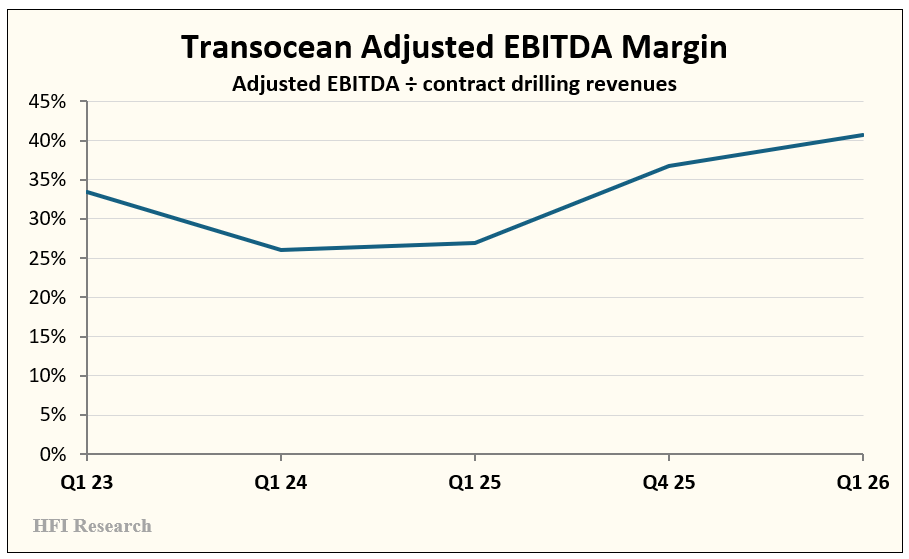
- Transocean supercharged fleet utilization to 86.7% and daily rig revenue hit a decade-high $475,600, driving EBITDA margins up to 40.7%.
- Noble boosted net income 12% to $121M in Q1 2026, while Transocean aggressively paid down $549M in debt and eyes a leaner, stronger balance sheet.
Mega Contracts Reshape Backlogs
Noble and Transocean landed multi-year, high-value deals with Petrobras and Vår Energi, signaling deepening client ties and strategic dominance in key offshore regions.
By early 2026, Noble Corporation and Transocean Ltd. both made significant strides in expanding their contract backlogs, underscoring robust commercial momentum and strengthening future revenue visibility. Noble added approximately $565 million in new contract value, including a pivotal three-year extension for the Noble Courage with Petrobras and a five-well contract for the Noble Deliverer with Woodside, pushing its backlog to $7.5 billion. Meanwhile, Transocean secured new agreements valued at around $1.6 billion, elevating its backlog to about $7.1 billion, anchored by a substantial 1,095-day contract for the Transocean Barents with Vår Energi ASA in Norway and multiple extensions with Petrobras in Brazil, signaling deepening client relationships and strategic positioning in key offshore markets.
Transocean’s contract wins not only bolstered backlog figures but also highlighted the company’s ability to secure long-term engagements that enhance market stability and operational planning. The 1,095-day agreement for the Transocean Barents with Vår Energi ASA exemplifies a commitment to the Norwegian sector, while extensions with Petrobras reinforce Transocean’s entrenched presence in Brazil’s offshore drilling landscape. These developments collectively illustrate how targeted contract expansions underpin Transocean’s competitive positioning amid a dynamic offshore drilling environment.


Lean Fleets, Fatter Margins
Transocean’s deliberate fleet downsizing and focus on premium rigs catapulted utilization and daily revenue to record highs, unlocking powerful operating leverage.
By early 2026, Transocean's strategic fleet rationalization—shrinking its total rigs from 37 to 27 over three years—catalyzed a remarkable surge in fleet utilization rates, climbing to 86.7% in Q1 2026 from just 51.9% three years prior. This deliberate focus on a higher-spec, leaner fleet not only optimized operational efficiency but also elevated per-rig economics, as evidenced by the average daily revenue per rig reaching $475,600, the highest in over a decade. Contracts such as the Var Energi deal for the Transocean Barents, commanding $450,000 per day, underscore how fleet quality improvements translated into premium pricing power and robust revenue growth.
This disciplined approach to fleet management and operational efficiency yielded outsized profitability gains, with Transocean's Adjusted EBITDA margin soaring from 26.9% in Q1 2025 to 40.7% in Q1 2026. The $175 million increase in EBITDA margin, representing roughly 112% of incremental revenue, highlights the company's strong operating leverage—demonstrating how rationalizing the fleet and enhancing utilization directly amplified earnings quality and shareholder value within a competitive offshore drilling market.

Profit Surge Fuels Growth Plans
Noble’s rising net income and Transocean’s aggressive debt cuts are powering targeted investments and a stronger, more flexible balance sheet.
Noble Corporation kicked off 2026 with a robust financial showing, posting a 12% year-over-year net income increase to $121 million in Q1, complemented by strong free cash flow of $169 million. This financial strength enabled the company to strategically increase its 2026 capital expenditure guidance by $25 million to reactivate the Noble Deliverer, signaling targeted investments to fuel growth while maintaining disciplined capital management.
Transocean’s Q1 2026 financial narrative is one of disciplined deleveraging amid mixed profitability signals. Despite a steep 189% decline in net income to $71 million, the company showcased operational resilience with adjusted EBITDA margins soaring to over 40%, driven by a 19.3% revenue surge and fleet utilization rising to 86.7%. This operational efficiency underpinned a 348% jump in operating profit, reflecting strong leverage of fixed costs and efficient capital deployment.
A cornerstone of Transocean’s capital management strategy is aggressive debt reduction, evidenced by retiring $358 million in high-interest Senior Secured Notes in March 2026, which is projected to save approximately $40 million in future interest expenses. By the end of Q1, total debt had shrunk by $549 million to $5.137 billion, with management targeting at least $750 million in debt retirements for the full year to reach a net-debt-to-EBITDA ratio near 3.3x, thereby strengthening the balance sheet and enhancing financial flexibility.
Transocean’s financial discipline extends beyond deleveraging to include robust cost management and synergy realization, anchored by a $250 million cost-reduction program and over $200 million in expected synergies from the Valaris acquisition. These initiatives are designed to accelerate deleveraging, improve leverage profiles, and support sustainable growth, positioning the company to capitalize on improved market conditions with enhanced financial agility.
Strategic Streamlining Spurs Resilience
Transocean’s sharper fleet and longer contract coverage are driving utilization and EBITDA margins higher, while rapid deleveraging fortifies the company against market volatility.
By early 2026, Transocean has strategically streamlined its fleet, boosting rig utilization from 63.4% to 86.7% within a year by shedding older assets and focusing on higher-spec rigs. This fleet rationalization, coupled with a tightening market evidenced by firm contract coverage of 86% for 2026 and longer average contract durations doubling to 480 days, positions the company to capitalize on a sustained offshore drilling upcycle despite ongoing oil price volatility risks.
Transocean’s operational improvements have translated into robust financial performance, with adjusted EBITDA margins soaring from 26.9% in Q1 2025 to 40.7% in Q1 2026, driven by a 19.3% revenue increase and lower costs. Concurrently, management is proactively mitigating financial risks by accelerating deleveraging efforts—reducing total debt by $549 million in Q1 2026 and targeting a 1.5x leverage ratio within two years post-Valaris acquisition—thereby reinforcing its strategic resilience amid industry uncertainties.