Oil markets defy crisis as hormuz closure fuels inflation spike
The gist
Despite Iran’s unprecedented closure of the Strait of Hormuz slashing global oil supply and driving inflation sky-high, markets are bizarrely shrugging off the crisis as oil prices defy gravity—and logic.
What to know
- Iran’s repeated Strait of Hormuz shutdowns have slashed global oil exports by about 11 million barrels per day, forcing Saudi Arabia and the UAE into risky reroutes while U.S. tankers run covert nightly missions.
- Even with a net global deficit of 3–4 million barrels per day and over one billion barrels drained from inventories, oil prices remain stuck in the low $80s—far below models suggesting $100+ is justified.
- Energy-driven inflation is squeezing consumers and complicating Fed policy, as investors flock to real assets and oil stocks, betting prices will soar above $120 per barrel while AI stocks fuel a tech rally.
Covert Tankers and Chokepoints
Iran’s militarized grip on the Strait of Hormuz is forcing a high-stakes game of shadow shipping and reroutes, as U.S. and Gulf states scramble to keep half the world’s oil flows alive under constant threat of escalation.
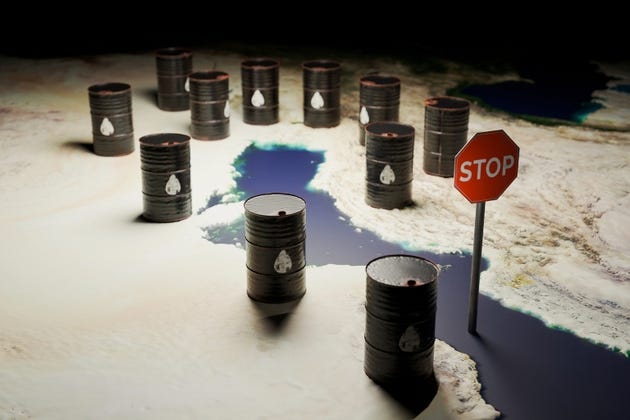
The Strait of Hormuz remains a critical and highly contested chokepoint in global oil supply, with Iran asserting near-total control and repeatedly shutting it down, while the U.S. military covertly manages a southern shipping corridor along Oman's coast to sustain about 10 million barrels per day—roughly half of pre-war volumes—through nightly transits of 15 to 20 tankers. This complex dynamic, involving covert 'dark' tanker movements and ship-to-ship transfers, allows non-Iranian Gulf crude exports to continue despite Iran's blockade and sanctions, mitigating a complete supply cutoff but prolonging logistical challenges that delay the reactivation of shut-in wells and complicate tanker operations.
Iran's militarization of the region, including deployment of shoulder-fired anti-aircraft missiles and Shahed drones, alongside the establishment of a 'resistance security belt' stretching from the Mediterranean through the Red Sea and Gulf, significantly escalates the threat to energy infrastructure and tanker movements. This strategic posture, combined with proxy actions such as the Houthis' naval blockade in the Red Sea targeting Saudi export routes, expands the conflict's geographic scope and heightens risks of broader supply disruptions beyond the Strait of Hormuz, signaling Tehran's intent to leverage control over multiple maritime chokepoints to increase its geopolitical bargaining power amid declining global oil inventories.
The closure of the Strait of Hormuz and related hostilities have precipitated the largest oil supply disruption in modern history, with Saudi Aramco estimating a loss of roughly 11 million barrels per day of liquid supply. Although strategic reserve releases, commercial inventory withdrawals, and regional demand reductions have temporarily buffered global markets, these finite measures mask a cumulative inventory draw of approximately 1.15 billion barrels over five months, creating a precarious supply-demand imbalance. Despite this, oil futures remain underpriced—WTI trading in the low $80s versus fair value models suggesting prices above $100 per barrel—indicating market mispricing that underestimates the severity of ongoing physical supply shortages.
Efforts by Saudi Arabia and the UAE to reroute oil exports through alternative Red Sea pathways illustrate attempts to circumvent the Strait of Hormuz closure, yet these routes face persistent threats from Iranian-backed Houthi forces who maintain capabilities to disrupt shipping despite sustained US, Israeli, and UK air campaigns. This evolving maritime contest underscores the fragility of global energy supply chains, as Iran's escalating demands and military control over multiple chokepoints amplify its leverage in a context of diminishing global oil inventories and shrinking supply buffers, thereby intensifying the risk of prolonged and widespread energy shortages.





Market Psychology vs. Reality
Oil prices remain stubbornly below crisis levels as hopes for ceasefires and political jawboning mask the true risk of historic supply gaps and the ever-present threat of a $200 per barrel price shock.
The prolonged closure of the Strait of Hormuz has precipitated the largest oil supply disruption in modern history, with a net deficit estimated at 3 to 4 million barrels per day after temporary offsets, comparable to the 1974 Arab oil embargo. Despite this, oil prices have remained surprisingly subdued, with WTI crude trading in the low-$80s—about 20% above prewar levels but still 30% to 40% below fair-value models that suggest prices should exceed $100 per barrel. This underpricing reflects a market caught between the tangible physical shortage and behavioral factors such as hopes for a ceasefire and verbal interventions from political leaders, which have injected volatility and tempered price spikes even as inventories have been drawn down by over one billion barrels since the conflict began.
Oil markets currently exhibit backwardation, signaling short-term tightness, yet price dynamics are heavily influenced by sentiment and operational constraints rather than fundamentals alone. While spot prices spiked to as high as $150 per barrel during near-zero supply periods in the Gulf, rapid price corrections followed ceasefire announcements, underscoring how market psychology drives volatility beyond supply realities. Moreover, even if the Strait reopens, logistical challenges—including shipping risks, insurance concerns, and the time-intensive process of redrilling wells—mean full restoration of pre-war capacity could take at least one to two quarters, sustaining elevated prices well beyond initial expectations.
There is a significant tail risk that oil prices could surge dramatically to between $150 and $200 per barrel if the Strait of Hormuz remains closed or if major oil infrastructure is attacked, causing months or even years of supply disruption. Patricia García of MacroYield warns that prolonged blockade scenarios could push crude to $150, while analysts like Rory Johnston emphasize that even a 10% probability of direct attacks on oil projects justifies a steep upside premium. This risk is compounded by the depletion of global inventories—estimated at roughly 14% below prewar levels—and the limited capacity of pipeline bypasses and risky tanker routes to offset the roughly 14 million barrels per day shut in from the Middle East, setting the stage for potential demand destruction in both emerging and advanced economies.
The market’s reliance on inventory drawdowns to buffer the supply shock is reaching critical limits, with operational stress expected by mid-2026 that could force prices to levels inducing demand destruction, particularly in emerging Asian markets. Analysts predict that by June or July, oil prices may need to climb to around $150 per barrel to balance the market, as strategic reserves dwindle and China’s import demand rebounds. Despite these looming pressures, the market continues to underprice the duration and severity of the supply disruption, creating a disconnect between current futures pricing and the harsh realities of prolonged Strait closure and constrained supply chains.




Fed’s Dilemma: Inflation’s Roots
Energy-driven inflation is colliding with sticky core prices and supply chain chaos, leaving the Federal Reserve powerless to curb cost-of-living pain without risking a deeper economic slowdown.
The closure of the Strait of Hormuz has triggered a sharp spike in inflation, primarily driven by soaring oil and gas prices that have pushed the Consumer Price Index upward, complicating the Federal Reserve’s policy landscape. While CPI inflation surged due to this external shock, core inflation remains sticky around 2.5%, fueled not only by energy costs but also by persistent supply chain disruptions and rising transportation expenses independent of oil prices. As one analyst noted, 'the 2.5% core reading is the one that's that feels sticky to me,' underscoring how these intertwined factors sustain inflationary pressures beyond the Fed’s direct control.
The Federal Reserve faces a profound policy dilemma as traditional tools like interest rate hikes risk being counterproductive amid inflation largely caused by external geopolitical shocks and supply constraints. With oil inventories dwindling despite coordinated releases of 400 million barrels across 32 countries, and ongoing disruptions in commodities such as natural gas and fertilizer, the Fed’s challenge is compounded by constrained consumer spending and economic growth. As highlighted, 'increasing interest rates is actually somewhat counterproductive' when inflation stems from factors outside monetary policy’s reach, leaving the Fed navigating between curbing inflation and avoiding economic contraction.
Rising energy prices have translated into tangible cost increases for consumers, with gasoline and airfare prices up nearly 25% year-over-year, squeezing household budgets amid wage growth lagging behind inflation for four consecutive months. This divergence has created a paradox where 'Corporate America can produce extraordinary earnings at exactly the same time the average American feels like they are falling further behind every month,' reflecting weakening consumer sentiment and spending power. These dynamics, coupled with supply chain bottlenecks and geopolitical risks, present a multifaceted headwind that complicates the economic outlook despite pockets of corporate strength.
Beyond immediate price shocks, the Strait of Hormuz closure has induced a two-month supply chain dislocation, effectively baking an inflationary shock into the global economy that will persist even if the passage reopens. The disruption extends beyond oil to critical related commodities like sulfuric acid and urea, essential for agriculture, thereby threatening longer-term economic stability. Countries are compelled to rebuild depleted strategic hydrocarbon inventories, sustaining upward pressure on energy prices and constraining economic activity, as 'the longer we stay closed, the bigger the inflationary shock,' illustrating how supply chain and inventory dynamics amplify the Federal Reserve’s economic challenges.



Flight to Real Assets
Investors are piling into energy stocks and commodities as traditional safe havens falter, even as AI-fueled tech markets soar in defiance of mounting oil shocks and geopolitical risk.
Amid escalating geopolitical tensions and the indefinite closure of the Strait of Hormuz, investors are strategically reallocating capital toward real assets, particularly energy companies and oil services like ExxonMobil, as a hedge against anticipated supply shortages and market volatility. This pivot reflects a growing recognition that traditional financial assets, such as treasury bonds and big-cap tech stocks, no longer offer sufficient protection against disruptions in energy security, with one analyst emphasizing that the era of relying solely on financial instruments while ignoring tangible energy assets is effectively over.
Simultaneously, the surge in oil prices—projected to breach $120 per barrel within the next 6 to 12 months due to countries expanding strategic hydrocarbon inventories beyond 100 days of imports—is reinforcing demand for real assets and defense sectors as safe havens. This sustained demand for energy security is driving investors to mirror strategies employed by major economies like the US, China, and Japan, who are stockpiling refined products to mitigate supply chain risks, thereby pushing commodity prices higher and reshaping investment priorities.
Contrasting the turbulence in energy markets, equity markets are simultaneously reaching all-time highs, fueled predominantly by a booming AI sector that investors view as a robust growth engine amid geopolitical uncertainty. The S&P 500 recently posted its best monthly performance since 2020, illustrating a bifurcated market dynamic where AI-driven equities attract capital seeking innovation-led upside, even as traditional sectors grapple with the fallout from the Strait of Hormuz blockade and soaring oil prices.