Oil tops $100, crypto surges as markets weather volatility
The gist
Oil smashed through $100/barrel and crypto roared ahead in August, injecting volatility and fresh inflation fears into global markets—but select sectors are thriving on the chaos.
What to know
- Brent crude vaulted past $100 amid US-Iran tensions, squeezing refinery margins and pushing Treasury yields up to 4.8%.
- Crypto tokens like Pons (+116.62%) and Arbitrum (+56.49%) led a broad rally, while gold climbed 9.43% and tokenized metals gained traction.
- Despite choppy bond markets, the S&P 500 eked out a 0.09% gain as energy stocks soared, even as Broadcom’s shares slid 3% after an 86% revenue leap.
Oil’s Ripple Effect Intensifies
Surging crude prices are squeezing refinery margins, stoking inflation fears, and pushing Treasury yields higher as market confidence in inflation containment erodes.
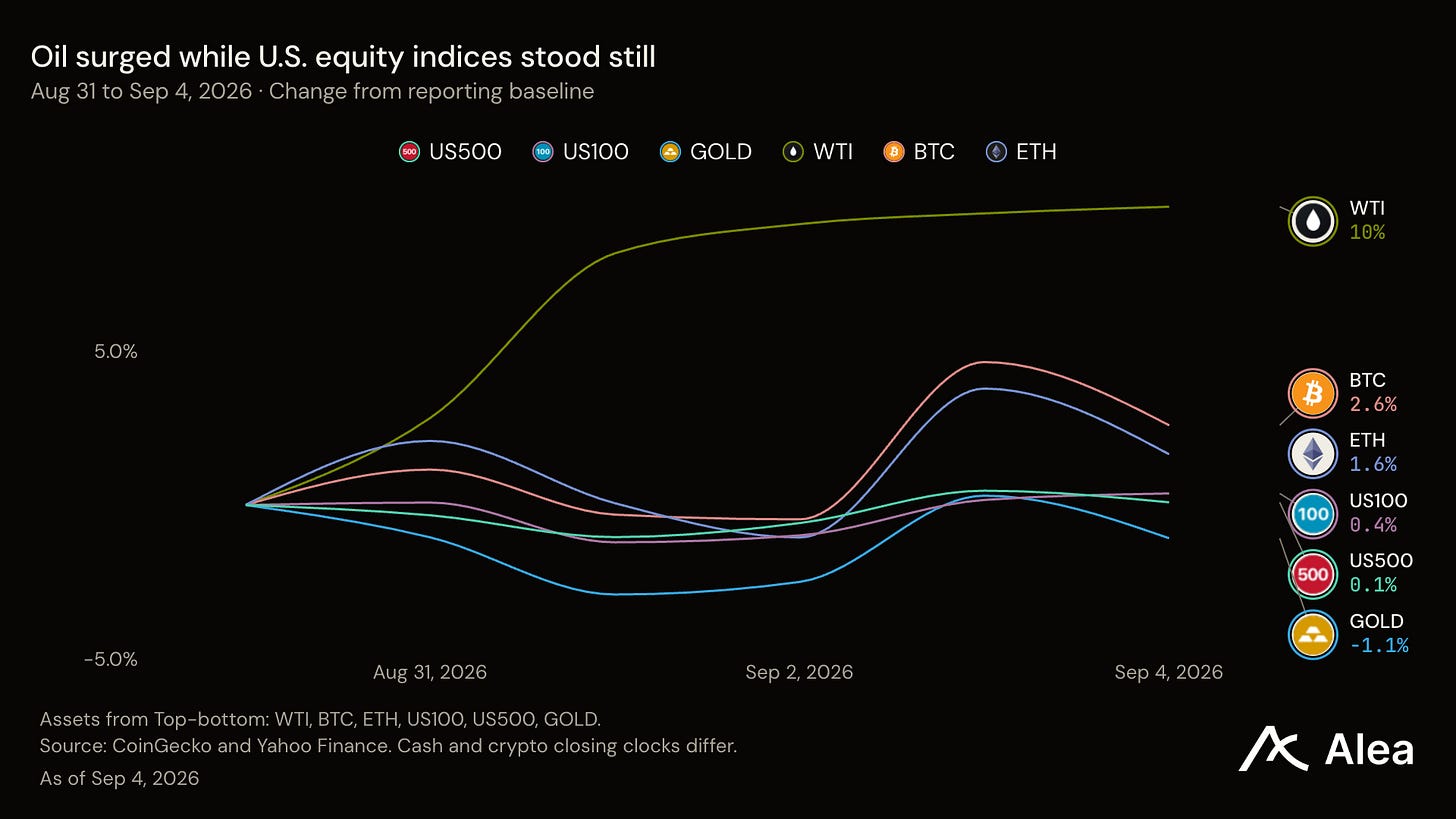
Oil prices have surged significantly amid escalating geopolitical tensions between the U.S. and Iran, with Brent crude futures crossing the $100 per barrel mark for the first time in about two months and WTI closing at $91.48, marking a five-day winning streak—the longest since the war began. This sustained upward pressure on crude has intensified inflation concerns, as rising energy costs ripple through the economy, contributing to market volatility and dampening investor sentiment.
The spike in oil prices has created a complex dynamic within the energy sector, where rising crude costs coincided with falling gasoline futures, squeezing refinery margins and highlighting challenges for refining profitability. This divergence underscores the nuanced impact of energy price movements, where upstream gains do not necessarily translate into downstream benefits, complicating the inflation narrative and market responses.
Geopolitical-driven oil price increases have also influenced Treasury yields, with the 10-year yield briefly touching 4.8% and the 2-year yield rising to 4.37%, reflecting investor concerns over inflation pressures. Despite these yield upticks, the U.S. dollar index fell by 0.54%, suggesting that higher yields alone have been insufficient to bolster the currency amid persistent inflation and energy market strains. Notably, Treasury efforts to stabilize long-term rates through increased debt buybacks have failed to contain yield rises, signaling market skepticism about inflation containment.
While rising oil prices and inflation concerns have heightened expectations for a Federal Reserve interest-rate hike in September, the odds remain essentially balanced near 50-58%, reflecting uncertainty ahead of key PPI and CPI data releases. Dovish remarks from Fed officials like Waller have helped temper Treasury yields and support equity markets, indicating that inflation pressures from energy costs are influencing but not decisively shifting monetary policy expectations at this juncture.





Crypto and Gold Defy Gravity
A broad crypto rally, fueled by DeFi innovation and maturing tokenomics, coincided with gold’s surge and the rise of tokenized commodities, signaling shifting safe-haven dynamics beyond traditional assets.
August witnessed a broad-based crypto rally with 142 of 175 eligible tokens rising, led by standout performers such as Pons (+116.62%), Arbitrum (+56.49%), and Dash (+50.45%). This surge was underpinned by innovative projects tied to evolving DeFi and trading infrastructure, notably Pons’ integration with Robinhood Chain and Arbitrum’s robust ecosystem growth, highlighted by Uniswap Labs’ acquisition of Pons and Arbitrum’s impressive $6.19 million first-half DAO income with a 97% gross margin.
Gold complemented the crypto rally by maintaining notable strength, rising +9.43% in August alongside steady bond yields and a modest 0.37% decline in the dollar index, indicating that its gains were driven by factors beyond currency fluctuations or Treasury yield shifts. Tokenized gold also gained traction as trading collateral on platforms like Lighter, whose token LIT surged +36.33%, supporting a selective commodity rally amid broader inflation pressures that extended beyond metals to cocoa, sugar, and wheat.
The crypto rally extended well beyond Bitcoin and Ethereum, with the median eligible token rising +16.76% and exceptional gains from tokens like Pump.fun (+115.09%), Ethena (+86.16%), and Zcash (+85.40%). This momentum coincided with increasing transparency in token economics, exemplified by Ether.fi initiating buybacks and Ethena proposing revenue-driven buybacks tied to supply thresholds, signaling maturing governance and value capture mechanisms within the crypto ecosystem.
While speculation and liquidity continue to fuel crypto’s momentum, the sector is also becoming integral to global payments infrastructure, especially in Asia, where companies like Sabre have processed over $3 billion in stablecoin-powered cross-border transactions across 40 countries. However, investors should remain cautious as many crypto firms remain early-stage startups with elevated risk profiles, underscoring the importance of balancing bullish enthusiasm with prudent risk management.

Equities Split by Sector Surge
Energy stocks powered market gains while tech lagged, as selective earnings and capital rotation drove a resilient but uneven equity landscape despite ongoing yield volatility.
The modest overall gains in the S&P 500, up just 0.09% for the week despite volatility in Treasury yields, underscore a resilient equity market that is best understood through sector-specific money flows rather than broad index movements. Energy stocks led this momentum, buoyed by a nearly 10% rise in WTI oil prices, while technology sectors showed a more mixed performance with notable declines in companies like Palo Alto Networks, reflecting a nuanced rotation where capital chases differentiated opportunities across industries.
Company-specific earnings narratives further shaped market dynamics, as seen in Broadcom’s paradoxical case where an impressive 86% annual revenue growth was met with a nearly 3% stock decline, highlighting investor caution amid broader volatility. Conversely, firms like Signet Jewelers and Jersey Mike's demonstrated resilience and selective equity gains by adapting strategies—Signet’s pivot to organic social media marketing drove a 24% surge in shares despite a down market, illustrating how tailored operational shifts can fuel sector-specific momentum even when macro conditions are unsettled.
Despite frequent spikes in the 10-year Treasury yield causing short-term stock setbacks, the overall US equity market has shown remarkable strength in 2026, with the S&P 500 and NASDAQ rising approximately 12% and 13% respectively. This resilience is largely supported by rising earnings expectations, up about 11% for the year, and a pronounced sector divergence where energy’s market capitalization surged 40%, led by 66% of companies posting gains, while technology’s growth was more concentrated among its largest players, revealing a top-heavy performance pattern.