Open USD consortium rattles circle with zero-fee stablecoin, but regulatory hurdles and banking doubts loom
The gist
Open USD, a zero-fee stablecoin backed by 140+ financial titans, is shaking up Circle’s USDC supremacy—but faces fierce regulatory, governance, and banking resistance.
What to know
- Open USD’s partner-governed model—backed by Visa, Mastercard, BlackRock, Google, and more—redistributes nearly all reserve earnings to its consortium, directly threatening Circle’s $30B Wall Street stablecoin dominance.
- Despite heavyweight support, Open USD’s reliance on Stripe-owned infrastructure and lack of exclusive partner commitments have raised questions about its true neutrality and staying power.
- Regulatory scrutiny and banks’ reluctance to convert deposits into stablecoins remain major obstacles as Open USD tries to disrupt entrenched players like Circle and Tether.
Consortium Model Upends Control
Open USD’s partner-driven consortium and zero-fee economics shift stablecoin power from single issuers to a curated board of industry giants, redistributing reserve profits and challenging the old guard’s dominance.
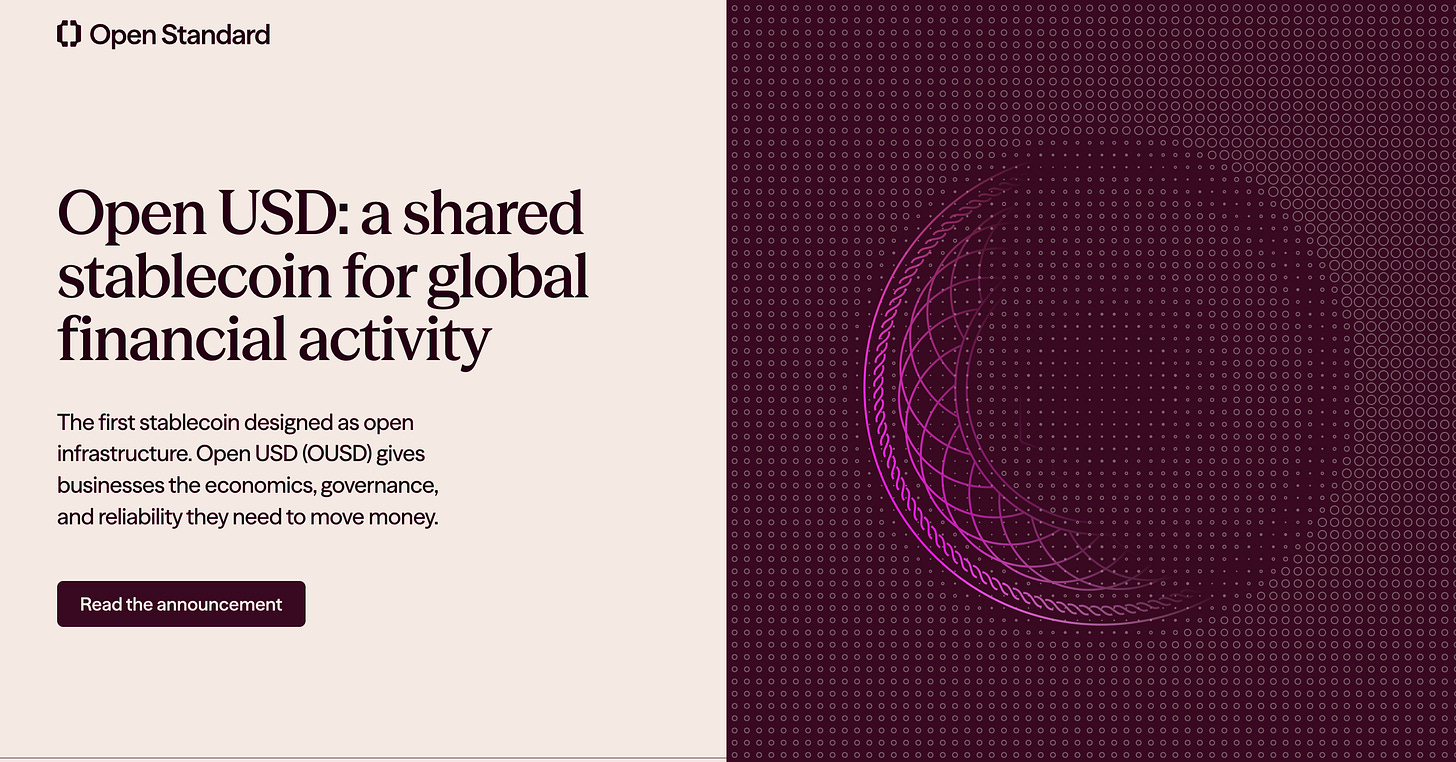
Open USD represents a paradigm shift in stablecoin governance by establishing a partner-driven consortium model that distributes control among over 140 major firms including Visa, Mastercard, Stripe, BlackRock, and BNY Mellon. Unlike traditional single-issuer stablecoins such as Circle’s USDC, governance is vested in an independent board of partner representatives, aligning with the 2025 GENIUS Act’s multi-stakeholder framework and fostering a collaborative approach to stablecoin issuance and oversight.
Economically, Open USD disrupts the conventional stablecoin model by eliminating minting and redemption fees and removing volume caps, thereby lowering barriers to adoption and usage. This zero-fee structure, combined with a novel 'earn by default' mechanism, channels nearly all reserve interest earnings back to partners after a modest operational fee, in stark contrast to incumbents like Circle and Tether who retain these yields. This revenue-sharing approach incentivizes ecosystem participants—ranging from payment networks to banks and merchants—to actively drive adoption while capturing economic value directly.
By commoditizing the stablecoin issuance layer through open-source principles and consortium governance, Open USD challenges the entrenched concentration where two firms control 83% of stablecoin reserves and yields. This strategic move not only democratizes the economics of the stablecoin float but also shifts competitive focus toward adjacent layers where partners hold sustainable advantages, such as payment rails and custody services. Yet, critics note that despite the 'open' branding, governance remains a curated board of incumbents rather than an open commons, highlighting tensions between marketing narratives and structural realities.
Open USD’s multi-chain issuance across Solana, Stellar, Base, and Polygon, coupled with its partner-governed economic model, enables diverse stakeholders like Visa and Mastercard to leverage stablecoin rails without surrendering economic benefits to a central issuer. This inclusive design empowers payment networks, infrastructure providers like Stripe, banks such as BNY Mellon, and merchants including Shopify and DoorDash to participate in a decentralized yet economically aligned ecosystem, thereby intensifying competition with incumbent stablecoins and reshaping the global crypto payments landscape.






Circle’s Moat Under Siege
Open USD’s radical revenue-sharing and default integrations threaten Circle’s core business model, fueling competitive realignment among payment giants and destabilizing longstanding crypto partnerships.
Open USD, a consortium-backed stablecoin supported by over 140 major firms including Visa, Mastercard, Stripe, BlackRock, Google, and Coinbase, is aggressively challenging Circle's USDC dominance by introducing a partner-governed, zero-fee model that redistributes nearly all reserve income back to its participants. This radical revenue-sharing approach directly threatens Circle’s primary revenue source, which relies on earning interest from USDC reserves constituting roughly 96% of its income, and has already triggered a sharp market reaction with Circle’s stock plunging nearly 40% over a month. By shifting stablecoin economics from a centralized issuer to a distributed governance structure, Open USD is reshaping the $30 billion Wall Street stablecoin surge and redefining competitive dynamics in global crypto payments and governance.
The consortium’s structure, which includes competing giants like Visa and Mastercard as co-owners, replicates market neutrality and challenges Circle’s strategic strongholds in payments and brand neutrality. Open USD’s integration as the default stablecoin on platforms such as Stripe and Shopify targets high-volume enterprise and B2B payment flows, directly competing with Circle’s growth strategy in merchant settlements and cross-border corridors. Furthermore, the impending expiration of Circle’s revenue-sharing agreement with Coinbase—now a founding member of Open USD—raises the prospect of less favorable terms for Circle, intensifying the competitive pressure and potentially altering longstanding partnership dynamics.
Despite its formidable backing and innovative model, Open USD faces significant challenges in gaining traction against Circle’s entrenched USDC, as consortium stablecoins historically struggle with commitment and execution due to lack of exclusivity and volume guarantees. Key partners like Coinbase continue to support USDC alongside Open USD, underscoring the complex incentives at play. Moreover, the consortium’s reliance on reserve yield sharing risks diluting banks’ incentives to migrate deposits, while agile, owner-driven competitors like Circle and Tether maintain market leadership through rapid feature deployment and strong operational execution, suggesting that Open USD’s success is far from assured amid intense governance and regulatory scrutiny.




Governance Gaps and Trust Risks
Open USD’s reliance on Stripe-owned tech and lack of regulatory clarity expose deep vulnerabilities in its independence and adoption prospects, as banks and institutions hesitate amid unresolved incentive and compliance questions.
Despite the impressive backing of over 140 major firms including Visa, Mastercard, and Google, Open USD grapples with significant governance doubts and regulatory tensions as it navigates the evolving crypto landscape of 2026. While positioned as an independent consortium, its heavy reliance on Stripe-owned infrastructure components such as the Tempo blockchain and Privy onboarding raises questions about true decentralization and independent governance, complicating regulatory acceptance and trust-building efforts.
Open USD faces formidable adoption barriers rooted in regulatory scrutiny and historical skepticism surrounding stablecoins, where trust hinges on transparent reserve management, redemption capabilities, and clear regulatory oversight. Unlike Circle’s USDC, which has advanced into the regulated financial system by establishing a U.S. national trust bank, Open USD has yet to disclose critical details about its regulated issuer, custodian, or reserve framework, leaving institutional users cautious amid a market that increasingly demands proven compliance and reliability.
The consortium model itself introduces governance and incentive challenges, as membership lacks binding commitments, exclusivity, or minimum volume requirements, potentially diluting collective motivation to prioritize Open USD’s success. Additionally, banks within the consortium face structural disincentives to promote OUSD, since converting client deposits into stablecoins reduces their balance sheets and net interest margins, creating a tension between participation and active adoption promotion.
Beyond domestic real-time payment advances like RTP® and FedNow, Open USD confronts the daunting task of achieving seamless cross-border interoperability amid fragmented regulatory regimes and payment systems, a critical hurdle for any new stablecoin aiming for global adoption. This challenge is compounded by fierce competition from incumbent stablecoins like Circle’s USDC, which rapidly deploys innovative features such as CCTP and Arc, underscoring the complex interplay of infrastructure dependencies, regulatory scrutiny, and market dynamics shaping the stablecoin ecosystem’s future.

Stablecoins Cement Wall Street’s Role
Institutional stablecoins like Open USD are transforming from disruptors to core infrastructure, letting legacy finance capture blockchain efficiencies while reinforcing their grip on global payments and cross-border flows.
The emergence of Open USD, backed by over 140 major firms including Visa, Mastercard, BlackRock, and Google, epitomizes the institutional commoditization of stablecoins within established financial ecosystems. Rather than disrupting incumbents, this consortium-driven stablecoin aims to entrench existing payment infrastructures by enabling these firms to leverage blockchain technology for greater efficiency and lower fees without sacrificing market dominance. This collaborative approach signals a maturation of stablecoins from niche crypto assets into foundational financial rails that complement and enhance traditional payment networks.
Amid a broader $30 billion surge in Wall Street-backed stablecoins, the payments landscape is undergoing a transformative shift where stablecoins reduce transaction costs—such as lowering merchant fees from typical credit card rates of 2.9% to around 1.5% via USDC acceptance on platforms like Stripe—while preserving traditional financial power structures. Open USD’s zero-fee, partner-governed model exemplifies this trend by offering a no-cost stablecoin network designed to streamline global B2B payments and cross-border commerce by 2026, reflecting a strategic effort to capture float and reshape global payment flows.
Stablecoins are rapidly evolving into indispensable infrastructure for global finance, facilitating approximately US$33 trillion in on-chain transaction volume in 2025 alone and driving innovation in cross-border settlements, treasury management, and liquidity optimization. The UAE, as the world’s second-largest outbound remittance market with around US$56 billion in on-chain value flowing through between 2024 and 2025, exemplifies how progressive regulatory ecosystems and institutional adoption accelerate the integration of blockchain-based payments with traditional financial systems, positioning the region as a global digital finance hub.
The stablecoin ecosystem is diversifying, with USDT dominating payments and USDC leading in DeFi, illustrating a segmentation of stablecoin roles rather than direct competition. Meanwhile, Open USD’s consortium model shifts network effects from issuers to distributors—exchanges, wallets, and fintechs—empowering these intermediaries to select the stablecoin closest to users and thereby transforming governance and distribution dynamics. This evolution supports the rise of machine-native, permissionless payments and institutional DeFi infrastructure exemplified by firms like Blueprint Finance, which offers compliant yield solutions integrating custody and regulatory frameworks, signaling a new era of institutional-grade digital asset deployment.