Open USD’s yield revolution rattles circle as institutions pile in
The gist
The Open USD consortium’s yield-sharing model is shaking up stablecoin power, sending Circle’s stock tumbling and igniting a fierce fight for dominance as institutions stampede into the fray.
What to know
- Since mid-May 2026, the stablecoin market shrank by over $12 billion, but USDT and USDC still command 82% share as yield-hunting coins like USDG and PYUSD surge.
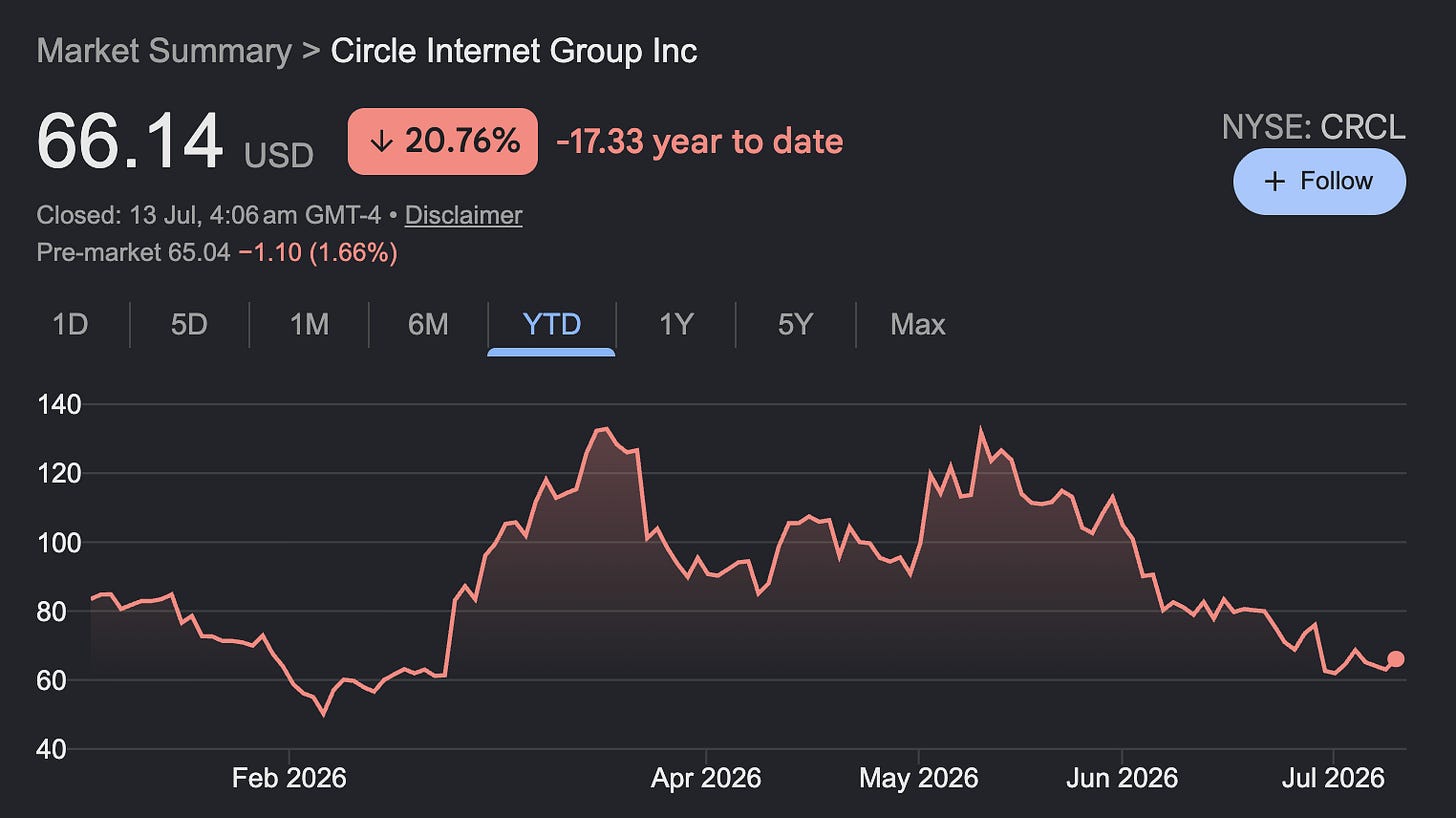
- Open USD, backed by 140+ heavyweights including Visa, Mastercard, and Coinbase, is challenging Circle’s USDC by redistributing nearly all reserve yields to partners—triggering a 17% plunge in Circle’s stock.
- Major players like Hyundai, JPMorgan, and BlackRock are embedding stablecoins into global finance, while regulatory delays and new governance models spark a stablecoin arms race.
Yield Chases Reshape Flows
Investors are abandoning low-yield stablecoins for higher-return alternatives like USDG and PYUSD, driving a capital migration that signals a risk-on pivot and challenges the longstanding dominance of USDT and USDC.
Since mid-May 2026, the stablecoin market has experienced a notable contraction with over $12 billion exiting, marking the sharpest decline since 2022. Despite this shrinkage, Tether (USDT) and Circle (USDC) continue to dominate, jointly controlling 82% of the market with $184 billion and $73 billion respectively, though they face rising competition from yield-oriented stablecoins like Global Dollar (USDG) and PayPal’s PYUSD, which are rapidly gaining traction. This contraction signals a structural shift away from traditional stablecoins toward assets offering more utility and yield, rather than a panic-driven sell-off.
The ongoing stablecoin supply contraction, evidenced by a $1.17 billion week-over-week decline and modest outflows from USDC and USDT, coincides with a pronounced accumulation of Ethereum off exchanges as ETH prices climb toward $1,870. This dynamic reflects a broader capital reallocation from stablecoins into Ethereum holdings and altcoins, with ETH outperforming Bitcoin for three consecutive weeks, underscoring a structural shift in investor preference amid choppy stablecoin inflows and cautious yet persistent institutional ETF interest.
Capital is migrating away from conservative, low-yield stablecoins such as USDS, BUIDL, and USDtb, which have collectively seen outflows exceeding $1.5 billion over 30 days, signaling a mild risk-on sentiment where funds seek higher returns rather than exiting the crypto ecosystem. Concurrently, yield-focused stablecoins like USDG are experiencing strong inflows—$256 million recently—driven not only by yield farming but also by increased trading activity on platforms like Robinhood Chain, indicating a more sustainable and sticky demand pattern that challenges the traditional dominance of USDT and USDC.
Institutional adoption is accelerating amid these market shifts, exemplified by Hyundai’s pioneering use of Avalanche for international stablecoin transfers in partnership with Circle and Visa, which envisions stablecoins and payment cards as complementary components in the emerging AI-driven micro-payment economy. This integration underscores how stablecoins are evolving from mere digital cash substitutes into integral infrastructure for global commerce, even as their overall supply contracts and market dynamics undergo profound transformation.


Institutions Embed, Not Disrupt
Major financial players are quietly integrating stablecoins into legacy infrastructure—using platforms like BlackRock’s BUIDL and Visa’s Stablecoin Platform—to seize control of crypto rails and shift the battleground from coin issuance to infrastructure dominance.
Institutional adoption of stablecoins is increasingly characterized by a strategic preference for integrating with established financial infrastructures rather than developing proprietary crypto-native systems. Major players like JPMorgan, Visa, and BlackRock leverage proven stablecoin issuance platforms and traditional rails such as card issuance, settlement, and custody to embed stablecoin capabilities seamlessly into existing workflows. This approach is exemplified by BlackRock’s BUIDL fund, which underpins major stablecoins and manages crypto collateral and risk through its Aladdin platform, signaling deep institutional governance involvement and a shift from issuance volume to infrastructure control.
Visa’s Stablecoin Platform (VSP) epitomizes the institutional drive to lower operational barriers by uniting stablecoin minting, wallet infrastructure, and payment-network connectivity within a managed environment. By initially supporting the consortium-backed Open USD stablecoin, VSP targets practical treasury, settlement, and liquidity use cases, enabling institutions to integrate on-chain payments without overhauling existing systems. The platform’s success hinges on beta testing outcomes and institutional demand, reflecting a cautious but deliberate movement toward embedding stablecoins into mainstream financial operations.
Despite a bearish retail crypto market, institutional engagement with DeFi and stablecoins is surging, driven by fintech giants like Robinhood and asset managers such as JPMorgan and BlackRock actively tokenizing products and deploying on-chain solutions. Maple Finance’s nearly $2 billion in active loans during a bear market underscores robust institutional participation, while neobanks and traditional asset managers are poised to fuel the next wave of global DeFi adoption. This divergence between institutional traction and retail sentiment suggests a foundational shift in capital markets toward on-chain finance and automated yield strategies.
The overarching institutional ambition centers on onboarding Fortune 500 companies onto blockchain networks, recognizing stablecoins as critical payment rails rather than mere crypto tokens. Enhanced blockchain infrastructure, including Layer 2 scaling and privacy tools, now supports the high-speed transactions necessary for enterprise-grade payments, which involve complexities beyond typical crypto use cases. This maturation of technology and market focus reflects a bifurcation where stablecoins underpin enterprise financial infrastructure while speculative assets occupy a separate niche, highlighting stablecoins’ emerging role as foundational to institutional finance.




Open USD’s Yield-Sharing Shock
Open USD’s consortium model, which returns nearly all reserve yield to partners, is upending Circle’s business and igniting a stablecoin arms race as Coinbase and other giants pivot to collaborative, revenue-sharing frameworks.
The stablecoin market is witnessing a seismic shift as the Open USD consortium, backed by over 140 major players including Visa, Mastercard, BlackRock, Google, Stripe, and Coinbase, challenges Circle’s USDC dominance with a revolutionary revenue-sharing model. Unlike Circle, which retains approximately 38% of USDC’s reserve income and earned $652.5 million in reserve income in Q1 2026 alone, Open USD redistributes nearly all reserve yield back to its distribution partners after a small management fee, igniting a yield-sharing revolution that threatens Circle’s $15 billion market stronghold and has already caused a more than 17% drop in Circle’s stock price following Open USD’s announcement. This consortium-based governance, emphasizing collaborative control rather than centralized issuer dominance, represents a democratization of stablecoin economics that directly contests Circle’s strategic advantages in payments infrastructure and brand neutrality.
Coinbase’s strategic pivot from exclusive support of Circle’s USDC to joining the Open USD alliance underscores intensifying competition in stablecoin governance and revenue-sharing frameworks. As a founding USDC partner that previously retained all interest income from USDC on its exchange, Coinbase’s move to the consortium-backed Open USD—while maintaining the option to renew its revenue-sharing agreement with Circle—signals a diversification strategy to capitalize on the broader stablecoin market growth, which saw Coinbase’s stablecoin revenue rise 48% year-over-year to $1.35 billion in 2025. This realignment not only boosts Coinbase’s leverage in upcoming revenue-sharing negotiations with Circle but also exemplifies the growing institutional appetite for collaborative stablecoin models backed by industry titans like Visa, Mastercard, Stripe, and BlackRock.
Open USD’s zero-fee minting and redemption model, combined with its Bitcoin-based cryptographic infrastructure, positions it as a formidable alternative to USDC by offering cleaner economics and enhanced privacy features that could accelerate U.S.-based stablecoin adoption globally. By building on familiar wallet and transaction concepts, Open USD aims to reduce user friction and challenge traditional permissioned banking systems, fostering an open standard for intercommunication among privately issued stablecoins. This technological and governance innovation not only intensifies the stablecoin arms race amid regulatory and DeFi governance battles but also signals a strategic effort to reshape market control through decentralized infrastructure and institutional coalition-building.
Despite the formidable consortium backing Open USD, early denials from prominent South Korean firms such as Samsung Electronics and Shinhan Financial Group reveal potential structural fragility and governance challenges inherent in large-scale stablecoin alliances. Meanwhile, both Circle and Stripe are pursuing vertical integration strategies by developing proprietary blockchains—Circle’s Arch and Stripe’s Tempo—to diversify revenue streams beyond issuance fees and dominate the stablecoin value chain. These parallel moves highlight a broader industry trend where stablecoin issuers and consortiums alike are innovating governance and infrastructure to secure long-term market control amid escalating competition and regulatory uncertainty.





Governance Battles and Regulatory Limbo
With regulatory clarity delayed and new governance models like Open USD’s threatening Circle’s fee structure, the stablecoin market is fracturing along lines of decentralization, institutional alignment, and shifting revenue power.
The stablecoin market is undergoing a profound transformation driven by the dominance of Circle and Tether, which has catalyzed a strategic unbundling of stablecoin issuance functions and intensified governance battles within DeFi ecosystems. This dynamic is exemplified by Base’s recent governance missteps, highlighting broader tensions between centralized decision-making and community-driven governance models. Meanwhile, regulatory clarity remains elusive as the Clarity Act faces delays, pushing potential definitive stablecoin legislation into 2027 despite ongoing congressional hearings aimed at unlocking innovation in digital finance.
Circle’s recent approval by the OCC to establish a national trust bank marks a significant milestone, enabling the company to scale digital asset custody under federal oversight and reinforcing institutional confidence. However, the anticipated regulatory certainty from the Clarity Act may paradoxically intensify competition, as Mizuho analysts warn it could commoditize USDC and erode Circle’s revenues over time. This regulatory backdrop also empowers Coinbase, USDC’s largest distributor, which has endorsed the consortium-backed Open USD stablecoin, potentially shifting revenue-sharing dynamics and challenging Circle’s market control.
Open USD’s governance model starkly contrasts with Circle’s by routing nearly all reserve yield directly to distributors while retaining only a small management fee, presenting a disruptive governance challenge that could reshape stablecoin infrastructure and market dominance. This pass-through yield-sharing approach not only threatens Circle’s traditional revenue model—where it retains about 38% of USDC’s reserve income—but also signals a broader shift towards more decentralized and distributor-aligned governance frameworks within the stablecoin ecosystem.
Regulatory frameworks such as the GENIUS Act have significantly bolstered institutional confidence by providing clearer guidelines for stablecoin issuance, yet domicile and compliance remain critical hurdles. Tether’s decision to domicile outside the U.S. and launch USA₮ specifically for the American market underscores the complexities issuers face under U.S. regulations that favor domestically based or equivalently regulated entities. Meanwhile, decentralized governance models like Sky’s USDS and MakerDAO’s DAI, governed by token holders rather than centralized companies, continue to influence the evolving regulatory and governance landscape by offering alternative stablecoin infrastructures that challenge traditional centralized issuance paradigms.