Palantir soars on AI and army wins—but Wall Street still wary of lofty valuation
The gist
Palantir’s blockbuster AI wins and surging defense revenue have investors both cheering its momentum and sweating its sky-high valuation.
What to know
- A strategic alliance with NVIDIA puts Palantir at the front of a $177B sovereign AI market, powering secure, on-prem AI for the U.S. government.
- Q1 revenue skyrocketed 85% to $1.6B thanks to a major U.S. Army contract, prompting a full-year guidance hike to $7.65B.
- Despite a $21.7B market cap jump, shares are still down 25% YTD as Wall Street debates whether Palantir’s premium price can be justified long term.
Sovereign AI’s Double-Edged Sword
Palantir’s deepening U.S. defense ties and exclusive NVIDIA alliance cement its edge in secure AI, but growing dependence on government contracts exposes the company to political and budgetary turbulence.
Palantir's strategic alliance with NVIDIA to integrate Nemotron open-weight models into its Sovereign AI Operating System marks a significant leap in delivering secure, domain-specific AI infrastructure tailored for U.S. government agencies and critical infrastructure. This collaboration enables clients to deploy, customize, and maintain full ownership of AI model weights within air-gapped, on-premises environments, a capability that CEO Alex Karp emphasized as a distinct advantage over cloud-based AI providers like OpenAI and Anthropic. By combining Palantir's ontology layer—which structures complex data into actionable intelligence—with NVIDIA's hardware acceleration, the partnership creates a robust full-stack sovereign AI solution that is difficult for competitors to replicate, positioning Palantir at the forefront of the projected $177 billion sovereign AI market growing at a 28% CAGR through 2035.
The U.S. Army's decision to standardize its Next Generation Command and Control (NGC2) common data layer on Palantir's Foundry platform cements Palantir's role as the backbone of mission-critical defense modernization efforts. This endorsement not only reinforces Palantir's position as the 'default infrastructure' for sensitive AI workloads in defense but also enhances long-term revenue visibility amid a surge in government contracts. By early 2026, Palantir's Q1 revenue soared 85% year-over-year to $1.6 billion, with U.S. government revenue more than doubling, prompting management to raise full-year guidance to an estimated $7.65 billion, underscoring strong momentum in regulated sectors.
Beyond government, Palantir's expanded partnership with Surf Air Mobility to accelerate SurfOS aviation software powered by Palantir's AI infrastructure signals a strategic diversification into private aviation, extending its secure AI capabilities into new commercial verticals. However, despite these durable revenue streams and leadership in secure AI infrastructure, Palantir remains heavily reliant on U.S. defense and public sector budgets, exposing it to concentration risks amid shifting political priorities and procurement cycles. This dependency underscores the ongoing challenge of balancing ambitious long-term growth targets with the inherent volatility of government spending.

Volatility Amid Sky-High Ambitions
Palantir’s market swings reflect both feverish investor optimism over AI-fueled growth and persistent doubts about whether its valuation can withstand intensifying competition and sector-wide skepticism.
Palantir's stock has exhibited pronounced volatility in 2026, with dramatic surges closely tied to strategic AI partnerships and defense contract announcements. Notably, the July 1 rally added approximately $21.7 billion in market value, driven by the sovereign AI collaboration with NVIDIA and a U.S. Army contract, underscoring investor enthusiasm for Palantir's positioning as a trusted operator in secure, sovereign AI environments. This spike was further amplified by revelations of Donald Trump’s $1 million-plus stake, which heightened market attention and trading volume. However, these gains occurred amid a broader context where Palantir's stock remains down about 25% year-to-date, reflecting persistent skepticism despite the company’s fastest-ever revenue growth and raised guidance. [1, 2, 3, 4, 6, 7]
The stock’s fluctuations also mirror broader market dynamics, including a sector-wide derating of expensive SaaS stocks amid fears that AI-driven coding could disrupt traditional software moats. Palantir’s valuation metrics remain elevated, with trailing and forward P/E ratios hovering between 73 and 149, and price-to-sales multiples exceeding 50, which fuels investor caution despite strong operational results. This tension is compounded by increasing competition as Palantir’s once-unique ontology capabilities become standard offerings among major AI players, challenging its market differentiation and contributing to the stock’s pullbacks from a November 2025 peak near $207 to lows around $106 in late June. [5, 14, 16, 17, 18, 19, 20]
Investor sentiment is notably mixed, balancing bullish analyst upgrades and optimistic price targets against bearish short positions and insider selling activity. Firms like UBS have upgraded Palantir to 'Buy' with a $180 target, citing strong AI-driven growth prospects and robust revenue gains—such as a 137% surge in U.S. commercial revenue and 66% growth in government contracts—while acknowledging the stock’s premium valuation and sector headwinds. Meanwhile, skeptics highlight Palantir’s heavy reliance on U.S. government contracts, which exposes it to political and budgetary risks, and question the sustainability of its ambitious long-term revenue targets that require over 40% annual growth to reach $10.8 billion by 2028. This dynamic creates a volatile trading environment where enthusiasm for Palantir’s strategic positioning is tempered by valuation and competitive challenges. [9, 10, 11, 12, 15, 21, 22, 23, 24, 25, 26, 27, 28]
Valuation Tug-of-War
Analysts are fiercely split as Palantir’s soaring multiples hinge on delivering extraordinary growth, while insider selling and rival tech giants threaten to erode its premium status.
Palantir's valuation remains a polarizing topic among analysts, with some like UBS's Karl Keirstead arguing the stock is undervalued despite a lofty P/E ratio of 131, citing rapid revenue growth—85% year-over-year to $1.63 billion in Q1—and expanding operating margins reaching 46%. Management’s ambitious guidance for $7.66 billion in revenue and $4.3 billion in free cash flow for the full year underpins this bullish stance, suggesting that the premium valuation multiples could be justified if Palantir sustains its momentum and margin expansion.
Conversely, skepticism runs deep with investors like Michael Burry maintaining a bearish price target below $50 per share, arguing that Palantir trades at a 16-times premium to its intrinsic value amid questionable business model durability and accounting practices. The stock’s extreme valuation multiples—trailing P/E around 135x, forward P/E near 76x, and price-to-sales about 60x—exacerbate concerns that the company must deliver extraordinary and sustained revenue growth to justify such lofty prices, a feat complicated by significant insider selling from executives including CEO Alex Karp and Peter Thiel.
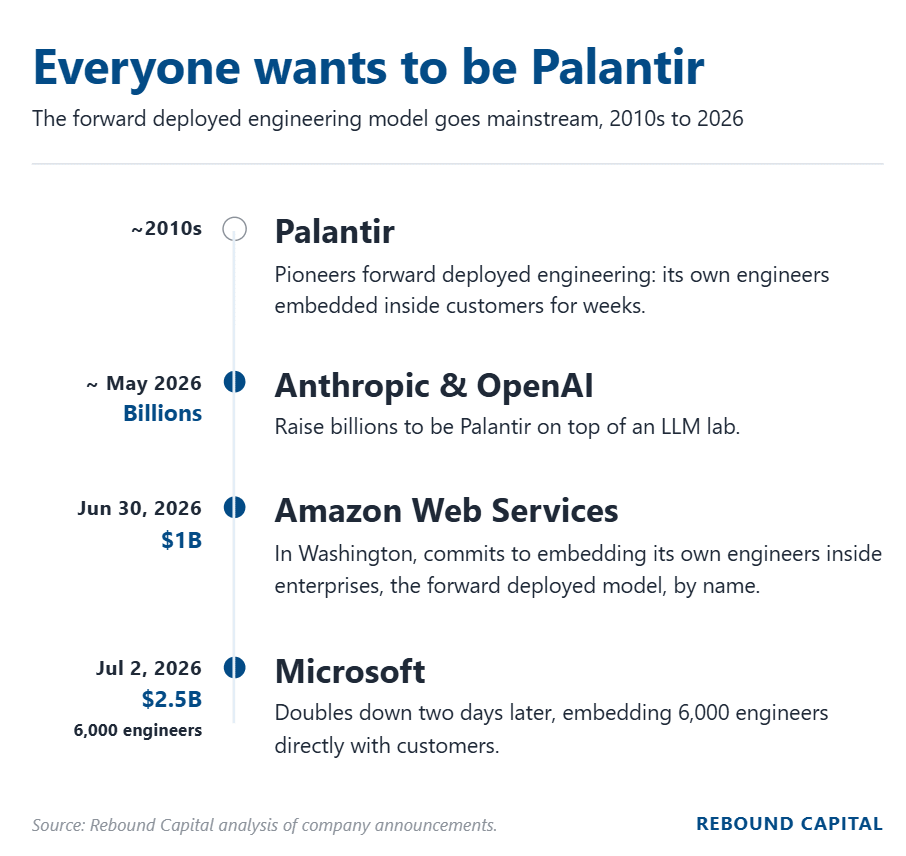
The high valuation is further challenged by structural risks and competitive pressures, as Palantir’s core advantage in ontology and forward-deployed engineering is being replicated by tech giants like AWS and Microsoft, who have committed billions to embed engineers with customers. This intensifying competition, coupled with Palantir’s reliance on U.S. government contracts and costly integration-heavy deployment model, raises doubts about the scalability of its commercial segment and whether it can realistically meet the ambitious $42 billion revenue target by 2030 needed to justify current prices.
Investor sentiment remains cautious despite Palantir’s strong recent growth and strategic AI partnerships, as the stock’s volatility and downtrend year-to-date reflect market wariness about whether the company’s lofty long-term revenue targets and margin expansion can be achieved without faltering. While some valuation models peg fair value near or above current prices, others see the stock as overvalued given the narrow margin for error baked into expectations, recommending a hold stance and emphasizing dollar-cost averaging and a long-term horizon to navigate the inherent risks.