Physical AI robots hit real workplaces—hype meets hard limits
The gist
Physical AI robots are finally leaving the lab and rolling into real workplaces, but the hype is already banging into hard hardware and safety limits.
What to know
- Robots powered by physical AI made the leap to semi-structured sites in late 2026, popping up everywhere from shipyards and warehouses to airport baggage claims (and even handing out popcorn).
- Physical AI startups raked in over $23 billion so far this year, with 7 in 10 manufacturing leaders expecting robot fleets soon—but only 4 in 10 have a plan for human-robot harmony.
- Biggest barriers? Robots are still slow learners, actuators eat up half the hardware bill, and no one wants a 100-pound bot tumbling onto their cat.
Robots Break Out of Factories
Physical AI robots crossed a critical threshold in late 2026, moving from controlled factories into unpredictable real-world spaces thanks to leaps in computer vision and hardware integration.
Physical AI, as Imagination in Action defines it, is not software that merely analyzes information but intelligence embedded in machines that can “affect the physical world” and create value by acting on objects and spaces. That definition matters to the late-2026 moment because the same explainer argued the field had reached a “tipping point,” with robots leaving fully structured factory settings and entering semi-structured environments such as warehouses, where stronger computer vision and compute were making reliable operation newly practical.
By late 2026, that shift was no longer theoretical: a November interview described a real robot “going around handing out popcorn to people,” adding that “this thing is going all the time” and concluding that robots had finally reached the stage where policies and hardware could be deployed into environments to do useful work. The same speaker underscored how quickly deployment expectations had changed, saying there was a time when progress looked “10 years” away, but “over the last quarter… we didn’t have agents in January of this year,” a compressed timeline that captures both the acceleration and the pressure to solve hardware and training bottlenecks at scale.


Sensing and Learning Merge
Robotics builders are now fusing sensors, controls, and training pipelines so machines can adapt to chaotic environments—slashing rigid preprogramming and feeding on real deployment data for rapid improvement.
Robotics operators and developers are moving beyond brittle automation toward systems that combine perception, learning, and controls. STMicroelectronics said it would integrate its sensors, microcontrollers, and motor-control solutions into NVIDIA’s robotics ecosystem to help developers design, train, and deploy robots, with early steps including Leopard Imaging’s stereo depth camera integration through the NVIDIA Holoscan Sensor Bridge and high-fidelity sim-to-real IMU models in Isaac Sim. This reflects a co-design approach in which sensors, control hardware, and training pipelines are built together so robots can perceive and act more reliably in complex physical environments outside factory floors.
The shift was driven by the limits of older robots in variable settings, where it still takes six to nine months to integrate a new robotic solution and the robot remains very rigid and preprogrammed. Newer systems learn from deployment data: Stord says it processes about 8 billion operational data points a year and uses post-deployment training videos after robots go live in an environment spanning about 100 million packages a year. Boris Sofman said the pattern began in transportation with Waymo, which has done cumulatively 200 million in the entire history of the company out of 3 trillion, and noted that in 2024 open source helped labs put AI into robots. Stanford’s 2026 AI Index found 12.4% full-task success on BEHAVIOR-1K versus 89.4% on RLBench, showing why real-world data loops and sim-to-real validation matter.





Industrial Robots Go Routine
The true milestone is not flashy demos but robots running repeat missions daily in shipyards, airports, and warehouses, signaling that physical AI is becoming a dependable part of industrial workflows.
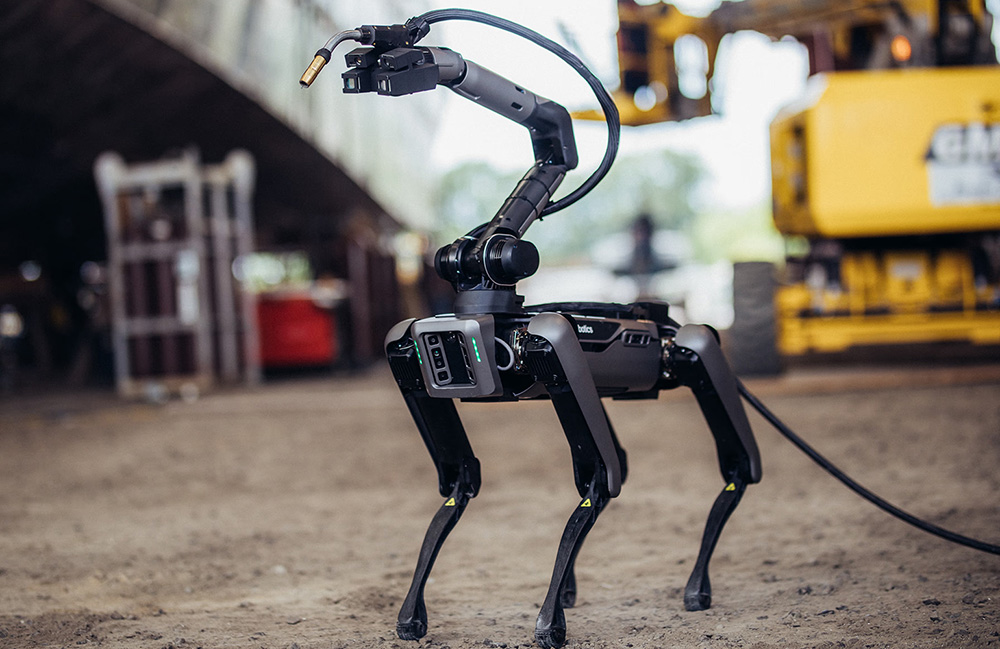
By late 2026, the clearest signal was not better robot demos but repeated use in live industrial settings. The Robot Report pointed to HII’s partnership with Path Robotics and GrayMatter Robotics to accelerate shipbuilding, evidence that physical AI was being integrated into a real production environment, while Anybotics CEO Peter Funkhouser said his company had evolved from “kind of a research lab” in its first five years into an inspection product in the last five, with “hundreds” of robots deployed over that period and customers running some missions 40 times a day.
The spread of deployments across inspection, logistics-adjacent infrastructure, and warehouses reinforced that this was a pattern, not an isolated success. At LaGuardia Airport, PYMNTS reported that a “headless, four-wheeled robot dog is now roaming Terminal B’s baggage claim to inspect the air” as part of a pilot that also included robotic cleaning machines, and the same analysis argued the 2026 wave looked like specialized robots doing unwanted tasks in real facilities; by November, PRWeb said Cartesian Kinetics’ Carte+ system was officially live at HJI Supply Chain Solutions’ Louisville fulfillment center.



Big Money, Small Jobs—for Now
Despite $23 billion in fresh funding and boardroom optimism, most robots are still limited to narrow, repetitive tasks as the industry wrestles with slow progress toward human-level speed and reliability.
The opportunity is plainly big enough to pull in serious money and board-level planning. The Robot Report, citing The Wall Street Journal, said physical AI firms had already raised more than $23 billion in venture capital in 2026 so far, with headline rounds including Waymo’s $16 billion Series D, Skild AI’s $1.4 billion Series C, NEURA Robotics’ $1.4 billion Series C, and Physical Intelligence’s $1 billion; meanwhile, an Intel-commissioned survey of 800 business and IT leaders found seven in 10 senior manufacturing leaders expect their organization to have a fleet of robots within five years, even though only roughly four in 10 have a formal strategy to manage humans and robots together.
But that capital and intent do not mean broad deployment is imminent, because the near-term market is still defined by narrow jobs that can tolerate today’s limits. Intel found approximately 40% of respondents had integrated robotics into certain processes or functions, while 35% were extending them across multiple processes or functions, and analysts on Cognitive Revolution argued the pattern resembles self-driving—“There was a ton of money that flowed into self-driving in 2016, 2017, 2018… it just didn't quite work well enough”—noting one startup had solved many tasks but was “10 times slower than a human” at a 53% success rate, with improvement to near-commercial reliability potentially taking “five or 10 years of work.”
Safety and Trust Remain Elusive
The toughest challenge is ensuring robots don’t just work—they work safely around unpredictable humans and environments, with actuator costs and integration bottlenecks slowing the path to true reliability.
Skeptics say the hardest part is not making robots look competent in a demo, but keeping them reliable and safe when bodies, environments, and people vary. Possible captured that anxiety most vividly: “no one really wants like this like, hundred pound robot in their house,” because it could “fall on their cat” or “trip and like go out of the window and just harm someone,” which is why they say “residential is much more of a, like a scarier place to deploy a robot,” while expecting “a lot more robotics in commercial environments in like the next like, three to five years.”
The deeper skeptical case is that deployment bottlenecks sit in data, integration, and hardware, not just model intelligence. A3 said a robot assisting someone “could encounter different physical capabilities from one week to the next,” while “An older adult's needs could change over several years,” helping explain why the University of Texas at Austin is leading a $30 million NSF Center for Human and Robot Co-Adaptation with 39 researchers from six universities; meanwhile, safety work now “must assess AI software alongside traditional functional safety, using design-time, runtime and validation-time guardrails,” and notes “Emerging standards such as ISO/IEC TS 22440 are beginning to address these,” while actuator supply remains “the biggest kind of bottleneck,” with actuators making up 30 to 50% of a humanoid’s BOM cost.