Physical AI steps out of LLM’s shadow, stakes its claim
The gist
Physical AI is breaking free from language models, staking its claim as the foundation for robotics, simulation, and industrial breakthroughs.
What to know
- By October 2026, models like PhysBrain 1.5—built on 50% sensor data and 20% video—were outperforming LLMs with a 72.5 average on 28 embodied benchmarks.
- Language-only systems miss crucial real-world signals, as shown when a pediatric ICU model hit high AUC (0.8521) but could only detect 42% of critical cases.
- The new multimodal, physics-aware AI stack is drawing major bets from Arm, Google Cloud, Microsoft, and Biohub’s $1.8B open-data push with the DOE and NIH.
Physical AI Finds Its Identity
PhysBrain 1.5 and its peers are breaking away from language-first models by prioritizing sensor and video data, establishing physical AI as a distinct and necessary paradigm for real-world intelligence.
By October 2026, the case for physical AI as a distinct model category was no longer theoretical; it was being articulated in both analysis and new model releases around the mismatch between language-era assumptions and real-world data. DataFramed had already framed the divide starkly: “Large language model is mostly text… maybe 80% images, 10%… everything else has much smaller percentage,” while “in physical AI… majority of the data… about 50%… is measurements… Then the next most popular data stream… is video… about 20%… And then text is less than 5%,” underscoring why sensor-heavy systems demand different foundations.
That argument was reinforced in October by concrete model work that defined physical AI on its own terms rather than as an LLM extension. 每日AI论文 described PhysBrain 1.5 as moving “From Vision-Language Models to Physical Foundation Models,” and its abstract said, “Across 28 embodied understanding benchmarks, our 8B model achieves an average score of 72.5… Beyond these understanding evaluations, qualitative examples show the model's ability to produce end-effector trajectories and predict future scenes,” while the later headline “MBZUAI’s IFM opens PAN 2 world model to all” signaled parallel momentum in world-model research beyond LLM-only approaches.



Language Alone Misses Reality
Text-based models strip away vital sensor details, leading to dangerous blind spots in critical applications like healthcare, where missing raw signals can mean failing to detect life-threatening events.
Language works by compression, and that is exactly the problem for physical intelligence. As Fei-Fei Li argued in WHERE MACHINES THINK, language is a “purely generated signal,” while the 3D world follows physics; Demis Hassabis added that spatial dynamics, mechanical context, and physical awareness are often hard to describe in words at all. Once raw observations are translated into text, the model inherits not just abstraction but omission: vocabulary gaps, human bias, and the loss of continuous detail that control systems need to distinguish a safe grasp, stable gait, or impending collision.
The cost of that loss shows up when prediction depends on preserved sensor structure rather than summaries. Researchers studying pediatric intensive care engineered “longitudinal bedside recordings” by representing “vital signs through their minimum, mean, and maximum values” and laboratory assays via “observed minimum and maximum concentrations,” using only the initial 24 hours, yet although the “top-performing model achieved an area under the receiver operating characteristic curve of 0.8521, [its] sensitivity reached only 42 percent at the selected operating threshold,” underscoring how missing fine-grained physiological signals can cripple real-world decisions.

Physics-Aware Models Reshape Prediction
New multimodal AI stacks align sensor streams in real time and use physics-based architectures to accurately model actions and states, moving beyond text correlations to reliable world understanding.
The emerging physical AI stack combines multimodal pretraining with temporal alignment so one model can jointly predict actions, observations, and physical state with higher fidelity than language-only systems. In the September physical-AI analysis, systems were described as starting multimodal from the start, consuming text, images, video, camera poses, audio, and later action, while a temporal position embedding normalizes different frame rates and hertz so tokens know which signals belong to the same instant and can jointly model forward dynamics, inverse dynamics, and policy.
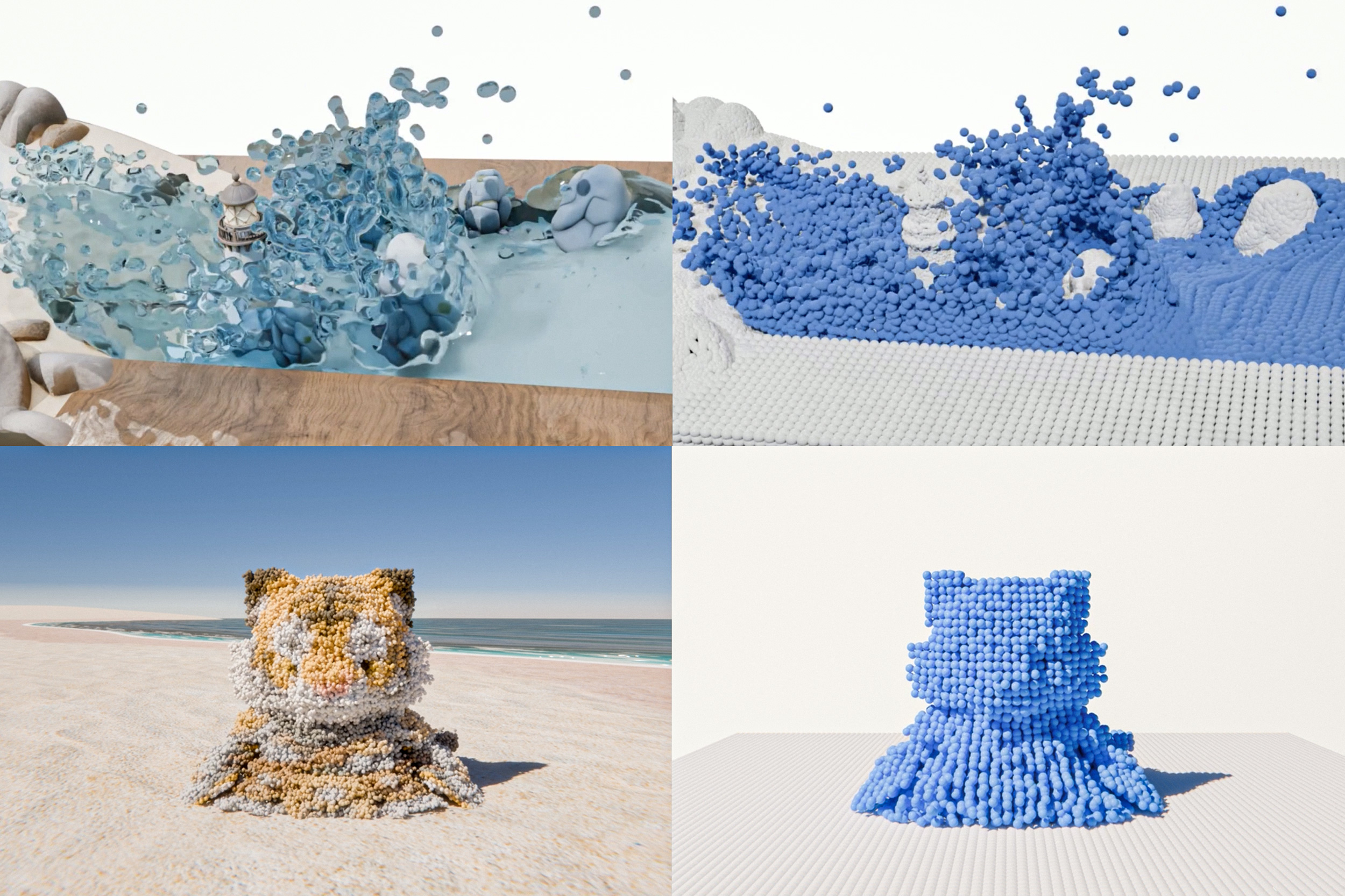
Higher fidelity also comes from physics-aware architectures that preserve physical structure instead of treating the world as loose correlations or text-like symbols. MIT News said WorldParticle breaks an object into thousands or millions of tiny, three-dimensional dots, or particles, using a Lagrangian representation and tracks their movement and velocity over time, while BigDATAwire reported it reproduced complex particle movements, including cases where earlier approaches struggled with unrealistic behavior; in parallel, the October 2026-era research roadmap for trustworthy physical intelligence is echoed in ACS Energy Letters, where the team outlined a physics-aware, feedback-driven roadmap for making AI-guided hydrogen-storage research more trustworthy, grounded by DigHyd’s more than 30,000 thermodynamic entries from over 4,000 publications.




Big Tech Races for Real-World AI
Industry giants are investing in physical AI as foundational infrastructure, betting on its role in everything from robotics to scientific discovery as the addressable market rapidly expands.
The opportunity is big because physical AI is not a single product category but a computing layer needed anywhere systems must sense, decide, and act in real time. Arm is already treating it that way, extending its platform across robotics and other physical systems while citing “OpenAI, Meta, Cloudflare, Oracle, SAP, Lenovo, Supermicro, and Verda” as “developing solutions around AGI CPU,” alongside Google Cloud’s use of Axion for agent sandboxes and Microsoft’s Cobalt—evidence that chip, cloud, and enterprise players see enough demand to build around high-fidelity inference infrastructure.
That demand also spreads well beyond robots into simulation, industrial control, and science, which is why the addressable market keeps widening. Packy McCormick writes that “Over the past two years, there’s been a massive build-out of reinforcement learning environments… each one with its own dedicated engineering,” but “for most of the things we actually care about, nobody knows how to hand-build a faithful simulator,” while Biohub “just announced a $1.8 billion collaboration with the DOE, NIH, Meta and Google to collect and open source, multi scale biological data that can be used to develop a new generation of virtual cells.”