Platforms unite on AI labels amid global compliance crunch
The gist
Under mounting global pressure and looming fines, tech giants are racing to unite around AI-generated content labeling—but compliance and authenticity are proving to be a high-stakes, moving target.
What to know
- By mid-2026, the EU AI Act and California’s AI Transparency Act forced platforms to label AI-generated content or face fines up to €15 million and $5,000 per violation.
- TikTok has already labeled over 3 billion AI-generated videos and now lets users control how much AI content they see, while YouTube and others ban fully AI-made videos from monetization.
- A coalition of seven major platforms—including TikTok, Meta, and Google—has adopted strict transparency standards and a 'no human, no reach' rule to keep synthetic media in check.
AI Labels Spark Debate
TikTok and WhatsApp’s pioneering AI labeling systems are igniting controversy over whether transparency builds trust or breeds skepticism, as platforms grapple with nuanced distinctions between AI-enhanced and fully synthetic media.
By early 2026, TikTok had taken a pioneering stance on AI transparency by labeling over 1.3 billion videos as AI-generated and experimenting with user controls that allow individuals to adjust the visibility of AI content in their feeds. This initiative serves a dual purpose: protecting the platform and creators from unintentional misrepresentation while empowering consumers to critically evaluate the authenticity of what they see. However, this move sparked a nuanced debate about whether such labeling normalizes AI-generated media or fosters broader skepticism toward all content, especially given the blurred lines between AI-enhanced and fully AI-generated videos, prompting suggestions for graduated indicators of AI involvement.
In August 2026, WhatsApp introduced a more targeted approach by testing AI-generated content labels specifically for Channel posts, requiring admins to disclose AI-created or altered photos and videos before they reach followers. This strategy acknowledges Channels as a distinct trust surface with higher stakes due to their broader audiences and authoritative content from creators and brands. Unlike labeling every AI-assisted message—which would be invasive and impractical—WhatsApp’s selective transparency reflects an early industry consensus on balancing authenticity with scalable enforcement, signaling a shift toward trust mechanics as a competitive frontier alongside AI creation tools.

Global Laws, Local Gaps
New EU and California laws demand visible AI content labels and technical markers, but enforcement audits reveal major compliance gaps and industry pushback over regulatory complexity and creative exemptions.
By mid-2026, the EU AI Act established a landmark regulatory framework mandating that all AI-generated or manipulated content targeting EU users must carry clear, visible labels and embedded technical markers such as watermarks or metadata. This sweeping transparency requirement, affecting giants like Meta, Google, and TikTok, aims to combat misinformation and bolster user trust, with a compliance deadline set for August 2, 2026, and a grace period until December. However, exemptions for personal, artistic, and satirical content reflect a nuanced approach to balancing regulation with creative freedom.
The EU’s enforcement mechanism is notably stringent, imposing fines up to €15 million or 3% of a company’s global turnover for noncompliance, underscoring the high stakes for industry players. Yet, major tech firms caution that overlapping labeling requirements and regulatory complexity risk confusing users and creating substantial administrative burdens, highlighting the tension between robust oversight and practical implementation challenges.
Simultaneously, the California AI Transparency Act, effective August 2, 2026, introduced parallel mandates requiring major generative AI companies to embed disclosure metadata in AI-generated media and provide public detection tools, with civil penalties of $5,000 per violation per day. A compliance audit revealed stark industry disparities: only Google and OpenAI passed the tampering resistance test for their detection tools, while nearly half of the 13 major firms—including HeyGen, Midjourney, and Synthesia—failed to meet these requirements, exposing significant gaps in adherence and enforcement.
These regulatory milestones expose persistent technical hurdles such as metadata stripping, usage caps, and detector fragility, which complicate enforcement and raise questions about the efficacy of current transparency tools. Given that similar regulations are proliferating across the EU and other U.S. states, this patchwork of compliance shortfalls and evolving standards is intensifying pressure on AI developers to innovate robust, user-friendly solutions that can withstand both regulatory scrutiny and real-world manipulation.
Monetization Crackdown Intensifies
YouTube and its peers are aggressively demonetizing and demoting fully AI-generated videos, deploying channel-wide enforcement and new reporting tools as low-quality synthetic content continues to flood platforms.
YouTube’s 2026 policy evolution reflects a strategic tightening around AI-generated content monetization, shifting from a previously named 'repetitious content' policy to a clearer 'inauthentic content' framework that targets channel-wide patterns of low-quality, repetitive AI videos rather than isolated instances. This nuanced approach categorizes violations into three main buckets—generic templated content, distressing videos, and AI personas on sensitive topics—employing a blend of automated detection and human review to assess originality and value across an entire channel’s output, emphasizing significant originality and authentic human input as prerequisites for monetization.
Enforcement has been robust and impactful, with YouTube removing channels flooding the platform with templated AI content, such as the January 2026 purge that eliminated 16 channels amassing 4.7 billion lifetime views and approximately $10 million in annual ad revenue. Despite these efforts, the sheer volume of low-quality AI-generated content remains high, fueled by ad revenue incentives, with studies revealing that over 20% of videos shown to new users fall into this category, illustrating the ongoing cat-and-mouse dynamic between platform enforcement and content proliferation.
This crackdown is not isolated to YouTube; a coordinated industry-wide movement has emerged among major platforms including LinkedIn, Snapchat, TikTok, Meta, Google, and Reddit, all adopting a 'no human, no reach' principle that demotes, labels, or excludes fully AI-generated content from recommendations and monetization. For example, LinkedIn introduced a 'seems like AI slop' report button and retired its AI writing tool, Snapchat stopped recommending fully AI-generated videos in Spotlight, and Meta and TikTok have mandated visible AI disclosures on ads, reflecting a growing consensus that AI-assisted content must bear a clear human creative imprint to retain visibility and monetization eligibility.
Regulatory frameworks like the EU AI Act, effective August 2026, reinforce these platform policies by imposing strict disclosure requirements and hefty fines—up to €15 million or 3% of global turnover—for non-compliance on AI-generated ads and deepfakes, thereby increasing the operational and reputational costs of deploying fully AI-generated content without human oversight. Complementing this, platforms are advancing detection and disclosure technologies, exemplified by YouTube’s 'likeness protection' system which has removed over 700 accounts spreading false claims about public figures, underscoring a multi-layered approach combining policy, technology, and regulation to uphold trust and transparency in AI content ecosystems.
Human-AI Moderation Takes Hold
Major platforms now rely on hybrid moderation—combining AI detection with human judgment—to swiftly throttle low-value AI content, with user flagging and region-specific expertise emerging as critical quality controls.
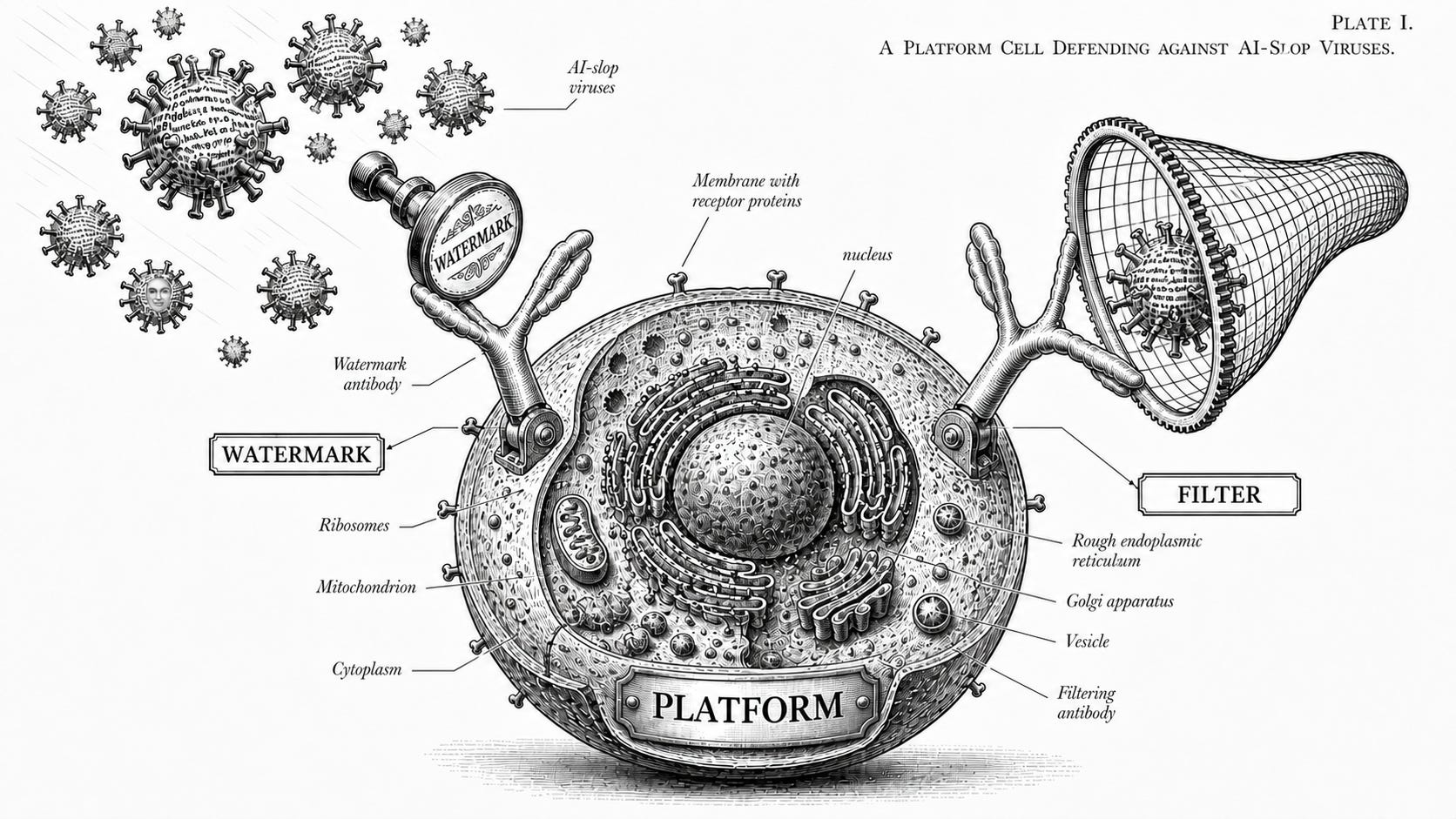
By mid-2026, leading platforms like LinkedIn and TikTok have embraced hybrid human-AI governance systems that function as digital 'antibodies,' detecting and throttling low-value AI-generated content—often dubbed 'slop'—while continuously refining detection models through feedback loops. LinkedIn’s system, boasting 94% accuracy, limits the spread of flagged posts beyond immediate networks and even introduced a user-flagging feature called 'Seems like AI Slop,' signaling a proactive stance against content dilution. This shift from purely automated tools to nuanced hybrid models underscores the industry's recognition that human contextual judgment remains essential to accurately enforce quality standards.
TikTok exemplifies the cutting edge of hybrid governance by removing nearly 97% of violating videos through AI automation before human moderators intervene, ensuring swift enforcement at scale while reserving complex, culturally sensitive cases for expert review. Its Transparency and Accountability Center in Singapore leverages multifaceted AI analysis—scanning images, audio, keywords, and even body posture—to detect policy breaches such as smoking or extremist symbols, yet defers ambiguous content, like distinguishing kombucha from alcohol, to human judgment. This layered approach balances efficiency with nuance, reflecting a sophisticated orchestration of machine precision and human insight.
Beyond detection, TikTok has integrated advanced AI labeling technologies, including the Coalition for Content Provenance and Authenticity standard and invisible watermarking, applying these to over 3 billion videos to enhance transparency around AI-generated content. Complementing this technological framework, the platform employs regionally tailored human moderators—such as Korean experts fluent in local language and culture—to navigate the subtleties of community guidelines enforcement. This synergy of global AI infrastructure with localized human expertise exemplifies the evolving ecosystem’s commitment to trustworthy, context-aware content governance.

Election Integrity Under Siege
TikTok’s specialized election taskforces and advanced AI labeling are setting new standards for combating synthetic political misinformation, with rapid removals and official partnerships to safeguard democratic processes.
In anticipation of Israel’s 2026 Knesset elections, TikTok has taken a robust stance against AI-generated political misinformation by launching a dedicated Israel Election Taskforce. This team collaborates closely with cybersecurity experts, Israel’s Central Elections Committee, and fact-checkers like Reuters to enforce stringent safeguards, including bans on false election logistics claims, impersonation of political figures, political advertising, and paid creator partnerships for political messaging. Such comprehensive measures underscore TikTok’s commitment to preserving election integrity amid the rising tide of synthetic media manipulation.
To further enhance transparency and traceability of AI-generated content, TikTok introduced rigorous election-safety guidelines mandating creators to label realistic AI-generated media. The platform leverages advanced technologies such as C2PA content credentials and invisible watermarking to identify synthetic content, reflecting a sophisticated approach to content authentication. This technological framework supports TikTok’s proactive moderation efforts, which in Q1 2026 led to the removal of over 551,000 videos in Israel alone, with an impressive 99.1% of these taken down before any user reports, illustrating the platform’s proactive defense against misinformation.
TikTok’s election integrity strategy also includes a controlled collaboration with official election authorities, who are permitted to share voter information through the platform. This partnership facilitates a more coordinated response to misinformation and influence campaigns, enabling TikTok to act swiftly and accurately in identifying and mitigating threats to the democratic process. By early 2026, these combined efforts contributed to the removal of over 40 covert influence operations globally, highlighting the platform’s expanding role as a gatekeeper in the intersection of AI governance and electoral security.
Unified Push for Authenticity
A coalition of seven major platforms now enforces strict 'no human, no reach' rules and mandatory AI ad labeling, prioritizing real human creators to meet tough new global transparency laws and restore user trust.
TikTok's elevation to the C2PA Steering Committee in July 2026 underscores its leadership in shaping global transparency standards for AI-generated content, having already labeled over 3 billion pieces using a sophisticated mix of Content Credentials, invisible watermarking, and user-facing controls. This commitment extends beyond labeling, as TikTok invests heavily in AI literacy initiatives and tools that empower users to customize their exposure to AI content, reflecting a broader industry trend toward enhancing user control and fostering trust in an AI-driven digital ecosystem.
By August 2026, a clear consensus emerged among seven major platforms—including LinkedIn, TikTok, Meta, Snapchat, YouTube, Google, and Reddit—who collectively adopted a 'no human, no reach' policy that penalizes fully AI-generated content through demotion, labeling, or user flagging. This unified stance prioritizes human involvement in content creation, especially emphasizing that paid social ads must feature real people, often on camera, to distinguish acceptable AI-assisted content from fully automated outputs, thereby maintaining authenticity and accountability in digital media.
The enforcement of the EU AI Act starting August 2026, which mandates disclosure of AI-generated ads and deepfakes for businesses targeting EU users under threat of fines up to €15 million or 3% of global turnover, has accelerated platform-level transparency measures. Platforms like TikTok, Meta, and Google have institutionalized mandatory labeling for AI-generated ads, while others such as LinkedIn, Snapchat, and YouTube have invested in advanced detection systems, signaling a multi-pronged approach to compliance that balances regulatory demands with technological innovation.
