Prediction markets hit Wall Street: billions pour in, regulators scramble, and the future of truth gets traded
The gist
Prediction markets have stormed Wall Street, attracting billions in institutional capital, regulatory blessing, and a starring role in shaping how the world bets on—and defines—truth.
What to know
- Major players like the NYSE, ICE, and Citadel have poured billions into platforms like Polymarket and Kalshi, now CFTC-regulated and valued in the billions.
- Prediction markets are upending finance and gambling with ultra-low fees, AI-powered markets, and forecasts now featured by CNN and the Wall Street Journal.
- Despite their accuracy, these markets face fierce debates over insider trading, regulatory gaps, and what counts as 'truth' in a rapidly evolving landscape.
From Fringe to Financial Core
Prediction markets have vaulted from regulatory gray zones to billion-dollar, CFTC-regulated powerhouses, now embedded in mainstream finance, media, and trading platforms.
Prediction markets have undergone a dramatic transformation from fringe, often legally ambiguous platforms to core pillars of mainstream finance and information. This shift is underscored by major institutional investments—such as the New York Stock Exchange and ICE pouring billions into Polymarket—and regulatory breakthroughs that have reclassified prediction markets as financial instruments rather than mere gambling. Platforms like Kalshi and Polymarket, once struggling for regulatory approval and limited to university-affiliated or offshore operations, now boast CFTC-regulated status, multi-billion dollar valuations, and partnerships with financial giants like Citadel and media outlets including Dow Jones and CNN, signaling a new era of legitimacy and public acceptance.
Mainstream adoption has been propelled by a convergence of user-friendly design, regulatory clarity, and strategic integration into major trading and media platforms. Companies like Coinbase, Robinhood, DraftKings, and BitMart have embedded prediction markets as core features, leveraging their vast user bases and trusted brands to accelerate growth—Coinbase alone now manages half a trillion dollars in assets and millions of tradable products, including CFTC-regulated event contracts. This integration is complemented by high-profile media exposure, with Polymarket topping app store charts and appearing on 60 Minutes, and prediction data now featured in the Wall Street Journal and CNN, making probabilistic forecasting a staple of both retail investing and public discourse.
The evolution of prediction markets is not just about scale, but also about technological and operational sophistication. Advances in crypto infrastructure, decentralized oracles, and the integration of AI agents—such as FractionAI’s on-chain agent competition—have enabled continuous, real-time signal extraction across thousands of micro-markets, vastly improving price discovery and market efficiency. At the same time, platforms are addressing core challenges like market resolution and fee structures, with Polymarket slashing fees to near zero and others pursuing decentralized governance to ensure fair outcomes, further enhancing trust and accessibility for both institutional and retail participants.
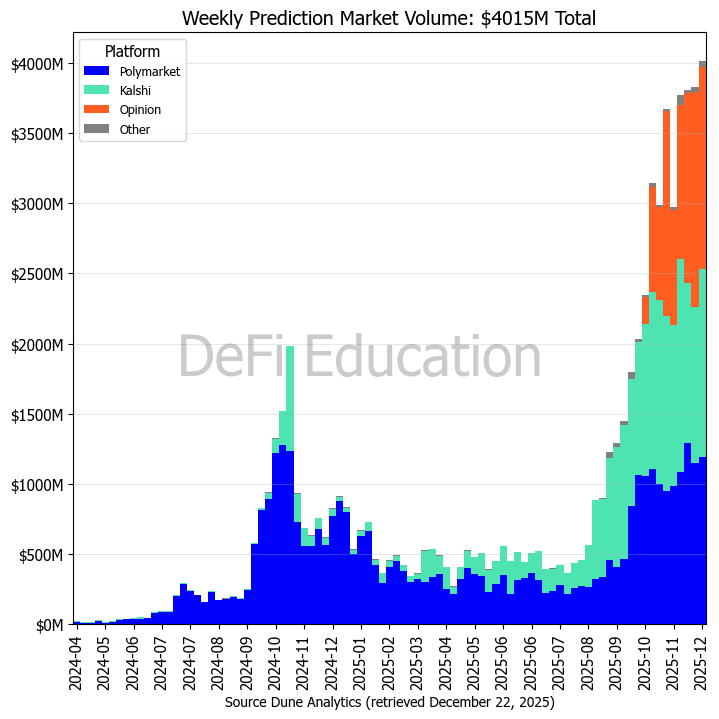
As prediction markets become ubiquitous features within broader financial and information ecosystems, their role is expanding beyond sports betting and political forecasting to encompass hyper-specific, real-time questions across geopolitics, supply chains, and even pop culture events like the Golden Globes. This broadening scope is matched by surging trading volumes—analysts predict $1.5 billion in weekly trades on Polymarket by 2026—and a growing perception that prediction markets could disrupt massive industries, including insurance. With Andreessen Horowitz, Paradigm, and Sequoia leading billion-dollar funding rounds, and educational initiatives rising to meet user demand, prediction markets are poised to become as fundamental to the internet’s data infrastructure as search engines or social media.





Insiders and Integrity Collide
Insider trading scandals and new legislation reveal gaping ethical and legal dilemmas as prediction markets become tools for both market accuracy and potential abuse by those with privileged information.
The regulatory and ethical landscape for prediction markets has undergone a seismic shift, moving from a period of near-illegality and aggressive crackdowns—such as the Biden administration’s efforts to shutter offshore platforms like Polymarket—to a phase of mainstream legitimization and institutional investment. This transformation is epitomized by the New York Stock Exchange’s $2 billion investment in Polymarket at a $9 billion valuation, signaling not only a newfound regulatory acceptance but also a dramatic recalibration of compliance and oversight frameworks. As one observer put it, 'I think the deregulation is great,' yet this enthusiasm is tempered by ongoing concerns about insider trading, market manipulation, and the appropriate role of major financial institutions in shaping the future of these rapidly evolving platforms.
Insider trading remains a thorny and largely unresolved issue in prediction markets, with recent scandals—such as the Polymarket Nobel Peace Prize incident and allegations of Google insiders betting millions on internal events—exposing significant regulatory gaps and ethical dilemmas. Unlike the securities markets, where the SEC enforces strict prohibitions and penalties, prediction markets under CFTC oversight lack equivalent safeguards, leaving platforms to grapple with the paradox that insider participation can enhance market accuracy while simultaneously undermining fairness and liquidity. This legal gray area has prompted both official investigations and calls for more robust oversight, including AI-driven anomaly detection and legislative proposals specifically targeting insider trading by government officials.
The rapid growth and increasing influence of prediction markets have catalyzed legislative action, most notably with Representative Richie Torres’s introduction of the Public Integrity in Financial Prediction Markets Act of 2026, which prohibits government officials from trading on insider information. This move reflects mounting concern that, as these markets become more liquid and impactful, insiders—especially those with access to classified or market-moving information—could not only profit but also potentially influence outcomes, threatening both market integrity and public trust. While the bill is seen as a necessary and largely uncontroversial step to protect retail users and uphold institutional credibility, it also highlights the ongoing tension between the public good of rapid information aggregation and the risks of private profiteering from state power.
Platforms like Kalshi and Polymarket have responded to these regulatory and ethical frontiers with divergent strategies: Kalshi, for example, enforces strict compliance by banning employee trading, maintaining rigorous market surveillance, and refusing to list markets on sensitive topics such as death or terrorism. However, even these measures are not seen as panaceas, as the boundaries of insider trading remain ambiguous—particularly with complex multi-event bets and the challenge of distinguishing illegal insider knowledge from public intuition or 'adjacent information.' As prediction markets continue to blur the lines between betting, finance, and information discovery, the sector’s legitimacy will increasingly depend on the evolution of both internal controls and external regulatory frameworks.




AI, DeFi, and the Next Wave
The fusion of AI agents, blockchain, and DeFi is transforming prediction markets into always-on, hyper-efficient information engines, driving exponential growth as regulatory barriers fall.
The technological integration of prediction markets is accelerating as regulatory barriers fall and institutional confidence surges. As early as late 2025, industry observers noted that prediction markets like Polymarket had been 'constrained not by demand but by regulatory restrictions,' but with these obstacles lifting, the sector is primed for dramatic expansion. This optimism is validated by major financial players such as Intercontinental Exchange—owner of the New York Stock Exchange—considering a $2 billion investment in Polymarket, signaling not only institutional confidence but also a new era of platform innovation and mainstream adoption.
Decentralized finance (DeFi) and prediction markets are evolving in tandem, driven by the proliferation of stablecoins, tokenized assets, and a rapidly expanding user base familiar with crypto wallets. Analysts predict that as a billion people become comfortable with wallet technology, DeFi could grow 10 to 30 times its current size, transforming platforms like Polymarket from niche experiments into billion-dollar monthly volume engines. This catch-up growth is enabled by years of quietly improving infrastructure, now ready to support real-world applications that were previously stifled by regulatory repression.
The convergence of AI and blockchain is fundamentally reshaping prediction markets, making them more scalable, efficient, and user-friendly. By early 2026, AI-driven agents are not only trading continuously within decentralized markets—such as FractionAI, the first AI Agent Prediction Market—but are also enhancing price discovery and probabilistic resolution in a transparent, on-chain environment. As blockspace becomes cheaper and user experience friction collapses, prediction markets are transforming from episodic, event-driven platforms into continuous, real-time information infrastructures, with everything from macroeconomic data to regulatory votes becoming tradable signals.
Mainstream financial platforms like Coinbase and Robinhood are rapidly integrating prediction markets and DeFi protocols, leveraging both regulatory compliance and technological advancements to enhance user trust and scalability. Robinhood’s acquisition of a CFTC license to launch event contract products independently, and Coinbase’s rumored partnership with Kalshi and AI integration, exemplify a trend where control over regulatory status and contract infrastructure becomes a competitive advantage. This shift toward regulated, transparent platforms is critical for user confidence, especially as perpetual futures and tokenized assets blur the lines between traditional finance and on-chain innovation.





Finance, Gambling, and Media Disrupted
Ultra-low-fee prediction markets are forcing traditional finance and sportsbooks to adapt, while real-time probabilistic forecasts begin reshaping how media and investors interpret world events.
Prediction markets have rapidly evolved from fringe, quasi-legal gambling tools to mainstream financial instruments, catalyzed by regulatory shifts and major institutional investments. The New York Stock Exchange’s $2 billion stake in Polymarket at a $9 billion valuation, a platform that was essentially illegal in the US just a year prior, underscores this dramatic transformation. This legitimization has not only attracted high-profile investors like Trump Jr. but also signals a broader realignment in how financial innovation is funded and integrated, with SPACs experiencing a revival as a marginally more attractive alternative to traditional IPOs in this new landscape.
The mainstreaming of prediction markets is fundamentally disrupting both traditional finance and gambling by compressing trading fees and challenging the dominance of established sportsbook models. Platforms such as DraftKings, Robinhood, Coinbase, and Underdog Fantasy are rapidly integrating prediction markets, often leveraging partnerships with liquidity providers like Kalshi and Polymarket. With Polymarket offering fees as low as 0.01%—a stark contrast to DraftKings’ 4-5% sportsbook take rate—these platforms are forcing gambling houses and financial intermediaries to rethink their business models, while simultaneously using prediction markets as a gateway to cross-sell crypto, investments, and other financial products.
Beyond their impact on trading and gambling, prediction markets are emerging as a real-time information infrastructure that is reshaping media and policy discourse. By early 2026, outlets like CNN began featuring probabilistic forecasts from platforms such as Kalshi and Polymarket, providing audiences with clearer, data-driven perspectives on politics, economics, and culture. High-volume, high-accuracy markets—like those quantifying the odds of geopolitical events—offer valuable context that traditional polling and punditry often lack, though mainstream media adoption remains uneven, with many outlets still slow to cite these markets despite their growing relevance.
Prediction markets are also expanding the boundaries of financial speculation and investment access, moving into domains like IPO forecasting and even insurance. Platforms such as Polymarket now host active markets on upcoming IPOs, allowing retail and institutional participants to anticipate and influence investment outcomes in real time. While industry leaders like Robinhood’s Vlad Tenev tout the potential for prediction markets to disrupt the $8 trillion insurance sector, scalability challenges—particularly around liquidity—remain a barrier to fully replacing traditional insurance products, as evidenced by the fate of DeFi summer’s Cover protocol.


Redefining Truth and Consensus
Prediction markets now aggregate informal signals and expert bets to anticipate real-world events, but regulatory limits and unresolved governance debates still constrain their impact on public truth.
Prediction markets like Polymarket have redefined how information is aggregated and consensus is formed, by enabling participants to bet on outcomes using not just official data but also informal, 'adjacent' signals—ranging from cocktail party chatter to early news leaks. This blend of expert knowledge, public signals, and probabilistic reasoning allows markets to often anticipate events before they become public, as seen when a trader turned $30,000 into $440,000 by betting on the capture of Venezuela's Maduro hours before it happened. Rather than relying solely on traditional forecasting or official disclosures, these markets harness collective intelligence, making intuition-driven bets and the aggregation of dispersed information intrinsic to the pursuit of truth in the digital age.
Despite their growing accuracy and ballooning volumes—Polymarket and Kalshi now handle billions monthly—prediction markets have yet to fundamentally transform how society integrates probabilistic forecasts into public discourse or decision-making. Most news outlets still neglect to cite market probabilities, even when these could contextualize major events like the Iran protests, leading analysts to admit, 'I don’t feel revolutionized.' Regulatory constraints further shape which truths can be pursued: U.S. rules steer Kalshi toward sports (81% of its volume), while Polymarket, operating offshore, focuses more on geopolitics, highlighting how legal boundaries influence both the content and societal impact of these platforms.
The ongoing debate over insider trading and dispute resolution in prediction markets underscores a philosophical tension: while such practices may be controversial or even illegal, they can paradoxically enhance market accuracy by incorporating more information into prices. As one analyst argues, 'insider trading should only increase accuracy—it’s bad for traders, but good for information-seekers,' suggesting that the messy realities of information flow may actually aid truth-seeking. However, these benefits come with governance challenges, as regulatory disputes—such as those facing Polymarket and Kalshi—raise questions about transparency, fairness, and who ultimately decides what counts as 'truth' in these markets.
Looking ahead, the integration of AI agents and superforecasters is poised to further revolutionize prediction markets, potentially surpassing even the most skilled human analysts in aggregating and interpreting signals. By early 2026, AI agents are already scanning the internet for tradeable information, while the rise of decentralized governance and AI (LLM) oracles promises to resolve disputes and define outcomes with greater precision. As one analyst notes, 'The big trading opportunity is who decides the Truth?'—a question that may soon be answered not by human consensus, but by algorithmic judgment and decentralized protocols.