Qualcomm’s bold AI bet draws bullish analyst upgrades

The gist
Qualcomm is betting big on AI, nearly doubling its 2029 non-handset revenue target to $40 billion and charging straight at Nvidia’s data center dominance with a next-gen, energy-efficient platform.
What to know
- AI data center infrastructure is expected to bring in over $15 billion by 2029 thanks to Qualcomm’s custom silicon, HBC architecture, and Alphawave connectivity.
- Smartphones will make up just one-third of QCT revenue as Qualcomm rapidly expands into automotive ($10B) and IoT ($14B+) chips, pushing into digital cockpits and industrial edge AI.
- The market is waking up: a recent Investor Day doubled targets, triggered analyst upgrades to $223, and highlighted a still-undervalued stock with a strong 'Buy' consensus from 67 analysts.
Qualcomm's AI Power Play
By doubling its non-handset revenue target to $40B and integrating custom silicon, advanced CPUs, and AI architectures, Qualcomm is transforming into a major force in data center AI, challenging industry incumbents on multiple fronts.
Qualcomm has dramatically recalibrated its fiscal 2029 revenue ambitions, nearly doubling its non-handset QCT target to $40 billion, with data center AI infrastructure expected to contribute over $15 billion of that sum. This strategic pivot is underpinned by a comprehensive AI platform approach that integrates custom silicon for initial revenue streams, the HBC inference architecture, C1000 server CPUs, and Alphawave’s advanced connectivity solutions, collectively positioning Qualcomm as a formidable player in the data center AI market.
Reflecting a profound diversification beyond its traditional smartphone base, Qualcomm forecasts handsets will represent only about one-third of QCT revenue by 2029, as automotive chips surge to a $10 billion target ahead of schedule and IoT segments surpass $14 billion. This broad-based growth strategy spans automotive digital cockpits, advanced driver assistance, and industrial AI applications, signaling Qualcomm’s commitment to stabilizing revenue through longer product cycles and expanding into emerging markets like robotics and edge AI.
Leveraging its Oryon architecture and deep expertise from mobile to automotive CPUs, Qualcomm is carving out a credible niche in specialized Arm server CPUs tailored for hyperscalers, supported by significant wafer capacity and memory commitments. The company’s recent $3.9 billion acquisition of AI software firm Modular further complements this hardware push by providing a software platform to rival Nvidia’s CUDA, underscoring Qualcomm’s ambition to challenge Nvidia’s dominance in AI data center chips.
Qualcomm’s leadership, exemplified by CEO Cristiano Amon’s emphasis on a strong engineering culture and clarity of vision, is driving an unprecedented revenue compound annual growth rate of roughly 40% from 2025 to 2029. This aggressive growth trajectory is fueled by simultaneous expansion across data center AI, automotive, IoT, and networking sectors, reflecting a confident and multifaceted reinvention that aims to reduce handset dependency and secure durable, long-term growth amid semiconductor market volatility.

Reinventing AI Hardware Efficiency
Qualcomm's High Bandwidth Compute architecture and DragonFly platform slash AI power costs and bandwidth bottlenecks, setting a new standard for inference performance from hyperscalers to edge devices.
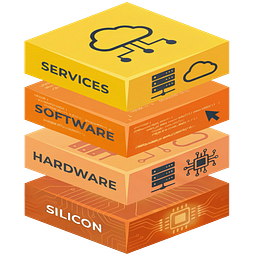
Qualcomm’s High Bandwidth Compute (HBC) architecture represents a significant leap in AI infrastructure by stacking AI accelerator logic directly beneath vertically integrated LPDDR memory using through-silicon vias (TSVs), thereby dramatically reducing data travel distance and circumventing the costly High Bandwidth Memory (HBM) packaging. This innovation achieves approximately six times higher bandwidth per watt compared to traditional HBM solutions, addressing the critical 'memory wall' bottleneck that increasingly dominates power consumption in AI inference workloads. As Citrini Research highlights, this approach not only enhances bandwidth efficiency but also lowers power consumption, positioning Qualcomm to tackle one of AI infrastructure’s largest cost centers rather than merely producing another AI accelerator chip.
Through its DragonFly brand, Qualcomm is pioneering the integration of its data center AI chip architecture into mobile and edge devices, including smartphones, PCs, and automotive systems, aiming to bring data center-level AI inference capabilities directly onto everyday devices. This strategic convergence leverages Qualcomm’s decades of mobile chip expertise to deliver superior performance per watt and lower system costs, differentiating itself from Nvidia’s training-focused GPU clusters by targeting AI inference workloads. The company’s recent acquisitions of Alphawave and Modular further bolster this ecosystem by enhancing high-speed connectivity and AI software capabilities, enabling a comprehensive AI infrastructure platform that spans from hyperscalers to edge devices.
Qualcomm’s expansion into custom silicon development for hyperscalers, accelerated by its acquisition of Alphawave’s SerDes technology, positions the company as a credible challenger to incumbents like Broadcom and Marvell in the AI data center space. By integrating its Orion CPU architecture with purpose-built AI inference accelerators and leveraging high-speed wired connectivity IP, Qualcomm is set to begin initial custom silicon shipments to leading hyperscalers as early as December 2026. This near-term deployment is expected to contribute positively to operating margins from day one, signaling a tangible and immediate impact of Qualcomm’s AI infrastructure strategy beyond conceptual innovation.
Despite the promising performance gains of Qualcomm’s stacked silicon HBC design, managing thermal dissipation remains a critical engineering challenge, particularly for mobile and automotive applications where space and cooling are constrained. Heat trapped within multiple silicon layers can create hotspots that threaten performance and longevity, making independent benchmarks and early customer deployments essential indicators for investors monitoring Qualcomm’s progress. Addressing this thermal hurdle is pivotal for Qualcomm to fully realize its vision of seamlessly integrating data center-grade AI compute into edge devices without compromising reliability or efficiency.


Taking on Nvidia’s AI Reign
Armed with Modular’s cross-platform software and DragonFly’s energy-efficient chips, Qualcomm is targeting Nvidia’s stronghold with a developer-friendly ecosystem and heavyweight partnerships with Meta and Microsoft.
Qualcomm is mounting a strategic challenge to Nvidia's entrenched dominance in AI data center chips, where Nvidia currently commands over 70% market share. Recognizing that raw silicon performance alone won't suffice, Qualcomm is focusing on highly efficient AI inference chips optimized for power and cost per token, aiming to carve out a competitive niche in inference workloads where Nvidia is perceived as more vulnerable. CEO Cristiano Amon acknowledges their chips are still 'two or three years away' but emphasizes their superior efficiency on a dollar per kilowatt basis, signaling a deliberate, differentiated approach to compete in a crowded field that includes AMD, Intel, and hyperscalers like Google and Amazon.
A cornerstone of Qualcomm's competitive positioning is its $3.9 billion acquisition of Modular, an AI software company whose hardware-agnostic platform and Mojo programming language enable AI inference workloads to run seamlessly across Nvidia, AMD, Qualcomm, and other architectures. This move directly targets Nvidia's CUDA ecosystem, which has long locked customers into proprietary software and hardware, by offering a portable, multi-vendor software stack that promises lower total cost of ownership and greater developer productivity. As Modular CEO Chris Lattner explains, their platform is designed to unify the industry and scale from data centers to the edge, reflecting Qualcomm's strategic pivot from pure silicon competition to ecosystem leadership.
Qualcomm is aggressively expanding its AI ecosystem through high-profile partnerships with Meta, Microsoft, and others, who have publicly endorsed Qualcomm’s Dragonfly AI data center platform and committed to deploying its custom silicon in large-scale AI workloads. These collaborations embed Qualcomm’s technology directly into major AI deployments, extending its reach beyond traditional mobile markets into hyperscalers and enterprises focused on inference performance and energy efficiency. The Dragonfly platform integrates CPUs, accelerators, custom silicon, and innovative High Bandwidth Compute memory technology, which Qualcomm claims delivers six times the bandwidth per watt of current HBM-based systems, addressing critical data center constraints and differentiating its offering from Nvidia’s training-heavy focus.
Beyond hardware and partnerships, Qualcomm is building a comprehensive AI infrastructure that spans cloud and edge environments, collaborating with companies like Hugging Face and Scam.ai to integrate hardware and software across diverse platforms. CEO Cristiano Amon highlights the industry's shift toward disaggregated, multi-vendor architectures as inference workloads become distributed everywhere, creating new market opportunities beyond traditional cloud-centric models. This ecosystem expansion, underpinned by Modular’s software and Qualcomm’s advanced interconnect IPs, positions the company to compete not just on chip specs but on a holistic AI data center infrastructure strategy that challenges Nvidia’s long-standing software and hardware moat.


Wall Street Wakes Up to Qualcomm
Analysts and investors are rapidly upgrading Qualcomm, betting that its aggressive AI and data center expansion will drive a rerating and deliver triple-digit returns despite short-term stock volatility.
Qualcomm’s AI data center initiatives have sparked a cautiously optimistic market response, with its stock currently undervalued relative to peers, trading at a P/E ratio of 28.39 compared to the semiconductor industry average of 44.48. Analysts see significant upside potential, reflected in a strong consensus 'Buy' rating from 67 analysts and median price targets rising from around $160 to as high as $223 following the company’s June 24 Investor Day disclosures. Despite short-term stock volatility and a 16.8% year-to-date decline, the market is beginning to recognize Qualcomm’s strategic pivot beyond smartphones into AI and data center chips as a compelling growth driver.
The June 24 Investor Day served as a pivotal moment, doubling Qualcomm’s 2029 non-handset revenue target to $40 billion and setting an ambitious $15 billion AI data center sales goal, which triggered a notable stock rally to $258.96 and a surge in analyst price targets. Yet, shares remain approximately 32% below their 52-week high, suggesting that the market has not fully priced in Qualcomm’s aggressive growth ambitions and hyperscaler deals worth billions. Valuation models, such as TIKR’s, forecast a potential 176% total return by 2030, underscoring the substantial upside investors could capture as Qualcomm scales its AI data center footprint.
Investor sentiment is buoyed by Qualcomm’s emergence as a credible third player in hyperscaler custom silicon, with bullish analyst ratings like 24/7 Wall St.’s BUY at a $260.52 target implying over 50% upside in the next year. Polymarket traders assign an 87% probability that Qualcomm will beat its upcoming earnings, reflecting confidence in near-term execution across AI and automotive segments. While concerns linger over handset revenue declines and insider selling, Qualcomm’s relatively low forward multiples compared to Nvidia and Broadcom highlight a market undervaluation of its AI-driven diversification, positioning it for a potential rerating akin to Broadcom’s 143% YoY AI semiconductor revenue growth.