Robot race heats up: China surges ahead as US faces power bottlenecks in global AI showdown
The gist
China is pulling ahead in the global robot race, rolling out humanoids at record speed while the US grapples with energy bottlenecks despite leading in AI chip innovation.
What to know
- By early 2026, China will deploy 85% of the world’s humanoid robots, supercharged by state-led investments and a $10B State Grid rollout.
- US robotics advances—like Qualcomm’s Dragonwing IQ10 and NVIDIA’s industrial AI partnerships—face scaling limits from power shortages and red tape.
- Robot prices are crashing toward iPhone territory, but real-world deployment still hits snags around safety, dexterity, and reliable generalization.
From Prototypes to Real-World Robots
Cutting-edge AI platforms are pushing robots into diverse, real-world environments, but true autonomy remains elusive as humanoids still rely on teleoperation and face hurdles in reliability and safety.
By late 2025, embodied AI systems like Sereact's Cortex platform and Wayve's autonomous driving model demonstrated the feasibility of scalable real-world deployments across diverse environments. Sereact expanded its Cortex fleet from 24 to over 100 robots operating reliably in challenging chilled and ambient warehouse zones across the DACH region, while Wayve's single end-to-end driving model autonomously navigated 90 cities on three continents within 90 days without retraining, logging over 10,000 hours of driving. However, despite these successes in logistics and driving, humanoid robots lagged in scalable deployment due to persistent challenges in hardware reliability, safety certification, and autonomous fleet data collection, with many humanoid behaviors still relying on teleoperation rather than full autonomy.
The introduction of Qualcomm's Dragonwing IQ10 Series processor and comprehensive robotics stack in early 2026 marked a pivotal technological breakthrough, integrating hardware, software, and advanced AI to accelerate the transition from prototypes to industrial-grade, deployable robots. Qualcomm's platform supports end-to-end AI models for perception, planning, and human-robot interaction, enabling energy-efficient, scalable deployments from household devices to full-size humanoids. Leveraging a robust developer ecosystem and partner network, Qualcomm aims to catalyze global adoption and digital transformation in autonomous robotics, positioning robotics as a major growth area within two years, with market forecasts projecting up to $370 billion by 2040 and $9 trillion by 2050 for humanoid robots.
Physical Intelligence (PI) has pioneered general robotic foundation models that unify control across diverse robot types and tasks through end-to-end reinforcement learning, challenging classical robotics paradigms. Their PI 0.6 release achieved over twice the throughput on complex tasks like coffee making and laundry folding, with robots operating continuously for hours and demonstrating the ability to generalize to new environments and tasks with some common sense, as evidenced by their PIO5 release enabling zero-shot operation in unfamiliar homes. Crucially, PI began commercial deployments two months prior to early 2026, leveraging real-world data collection to overcome the intelligence bottleneck, with autonomous data gathering during deployment fueling continual learning and scalable improvements beyond demonstration-based training.
The first quarter of 2026 witnessed a surge in real-world embodied AI deployments and innovations across warehouse automation, humanoid robots, and industrial robotics. Companies like Sereact advanced their Cortex 1.6 platform with learned Process-Reward Operators enabling reinforcement learning from dense operational telemetry, while Figure's Helix 02 humanoid robot demonstrated continuous room-scale autonomy with integrated whole-body control. Meanwhile, Virtuals Robotics launched Eastworld Labs to accelerate humanoid robot autonomy by providing integrated fleets and datasets, and RLWRLD secured $41 million to scale industrial robotics AI trained directly in live environments. Additionally, Faraday Future introduced humanoid robots priced between $20,000 and $35,000 and expanded deployments into education and performance sectors, exemplifying the transition from prototypes to scalable, economically valuable applications.






AI-Hardware Alliances Redefine Industry
Strategic partnerships between tech giants and startups are fusing AI, hardware, and simulation, turning robotics into a core pillar of industrial transformation and accelerating the leap from concept to 24/7 operation.
By early 2026, the industrial robotics landscape is being reshaped through strategic partnerships that tightly integrate AI software with advanced hardware platforms, exemplified by collaborations between NVIDIA and industry giants like Caterpillar, ABB, and KUKA. Caterpillar’s alliance with NVIDIA aims to embed autonomous AI systems into heavy machinery to revolutionize job sites, while NVIDIA’s Dream Zero foundation model and Omniverse platform provide universal AI capabilities and simulation frameworks that accelerate robotics adoption across manufacturing and logistics. These partnerships underscore a shared vision, as NVIDIA’s CEO Jensen Huang articulated, that 'every industrial company will become a robotics company,' signaling a transformative shift towards AI-driven industrial ecosystems.
The emergence of integrated AI-hardware-software ecosystems is further propelled by collaborative initiatives like the AI for Industry Challenge and the Physical AI Fellowship, which unite major players such as Intrinsic, Open Robotics, Google DeepMind, NVIDIA, AWS, and startups to foster scalable robotics solutions. These programs provide developer access to vision models, digital twins, and cloud resources, accelerating innovation in dexterous manipulation and real-world deployment across sectors from electronics assembly to renewable energy. This ecosystem approach not only lowers barriers for startups but also cultivates a vibrant global network that drives rapid validation and scaling of physical AI technologies.
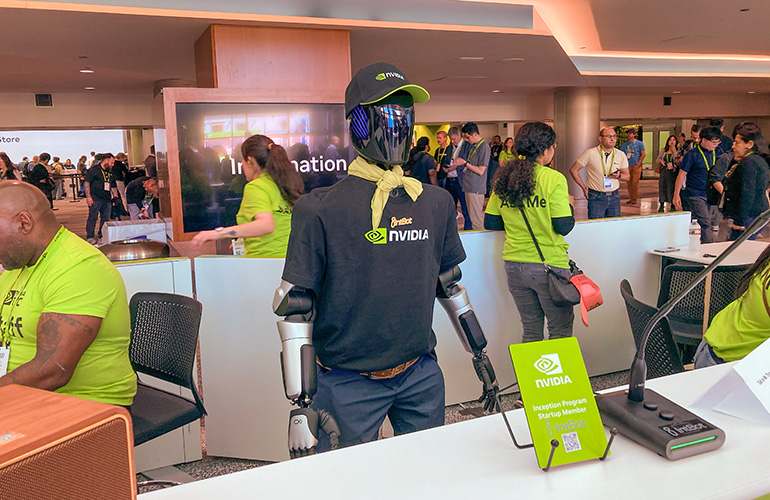
Startups like Ambi Robotics, Skild AI, and IntBot exemplify how hardware-agnostic AI platforms and generalized robot intelligence are expanding robotics capabilities across diverse industrial and service sectors. Ambi Robotics’ AI Skill Suite leverages its PRIME-1 foundation model trained on extensive real-world telemetry to deliver robust, adaptable applications, while Skild AI’s collaboration with ABB and Universal Robots integrates its Skild Brain to automate complex workflows without task-specific programming, marking milestones such as deployment on Foxconn’s NVIDIA Blackwell GPU lines. Meanwhile, IntBot’s social intelligence layer, powered by NVIDIA Cosmos Reason-2 VLM, enables humanoid robots to perform natural interactions in hospitality settings, illustrating how strategic partnerships accelerate the transition from concept to practical, 24/7 operations.
China’s state-led capitalism is actively shaping its robotics ecosystem by leveraging established EV manufacturing hubs to attract humanoid robotics firms like UBTech, which reported a 23-fold revenue increase after selling over 1,000 units last year. Local governments are investing heavily in robotics data collection centers, transforming training data into valuable assets that fuel further industry growth and regional demand. However, the labor-intensive nature of robotics training remains a bottleneck, with each task requiring 200 to 300 hours of human demonstration, highlighting a paradox where human labor is still essential to train robots before they can effectively replace it.



Policy and Power: East vs. West
China’s centralized planning and massive infrastructure investments are outpacing the US’s fragmented approach, giving it a structural advantage in scaling embodied AI despite ongoing chip supply battles.
The US-China competition in AI and robotics is deeply shaped by contrasting national strategies and infrastructure capabilities, with China leveraging rapid, centralized energy grid expansion and state-led industrial policy to accelerate embodied AI deployment. China’s 15th Five-Year Plan, adopted in early 2026, explicitly elevates embodied AI as a core economic engine, integrating humanoid robots and AI infrastructure across manufacturing, social welfare, and governance sectors, supported by massive investments such as a 40% increase in power infrastructure spending totaling 4 trillion yuan. Meanwhile, the US faces critical bottlenecks in electricity supply and regulatory hurdles that constrain data center expansion, despite leading in advanced AI chip technology and compute capacity dominated by Nvidia and major tech firms. This divergence highlights a structural advantage for China in scaling embodied AI through coordinated energy and manufacturing ecosystems, while the US grapples with fragmented policy and infrastructure challenges.
China’s approach to AI chip supply reflects a strategic push for self-reliance amid US export controls that restrict access to cutting-edge Nvidia chips like the H200. Despite these constraints, Chinese firms such as Huawei and emerging startups dubbed the 'four dragons' are rapidly scaling domestic AI chip production, closing the performance gap generation by generation, though still hampered by shortages of critical components like high-bandwidth memory. The US decision to permit limited Nvidia H200 sales to China, driven by questionable assumptions about China’s domestic chip capabilities, has intensified chip supply debates, as Nvidia balances fulfilling Chinese demand against prioritizing advanced Blackwell chips for the US market. This dynamic underscores a complex interplay where export controls slow China’s near-term AI progress but simultaneously accelerate its drive for a resilient semiconductor supply chain.
China’s long-term, top-down planning contrasts sharply with the US’s more fragmented, market-driven approach, resulting in divergent geopolitical strategies for embodied AI dominance. While China orchestrates a comprehensive 'model-chip-cloud-application' architecture and aggressively invests in humanoid robotics to address demographic challenges and labor shortages, the US focuses on advancing AI algorithms and chip technology but struggles with scaling deployment due to local opposition, regulatory inertia, and insufficient industrial policy. This divergence is exemplified by China’s large-scale robot rollouts in sectors like power grid maintenance, supported by government subsidies and infrastructure, whereas the US debates bipartisan restrictions on Chinese-made robots over security concerns and lacks targeted incentives to accelerate humanoid robot adoption in manufacturing.
The geopolitical AI and robotics rivalry is fundamentally a contest over critical bottlenecks: the US’s principal challenge lies in energy infrastructure and regulatory constraints limiting data center expansion, while China’s main hurdle is achieving advanced chip manufacturing self-sufficiency. China’s rapid electricity capacity growth—adding over 500 gigawatts in 2025 alone and planning to double grid capacity within five years—paired with lower data center construction costs, provides a substantial competitive edge. Conversely, the US faces a projected 44-gigawatt power shortfall for data centers by 2028 and rising electricity prices, threatening its ability to sustain AI compute growth despite leadership in chip innovation. Resolving these bottlenecks will likely determine which nation secures long-term dominance in scalable embodied AI and robotics.






Humanoid Robots Hit Mass Market
Plummeting robot prices and China's aggressive scale-up are transforming labor markets and making humanoid robots as accessible—and disruptive—as smartphones by mid-decade.
The physical AI and humanoid robotics market is experiencing explosive growth driven by rapidly declining costs and accelerating deployment, with prices for humanoid robots dropping to around $5,000 per unit and projected to approach the affordability of consumer electronics like iPhones rather than cars. This cost reduction, fueled by scaling laws and Wright’s law, is enabling robots to address labor shortages in sectors such as AI datacenter construction and post-shell building work, which constitute up to 40% of construction costs and are well-suited to robotic automation. Major companies including Amazon, Tesla, NVIDIA, and SoftBank, alongside government initiatives—most notably in China—are heavily investing in physical AI, signaling a robust market expansion expected to reach trillions of dollars by mid-century.
China has emerged as the undisputed leader in humanoid robotics deployment and supply chain dominance, installing 85% of the world’s humanoid robots by 2025 and controlling critical raw materials essential for manufacturing. Companies like Aggiebot have shipped 10,000 units across 17 countries within two years, while Unitree and UBTECH scale production rapidly supported by integrated domestic ecosystems and aggressive pricing strategies. This leadership is bolstered by state-led capitalism, with local governments investing in training centers that transform data into economic assets and the government itself acting as a major customer, exemplified by State Grid Corporation’s $10 billion investment plan to deploy 8,500 robots in power grid maintenance, dramatically improving efficiency and safety.
The integration of humanoid robots is fundamentally reshaping labor markets globally, particularly in China and the U.S., where demographic pressures and labor shortages are acute. In China, robots are filling up to 60% of the workforce gap caused by an aging population by 2035, taking on roles from factory work to service jobs like hotel reception and elderly care, while in the U.S., humanoid deployment threatens to transform two-thirds of the service sector reliant on physical labor. However, this shift is not merely about job displacement; Barclays Research highlights that humanoids extend automation to entire roles previously resistant to it, potentially easing the Baumol effect and reshaping rather than reducing employment, with economic gains manifesting as higher productivity, stronger earnings growth, and improved asset returns.
Despite the promising market growth and labor transformation, the U.S. faces significant challenges in scaling humanoid robotics deployment beyond controlled environments, hampered by single-task robot designs and insufficient economic incentives for manufacturers to integrate robotics at scale. Unlike China’s comprehensive industrial policy and aggressive deployment strategies, U.S. federal R&D tax credits focus on discovery rather than deployment, limiting productivity gains and labor market impact. Experts advocate for targeted manufacturing deployment tax incentives to offset integration costs and workforce transition expenses, a critical step to unlocking the vast economic potential of robotics-driven automation and maintaining global competitiveness.




The Intelligence Bottleneck
Generalizing robot intelligence across messy, unpredictable environments is now the biggest challenge, with real-world data and continual learning emerging as the keys to breaking through.
By early 2026, the foremost challenge in scaling embodied AI and robotics from pilot projects to widespread industrial deployment lies not in hardware sophistication but in the intelligence layer—specifically, enabling robots to generalize effectively across diverse, unseen environments. As highlighted in the April 2024 Pi05 release, progress has been made by leveraging diverse data sets to imbue robots with a degree of common sense necessary for operating in new homes, yet true generalization remains a "really really difficult" problem requiring continuous data diversity and real-world experience to overcome.
Reliability and continual operation have emerged as critical bottlenecks for real-world deployment, with models now capable of running for hours, recovering from failures, and doubling throughput on tasks like box building and coffee making. Reinforcement learning from autonomous data collection during deployment is increasingly vital, as human-curated data alone cannot scale; this approach not only enhances reliability but also enables robots to master new tasks beyond initial training, marking a significant shift towards sustainable, scalable embodied AI.
Despite these advances, a substantial gap persists between laboratory capabilities and reliable field deployment due to brittle interfaces connecting perception, planning, and control that fail under real-world variability, causing costly physical failures. Sereact’s Cortex 1.6 exemplifies a breakthrough by replacing modular pipelines with an end-to-end learned system that continuously evaluates execution progress through dense process-level feedback, fueled by a fleet of robots generating high-fidelity interaction data across logistics and manufacturing environments—underscoring the infrastructural importance of broad, diverse deployment for scaling.
Operational and infrastructural hurdles remain significant, especially in complex tasks like dexterous manipulation where robots struggle to handle the variability of household objects beyond constrained factory settings. While navigation and object recognition have neared maturity, integrating tactile sensing hardware with precise training models remains a technical bottleneck. Moreover, safety, privacy concerns, and the high cost of failure limit deployment in sensitive environments like homes, necessitating cautious, task-specific scaling strategies as the industry transitions from remote-controlled to autonomous systems.

Safety and Reliability Roadblocks
Despite recent breakthroughs, fragile system integration and real-world unpredictability still cause costly robot failures, highlighting the need for robust, end-to-end learning and massive deployment data.
Despite recent breakthroughs, fragile system integration and real-world unpredictability still cause costly robot failures, highlighting the need for robust, end-to-end learning and massive deployment data.