Robotaxi rivalry heats up: china’s multi-app showdown outpaces cautious U.S. rollout
The gist
China’s robotaxi market is surging ahead with fierce multi-app competition and rapid global expansion, while U.S. rivals like Waymo and Tesla are stuck in the slow lane of regulation and caution.
What to know
- By mid-2024, Waymo and Baidu’s Apollo Go each hit 250,000 weekly paid rides, but China’s market features multiple rivals battling on price and innovation.
- Baidu’s Apollo Go achieved per-vehicle profitability in Wuhan with over 1,000 vehicles and fares 30% cheaper than major cities, fueling aggressive expansion into Europe and the Middle East.
- Western robotaxi firms face regulatory bottlenecks and slower scaling, with mass adoption unlikely before the 2030s despite a projected $415 billion global market by 2035.
China’s Multi-App Edge
Fierce competition and direct app choice in China drive robotaxi innovation and pricing, leaving U.S. riders with fewer options and slower market evolution.
By mid-2024, Waymo and Baidu’s Apollo Go each achieved a landmark scale of approximately 250,000 weekly paid robotaxi rides, signaling a pivotal moment in commercial autonomous ride-hailing. Waymo’s rapid ascent—from 50,000 weekly rides in May 2024 to 250,000 within a year—demonstrates exponential growth in fewer cities, while Baidu’s steadier expansion reflects China’s broader multi-provider ecosystem. This milestone underscores the tangible market traction robotaxis have gained on both sides of the Pacific, with Waymo leading in the U.S. and Baidu anchoring China’s competitive landscape.
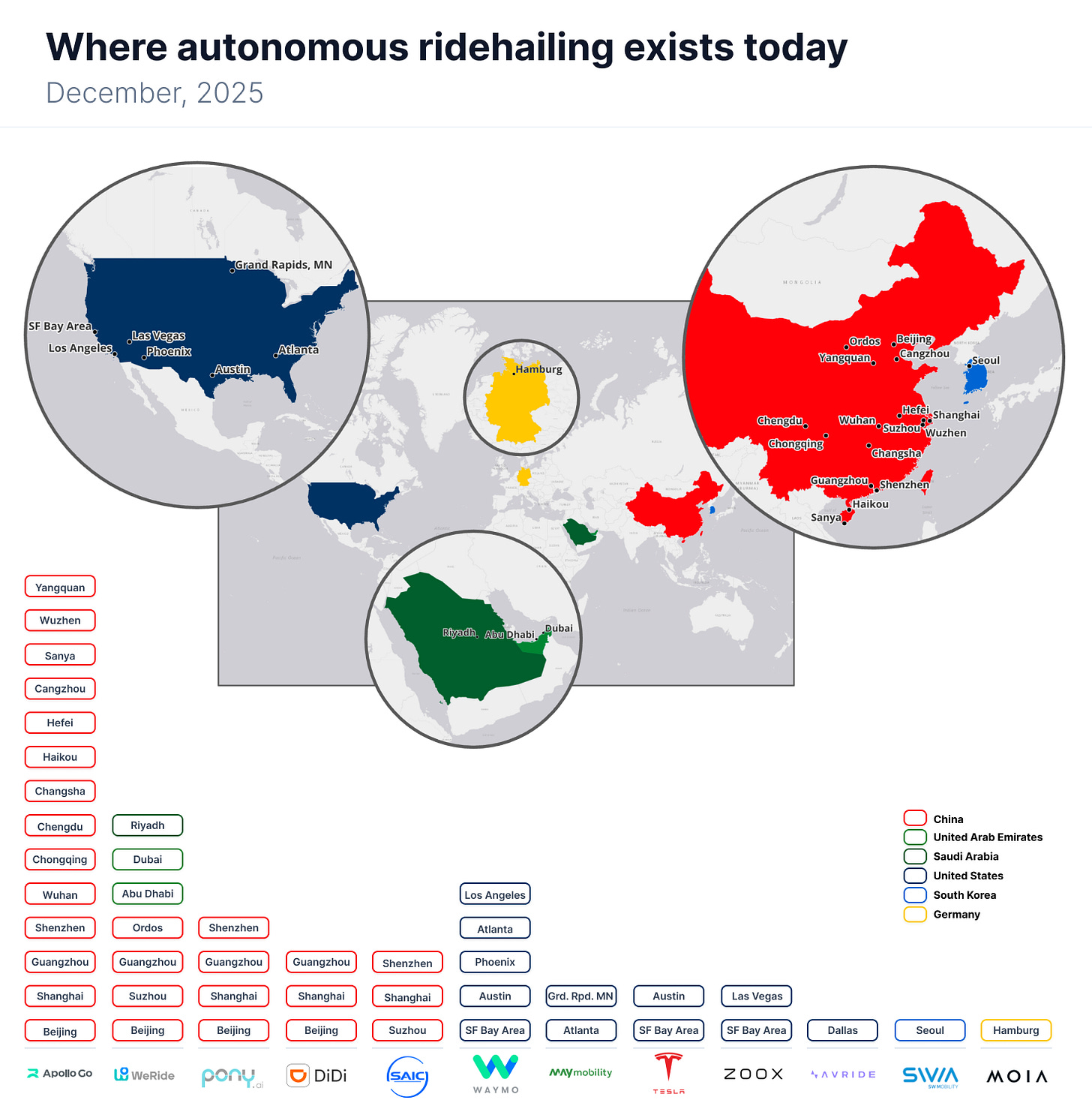
China’s robotaxi market stands out for its intense competition and scale, with multiple companies such as Apollo Go, Pony.ai, WeRide, DiDi, and SAIC operating driverless, fare-charging services across major cities since 2022. Cities like Beijing, Shanghai, and Guangzhou host four competing services, fostering price wars and service improvements that contrast sharply with Western markets, where Waymo remains the sole major player offering fully commercial, driverless rides. This vibrant Chinese ecosystem has been described by industry experts like Grayson Brulte as a 'wake-up call,' highlighting China’s underappreciated lead in the global autonomous vehicle race.
While Western robotaxi providers such as Tesla, Zoox, and Mobileye are actively scaling fleets and expanding into new markets—Tesla operating fully driverless cars in three Texas cities and Mobileye targeting a 100-vehicle fleet launch in 2027—regulatory hurdles and operational constraints continue to temper rapid growth. Waymo’s strategic expansion to 12 new U.S. cities by late 2026, alongside plans to integrate multiple AV providers on platforms like Uber, suggests a shift toward broader accessibility, albeit with less direct consumer choice compared to China’s multi-app competition. This model may increase ridership but could slow the pace of competitive innovation in Western markets.
Despite nearly two decades of development since its 2009 founding, Waymo’s launch of a $29.99/month subscription tier in mid-2026 epitomizes both the progress and the persistent challenges in scaling robotaxi services. The industry remains years away from mass adoption due to complex physical and infrastructural hurdles, yet the emergence of global players like UK-based Wayve, backed by Nvidia, signals a maturing ecosystem of AV software and AI innovation. As one analyst notes, while the road to autonomy is arduous, the 2030s promise an exciting era for robotaxis as commercialization, fleet scale, and safety transparency become the new benchmarks of success.





Global Expansion Playbook
Chinese robotaxi firms leverage partnerships, cost leadership, and rapid scaling to outpace Western rivals in new markets across Europe and the Middle East.
Chinese robotaxi companies such as Baidu, Pony.ai, and WeRide have aggressively expanded their global footprint through strategic partnerships with platforms like Uber and Bolt, enabling rapid market entry in regions including the Middle East and Europe. Baidu’s Apollo Go notably achieved per-vehicle profitability in Wuhan by operating over 1,000 vehicles with fares significantly cheaper than in major Western cities, underscoring a scalable and cost-efficient business model that leverages large fleet deployments and in-house electric vehicle production to reduce costs by 50%. This aggressive scaling contrasts with Western firms, which face slower fleet growth due to supply constraints and regulatory challenges.
Waymo maintains a leadership position in the Western robotaxi market through extensive operational experience and regulatory navigation, operating 24/7 services across six U.S. markets and completing nearly twice as many weekly rides as Baidu’s Apollo Go despite serving fewer cities. Its strategy emphasizes safety and regulatory cooperation, exemplified by proactive responses to incidents and partnerships with local authorities, while expanding fleet size through alliances with automakers like Zeekr and Hyundai, though geopolitical and tariff barriers temper rapid scaling before 2026. Meanwhile, Tesla’s approach remains incremental and cautious, leveraging its massive existing vehicle base but hindered by legal and safety constraints that limit full autonomy deployment.
The competitive dynamics between Chinese and Western robotaxi providers reveal distinct regional strategies: in China, consumers directly select among multiple competing apps like Apollo Go, WeRide, and Pony.ai, fostering intense price and service competition across major cities. Conversely, in Western markets, platforms such as Uber aggregate multiple AV providers, with rider choice often algorithm-driven rather than direct, potentially diluting competitive pressure. This divergence reflects broader differences in market structure and regulatory environments, influencing how companies like Waymo, Tesla, and Zoox approach commercialization and expansion.
Strategic partnerships and technological innovation continue to shape the evolving robotaxi landscape, with Chinese firms expanding aggressively into Europe and Switzerland through collaborations with local operators like Swiss Post and Uber, signaling a concerted push beyond Asia. Western companies, including Waymo, Tesla, and emerging players like UK-based Wayve and Intel-owned Mobileye, are investing in fleet expansions and software development, though operational and regulatory hurdles persist. This dynamic interplay of alliances and regional strategies underscores a global race marked by differing technology approaches—such as XPeng’s vision-only system challenging Tesla’s narrative—and varying paces of commercialization and public engagement.



Safety Versus Speed Dilemma
Regulatory caution, safety incidents, and operational setbacks in the West slow robotaxi rollouts, while Chinese providers push boundaries with bolder deployments.
By the end of 2026, regulatory and operational challenges continue to shape the robotaxi landscape, with Waymo grappling with vehicle availability bottlenecks due to production delays and geopolitical tensions limiting its fleet expansion, despite strong regulatory acceptance and technical leadership. Meanwhile, Tesla adopts a cautious operational stance, deploying robotaxis with safety monitors present and delaying full driverless deployment to mitigate liability concerns, contrasting with competitors like Tensor aiming for limited-area fully driverless launches. This cautious approach reflects broader industry hesitancy amid unresolved liability and safety frameworks, impacting public perception and regulatory approval.
Waymo’s commitment to safety and regulatory cooperation is evident in its extensive 24/7 robotaxi operations across six U.S. markets, having logged nearly 200 million fully autonomous miles by early 2026 and demonstrating a safety record with 13 times fewer serious crashes than human drivers. However, incidents such as a low-speed collision with a child in Santa Monica and challenges with complex edge cases like navigating parked school buses in school zones underscore ongoing technical hurdles. Waymo’s proactive software updates, partnerships with local school districts, and openness to NTSB investigations highlight the evolving interplay between safety innovation and regulatory scrutiny.
Despite technological advances, robotaxi operators face persistent operational and public acceptance challenges, including safety incidents and security threats such as anti-robot attacks that expose vulnerabilities in vehicle protection and societal trust. Waymo’s recall of nearly 4,000 vehicles for entering closed roadwork zones and high-profile collisions involving competitors like Avride further amplify concerns about autonomous navigation reliability. Tesla’s struggles with driver attention monitoring circumvention in China and regulatory restrictions on autonomous mode at San Francisco airport exemplify the complex regulatory landscape and enforcement difficulties that continue to slow widespread adoption.
Scaling robotaxi services remains a formidable challenge across the industry, with Waymo taking over a decade since its 2009 founding to launch a commercial subscription service in select cities by mid-2026, while infrastructure bottlenecks in AI and data centers delay broader deployment until the 2030s. Other players like Intel-owned Mobileye and Amazon’s Zoox face similar scaling hurdles, with Mobileye targeting a modest 100-vehicle fleet launch in 2027 and plans to grow to 17,000 vehicles over five years. These timelines reflect the immense complexity of manifesting AI-driven mobility at scale amid regulatory, technical, and operational headwinds.
Baidu’s Overseas Blitz
Baidu’s Apollo Go is translating its Wuhan profitability model into international wins, securing regulatory breakthroughs and major collaborations in Europe.
China’s robotaxi giants, led by Baidu’s Apollo Go, have aggressively accelerated their international expansion over the past two years, outpacing U.S. rivals by leveraging strategic partnerships and regulatory breakthroughs. Baidu’s approach hinges on replicating its scalable, profitable model proven in second-tier Chinese cities like Wuhan—where Apollo Go operates over 1,000 vehicles with fares 30% cheaper than in Beijing or Shanghai—into global markets. As Halton Niu, Apollo Go’s overseas GM, stated, profitability in cities like Wuhan signals readiness for worldwide expansion, a strategy reflected in Baidu’s rapid entry into the Middle East and Europe through collaborations with Uber and Lyft, and regulatory progress in countries including the UK and Switzerland.
Baidu’s European push is marked by high-profile trials and regulatory milestones that underscore its commitment to establishing a foothold in key markets. By mid-2026, Apollo Go commenced robotaxi road tests in London in partnership with Lyft, which manages fleet operations and marketing, aiming for a commercial launch pending regulatory approval. Simultaneously, Baidu secured a Level 4 autonomous driving permit in Switzerland alongside Swiss Post’s PostBus to operate AmiGo, Europe’s largest planned driverless shuttle trial across an 80-square-kilometer area. This initiative not only validates Baidu’s technology readiness for regulated European environments but also integrates autonomous mobility into public transport systems, signaling a strategic blend of innovation and local collaboration.
China’s broader autonomous vehicle strategy, exemplified by Baidu’s European activities and Pony.ai’s Singapore launch, is propelled by the autonomous Belt and Road initiative, which facilitates the international export of cutting-edge robotaxi technology. This coordinated expansion reflects a deliberate effort to embed Chinese autonomy solutions across Asia, the Middle East, and Europe, leveraging both commercial partnerships and regulatory engagement to secure market access. Meanwhile, companies like XPeng are advancing their robotaxi capabilities domestically with new vision-only models and dedicated fleet operations, underscoring China’s holistic push to dominate the global robotaxi landscape from technology development to international deployment.

Profitability Shifts the Game
Baidu’s per-vehicle profitability in Wuhan signals a new era of sustainable robotaxi economics, intensifying investor debates as global valuations soar.
By late 2025, Baidu’s Apollo Go robotaxi unit achieved a landmark financial milestone by reaching per-vehicle profitability in Wuhan, leveraging a fleet of over 1,000 vehicles and a fare structure 30% cheaper than major Chinese cities. This profitability breakthrough underscores a broader industry shift from aggressive cash-burning for market share to sustainable business models, bolstered by strategic global partnerships with ride-hailing giants like Uber, which are critical to accelerating profitability and scaling operations internationally. Goldman Sachs’ projection of a $25 billion global robotaxi market by 2030 highlights the strong investor confidence and growth potential underpinning this transition.
Scaling operations in second-tier cities like Wuhan is central to Baidu’s profitability thesis, as Halton Niu emphasized that replicating per-vehicle profits in such markets can unlock global profitability. Baidu’s vertically integrated approach—manufacturing its own electric robotaxi vehicles at half the cost of third-party alternatives—further strengthens its financial outlook by reducing capital expenditure and improving margins. This cost leadership, combined with expanding fleets and strategic partnerships, positions Baidu to capitalize on the anticipated robotaxi market expansion and cost efficiencies.
Despite the promising growth narrative, valuation debates intensify in early 2026, exemplified by Waymo’s sky-high $126 billion valuation, which trades at an unprecedented 126 times forward revenue despite projected $1 billion revenue in 2026—far exceeding multiples of Uber and Tesla. Tesla’s robotaxi rollout, hampered by only 19% availability eight months post-launch, remains a wild card; if stabilized, Tesla’s massive installed base and integrated tech stack could disrupt the market. Meanwhile, early-stage infrastructure startups like RoboDock attract strategic investments from Uber, signaling a growing focus on operational efficiency and cost reduction across the robotaxi ecosystem.
Looking toward 2035, Goldman Sachs forecasts explosive growth with the global robotaxi market soaring from $40 billion in 2030 to $415 billion, while the broader autonomous vehicle ecosystem—including AI software and hardware—could generate up to $2 trillion in revenues. Cost reductions are pivotal, with robotaxi cost per mile expected to plummet to $0.30 by 2030, making rides 60% cheaper than traditional Uber trips, and total U.S. COGS per mile dropping below $1.00 by 2035. Operational efficiencies, such as improving remote supervision ratios from 6-to-1 to 40-to-1, will drive labor cost savings and enable operators to achieve gross margins between 30% and 50%, supported by fleet expansions from 7,000 vehicles today to 6 million by 2035.
By mid-2026, Baidu’s stock valuation reflects a complex interplay of optimism and caution: while the market undervalues Baidu relative to long-term AI and autonomous driving growth potential—with fair value estimates around $176 versus a $116 share price—discounted cash flow analyses suggest current prices may already incorporate much of the anticipated upside. Baidu’s global expansion of Apollo Go through asset-light partnerships with Uber, Lyft, and international markets promises high-margin recurring revenues, yet execution risks persist, including margin pressures from heavy AI and cloud investments and vulnerabilities in its core online marketing business. The company’s recent Swiss Level 4 autonomous permit and capital return initiatives, including a $5 billion share buyback and inaugural dividend policy, highlight management’s balancing act between near-term financial strain and long-term growth ambitions amid regulatory and geopolitical uncertainties.
Policy, Perception, and Pushback
Public trust hurdles, regulatory scrutiny, and headline-grabbing incidents underscore the complex path to mainstream robotaxi adoption worldwide.
Public trust hurdles, regulatory scrutiny, and headline-grabbing incidents underscore the complex path to mainstream robotaxi adoption worldwide.