Robotaxi rivals shift gears: Tesla, rivian, and waymo accelerate the autonomous arms race—and the subscription revolution
The gist
Rivian, Tesla, and Waymo are shifting the autonomous vehicle race into high gear, rewriting the rules of urban mobility and turning self-driving tech into a subscription-fueled showdown.
What to know
- Tesla and Rivian are battling to bring hands-free driving to millions—Tesla has launched fully driverless rides in Austin, while Rivian aims for 3.5 million hands-free miles by 2026.
- The industry is ditching one-time software fees for monthly subscriptions, with Tesla’s FSD now $99/month and Rivian offering both one-time and $49.99/month options to drive wider adoption.
- Waymo leads with over 250,000 paid robotaxi rides per week and plans to expand to 12 more cities by 2026, as regulations and fierce competition in China and the West reshape who wins where.
Rivian’s AI Edge
Rivian’s vertically integrated sensor and AI strategy, validated by a Volkswagen partnership, positions it to outpace rivals in rapid, over-the-air autonomy upgrades.
Rivian’s pursuit of autonomy is defined by a vertically integrated approach that treats data, sensors, and compute as an inseparable design challenge, rather than a collection of bolt-on components. By unifying these elements into a single system architecture, Rivian aims to maximize stability and performance, ensuring that its autonomous stack can evolve rapidly through over-the-air updates and end-to-end AI models. This strategy not only accelerates software agility but also positions Rivian to iterate quickly in a fiercely competitive market, as evidenced by their recent joint venture with Volkswagen, which serves as a major validation of the company’s autonomy-ready technology.
A key technical breakthrough for Rivian has been its investment in purpose-built sensor technologies—such as custom cameras and imaging radar—designed to maintain a consistent, high-quality data stream for AI training. This stable sensor suite addresses a common industry challenge: the degradation of training data as hardware ages or changes, which can undermine the reliability of autonomous systems over time. By focusing on multi-modal sensing and ensuring that hardware and software evolve in tandem, Rivian is able to future-proof its autonomy stack and preserve the integrity of its AI models.
The leap from deterministic, rules-based driving to end-to-end AI-centric models marks a pivotal shift in autonomous vehicle development. Rivian’s Large Driving Model (LDM), inspired by transformer-based AI and deployed in its second-generation R1 vehicles, exemplifies this transition—enabling vehicles to handle complex driving scenarios, such as stoplights and speed bumps, without explicit programming. This approach, similar to Tesla’s Full Self-Driving strategy, allows the system to adapt across different geographies and sensor configurations, with real-world fleet data fueling rapid improvements and aiming for hands-free driving on 3.5 million miles of roads by early 2026.
Custom hardware is emerging as a differentiator in the race to higher levels of autonomy. In December 2025, Rivian unveiled its own AI chip—developed with Arm and TSMC—alongside the ACM3 car computer, both integral to its push for SAE Level 4 automation and a 2026 robotaxi launch. Meanwhile, Tesla’s Full Self-Driving (FSD) V14.2 demonstrated its prowess by completing a 2,700-mile coast-to-coast drive with zero disengagements, and the company has since launched fully driverless robotaxi rides in Austin, removing the human safety driver altogether. These milestones underscore how custom chips, large-scale deployment, and relentless AI iteration are propelling the industry toward truly autonomous mobility.





Robotaxi Strategies Diverge
Waymo, Tesla, and Rivian are betting on radically different tech stacks and business models, with China’s fierce app-based competition contrasting the West’s platform-driven approach.
The race for dominance in autonomous vehicles has reached a fever pitch, with industry leaders like Waymo, Tesla, Zoox, and Rivian each pursuing distinct strategies to scale their fleets and capture new markets. Waymo has surged ahead by offering fully driverless rides in major U.S. cities, reporting exponential growth to over 250,000 paid trips weekly and expanding into highways, airports, and international markets such as London and Tokyo. Meanwhile, Tesla leverages its massive installed base and a vision-only approach to autonomy, recently completing a coast-to-coast FSD drive and shifting to a subscription model for its Full Self-Driving feature to stay competitive, even as it faces regulatory hurdles and lags behind Waymo in commercial robotaxi deployment.
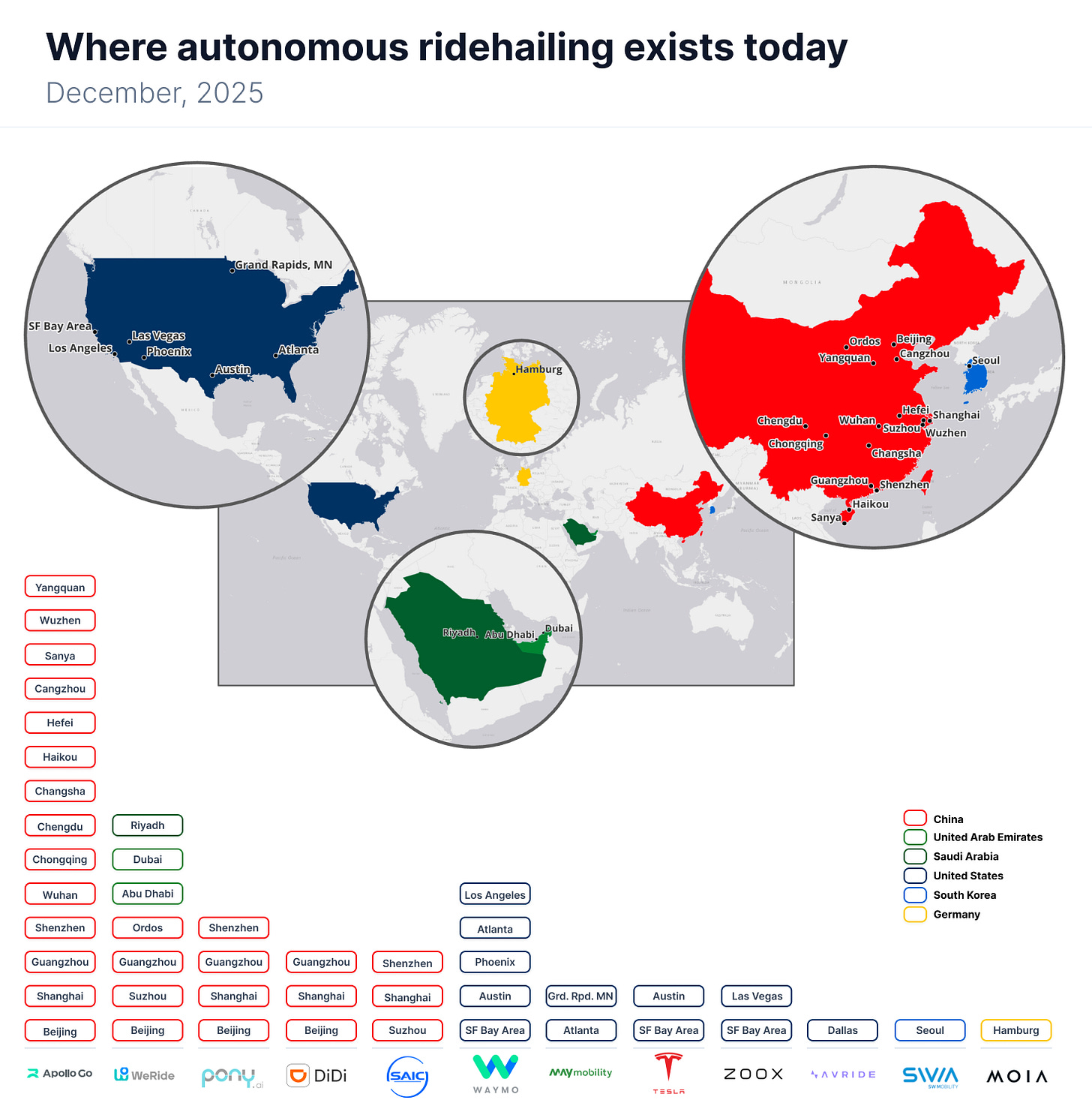
Geography is shaping the competitive landscape, with China, the U.S., and Europe each fostering their own champions and regulatory environments. In China, the intensity is unmatched: Apollo Go, WeRide, Pony.ai, DiDi, and SAIC battle in cities like Beijing and Shanghai, pushing rapid improvements and price drops as riders choose directly between competing apps. By contrast, the West sees a more platform-centric model—Uber integrates multiple AV providers, but algorithms, not riders, select the service, potentially slowing direct competition but broadening access, while only Waymo currently operates a fully commercial driverless service outside China.
Strategic differentiation is evident in both technology and business models. Waymo’s meticulous, sensor-rich approach enables reliable urban autonomy but is constrained by vehicle supply and regulatory challenges, while Tesla’s broad, camera-based strategy aims for ubiquity but faces hurdles in dense city robotaxi deployment. Rivian, meanwhile, is betting on proprietary AI chips and an end-to-end neural network platform to leapfrog traditional rules-based systems, offering a $2,500 'Universal Hands-Free' autonomy package and targeting mass-market scale with the upcoming R2. These divergent paths underscore that, despite Waymo’s current operational lead, the market remains wide open as adoption is still in its early phase and new entrants like Tensor and BYD bring fresh competitive pressure.
Partnerships and platform strategies are becoming critical levers for growth and resilience. Uber is hedging its bets by integrating over 20 AV partners into its hybrid network, aiming for a gradual transition from human to robot drivers and leveraging its vast demand base—though this advantage may erode as Waymo and Tesla build their own direct-to-consumer fleets and apps. Meanwhile, companies like GreenMobility, Bolt, and Pony.ai are accelerating European expansion through alliances, and regulatory and community challenges—such as Waymo’s depot disputes in Santa Monica—are forcing all players to adapt their operational strategies in real time.




Subscriptions Over Sales
Tesla and Rivian are abandoning one-time autonomy fees for monthly subscriptions and licensing, chasing recurring revenue as platform players threaten to commoditize self-driving tech.
The autonomous vehicle industry is undergoing a seismic shift as leading players like Tesla and Rivian pivot from traditional one-time software sales to subscription-based and platform-driven business models. Tesla’s high-profile move in early 2026 to discontinue its $8,000 Full Self-Driving (FSD) buyout in favor of a $99 monthly subscription underscores a broader industry trend toward recurring revenue and increased user adoption, with Elon Musk’s own compensation now tied to reaching 10 million active FSD subscribers. This transition not only lowers the barrier to entry for consumers but also signals a defensive response to intensifying competition from platform solutions like Nvidia’s 'Android for Autonomy,' which threaten to commoditize autonomous driving features and erode Tesla’s early-mover advantage.
Rivian, meanwhile, is embracing a multi-pronged monetization strategy that leverages both vertical integration and external partnerships to expand its addressable market. By offering its 'Universal Hands-Free' autonomy system as either a $2,500 one-time purchase or a $49.99 monthly subscription starting in 2026, Rivian is testing the waters of recurring revenue while targeting a broader customer base with its more affordable R2 SUV. The company’s joint venture with Volkswagen not only validates its autonomy-ready tech stack but also paves the way for licensing its proprietary AI and autonomous driving technology—a move CEO RJ Scaringe touts as central to Rivian’s ambition to become a technology leader beyond vehicle manufacturing.
On the platform front, Uber is doubling down on its role as a marketplace intermediary by integrating both human and robot drivers through partnerships with over 20 companies, aiming to create a hybrid network that gradually transitions riders to AVs. While Uber’s approach allows for a responsible, customer-driven adoption of autonomous vehicles and maintains engagement with human drivers, it faces mounting pressure from the likes of Tesla and Waymo, whose vertically integrated fleets and direct-to-consumer robotaxi services threaten to erode Uber’s traditional aggregator advantage. As Tesla’s robotaxi launch in Austin demonstrates, the ability to deploy millions of vehicles already on the road—without the need for human drivers—could fundamentally reshape the economics of ride-hailing, potentially making robotaxis up to eight times cheaper per mile than Uber’s current offerings.



Regulation Shapes the Road
Diverging global laws and city-specific rules are creating a patchwork of opportunities and barriers, with regulatory agility now a key factor in AV deployment speed.
The regulatory landscape for autonomous vehicles is undergoing rapid transformation, with governments enacting new laws and policies to address mounting safety and legal concerns. California, for example, has introduced legislation to hold AV companies accountable for traffic violations, reflecting a broader trend toward increased oversight. Simultaneously, the UK is fostering a more supportive environment, attracting major players like Waymo to expand robotaxi operations internationally and signaling a competitive, fast-evolving market shaped by regulatory readiness.
Divergent regulatory approaches and city-specific policies are creating a patchwork of opportunities and obstacles for autonomous vehicle deployment. While Waymo has secured exemptions for demonstration purposes in some regions, it still faces commercial restrictions, and companies like Zoox must navigate federal and state-level hurdles, such as obtaining California CPUC permits and federal exemptions for vehicles without traditional controls. Meanwhile, Tesla’s lack of permits for driverless or commercial testing underscores the uneven regulatory playing field, with local policies—like Santa Monica’s restrictions on overnight charging due to noise complaints—adding further complexity to the rollout of AV services.
The pace and geography of autonomous vehicle adoption are increasingly shaped by city-specific rollouts and evolving public policy debates. Companies like Waymo and Zoox are cautiously expanding into new markets such as San Francisco, Las Vegas, Minneapolis, New Orleans, and Tampa, with each city’s regulatory environment and public acceptance influencing the trajectory of AV services. As seen in Minneapolis, where local opinion pieces encourage welcoming self-driving cars, the interplay between municipal regulations and community sentiment is becoming a decisive factor in the industry’s expansion.
Government support and strategic partnerships are accelerating the timeline for autonomous vehicle adoption in select regions. In the UK, the government’s proactive stance is exemplified by its backing of Wayve’s partnership with Uber, aiming for Level 4 robotaxi trials by 2026 in north London. This alignment of public policy and private innovation not only expedites technological deployment but also positions the UK as a key battleground in the global race for AV leadership.
Urban Mobility’s Next Act
Waymo’s rapid city rollouts, strategic partnerships, and China’s head-to-head robotaxi battles are redefining how autonomous vehicles scale, compete, and change daily transportation.
The rapid expansion of robo-taxi services, spearheaded by Waymo’s aggressive rollout in cities like Minneapolis, New Orleans, and Tampa, marks a pivotal transformation in urban mobility. However, this momentum is tempered by persistent regulatory hurdles, as seen with Zoox’s need for federal exemptions to operate vehicles without traditional controls and state permits to charge for rides. These regulatory complexities will play a decisive role in determining how quickly and broadly autonomous vehicles can reshape city transportation landscapes.
Business models in the autonomous vehicle sector are evolving rapidly, with partnerships between AV developers and established mobility players becoming the norm. Waymo’s collaborations with Uber in Austin and Atlanta, Move in Phoenix, and Avis in Dallas illustrate how leveraging existing networks is key to scaling deployment and managing operational complexity. This shift not only accelerates the integration of robo-taxis into daily life but also signals a reimagining of how urban transportation services are delivered and monetized.
A stark contrast is emerging between the competitive dynamics of robotaxi markets in China and the West. In China, cities like Beijing and Shanghai host up to four competing robotaxi services—Apollo Go, WeRide, Pony.ai, DiDi, and SAIC—driving rapid service improvements and price reductions through direct consumer choice. Meanwhile, Western markets remain platform-centric, with Waymo as the primary operator and others like Zoox and Tesla still in pilot phases, resulting in slower consumer adoption and fewer competitive benefits, though integration with familiar platforms like Uber may help accelerate ridership.
By late 2026, Western urban centers are poised for a significant shift as Waymo plans to launch in 12 new cities and other players race to overcome operational and regulatory barriers. The increasing availability of driverless, directly bookable robotaxi services—without safety drivers or geographic restrictions—signals a tipping point for mainstream consumer adoption and the potential for a fundamental transformation of urban mobility patterns, labor markets, and city infrastructure.