Robotaxi turf war escalates as rules shift, doubts linger
The gist
The global robotaxi arms race is accelerating as new rules open borders, but safety doubts and political gridlock keep fully driverless cars stuck in neutral.
What to know
- The UN's 2024 WP29 framework lets companies like Volkswagen and Tesla test and sell driverless vehicles across Europe, even as the US and China tweak the model to fit their own regulatory puzzles.
- Waymo leads the US robotaxi market with over 4,000 vehicles and 500,000 weekly rides, but faces stiff competition from Tesla, Volkswagen, and Chinese upstarts as cost and regulation slow expansion.
- Despite flashy demos like Tesla's employee-only Cyber Cab rides, human oversight and patchwork laws—from New Jersey to Hamburg—still block the road to true autonomy.
Global Rules, Local Battles
Europe’s unified robotaxi regulations are reshaping the industry, but U.S. and Chinese adoption remains fragmented as state-level turf wars and powerful lobbyists slow true autonomy.
The UN WP29 Working Party has established a groundbreaking regulatory framework since 2024 that enables the testing and homologation of fully driverless vehicles without a human driver, facilitating cross-border sales across the EU, UK, Switzerland, and Norway through a unified type approval process. This harmonized approach, adopted pragmatically even by non-EU countries like Switzerland, marks a pivotal shift toward legal commercial deployment of autonomous vehicles in Europe, streamlining market access and regulatory consistency for manufacturers such as Volkswagen and Tesla.
Despite not being formal signatories to the WP29 type approval system, the United States and China have actively contributed to the development of these global standards and agreed to integrate them into their national regulatory frameworks, reflecting a rare convergence in the otherwise fragmented global landscape. However, the U.S. regulatory environment remains distinct, relying on FMVSS regulations enforced by NHTSA without a centralized testing agency, which complicates certification and contrasts with Europe's more unified approach.
In the United States, state-level legislative battles, exemplified by New Jersey’s ongoing AV law debates, underscore the complex interplay of political resistance, safety concerns, and incumbent industry interests that shape autonomous vehicle deployment. Uber’s aggressive lobbying for hybrid ride-hailing models that combine human drivers with robo taxis reflects strategic efforts to slow full autonomy rollout, citing operational incidents and congestion as justifications, while companies like Waymo push for clearer, more permissive regulations to accelerate deployment amid this contentious environment.
Europe faces unique regulatory challenges due to fragmented national and EU laws, which hinder large-scale autonomous vehicle deployment despite advanced technical frameworks and type approval models. Advocates like Pier Francesco Maran emphasize the urgent need for harmonized EU-level regulations, data sharing, and sandbox environments involving local communities to foster public acceptance and business viability. Moreover, European policymakers are increasingly focused on preparing for autonomous mobility as a shared service rather than private ownership, with education and cross-border testbed initiatives seen as critical to overcoming political and infrastructural hurdles.




AI Mastery vs. Human Judgment
Split-second AI driving is no match for the messy realities of the road, as decades-old safety concerns and the need for human oversight keep full autonomy out of reach.
Autonomous vehicle control operates on a dual-layered system where rapid 20-millisecond dynamic driving tasks—such as steering adjustments—are managed separately from slower supervisory functions that handle complex decisions like route changes or obstacle avoidance. While AI excels at these split-second maneuvers, full autonomy remains elusive because supervisory oversight must interpret nuanced, real-world contexts, a challenge that experts predict will take decades to fully overcome. As one industry insider put it, 'I'm the safety problem. My misbehavior is the problem... it's going to be again 50 years in the future before you get that... on the safety problem.'
Tesla’s Cyber Cab has marked a milestone by initiating employee-only rides without human drivers, showcasing a bold step toward fully driverless robotaxis devoid of steering wheels or pedals. However, this milestone contrasts with the broader industry reality where human supervisory oversight remains indispensable; as one expert cautioned, 'I'm not ready to let that sucker go... without having someone behind the wheel in order to be able to supervise it.' This tension highlights the gap between technological ambition and operational safety, underscoring why fully autonomous deployment is still fraught with risk and regulatory scrutiny.
Despite billions invested and decades of effort, the autonomous vehicle sector has yet to deliver measurable societal value or significant safety improvements, with driving’s inherent complexity cited as a key barrier. Industry critiques are blunt: 'Driving is not just steering the wheel... It's the most complex activity that humans do today,' and 'Here it is 2026, and we've... delivered essentially zero societal value out of this... and you've spent 320 billion or whatever McKinsey says.' This stalled progress is reflected in the robotaxi turf war between Tesla and Waymo, where mounting safety stumbles and regulatory gridlock have slowed rollouts and intensified skepticism about AI’s readiness to replace human drivers.
Waymo’s reliance on strict human-in-the-loop oversight to manage rider misbehavior and ensure safety exemplifies the ongoing ethical and legal complexities in autonomous mobility. This necessity for human supervision amidst AI-driven competition with Tesla underscores that trust and regulatory compliance remain central hurdles. The escalating AI arms race is reshaping autonomous driving strategies and regulations, but the persistent need for human oversight reveals that fully driverless robotaxis are still navigating a labyrinth of technical, safety, and political challenges before achieving widespread deployment.
Robotaxi Titans: Diverging Paths
Tesla, Waymo, and Uber are betting on radically different strategies—visionary scale, deep-pocketed tech, or hybrid fleets—to win a market still hamstrung by cost, geography, and regulation.
Tesla’s robotaxi ambitions are uniquely intertwined with Elon Musk’s grand vision of funding Mars colonization, driving a strategy that leverages the company’s massive production scale and brand power to potentially dominate through low-cost, high-volume deployment. However, Tesla’s rollout remains limited and challenged by software issues and regulatory scrutiny, underscoring the difficulty of translating Musk’s visionary motives into reliable, scalable service. Meanwhile, regulatory environments—such as restrictive laws in New Jersey—often clash with the goal of affordable autonomous rides, complicating Tesla’s and others’ efforts to expand testing and deployment.
Waymo currently leads the U.S. robotaxi market with over 4,000 vehicles and more than 500,000 paid rides weekly across 10+ markets, benefiting from Alphabet’s deep pockets and engineering prowess that have allowed sustained investment despite early losses. Yet, its dominance is concentrated in affluent, tech-savvy urban areas like San Francisco, where rides cost 13–27% more than competitors like Uber and Lyft, limiting broader adoption. As competitors such as Zoox prepare to scale and Chinese firms like Pony.ai and Baidu Apollo Go enter Western markets, Waymo faces a critical 12-month window to defend and extend its lead amid intensifying competition and regulatory challenges.
Uber’s strategic approach diverges sharply from Tesla and Waymo by embracing a hybrid model that integrates human drivers with autonomous vehicles from a diverse portfolio of over 30 partners, including Waymo, Lucid, Nuro, and Rivian. This multi-partner platform strategy not only hedges regulatory and technological risks but also allows Uber to flexibly balance supply and demand, offering consumers explicit choices between autonomous and human-driven rides. By positioning itself as a global integrator of autonomous mobility services, Uber aims to maintain competitive advantage through its demand layer and hybrid fleet model, even as it navigates increasing regulatory scrutiny that recently ended its Phoenix collaboration with Waymo.
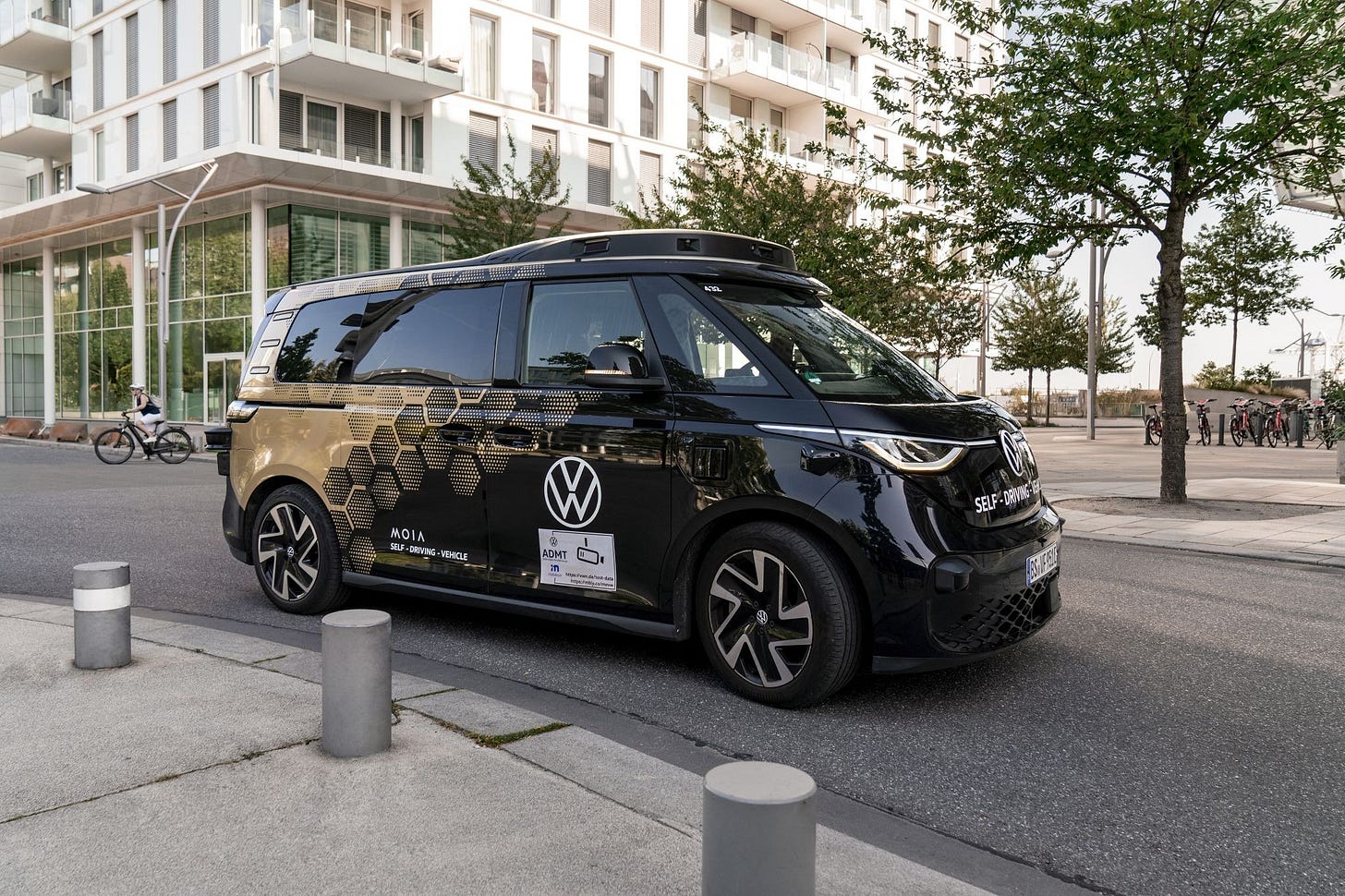
Volkswagen’s cautious but strategic entry into the robotaxi turf war with its MOIA AI-powered shuttle pilot in Hamburg signals a significant escalation in competition, intensifying pressure on incumbents Tesla and Waymo amid persistent regulatory, safety, and infrastructure challenges. As the autonomous fleet race heats up globally, Volkswagen’s move highlights the fragmented and contested nature of the market, where players must simultaneously navigate AI governance, digital traffic management innovations, and electrification hurdles to carve out viable commercial footholds.

Politics, Cities, and Public Trust
Fragmented laws, outdated infrastructure, and public skepticism—not just technology—are the biggest barriers to robotaxi rollouts across Europe and the U.S.
Political roadblocks remain a formidable barrier to the widespread deployment of AI-powered robotaxis, as vividly illustrated by the legislative turmoil in New Jersey and the fragmented regulatory landscape across Europe. Leaders like Pierfrancesco Maran emphasize the urgent need for harmonized policies and coordinated data-sharing frameworks at the EU level to ensure safety and competitiveness, noting that autonomous driving has been overshadowed by traditional emission reduction priorities. This regulatory patchwork not only delays market entry—Waymo’s choice to launch in London over other EU cities exemplifies this—but also fuels public skepticism fueled by transparency gaps in the intense competition between Tesla and Waymo.
Infrastructure bottlenecks and urban planning challenges compound political hurdles, as the rollout of Volkswagen’s MOIA robotaxi service in Hamburg underscores the pressing need for integrated digital traffic management and electrification solutions. Autonomous mobility’s success hinges on reimagining city layouts and transport ecosystems, particularly in Europe where shared mobility and public transport integration dominate cultural preferences. This shift demands not only physical infrastructure upgrades but also proactive engagement with local communities and policymakers to foster understanding and acceptance, avoiding pitfalls experienced during the uncoordinated introduction of electric scooters.
To navigate the complex political and infrastructural landscape, European stakeholders advocate for innovative regulatory mechanisms such as flexible, ongoing safety assessments and a dual licensing system that accounts for both vehicle capability and geographic operational zones. This nuanced approach aims to balance safety with scalability, recognizing that a vehicle safe in one city like Brussels may face different challenges in another like Liège. Complementing these technical measures, sustained efforts to educate policymakers through direct dialogue, study visits, and collaborative events are crucial to aligning autonomous mobility deployment with local policy goals and ensuring cities are prepared rather than caught off guard by robotaxi integration.