Samsung, SK hynix lock in AI memory deals
The gist
Samsung and SK Hynix are unleashing mega-billion alliances with Broadcom and Nvidia to seize control of the global AI chip supply—and challenge TSMC’s iron grip.
What to know
- Samsung is betting $200 billion on a diversified AI chip strategy with Broadcom and OpenAI, bundling 2nm logic and HBM4E memory to lock in multi-year demand and rival TSMC.
- SK Hynix and Nvidia inked a $500 billion pact to co-develop next-gen HBM4 memory and build a 2-gigawatt AI data center by 2027, targeting critical memory shortages and sky-high margins.
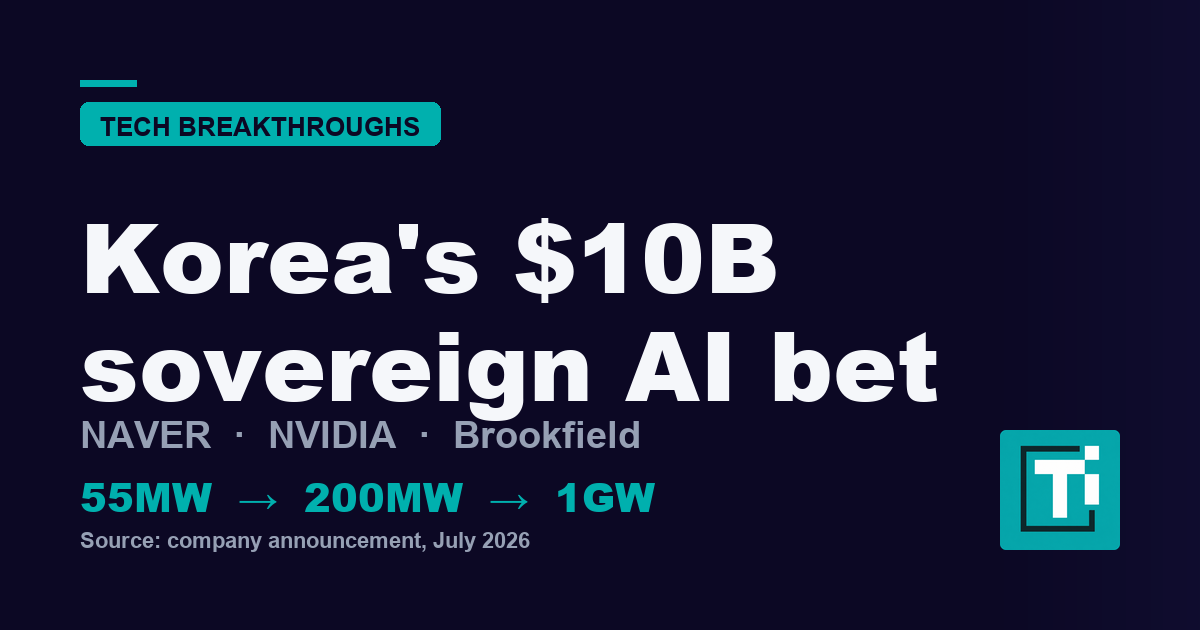
- South Korea is turbocharging its AI ambitions with a $10 billion cross-border data center push—powered by NAVER, Nvidia, and Brookfield—to hit 1 gigawatt of sovereign AI compute by 2028.
Samsung’s Vertical AI Bet
By fusing memory, logic, and packaging in a $200B Broadcom alliance, Samsung is building a vertically integrated AI chip powerhouse to challenge TSMC and lock in long-term demand.
Samsung’s landmark $200 billion, five-year partnership with Broadcom exemplifies its diversified strategy to dominate the AI semiconductor landscape by integrating advanced memory, foundry, and packaging technologies. This collaboration focuses on manufacturing cutting-edge 2nm and smaller process AI chips alongside next-generation HBM4E memory, addressing the global memory crunch while challenging TSMC’s foundry supremacy. By bundling high-bandwidth memory, logic, and sophisticated 2.3D/2.5D packaging into a vertically integrated supply chain, Samsung aims to leverage its unique position as the world’s leading memory manufacturer to capture a larger share of the custom AI chip market through 2030.
This partnership not only strengthens Broadcom’s AI infrastructure hardware capacity outside Taiwan but also enhances supply chain resilience amid geopolitical uncertainties. Broadcom’s substantial $73 billion AI ASIC backlog and dominant 60% share in custom AI ASIC co-design make it a critical partner for Samsung’s foundry ambitions, reflecting a broader industry shift toward integrated semiconductor solutions. However, the collaboration also exposes both companies to risks tied to Broadcom’s concentrated hyperscaler customer base and ongoing legal challenges, such as the ITC investigation into Samsung’s memory products, which could impact AI accelerator volume growth and investor sentiment.
Samsung’s diversified AI ecosystem extends beyond Broadcom through strategic engagements with OpenAI, supplying advanced DRAM for projects like OpenAI’s Stargate and collaborating on AI data center design and operations. This broad-based approach reflects Samsung’s intent to challenge TSMC’s foundry dominance by leveraging its integrated device manufacturing strengths across memory, foundry, and packaging domains. Additionally, Samsung has secured five-year DRAM supply agreements with major AI datacenter customers, dedicating 60-70% of its DRAM and NAND output to AI workloads, thereby ensuring stable demand, healthy pricing, and protection against market volatility through advance payments and minimum price floors.
Samsung’s aggressive push in high-bandwidth memory, particularly with its early rollout of sixth-generation HBM4 chips, positions it to overtake SK Hynix in the HBM market by 2027. HBM4’s generational leap—doubling I/O channels and integrating advanced DRAM, logic, and packaging technologies—aligns with Samsung’s diversified semiconductor capabilities and partnerships with industry leaders like Nvidia and AMD. Coupled with strategic land acquisitions at Pyeongtaek for future capacity expansion, Samsung is building a robust platform to enhance supply chain resilience and compete head-to-head with TSMC’s foundry dominance in the evolving AI semiconductor sector.
Nvidia-SK Hynix: Memory Powerplay
A $500B pact between SK Hynix and Nvidia secures critical HBM4 memory and data center infrastructure, transforming memory from a commodity into a strategic bottleneck for AI growth.
SK Hynix and Nvidia have cemented a monumental $500 billion-plus partnership that tightly integrates next-generation AI memory supply with AI data center infrastructure, underscoring a concentrated strategic alliance within the AI semiconductor sector. Announced at the 2026 AI Summit in San Francisco, this collaboration focuses on supplying advanced HBM4 memory critical for Nvidia’s Vera Rubin AI chips and constructing a 2-gigawatt AI data center operated by SK Telecom, positioning SK Hynix as an indispensable technology partner rather than a mere commodity vendor. Nvidia CEO Jensen Huang emphasized the acute memory supply constraints, stating, 'We don't have enough bits,' highlighting that the bottleneck in AI system shipments lies more in memory availability and physical infrastructure than in GPU fabrication capacity.
The partnership addresses a severe and persistent shortage of HBM4 memory, a complex and tightly qualified component that currently limits AI accelerator production more than GPU manufacturing itself. Industry estimates forecast a 40% supply shortfall extending through 2027 and potentially beyond 2030, with SK Hynix commanding roughly 60-65% of the global HBM market and enjoying unprecedented 80% gross margins on these chips. This scarcity has driven Nvidia to secure not only memory supply but also advanced packaging capacity, effectively cornering critical segments of the AI data center supply chain and locking in long-term demand visibility that transforms memory from a cyclical commodity into a strategic, high-margin technology closely integrated with AI compute platforms.
While the scale and ambition of the SK Hynix-Nvidia alliance are unprecedented, execution risks remain significant due to the technical challenges of qualifying HBM4 memory and integrating it seamlessly with Nvidia’s Vera Rubin platform. Analysts note delays caused by thermal-lid issues and the intricate testing required for stacked die architectures, which could impede Nvidia’s ability to ramp AI system shipments despite the strategic partnership. Nevertheless, the planned 2027 operational launch of the 2-gigawatt AI data center marks a critical inflection point, transitioning the collaboration from engineering development to substantial revenue generation and solidifying SK Hynix’s role as a linchpin in the global AI semiconductor ecosystem.


Korea’s Sovereign AI Surge
South Korea’s $10B cross-border push with NAVER, Nvidia, and Brookfield aims to build a gigawatt-scale AI cloud, blending local expertise and global capital to anchor national AI competitiveness.
South Korea's ambitious expansion of its AI data center ecosystem is anchored by a landmark $10 billion cross-border financing initiative involving NAVER, Nvidia, and Brookfield, aiming to scale the GAK Sejong data center from an initial 55 megawatts to 200 megawatts by 2028, with a long-term vision of reaching 1 gigawatt of sovereign AI compute capacity. This collaboration leverages NAVER’s operational expertise, Nvidia’s cutting-edge AI platforms like Blackwell and Vera Rubin, and Brookfield’s capital and power infrastructure capabilities to build a full-stack, cost-efficient sovereign AI factory model that supports enterprise, industrial, and government clients, reinforcing South Korea’s AI competitiveness and sovereignty. Nvidia CEO Jensen Huang encapsulated this vision by stating, "AI factories are the infrastructure nations need to compete and innovate in the intelligence era," while NAVER Chairman Haejin Lee emphasized the drive to "strengthen South Korea’s AI competitiveness."
SK Telecom emerges as a pivotal player in South Korea’s AI infrastructure expansion, spearheading a massive 2 gigawatt AI data center powered by Nvidia’s Vera Rubin platform, with operations slated to commence in 2027. This facility is part of a broader $500 billion partnership between Nvidia and SK Group that also includes co-developing next-generation HBM4 memory with SK Hynix, positioning SK Hynix as a strategic technology partner rather than a mere supplier. Nvidia CEO Jensen Huang highlighted the infrastructural challenges of scaling AI data centers, noting constraints in land, power, and labor, which underscores the critical importance of integrated ecosystem collaboration and cross-border financing to overcome these bottlenecks and enable AI proliferation through SK Telecom’s AI cloud services.
The intertwined financing and infrastructure scaling efforts extend beyond semiconductor manufacturing to encompass AI cloud capacity expansion, exemplified by Nvidia’s $1 billion strategic investment in NAVER to boost Korea’s AI cloud power to 200 megawatts domestically with plans for global growth. This investment complements Brookfield’s commitment of up to $9 billion in data center funding, collectively illustrating the vital role of cross-border capital flows and ecosystem partnerships in building sovereign AI infrastructure. By integrating Nvidia’s DSX platform and next-generation chips into Korea’s AI ecosystem, these collaborations aim to broaden the customer base beyond traditional US hyperscalers, fostering a robust, telecom-backed compute capacity that underpins South Korea’s AI ambitions.
The 2027 timeline for operationalizing key AI data center facilities marks a critical inflection point where the massive investments and strategic partnerships begin to translate into tangible infrastructure and financial returns. This milestone emphasizes the urgency and scale of South Korea’s sovereign AI factory ambitions, as letters of intent convert into concrete projects that address both supply chain integration and physical infrastructure challenges. The coordinated efforts of SK Telecom, SK Hynix, NAVER, Nvidia, and Brookfield collectively underscore a comprehensive approach to scaling AI compute capacity, memory technologies, and data center infrastructure, positioning South Korea as a formidable hub in the global AI semiconductor and cloud ecosystem.
Long-Term Memory Locks In
Multi-year supply deals and vertical integration are reshaping the memory business, insulating Samsung and SK Hynix from market swings and fueling investor confidence in AI chip growth.
Samsung’s $200 billion partnership with Broadcom exemplifies a strategic push toward vertical integration, bundling HBM4 memory, 2nm logic, and advanced packaging into a unified supply chain that challenges TSMC’s foundry dominance. This approach not only enhances supply chain resilience by reducing geographic concentration risks outside Taiwan but also aims to reshape AI semiconductor market dynamics by offering a comprehensive manufacturing and memory package. However, yield gaps in Samsung’s 2nm process and ongoing legal uncertainties, such as the ITC investigation into Samsung’s memory products, inject execution risks that temper investor enthusiasm despite the deal’s transformative potential.
The acute shortage of HBM4 memory, critical for AI accelerators, has catalyzed unprecedented multi-hundred-billion-dollar supply deals, including Nvidia and SK Hynix’s $500 billion alliance and Samsung’s $200 billion Broadcom pact, locking in supply amid a projected 40% shortfall through 2027. These vertically integrated strategies extend beyond memory to encompass advanced packaging capacity, enabling companies like Nvidia to control key supply chain chokepoints and maintain competitive advantage. While this scarcity drives strong pricing power and margin stability for leading memory makers, it also signals prolonged supply constraints that could persist into 2030, eliciting a cautious yet optimistic investor stance on growth tempered by cyclical volatility.
Samsung and SK Hynix’s shift to long-term, multi-year supply agreements with AI datacenter customers represents a deliberate re-engineering of the DRAM business model to stabilize demand and pricing amid volatile memory markets. These contracts, often spanning five years with minimum price floors and substantial advance payments, not only insulate suppliers from boom-and-bust cycles but also enhance supply chain resilience by reducing risks of excess inventory and economic downturns. This strategic move has bolstered investor confidence by signaling a more predictable and sustainable growth trajectory in the AI semiconductor memory sector, reflecting lessons learned from past oversupply losses.
Investor sentiment across the AI semiconductor sector is a nuanced balance of optimism and caution; while multi-hundred-billion-dollar deals underscore robust growth potential and strategic vertical integration, concerns linger over hyperscaler revenue concentration, legal and supply chain uncertainties, and execution risks in advanced process technologies. For instance, Broadcom’s reliance on a handful of hyperscale customers and shared suppliers like Samsung heightens vulnerability to disruptions, prompting analysts to weigh aggressive revenue projections against these systemic risks. Consequently, investors are advised to maintain positions with an awareness of the sector’s inherent boom-and-bust cycles and the evolving competitive landscape.